• Page list
    • Posts
    • The Book of Psalms

The Book of Psalms

  • August 9th, 2023

    Psalm 150

    * * *

    In the final Hallelujah Psalm, the final psalm of the entire Psalter, pattern is all. Nine “Laud him” imperatives are preceded by one “Laud God” imperative (1b) and followed by one third-person jussive “let it laud the Lord” expression (6a). All of this is framed by two hallelujahs, “Laud the Lord” (1a, 6b).

    That total of thirteen may seem uneven, but it parses in multiple ways. There are twelve imperatives plus one third-person verb. There are three namings of the Lord plus one of God. And there is a 1+2 frame around a block of 10 imperatives that are all detailed by prepositional phrases (1b-5b): three b- prepositions (“in,” 1b-2a), one k- preposition (“fitting,” 2b), then six b-prepositions (“in,” 3a-5b). Within the block of ten imperatives, the first four are cosmic (1b-2b), the last five musical (3b-5b), with the fifth, the sound of the shofar (3a), functioning as both cosmic and musical. From the fifth imperative until the end of the psalm, there are ten “instruments” all told. Seven of these are in the second set of five imperatives: “lute and lyre” (3b), “timbrel” (4a), “strings and reed” (4b), “cymbals that hang” (5a) and “cymbals that clash” (5b). The shofar or “horn” (3a) introduces the list, “whirling” is included with “timbrel” as part of a Hebrew idiom that may have indicated sound as well as movement (4a), and “breath” joins the chorus just outside the block of imperatives (6a).

    In its movement from the cosmic to “all with breath,” the psalm recalls Psalms 146 and 148 most proximately, but more compellingly revisits the scene of creation as well, which each act of praise recreates. In its pattern and in its word choices, most importantly, Psalm 150 reenacts the heart of the Exodus, the giving of the law, with the music of worship as a new Song of Moses and of Miriam, the temple itself as Sinai made new.

    Every line in the first half of Psalm 150 revisits words or phrases from both the Torah and the book of Psalms, cinching the two. In verse 1b, this hymnic decalogue begins, as do the decalogues in Exodus 20, Deuteronomy 5, and Psalm 15, with God’s “hallow” (beqodsho), an abstraction for divine apartness that extends to name the tabernacle, the temple sanctuary, Zion, and expands to the cosmos as well (e.g., Exod 3:5, 15:11,13, 26:33-34; Ps 2:6, 3:4, 15:1, 30:4, 60:6). Verse 1c turns to “his sturdy vault” (birqi`a `uzzo), a clear allusion to Genesis 1, where the created “vault” or firmament is named nine times, and a subtler reference to Psalm 19:1 (where raqi`a is rendered “cosmos” in this translation). Divine might (`uz) appears in Psalm 59:9 and 78:61, but also, like the word “hallow,” twice in the Song of the Sea (Exod 15:2,13): “my might and song is the Lord” and “with your care you led | the people you released / with your might you guided | to your hallowed home.” The word berov, “in the greatness of,” also appears in the Song of the Sea (Exod 15:7), close kin to the word kerov in the very next verse of Psalm 150, kerov gudlow, literally, “according to the greatness of his greatness,” translated here as “fitting his grand scale” (2b). (For rov, see Gen 16:10 and Deut 28:47,62; Pss 51:1, 69:16, 106:45. For godel, see Num 14:19, Deut 5:24, 32:3; Ps 79:11.) The word geburah is present not just in Psalm 150:2a as bigburotav, “his shows of strength,” but in at least seven other psalms (Pss 20:6, 21:13; 54:1; 66:7; 71:16,18; 80:2, 145 [3x]) and twice in the Torah (Exod 32:18, Deut 3:24).         

    In just these first two verses of Psalm 150, then, references to creation and the Exodus tradition abound, emphasizing divine power and immensity. These four objects of praise are not just divine traits or locations or reasons for worship: they are the cosmos recreated in the imperatives of praise.

    Similarly, verse 3’s four varied words cross the book of Psalms and recall the heart of the Torah. The noun teiqa`  (“blare”) is used only in Psalm 150, but its verb taqa` shows up in the Qorachite Psalm 47:1 and the Asaphite Psalm 81:3, in both cases, as here, not far from the shofar or “horn” (Ps 47:5, 81:3). In the Torah, the verb “to blare” runs throughout Numbers 10:3-10, God’s instructions to Moses to make the two silver trumpets (chatsotserot) that announce travel, war, and worship. The shofar itself first appears in the dramatic theophanies that surround the giving of the law on Sinai (Exod 19:16,19, 20:18). Together, halfway through the ten imperatives, this one “horn-blare” in Psalm 150:3a declares the arrival of the law and the worship of the assembled.

    The importance of these terms in the Torah is emphasized by the comparative scarcity in the books of Moses of the next few terms, neivel and kinnor, “lute and lyre,” in verse 3b, tof and machol, “timbrel and whirling,” in 4a, minim and ugav, “strings and reed” in 4b, and tseltselim in verse 5. Most of these terms appear in psalms (neivel in Pss 57:8, 81:2, 108:2; kinnor in Pss 33:2, 43:4, 49:4, 147:7; tof in Pss 81:2, 149:3; machol in Pss 30:11, 149:3; neither minim nor ugav nor tseltselim show up in the book of Psalms). But lute and strings, whirling and cymbals are not in the Torah at all, the reed is mentioned only once (Gen 4:21) alongside the lyre, which is only mentioned twice (Gen 4:21, 31:27). The timbrel shows up twice (Gen 31:27, and in the Song of the Sea, Exod 15:20). It makes sense that specific musical instruments would be named less frequently than divine traits. But the contrast is emphatic between the first five lines and the last five lines of the ten imperatives. Psalm 150, which began by paralleling Psalms and Torah, now emphasizes the book of Psalms, but increasingly exceeds both books.

    Only in its final three lines, verses 5a-6a, does Psalm 150 return to words that matter deeply to the Torah. Verse 5 describes two kinds of cymbals: the translation uses “cymbals that hang” and “cymbals that clash” to distinguish between the literal “cymbals of hearing” (tsiltselei shama`) and “cymbals of alarm” (tsiltselei teru`ah). While, again, there are no cymbals in the Pentateuch, the noun shama` appears most significantly in the book of Deuteronomy when other nations hear about the children of Israel (Deut 2:25, cf. Num 14:15). The imperative form shema` is obviously even more significant, introducing the terse prayer that is likely the most important single verse in the Hebrew Bible: “Hear, Israel: the Lord: your God: the Lord: One” (Deut 6:4). The word teru`ah—which sounds a little like Torah— is weighty as well, marking Rosh Hashanah in Leviticus 23:24 and Yom Kippur in Leviticus 25:9, and the blasts of the silver trumpets that convene worship in Numbers 10:5-6. Both nouns also appear in Davidic psalms, shama` in Psalm 18:44, teru`ah in Psalm 89:15.

    Perhaps most significant of all is the noun that appears in verse 6, hannishamah, the breathing, all those “with breath.” In Psalm 18:15, the only other time this noun appears, the one “with breath” is the Lord, celebrated for intervening at the sea during the Exodus for blasting with nostrils to expose the very foundations of the earth. In the Torah, the noun sounds three times. In Genesis 2:7, it is the essence of life, breathed into human nostrils: “The Lord God shaped the mortal from the dust of the dirt and breathed into its nostrils the breath of life.” Creation and Exodus, brought together once more. But more, the word nishmat appears in Genesis 7:22 and Deuteronomy 20:16 as it does in the book of Joshua, as an indicator of the life to be lost in disasters and in genocide, the utter absence of breath.

    Fittingly, the Psalter ends with the force of life itself, divine breath, mortal breath, brought together in an act of praise fully aware of human impermanence.
    Share:

    • Share on X (Opens in new window) X
    • Share on Facebook (Opens in new window) Facebook
    Like Loading…

    About Me

    My name is Mark Minster. I’m an English and Comparative Literature professor with a background in ministry and in poetry. I teach courses on writing, reading, religion, and nature.

    Recent Posts

    • Psalm 150
    • Psalm 149
    • Psalm 148
    • Psalm 147
    • Psalm 146

    Newsletter

  • August 8th, 2023

    Psalm 149

    * * *

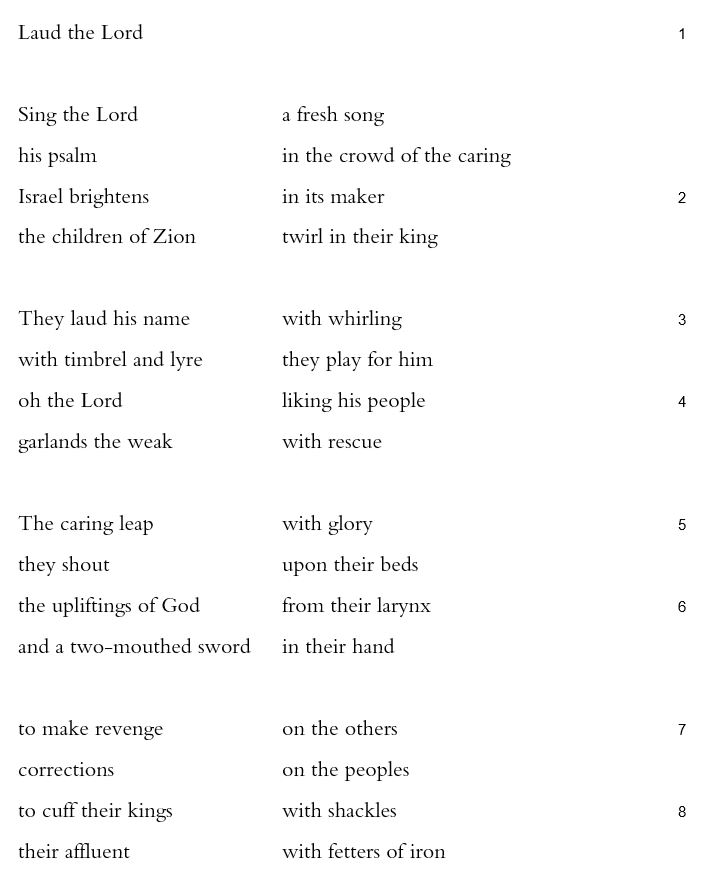
    Reading Psalm 149, every reader assumes that the “timbrel and lyre” (3) are real, that they are literal objects touched and sounded and heard. So, too, “the fresh song” sung “in the crowd of the caring” (1) readers take as literal, though with an added sense of performance: that this song being sung now is the new one identified by the song itself. Even the psalm’s language of dancing, “twirl” (2b), “whirling” (3a), and “leap” (5a), seems more likely to indicate literal joyful movement than to symbolize internal feelings of gladness. The literal anchors readers, especially when it’s easy to see.

    What’s definitively figurative in the psalm is easy to see as well. “He garlands the weak | with rescue” cannot be literal because it’s abstract (4b). The image, or figure, is there in the verb “garland,” which can mean both a kind of encircling and an adorning or beautifying: divine help is thus like a necklacing of the poor, like a laying of a lei. The figurative sails the reader off in search of what is meant but not said. With no literal, the reader drifts; with no figurative, there’s only treading water or there’s no water to tread.

    Poetry—psalms are no exception—layers the literal and the figurative. To continue the nautical metaphor, poetry tacks. The lines “with whirling / with timbrel and lyre | they play for him” (3) may be literal, but they borrow language from other dances with instruments. The ideal reader recalls the celebration of Miriam and “all the women” in Exodus 15:20, the untimely celebration of Jephthah’s daughter in Judges 11:34, and the vision of a restored Jerusalem in Jeremiah 31 (esp. Jer 31:4). The timbrel and the lyre are no less real for being richly allusive, but they mean more than one literal thing. Likewise in verse 4, both the Lord’s “liking” and the word “weak” reuse words from Psalm 147 (Ps 147:11, 147:6), words that are also found in the late chapters of Isaiah. Psalm 149 doesn’t just hold up objects and state facts about them. It figures meaning by allusion and reference; poems are about other poems, as Harold Bloom among others relentlessly showed.

    What, then, is the reader to do with these other concrete objects in Psalm 149, the troublesome “beds” (5) and “sword” (6), the “shackles” and “fetters” that avenge captivity (8), the “verdict written down” (9)? Are those literal beds that the covenant faithful, “the caring,” literally bounce and shout upon, while—depending how one links verses 5 and 6—wielding a literal sword? Are the neighboring nations of verse 7 literally to be punished with literal manacles and chains, governed by a literal verdict (already or yet to be) written down? All of these things cannot be literal, unless jumping and yelling on a bed with a sword somehow facilitates revenge.

    In his nineteenth-century commentary on Psalm 149, Franz Delitzsch writes,

    “By means of this psalm Gaspar Scioppius inflamed the Roman Catholic princes for the thirty years’ religious war in his book Classicum Belli Sacri, a book which was not written with ink, but with blood. And within the Protestant church, by means of this psalm, Thomas Münzer stirred up the Peasants’ War” (Gunkel 366).

    In our time, the bottom of the cage of the internet is lined with confident screeds that would make the second half of Psalm 149 support theologies of private militarization or armed insurrection, even theories of divine authorship for select clauses in the Bill of Rights, taking that sword literally, all too literally.

    But there is every reason to read the sword figuratively. It’s a cherev pipiyot, literally a sword with two mouths. The “mouth” of a sword is the idiom for its blade edge, so the word is taken to mean “double-edged” (Judg 3:16) But pipiyot is a word that only appears here and in Isaiah 41, in a passage of consolation for those released from exile to Babylon. The Lord tells them they have been strengthened, their enemies finished off.

    Now, I have turned you into a grind-board, newly sharp with teeth (pipiyot). You can thresh mountains and crush them and the hills you can turn to chaff. You can winnow them and a breath will lift them, a tempest toss them, and you will whirl in the Lord and the hallowed of Israel you will praise. (Isa 41:15-16)

    By the use of that rare word, Psalm 149 invokes the entire passage, importing Second Isaiah’s message of comfort, as well as its image of leveling mountains to make the road home more smooth. That the sword has two “mouths” seems relevant as well, given the proximity of shouting and the even more proximate rare word garon, “larynx.”

    It’s not even clear that most of the other objects are literal, either. Biblical beds suggest not just privacy (Exod 8:3, 2 Sam 4:11) and rest (2 Sam 4:5, Job 33:15) but sexual intimacy (Prov 7:17, Songs 3:1, Isa 57:8). The word mishkebotam, “their beds” (Isa 57:2, Hos 7:14) is very close to mishkenotam, “their homes” (Ps 49:11, cf. Isa 54:2). Verse 5 could then pair— whether it is a scribal error or just a near-homonym— the words kavod and mishkan, synonyms for the sanctuary (Ps 26:8). In association with revenge, the shackles and fetters of the vengeful second-to-last psalm in the Psalter call to mind the “chains” and “ropes” of the vengeful Psalm 2, making a tidy chiasm (Ps 149:8, Ps 2:3).

    Even if the sword is literal, it is by no means clear whether it is grammatically linked to the sequence of infinitives that follow, “to make revenge… to cuff their kings… to make for them | a verdict written down” (7-9). Verse 9 concludes with an ambiguous pronoun in its pronouncement: “this is an honor | for all his caring.” Which? All three of the infinitives, plus the sword? Just the last infinitive, without the sword? Does the psalm’s conclusion suggest that it is glorious and honorable to wave a doubly dangerous sword intending revenge against governments and the 1% in some frothy apocalyptic vision of a verdict to be delivered? Or does it suggest that, of the three infinitives, making revenge, locking up the oligarchs, and making a written verdict, only this last is “an honor | for all his caring”? When possibilities multiply like this, certainty goes.

    None of this is to kid-glove the Bible or to dispute Goethe’s conclusion that Psalm 149 may well be a “nasty” psalm (qtd. in Prinsloo 395). Nor is it to tame a psalm that, for all its confusions and discomfiting, clearly argues for a divine preference for the weak (4) over the affluent (8). It is to insist, rather, on not making texts say what we want them to say. From the second verse of Psalm 146 to the end of Psalm 150, the first-person singular has disappeared entirely from the book of Psalms in favor of a collective vision of a society built from castoffs (147:2), “making verdicts for the oppressed” (146:7), shackling others’ “affluent | with fetters of iron” (149:8). This is not a psalm that rubber-stamps gun ownership as necessarily caring or honorable, nor does it suggest God craves blood.

    Share:

    • Share on X (Opens in new window) X
    • Share on Facebook (Opens in new window) Facebook
    Like Loading…

    About Me

    My name is Mark Minster. I’m an English and Comparative Literature professor with a background in ministry and in poetry. I teach courses on writing, reading, religion, and nature.

    Recent Posts

    • Psalm 150
    • Psalm 149
    • Psalm 148
    • Psalm 147
    • Psalm 146

    Newsletter

  • August 7th, 2023

    Psalm 148

    * * *

    In his Anchor Bible commentary, the scholar Mitchell Dahood describes what he calls the “tripartite structure” of Psalm 148, treating verse 7 all by itself as the second of three sections, and translating its word ha’arets as “the nether world” rather than as “the land” or “the earth.” The psalm itself disagrees. It patently pairs verse 7’s “Laud the Lord | from the land” with verse 1’s “Laud the Lord | from the skies,” marking out two twelve-line sections (1-6, 7-12). These two main sections are pulled together by a six-line conclusion that begins “Let them laud | the Lord’s name” (13a=5a). But while Dahood’s reading seems almost willfully mistaken, it nevertheless recognizes a strangeness in verse 7, which immediately follows its turn from the skies to the land by invoking “sea beasts | and all deeps / fire and hail | snow and smog / breath of storm | making his word” (7b-8). Why should a psalm that calls for praise from the orders of sky and of earth begin its terrestrial section with mythic depths and swirling atmospheric heights? The “nether world” goes in exactly the wrong direction, but Dahood’s attention to the chaos is helpful, allowing the insight that several overlapping logics govern the meticulous order of Psalm 148.

    The first organizing principle is along the vertical axis of what would come to be called, in its Neoplatonic form, “the great chain of being,” evident from the psalm’s division into “skies” (1-6) and “land” (7-12), but visible within these divisions as well. The sky section moves from “messengers” and “forces” (2) to “sun and moon” and “all stars of light” (3) to “skies of the skies” and “waters above the skies” (4) in an order that becomes more remote from earth, less concrete. The earth section moves from meteorological phenomena (8) down to mountains and trees (9) to animals (10) to human social phenomena, from kings to princes to judges (11), men to women, old to young (12). Thus, the overall architecture of the psalm builds from the limit of the skies upward, and then from that same limit downward, with three effects. The psalm’s middle emphasizes the limit itself, “a limit | that shall not pass” (6b). This limit protects the created world against the chaos depicted by the verses immediately surrounding the limit, chaos which the limit splits, dividing “the waters above” (4b) from the sea beasts and all deeps below (7b). And finally, by building up from the limit then down, each section culminates at a vertical extreme, high divine then low human, which are brought together by the repetition of the name of the Lord (5a, 13a, 13b) and by the final verse, in which God “lifted a horn | for his people / a psalm | for all his caring / for the children of Israel | people close to him” (14). Poles meet.

    A second organizing principle in Psalm 148 is temporal, following a timeline roughly similar to that of the creation narrative in Genesis 1. Again the psalm’s two main sections move in opposite directions, from the “lights in the vault of the skies” of the fourth day (Gen 1:14-19) chronologically backwards to the second day, with the creation of the vault itself, which split “the waters which are under the vault from the waters that are above the vault” (Gen 1:7). That the author of Psalm 148 knows and responds to the Genesis narrative is clear from its inclusion in verse 4 of the prosaic ’asher me`al, “that are above” from Genesis 1:7, which is cumbersome and grammatically unnecessary to the poem, but an integral marker of the rhythmic style of Genesis 1. The psalm’s second main section moves from the third day, combining geographical and botanical features (9, cf. Gen 1:9-13), to the fifth and six days, lumping together avian and terrestrial animals (10, cf. Gen 1:20-25). (The author of Psalm 148 may not have noticed that Genesis 1 presents birds as created first in keeping with its [that is, Genesis’s] strategy of populating, on Days 4, 5 and 6, the celestial, watery, and land-based spheres created, in turn, on Days 1, 2,3. More likely, the psalmist didn’t care, having strategies of her own.) In both Genesis 1 and Psalm 148, the cosmic timeline ends with humans, male and female (Ps 148: 11-12, Gen 1:26ff). Arguably in both texts, but certainly in the psalm, the human position emphasizes cosmic lowness and lateness, how earthbound we are, how young. Like the vertical scheme, the temporal arrangement carefully contrasts earth’s creatures with those creations and manifestations above, which were stood “for on and ever / he gave a limit | that shall not pass” (6).

    While Genesis describes the creation of a vault, a firmament to separate above and below, Psalm 148 deliberately replaces the raqi`a with the word chaq, a word of both legal and ritual significance that shows up all over the Torah. In the plural it refers to the statutes of the law (Exod 18:20; Lev 26:46; Num 30:16; seven times in Deut 4) but also, as here, in connection with the word `olam, “ever,” it indicates the priestly allotment (Exod 29:28, 30:21; Lev 6:22, 7:34; Num 18:8, 18:11). A third organizational principle of Psalm 148, then, is to present a vision of cosmic order in which both the law and the priests who govern its celebration are there at the center, structurally equivalent to the vault of creation that holds back chaos.

    If the five Hallelujah psalms that conclude the Psalter are patterned after the five books ascribed to Moses, Psalm 148 is their centerpiece just as the book of Leviticus is the centerpiece of the Torah. At its center—somewhere between verse 6’s “gave a limit” and verse 8’s “making his word”—the psalm folds together language from Genesis and Deuteronomy, creation and the law, mapping time and space, locating the human and the divine, emphasizing the cosmic propriety of praise.

    Share:

    • Share on X (Opens in new window) X
    • Share on Facebook (Opens in new window) Facebook
    Like Loading…

    About Me

    My name is Mark Minster. I’m an English and Comparative Literature professor with a background in ministry and in poetry. I teach courses on writing, reading, religion, and nature.

    Recent Posts

    • Psalm 150
    • Psalm 149
    • Psalm 148
    • Psalm 147
    • Psalm 146

    Newsletter

  • August 6th, 2023

    Psalm 147

    * * *

    Psalm 147 is a barrage of quotations from all over what was becoming— what the psalm’s own work helped become— the Hebrew Bible. It excerpts or alludes to other psalms, poetry from Job to Jeremiah and the latter chapters of Isaiah, and important passages from Exodus, Numbers, and Deuteronomy. While not exactly a psalm of psalms the way the Song of Songs is superlative as well as anthological, yet there is method in it. In its elliptical style, its expectations of its readers, and a thoroughgoing textuality that converts chronological history to liturgy, the psalm has as much in common with developing traditions of midrash as with the poetry it cites. Its approach, in fact, seems continuous with that of Ben Bag Bag in the Pirkei Avot, who encourages readers of the Torah: “Turn it and turn it, for all is within it.”

    The psalm announces its themes in its first verse by pairing clips from the first verses of Psalm 33 (“from the plumb | a hymn is lovely”) and Psalm 133 (“how stunning | how sweet”) and from the third verse of Psalm 135 (“oh sweet Lord / hymn his name | oh stunning”). Each of these sources is itself a revisionary psalm, drawn from near the end of what seem like smaller collections, Psalms 25-34 from Book 1, and the Songs of Steps, Psalms 120-134, from Book 5. Psalm 33 undoes the martial Psalm 18, a psalm of David, by appealing to creation and to the Exodus. Psalm 133 and Psalm 135, one a psalm of David, the other a Hallelujah psalm, both also appeal to creation and the Exodus, celebrating the gathering at the temple in Zion. Psalm 147 begins, then, by gathering texts that gather other texts and traditions, whose very theme is gathering.

    Gathering is precisely where Psalm 147 goes next in verses 2 and 3. Language from Isaiah (Isa 11:12, 56:8, 61:1,4) implies that the rebuilding of Jerusalem is achieved not by stonework or by population but by assembly for worship, the wounded staggering towards healing embrace. Verse 2’s unusual subject-object-verb order, “the Lord / the castoffs of Israel | enfolds,” enacts this encompassing movement, even as the sequence of opening verses makes the building of Jerusalem continuous with the acts of worship, both of which are continuous with God’s rescuing interventions of creation and the Exodus. The images of gathering multiply. Counting the stars (4) as a figure for the people of Israel calls to mind, at least for us, Genesis (esp. Gen 1:16, 15:5, 22:17), Deuteronomy (Deut 1:10, 10:22, 28:62), and Nehemiah (9:23). “Reckoning” the people calls to mind a glittering Jerusalem vision of Jeremiah (33:10-18) and a terrifying Jerusalem vision of Isaiah (65:9-15). Calling the people by name evokes Isaiah 40 (esp. Isa 40:23), which similarly sees the return from Babylon as a new Exodus and a new creation. And most importantly, God’s reading out of names invokes the entire book of Exodus itself. Literally, verse 4 ends “to all of them names he calls,” with Names being the first word and Hebrew title of the book of Exodus.

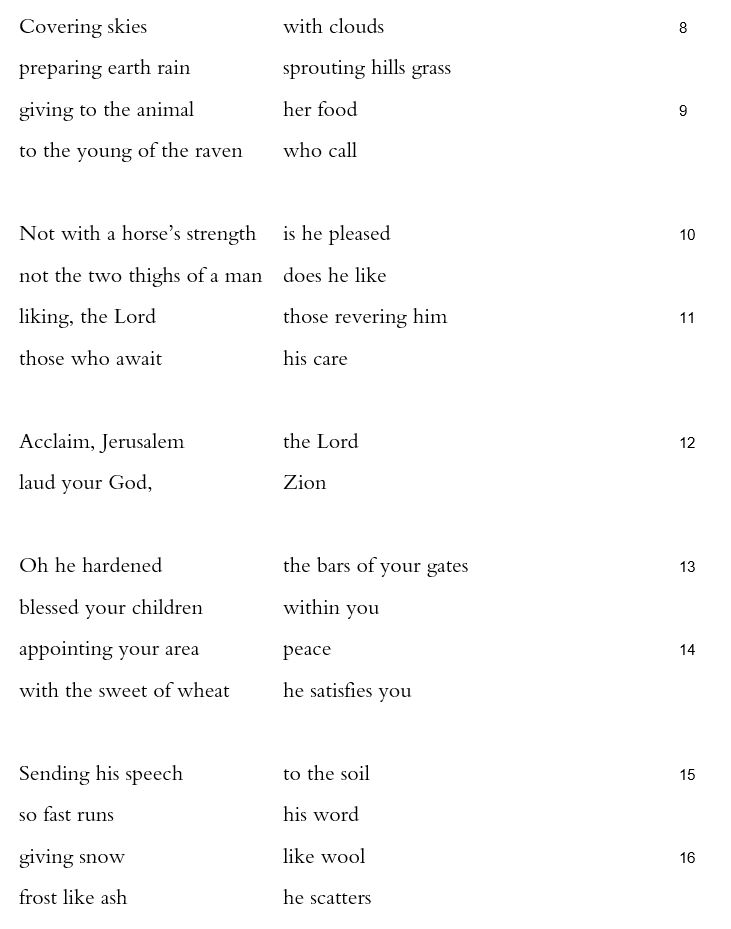
    Allusions to the books of the Torah run throughout Psalm 147. The encouragement to “sing back” in verse 7 appears only here and in Numbers 21:17 in the brief Song of the Well, sung when Moses gathered the people at the Lord’s request: “Then Israel sang this song, ‘Go up, you well | sing you back all to her.’” The root of the verb `anah, “to sing in response,” which commonly means “answer,” calls to mind another song associated with Moses, Miriam’s song, which she “answers”: “Sing to the Lord | oh overwhelming he overwhelmed / horse and rider | he tricked in the sea” (Exod 15:21). The similar-looking word “weak” (`anavim)  in verse 6 of Psalm 147 also suggests Moses, whom Numbers 12:3 calls “very weak” (`anav me’od). Such subtle cues may just be overtones in the reader’s ear, but the “covering skies | with clouds” of Psalm 147:8 unmistakably echo Exodus:  “Moses went to the mountain; a cloud covered the mountains. The glow of the Lord settled on Mount Sinai. The cloud covered it six days. And he called to Moses on the seventh day from the middle of the cloud” (Exod 24:15-16).

    In the second half of Psalm 147 as well, the Torah is an important presence. The “bars” in verse 13 are first mentioned in the building of the tabernacle in Exodus 26, 36, then later in Nehemiah 3 in the rebuilding of city gates. The “hardening” of those bars recalls the hardening of Pharaoh’s heart, and Moses’ words to the Israelites near the end of Deuteronomy, encouraging them to “be hard” (Deut 31:6), as well as the repairing of breaches in 2 Kings 12 and 22, not to mention the approximately three-dozen times the root chazaq occurs in 2 Chronicles and again in Nehemiah 3. And yet nowhere in Psalm 147 is the presence of Moses more significant than in verses 15-20, which read like an icy riff on the opening of the Song of Moses, “May my instruction fall like rain, my speech condense like the dew like showers on the sprouts like downpours on the grass.” (Verses 19 and 20 also cite Deuteronomy: Deut 33:10 “tell your ordinances to Jacob”; Deut 29:26 and 32:17 “they do not know them”).

    Psalm 147 clearly also knows Isaiah 55’s gorgeous version of speech-as-precipitation, in which the Lord describes the Lord’s word:

    for as descends shower or snow | from the skies and does not return

    but oh has soaked the soil | and brought forth and bloomed

    and given seed to who sows | and bread to who eats

    just so is my word | that goes from my mouth

    and does not return to me | empty

    but has done what I liked | and achieved why I sent it

    oh in brightness you go | in you peace you are carried on

    the mountains and ranges | burst with song before you

     and all the trees of the plains | clap hands (Isa 55:10-12).                 

    It is possible to read Psalm 147 as simply a welter of remembered verses and passages meaningful to both writer and early audiences. The Septuagint considered it two separate psalms, the first ending at verse 11. It is also possible to read it as a code whose secrets are lost to time and inattention, or found only by those in the know. Its seventeen participles and play on the root `od in verse 6 (“keeping going… all the way”) make it stylistically continuous with Psalm 146. Its ten divine names, eight instance of “Lord” and two of “God,” make it seem at least like an editorial unity. But it is the threefold repetition of “his word” in verses 15, 17, and 19, combined with the extensive reference to other texts, especially those that blend creation, redemption, song, worship, and the building of Jerusalem, that make Psalm 147 seem not just an editorial unity, but a textual unifying, pulling Torah and Prophets and Writings together.   

    The assumption that the word of God and the Bible are simply coterminous is one of those sentence equations that manages to harm both of the terms it equates. Psalm 147 is an earnest latecomer to the long, slow work of canonization. It encourages the building of Jerusalem, and demonstrates in miniature the building up of the Bible. And as it culminates with a vision of a divine word that pours fast, now freezing, now thawing, now speaking specifically to Jacob, it makes abundantly clear that its regard for the written word is great, its celebration of divine action that transcends writing greater still.

    Share:

    • Share on X (Opens in new window) X
    • Share on Facebook (Opens in new window) Facebook
    Like Loading…

    About Me

    My name is Mark Minster. I’m an English and Comparative Literature professor with a background in ministry and in poetry. I teach courses on writing, reading, religion, and nature.

    Recent Posts

    • Psalm 150
    • Psalm 149
    • Psalm 148
    • Psalm 147
    • Psalm 146

    Newsletter

1 2 3 … 37
Next Page→

Blog at WordPress.com.


Loading Comments...
 

    • Subscribe Subscribed
      • The Book of Psalms
      • Already have a WordPress.com account? Log in now.
      • The Book of Psalms
      • Subscribe Subscribed
      • Sign up
      • Log in
      • Report this content
      • View site in Reader
      • Manage subscriptions
      • Collapse this bar
    %d