(director: with flutes; lyric, of David)

* * *
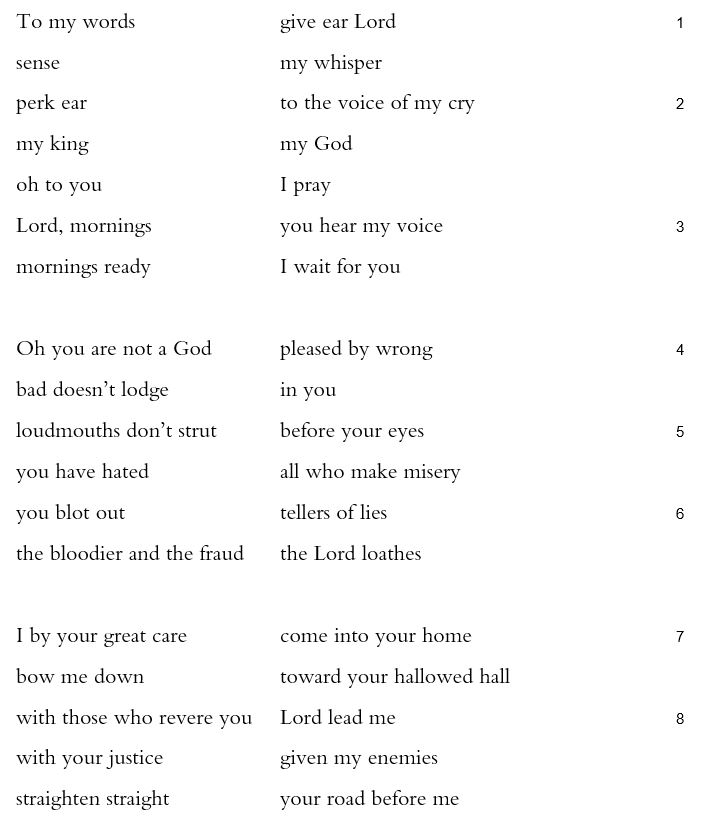
Though its opening pairs well with the closing of Psalm 4— as reclining to sleep in peace is followed by readying at dawn— Psalm 5’s closer parallels are with Psalm 1 (see Botha 2018, Barbiero 1999). Both starkly contrast the paths walked by the good and the bad (1:6). In Psalm 1, the good person roots and follows direction, while the bad is scattered as chaff and cannot stand (1:4-5). Psalm 5 has only one road, the good person’s road, which is the road of the Lord: “straighten straight | your road before me” (5:8). The good person moves along a road that leads to and from “your home” (7a), “your hallowed hall” (7b). As for the bad person, instead of walking a road, in this psalm they get broken down into a tight, static typology of corruption in verses 4-6: “wrong,” “bad,” “loudmouths,” “all who make misery,” “tellers of lies,” the “bloodier and the fraud.” This rogue’s gallery of seven synonyms is woven together with three negative predications of God—“not a God | pleased” (4a), “does not lodge | in you” (4b), “do not strut | before your eyes” (5a)—and three synonyms for abjection—“you have hated” (5b), “you blot out” (6a), “the Lord loathes” (6b).
Near the end of the psalm, the speaker claims alignment with those “who shelter in you” (11a), those “who love your name” (11c), and finally “the just” (singular, 12a). Three times, the speaker prays that this threefold crowd of the good will be embraced and encircled: “may they joy” (11a), “may you wrap them” (11b), “may they leap in you” (11c). Again, as for the bad, alas— the speaker names them as enemies, asking, in imperatives, for three punishments: “declare them guilty” (10a), “fell them” (10b), “exile them” (10c).
Good, the psalm seems to assert, is centripetal; bad, centrifugal. It’s fitting that its poetic highlight is verse 9, which so memorably depicts badness with four images of emptiness at the center:
For nothing in their mouth is firm
their inside is want an open tomb their throat
their tongue slips around
Look inside every kind of cheat—the braggart, the harmful, the liar, the bully, the fraud. See how hollow it is inside.
*
5:1 flutes The word is a hapax legomenon. Some say “strings,” some “the droning of bees” (Rozenberg & Zlotowitz 22). Kraus justifies “flutes” by reference to 1 Kgs 1:40 and Isa 30:29.
5:1 to my words | give ear… This put the object first, the word “words” (or sayings), and then the imperative.
5:1 sense | my whisper The word hagigi is decidedly sensory, and the movement of the first verse is intimate: “consider my meditation” is all wrong, abstract when it should be concrete. Dahood has “attend to my utterance” which is justified, as often in his commentary, by reference to Ugaritic—in particular, a parallel passage to the beautiful phrase “word of tree and whisper of stone” (Dahood 29, my emphasis).
5:2 perk ear | to the voice of my cry Again, very literal here because the power and the beauty are in the intimacy.
5:5 bad does not lodge The Septuagint “the evil man shall not dwell with you”
5:5 loudmouths do not strut The word halal conveys both praise to the point of boasting and volume. The verb yityatstsebu is the reflexive form of standing: they stand themselves up. By transitive property, this became “strut.”
5:6 the bloodier The word dammim probably refers to a particular kind of bloodguilt, which makes this as much about vengefulness as about violence. Dahood speculates that this half-verse concerns idolatry: “the man of idols and figurines” (31).
5:8 with your justice… straighten straight Note that both of these figures for goodness are directional. They have to do with alignment, balance, linearity.
5:9 firm Dahood points out that Mot, the death god, has a miry mouth as well (34).
5:10 Declare them guilty This is the only time in the Bible this root is used with a causative stem, but its association with formal wrongdoing is clear from Leviticus (especially chapter 5, where it appears seven times).
 The Book of Psalms