(director: a lyric, of David)

* * *
Psalm 21 is explicitly a royal psalm and a martial one at that. It is also, implicitly, a providential psalm. The king is mentioned twice, once at the start of each half (1a, 7a), and there’s a golden crown (3b), while the conclusion pairs “strength” and “might” (13; cf. Ps 89:13). Throughout the psalm runs the insistence that whatever the king has is a gift from the Lord: “sweet gifts,” “blessings that last” (3a, 6a). “You gave him” (2a, 4a), the psalm repeats; “you set” (3b, 5b, 6a, 9a, 12a). The psalm’s claim is that the Lord’s strength pleases the king (1). And why should it not, since the evidence for the claim is a list of all the Lord has handed him?
Both halves begin with the king’s reliance on the Lord. The first half ends with gladness, as it began (1a, 6b). But the happiness that the Lord’s face elicits in verse 6 contrasts sharply with the fury of the Lord’s face in v. 9. If glad reliance frames the king’s gifts in the first half of the psalm, the second half is enclosed by a deft contrast between the king’s posture—leaning without being shaken (7)—and the posture of his punished foes, who are bent with burdens and shaking in terror (12).
This overall structure inverts Psalm 18, which moved from the mythological anger of a descending God to the king’s military campaign against an array of enemies. Here we start with the king’s rewards—narratively, the result of the rescue called for in both Psalm 20 and Psalm 18—and then we move back to God’s punishment. Fittingly, the psalm closes not with descent but ascent: “Be lifted Lord | by your strength” (13). All’s right with the king— God’s in his heaven (again).
*
21:5 grandness and grandeur The words in Hebrew are hod and hadar, both gesturing at the decorative splendor.
21:7 the Highest As a parallel to “the Lord” in this verse, the word `elyon functions primarily as a divine epithet, though it can also mean “the most.” Sadly, using the lowercase “highest” here, as in “the highest / utmost care,” wouldn’t preserve the ambiguity, but would make the secondary reading seem primary.
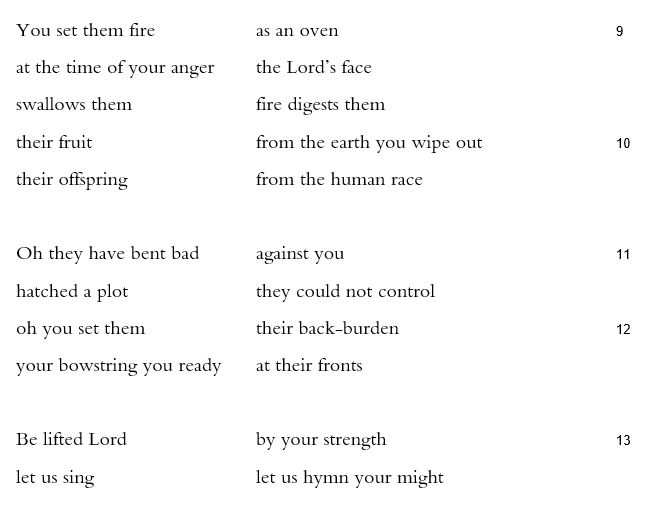
21:9 at the time of your anger | the Lord’s face / swallows them Though it’s on the page here as three lines with two parts, verse 9 parses better as a pair of lines with three elements each. Still, “at the time of your anger” fits with both the fiery oven of 9a and the Lord’s consuming face. Note the shift from second to third person. Clearly this conception of divine rage as fire serves as a model for those who want to imagine a hell with punishing fire, or a fiery apocalypse. And yet the moment here is not eschatological—it’s contemporary with, or even a precondition for, a human realm.
21:11 they have bent bad | against you The verb natah is to stretch out or to lean or to diverge (e.g., Job 31:7). “Turn bad” is accurate, but more on-the-nose than the original.
21:12 their back-burden Literally, “you appointed them a shoulder.” In 1 Samuel 10:9, the shoulder represents the turning of the back. Here in Psalm 21, however, the verb doesn’t indicate turning, and so the more common implication of “shoulder” in the Bible makes more sense: the location of a weight to be carried (e.g., Gen 9:23, 24:15, 45; Judg 9:48). In other words, the Lord is imagined here to be subjugating foes.
 The Book of Psalms