(director: tune “Doe at Dawn,” lyric, of David)
* * *
Psalms of lament are grounded in a number of ways. Having stated or cried out about a problem—lamented it— with more or less metaphor, the speaker calls for mercy or rescue or revenge, appealing either to abstract principles of justice (4:1, 5:12, 7:8-9, 11:7, 14:5, 17:1, 18:20) and moral opposition to wrong (5:4-6, 11:5, 18:23); or to a relationship of divine care (Ps 4:3, 6:4, 13:5, 16:1); or to feelings of compassion and pity (Ps 6:2, 9:13; 18:19); or to God’s identity and reputation (3:8, 6:5, 9:10-12, 12:5). As an argument, the lament has a claim (“help me”), evidence (“for I am in trouble”) and a warrant (“rescue | is the Lord’s” 3:8; or “you’ve never left | who seek you Lord” 9:12). I am just; my enemy’s a cheat; you hate injustice. I follow the rules; my foes are bad; rules are rules. I am hunted; these hunters are terrifying; you care for who shelter in you. I suffer; look at these bones; pity me. I might die; these haters won’t stop; how can I praise you if I’m dead (6:5)?
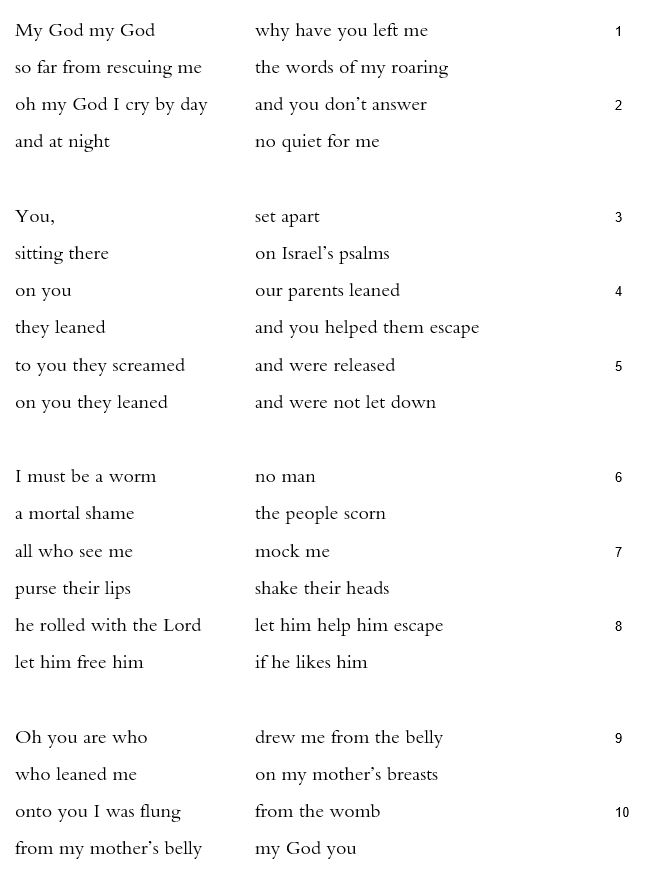
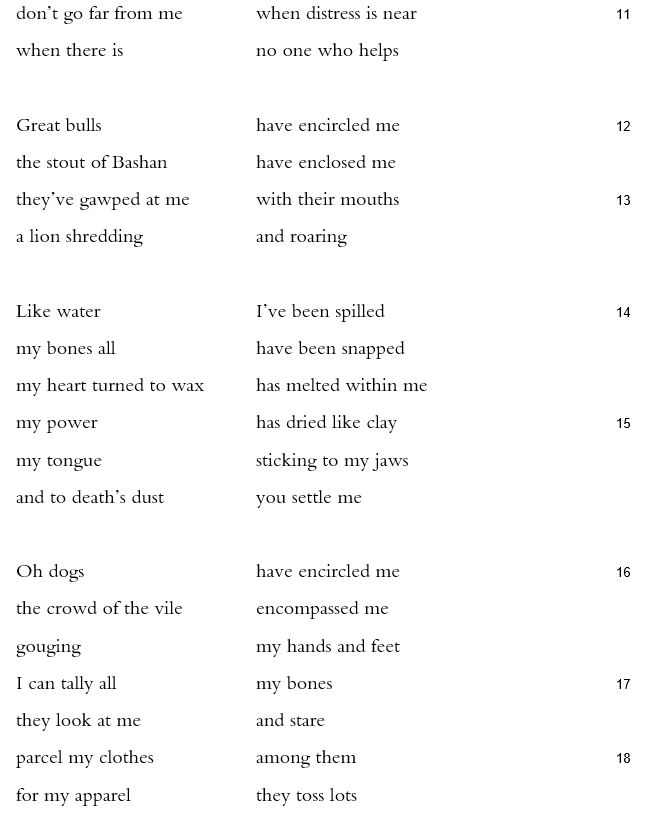
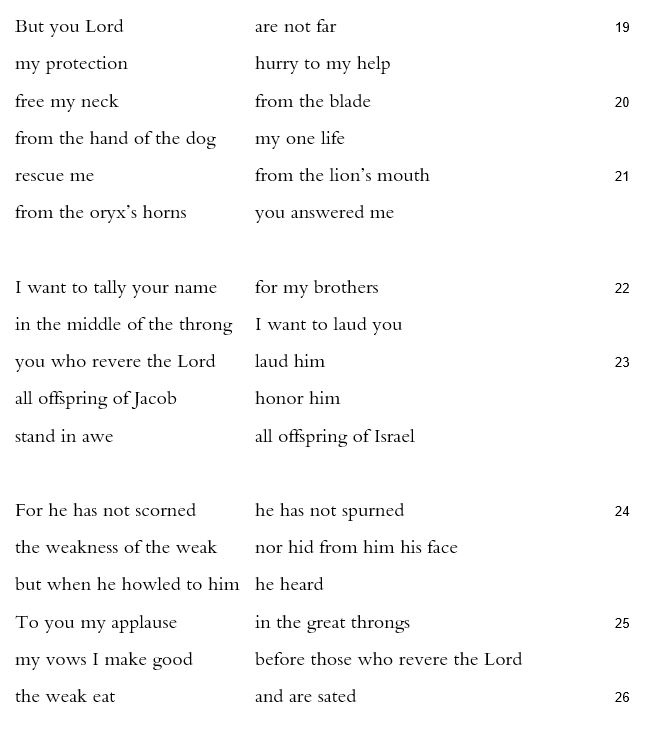
Psalm 22 is remarkable in all three of these areas, in claim, evidence, and warrant. Its complaint is elaborate and tart, the threat vivid and brute, the rhetorical appeal rich and generational, to who God was and will be. You have gone far away; the beasts are closing in; remember our past and imagine the generation to come. The speaker is distraught, even outraged, driven to “roaring” like an animal (1, cf. 13) at the Lord’s removal: “so far from rescuing me” (1). Distance is the problem: “don’t go far from me | when distress is near“ (11). These two poles, far (rachoq) and near (qerov) occasion a scramble of verbal dexterity. Several key words in the psalm pick up on their sounds: the dog/dogs (kelavim, 16, kelev 20), the sword (cherev, 20), my power (kochi, 15), my jaws (malqochai, 15), they divide (challequ, 18). The difference between here and there resonates.
Outraged, the speaker’s accusations broach sarcasm. In verse 3, a line that’s sometimes been read as an addition, the speaker declares God’s sanctity: “You, | set apart / sitting there | on Israel’s psalms” (3). The line reads as a celebration of the Lord’s holiness, which sets up the historical appeal of verses 4 and 5. It also reads as a barb, God’s set-apartness, the quintessence of qadosh, precisely the thing that keeps him far away. Again in verse 6, “I must be a worm | no man” reads as both self-abasement and ironic critique. Even verse 8, with its lines that seem to quote those who scorn the speaker, makes sense as denunciation: “let him help him escape / let him free him | if he likes him.”
Besides mockery, what actually threatens the speaker? It’s hard to tell. The psalm groans under the weight of its figures: lions and bulls and dogs, oh my. The imagery is arresting, but probably none of it is literal: “my bones have all | been snapped” and “I can tally | all my bones” are obvious hyperbole (14, 17). But the lack of a single clear referent or literal meaning is what makes this psalm so potent and adaptable, most notably by the writers of the gospels, who shape the passion narrative around allusions to it: (v.1, v. 8, v. 18).
Why does the speaker think God should care about such a censorious complaint, described almost entirely metaphorically? He looks first to the past and then to the present. The past is generational: “on you | our parents leaned / they leaned | and you helped them escape (4). Perhaps it’s the verb betach—to trust, to rely, but literally to lean—that triggers the noun beten—the belly. Or maybe it’s just thinking about parents—literally, verse 4 says “fathers.” But verses 9-11 return to the generational appeal in the psalm’s most intimate lines:
For you are who drew me from the belly
who leaned me on my mother’s breasts
onto you I was flung from the womb
from my mother’s belly my God you
don’t go far from me when distress is near
when there is no one who helps.
It’s not that long ago God rescued the speaker’s parents, who leaned, in dead metaphor, against the Lord. But when God was the midwife, the leaning was not abstract, but concrete, bodily, maternal: “who leaned me | on my mother’s breasts” (9b). The Freudian image of Anlehnung, the leaning-on of desire, comes clear to mind. Gender, too, is fascinating here. “I am no man,” the speaker says in verse 6, though the mockers use masculine pronouns in verse 8. And here, the speaker recalls being “flung | from the womb / from my mother’s belly | my God you” (10b). Is this a father delivering a child? Or is God the mother onto whom the newborn is laid, or the nursemaid? (The divine epithet “my protection” in verse 19, for what it’s worth, is grammatically feminine.) The generic fathers of v. 4 have become this speaker’s earliest caretaker.
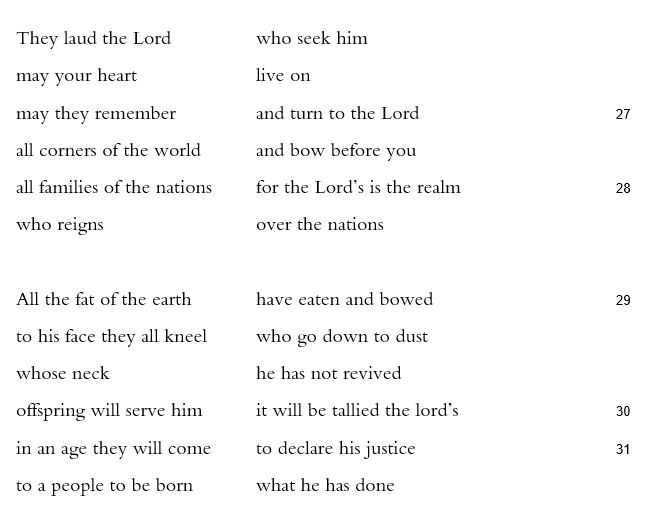
Only in its turn to thanksgiving is this psalm relatively common. The Lord responds—or, has responded, strikingly, in the middle of a verse (21b)—and the psalm become laudatory in traditional ways (“They laud the lord | who seek him,” 27). Still, the second half of the poem fits the first half in at least one way. It picks up the generational appeal as it turns to the future: “all offspring of Jacob… all offspring of Israel” (23). The psalm’s closure is explicit about this:
offspring will serve him it will be tallied the lord’s
in an age they will come to declare his justice
to a people to be born what he has done (30-31)
To many Christian readers, it’s the psalm’s afterlife in the gospels that make it memorable. Other readers relish those bestial images, worm and bulls, even an oryx, and those trippy bodily images of a melting wax heart and countable bones. Ending with “a people to be born,” however, snaps the reader back to the moments of birth and just after, skin-to-skin contact, an appeal not to generations but to generativity, to leaning on the mother’s body.
*
“Doe at Dawn” Beautiful in Hebrew, too, ’ayyelet hasshachar appears to be the name of a melody
22:1 My God my God | why have you left me The cry is rhythmic in the original, punchy two- and four-syllable words. This is the first of three parts of Psalm 22 borrowed by the gospel writers, who punctuate their Greek with the line in Aramaic or Syriac Eloì, Eloì, lemà sabachtháni (Mk 15:34), Elì, Elì, lemà sabachtháni (Mt 27:46).
22:1 the words of my roaring It’s the sound a lion makes.
22:3 You, | set apart Treating this as a clause with an implied copula (e.g., in the KJV: “But thou [art] holy”) misrepresents the tone. The speaker isn’t asserting a theological fact. The speaker speaks daggers—or darts, at least—while pointing out that God was there for the older generation.
22:6 I must be a worm Here, however, supplying a copula makes sense for the literal “I a worm” in the Hebrew. The addition of the modal “must” helps to register the tone of the original, more bitterly sarcastic hyperbole than actual self-abasement.
22:8 he rolled with the Lord | let him help him Biblical Hebrew idiom coincides with English idiom strangely well here in “roll with,” which suggests accompaniment and trust. Since the verse is clearly the reported speech of the cruel jeerers, informality seems appropriate. The verse is dramatized by the gospel of Matthew, where the mockery is spoken by Roman soldiers: “He relied on God. Let him free him now if he wants him” (Mt 27:43).
22:12 the stout of Bashan The phrase ’abirei bashan is rich. The first word, the plural “stout,” is a general descriptor of strength and a synonym for “bulls” or other strong animals, or powerful people. A northern region east of the Jordan River, Bashan with its bulls (and the lion of verse 13) likely figures the dangers of the Amorites and/or the Assyrians.
22:18 parcel my clothes… toss lots These images are so vivid that they become part of all four gospels’ passion narratives: implicit allusion in Mark 15:24 and Luke 23:34, explicit reference in Matthew 27:35 (“so that what was spoken by the prophet might be fulfilled”) and John 19:24 (“so that the writing might be fulfilled which told…”).
22:21 you answered me Such a strange place for this sudden perfect-form declarative verb, marked to indicate completed action, in the last half-line of a verse. A revision for logic would position this at the start of a new stanza, but there’s a potency to its location, interrupting a litany of imperatives.
22:22 I want to tally your name Compare verses 17 and 30. With the singular object “your name,” the verb saphar (here conjugated as ’asapperah, a first-person singular cohortative) tends to work better as telling than as counting, which makes more sense with plural objects, as in “telling” or “numbering” the stars (Gen 15:5). But “tally” conveys the speaker’s enthusiasm, while keeping transparent in translation the psalm’s movement from counting bones, to recounting of the Lord’s name, to accounting the children of the next generation as “the lord’s.”
22:29 All the fat of the earth… revived From verse 26 to this point, as the first-person singular speaker fades from view, the psalm’s logic seems to lurch. The overall drift seems to be that both the weak (26) and the rich (“the fat” 29) will eat and be satisfied and show gratitude, if not in their own lifetime, then in the generation of their “offspring” (30).
 The Book of Psalms