(lyric, of David)

* * *
In bright contrast with Psalm 28, this is a psalm of power. Where the prior psalm found roundabout ways of saying much the same thing, Psalm 29 explicitly repeats. The Lord’s name appears eighteen times, ten times in refrains: “Grant the Lord” three times (1-2), and “the Lord’s voice” seven (three times before verse 5, once in verse 5, three times after). Yet despite this repetition, or because of it, the psalm moves.
So much is specific and concrete that even the psalm’s abstractions feel grounded. Cedars snap. Calves—aurochs calves, more precisely—leap. The wilds quicken as if giving birth. The voice of the Lord thunders, not just anywhere or everywhere, but far south in the wilderness of Kadesh, and far north in the Lebanon and Anti-Lebanon mountain ranges, the Lebanons, whose name points to their whiteness, and Mount Sirion, or Mount Hermon, seat of the Canaanite god Baal, whose Sidonian name refers to snow.
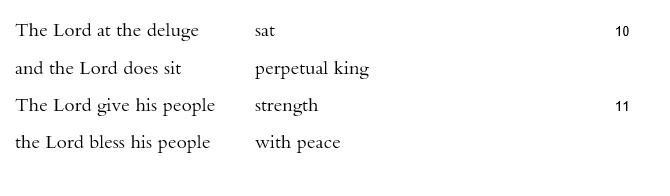
Through the psalm, we move neatly from present imperatives to past, to present events and back, even as the refrains drown temporality in sound. The first stanza commands listeners to credit the Lord with “respect,” kabod, which again means heft, weight, and honor, as well as visual glory (see 8:5 note and the introduction to Psalm 57). The second stanza flashes back in time to the waters, the waters of creation, to the waters of the flood, that second creation, to the waters that swept away Pharaoh, a third creation (3-4). The intense third stanza— two prefixed verbs and a present participle (5-6)—and the doubly intense fourth—four prefixed verbs and two present participles (7-9)—both take place now, first in northern mountains, then in southern wilds, then the temple in between, with “everyone saying | respect” (9). The fifth and final stanza moves swiftly from past to present to out of time: “The Lord at the deluge | sat / and the Lord does sit | perpetual king” (10). The psalm ends with a benediction, two statements that are also wishes: “The Lord give… the Lord bless” (11).
It is disappointing to hear others interpret this psalm as a description of a thunderstorm, as if that explains what happens here. That approach turns us into Victorian-era armchair anthropologists, bemused by naïve anthropomorphic explanations of natural phenomena that would be better explained (puffs cigar, swirls sherry) by scientific inquiry. This psalm is not the bad science of primitives, nor does it supernaturalize the natural world. Whoever wrote this, they were not simpletons cowering from storms. This psalm sees power and display inside the imperatives of its collective practice. And it does so outside, out in a world that is not sub-supernatural, not even natural, for there is no biblical concept of “nature.” There is, rather, leaping and writhing in respect and strength.
It is possible to read this as an extractive poem, in which the stripping of forests gives way immediately to a temple built from their timber. In this reading, the grammar of “everyone saying | respect” aligns this “everyone” with the deer and with the woods, all made to writhe even as they are stripped bare. It’s better, however, to read the psalm as new creation in a constant present tense. This reading accounts for the writhing in verses 8 and 9, which are really birth pangs. And it accounts for the dancing in the mountains in verse 6. The Lord sits where he always sat, verse 10 asserts, even before the deluge, back to creation.
The poem begins by addressing “children of gods,” benei ’elim, continuous with the God (’el) of respect in verse 3. Since it ends, as well, with the Lord’s people, we are invited to wonder who these “children of gods” are and what they are capable of. Most importantly, the poem ends by returning almost exactly where it began, with “respect” (1, 2, 3, 9) and with “strength” (1, 11).
Not exactly where it began, though. The psalm’s final word for what the Lord’s voice makes happen is “peace.”
*
29:1 Grant the Lord… respect and strength The refrain calls for giving to the Lord before it names either the audience—“children of gods” (benei ’elim), descendants of the mighty, an open-ended appellation—or the direct objects that are to be given, the open-voweled kavod va`oz and kavod shemo, “respect and strength” and “the respect of his name.”
29:2 in hallowed display In the perfect dactyls of the King James Version: “worship the Lord in the beauty of holiness.”
29:3 the God of respect thundered As in verse 1, “respect” may seem less impactful to readers of some generations than others, but all audiences have a less automated theological response to “respect” than to “glory.” The name of God here is not the more common ’elohim, but ’el, which means either “God” or “god” or “might.” As a preposition, ’el indicates direction towards, which here would play off the two `al prepositions in the phrases that precede and follow.
29:6 he makes caper.. the aurochs A good example of the kind of chiastic parallelism that ties the second half of the first line to the first half of the second line: “the White Mountains / and Snowy Mountain.” “Lebanon / and Sirion” would also work, but the name Lebanon does not refer to what readers will think of as the country, and the derivations of both geographical terms are striking.
29:7 carving blades of fire Such a skillful line. The participle chotsev suits activity both destructive and constructive, while the lahabot are things that glint, both flames and blades. Thus the voice of the Lord might be what forges blades or splits them, what fuels flames or divides them.
29:8-9 wreathes | the wilds of Qadesh… makes writhe the does The verb chul has tremendous range. The common translation “shakes” is fine, but there seems to be a twisting, wrapping motion involved as well, continuous with labor pains and dancing. The name for female deer ’ayalot compellingly calls back ’el and ’elim from verses 1 and 3.
29:9 everyone saying | respect The phrase “in his temple” would seem to limit this “everyone” to human worshippers. And yet the psalm’s persistent celebration of how Lord’s voice affects animals, mountains, wilderness, and woods makes the saying resonate outside the temple as well.
29:10 at the deluge | sat / and… does sit Note the contrast with 26:4-5 “I have not sat… I will not sit”
29:11 The Lord give The verb functions as a jussive as well as an indicative, as wish and as declaration.
 The Book of Psalms