(director: lyric, of David)



* * *
Like a kitchen sink, Psalm 31 is full. At first glance, it’s a jumble of quotation and cliché. Psalms 7, 11, 16 and 71 all start with the same image of refuge, and the first line here (1a) seems cribbed from Psalm 25:20: “In you Lord I nest.” Verse 2 seems to compile other prayers’ introductory verses. “Stretch me | your ear” shows up in 86:1, 88:2, 102:2, and in the second verse of Hezekiah’s prayer in 2 Kings 19:16. The cliff, tsur, appears in Psalm 18:2 and 28:1 (28:2 itself seems to be quoted in 31:22). In 31:3, “for the sake of your name” is also in 25:11 and, together with the third-person “..his name,” also in 23:3, a verse that includes the verb “he guides me,” while 23:2 includes “he makes me rest.” We could go on.
But if the psalm is quoting, why? It’s one thing to evaluate—“a jumble of quotation and cliché”—and another to understand. The line in verse 9, “it’s rotted with grief, my eye,” for instance, quotes a psalm where the image fits, where it makes poetic sense: “I make my bed swim | all night / with tears | I melt my couch / from grief | my eyes have rotted” (6:6b-7a). But here in Psalm 31, there has been no grief (yet), let alone overflowing tears that would make eyes waste away. Instead, the rotted eye provides only generic evidence of generic “trouble.” The psalmist continues, but diffuses the image rather than honing it: “it’s rotted with grief, my eye | my throat, my belly / for my life has been spent | with ache” (9-10). Images from Psalm 6 recur: the sighs, the bones. Again, why?
It’s impossible to answer with certainty. At one extreme, we could conclude that this is sloppiness and disinterest, a rough draft, a scribe trying to remember other psalms, a third-rate writer cobbling something from others’ music and verbal pictures. At the other extreme, we could assume the psalm and writer are accomplished and adjust our aesthetics to match it. After all, a chunk of this psalm itself appears to be remade as Psalm 71—or vice versa—and there are other psalms that include, or are, wholesale copyings and borrowings. In between, we might imagine strategies of quotation, revision, and commentary that writers and musicians expected reciters to notice. This is more than allusion, but without our cultural stigma of plagiarism.
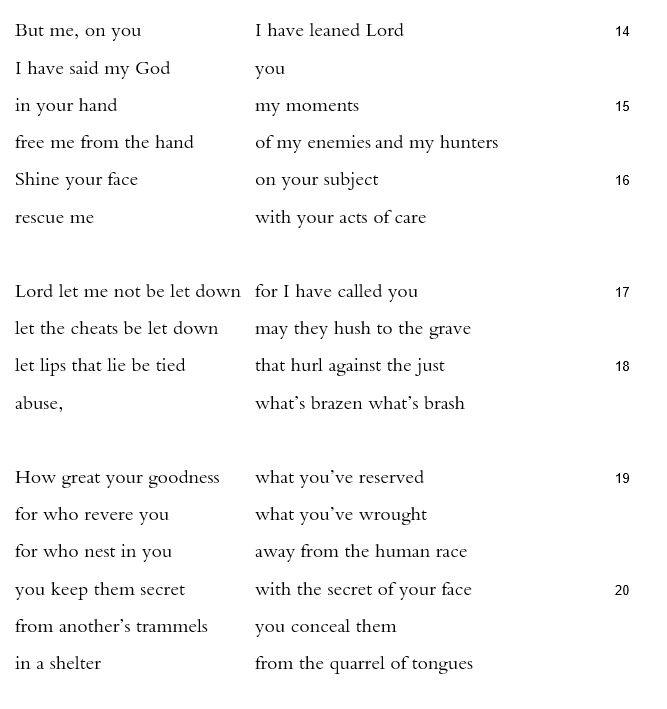
It’s tempting with a psalm like this to take out scissors as Jefferson with his gospels or Pound with Eliot, excerpting only the fresh and new, freeing it from all the all-too-familiar. There’s that image of the speaker handing over her breath to the Lord God of faithfulness, as opposed to those who guard the worthless, “keepers of empty air” (5-6). And when the speaker who’s compared herself to a dead person “forgotten… from the heart” pairs herself with a “broken jar” (12), the effect is shattering. Even more powerfully, there’s the vivid idea that the Lord keeps those who seek shelter “secret | with the secret of your face,” an image only the book of Job has the inventiveness to match (Job 13:10, 24:15). That pause to wonder: where are the secrets of the face? Oh.
As a whole, the psalm attempts to process an experience of siege. “His care for me | in a city besieged” (21) is not the central line, but it might be the most telling. Whether siege is literal or figurative, collective or individual, hardly matters. Quotation, at least in this psalm, is not a careful collage of found images that fit together, recollected in tranquility, but a kind of emotional rush of a flipping through a catalog. To be beset and surrounded is to nest, to hide in a fort, to hide from a net in a fastness—a kind of acknowledgment that the word metsudah means both “net” and “stronghold” (1-4). It is to be closed in, though yearning for space (7-8). It is to witness a cityscape in which enemies mock and friends flee and forget, and terror encloses (11-13). And it is to return again and again to whatever works, “feel for me Lord | for I am in trouble” (9) and “free me from the hand | of my enemies and my hunters” (16) and “for I said | in my panic / I’m severed | from before your eyes / and you heard | the voice of my pleas” (22). The process is not linear, the experience not about originality or about convention, but a jumble, a blur of panic and praise.
*
31:2 be my cliff fastness / a fort of defense Consonance here in English tries to replicate the effect of consonance in the Hebrew: hatsileini… litsur… metsudot, “free me… cliff… defense.”
31:5 To your hand I hand over… you ransomed me Here, too, repetition attempts to keep wordplay, though it’s actually “you ransomed” (paditah) that chimes with “your hand” (beyadikha) and shares consonants with “I hand over” (aphqid). The punning in Hebrew connects the divine act of rescue with the speaker’s own devoted response.
31:6 the keepers of empty air The speaker pledges opposition to those who guard or watch havlei–shav’, a term that pairs two euphemisms for idols, “breath” (hevel) and “worthlessness” (shav). See also Jonah 2:8.
31:7 have known my neck | through troubles Following the verb “to know” (yada`) with the preposition b- (“with” or “in” or “through”) creates an expression both literal and idiomatic. The Lord has perceived the troubles of the speaker (“neck” is a synecdoche) and has known the speaker, even through distress.
31:9 it’s rotted with grief, my eye | my neck, my belly Those (e.g., NIV, ESV, NASB, and more) who take nefesh to mean “soul” see this verse (likely an expansion of Psalm 6:7) as concluding with “soul and body,” reading a kind of dualism into the text. The more literal, more vivid, and more defensible reading is to understand here a grief so eviscerating that tears destroy the entire body as they fall from eye to throat to gut.
31:13 the hearsay of many Dibbat implies subtle slander.
31:18 let lips that lie… what’s brash The verse’s syntax relies on increasingly outraged apposition, while its rhythm moves from three carefully measured four-syllable semantic units to a unit of five and a unit of six.
31:20 you keep them secret | with the secret of your face The normal biblical idiom is to hide one’s face (e.g., Exod 3:6, Ps 13:1). This line turns the idiom around: they (the ones “who revere you… who nest in you” from verse 19) are not hidden from the Lord’s face, but by it.
31:20 from another’s trammels This noun only appears here. The Hebrew root rokes appears to derive from the Assyrian word riksu, a binding strap, such as the markasu, the strap that binds the cosmos. (See Assyrian Dictionary of the Oriental Institute 347-55) A precise, slightly difficult word seemed in order.
31:22 I’m severed Another hapax whose meaning seems clear enough from context.
31:23 the true the Lord | preserving / requiting… the doer of pride “Preserving” is a singular participle, so it’s the Lord who protects the faithful. It’s also the Lord who makes things even—the verb is shalom—with the proud, a point of considerable ambivalence.
31: 24 Stay stout The word chizqu is used in benediction by both Moses (Deut 31:6, cf. 31:7,23) and Joshua (Josh 10:25, compare the words of the Lord and the people in Josh 1:6-9, 18), both times in combination with the verb ’amats. See also Psalm 27:14.
 The Book of Psalms