(director: instructive, of the Qorachites)

* * *
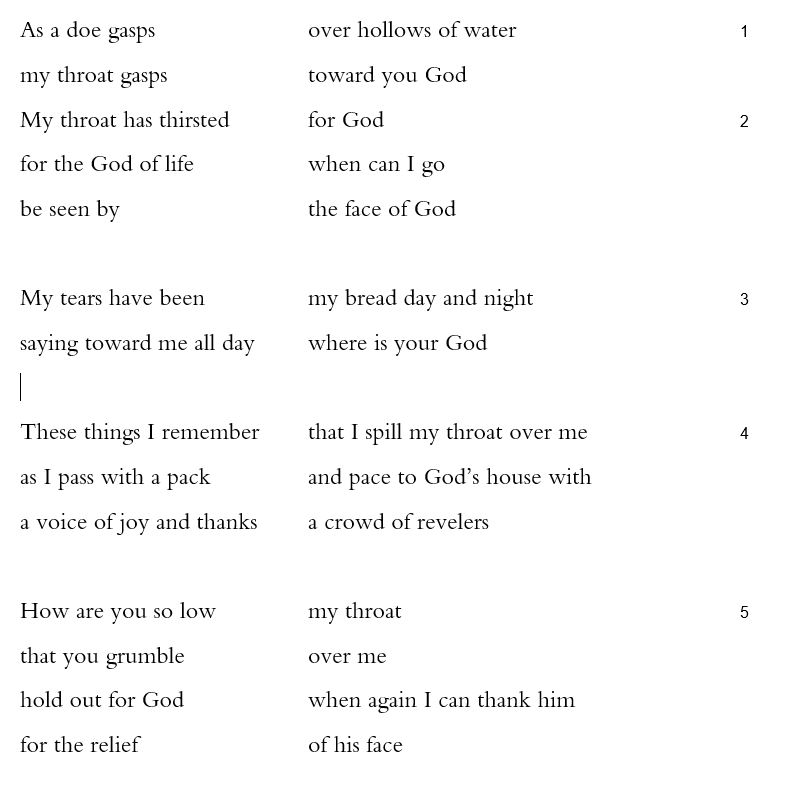
The red deer that begins this double psalm, and with it the second collection of the book of Psalms (Pss 42-72), draws our attention first. Yet every other word in the first verse matters more. The rare verb ta`arog, to cry or pant for, conveys bodily longing. It appears twice here, marking what’s shared by the deer’s throat and the speaker’s nefesh, that resonant word for neck or throat that gets at the life of a creature. The ‘afiqei-mayim, usually translated as “brooks” or “streams of water,” describes the geological feature of a ravine, a streambed that seasonally goes dry or flashfloods in torrents. These properties are paired with God, ‘Elohim, about whom the verse makes us wonder: is this the God of floods or the God of drought? Our answer changes how we read the whole verse, indeed the whole psalm, especially the gasping of the deer and the throat. Do they gasp dying of thirst, or gasp slaking it?
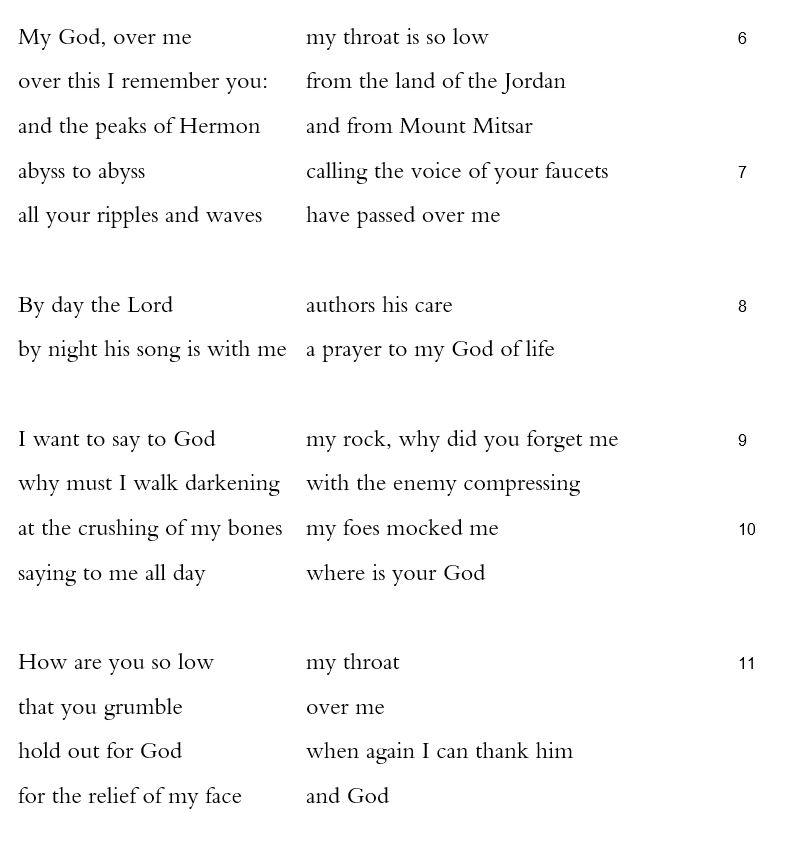
Already in this first verse, something crucial happens even in the prepositions. The deer gasps “over” or “upon” the ravines or “hollows,” whereas the speaker’s throats gasps “toward” or “at” God. The prepositions sound similar: `al means “over”; ’el means “to.” The word ’el also means God (see 42:2, 8, le’el-chay, God of life; 42:9, le’el-sal`i). The Hebrew word for deer—the noun is masculine but the verb is feminine— is the similar sounding ’eyyal. Thus the verse pairs `al and ‘el, setting in motion a motif that runs throughout the double psalm’s three main stanzas (42:1-4, 42: 6-10, 43:1-4) and three main refrains (42:5, 42:11, 43:5). The psalm’s direction is ’el-’Elohim, toward God. But the speaker is elsewhere. The speaker’s throat is poured out “over me” and is low “over me”; it grumbles “over me”(`alay, 42:4, 5, 6, 11). Others say to the speaker (to me, ’elay), ’ayyeh ’eloheykha “where is your God?” (42:3, 10). The deeps call “to” (’el) the deeps, even as the waves have gone “over me” (`alay, 42:7). This verbal play shows up later, too, even in the words “these,” ’ellah, in 42:4, and “over this,” `al-ken, in 42:6.
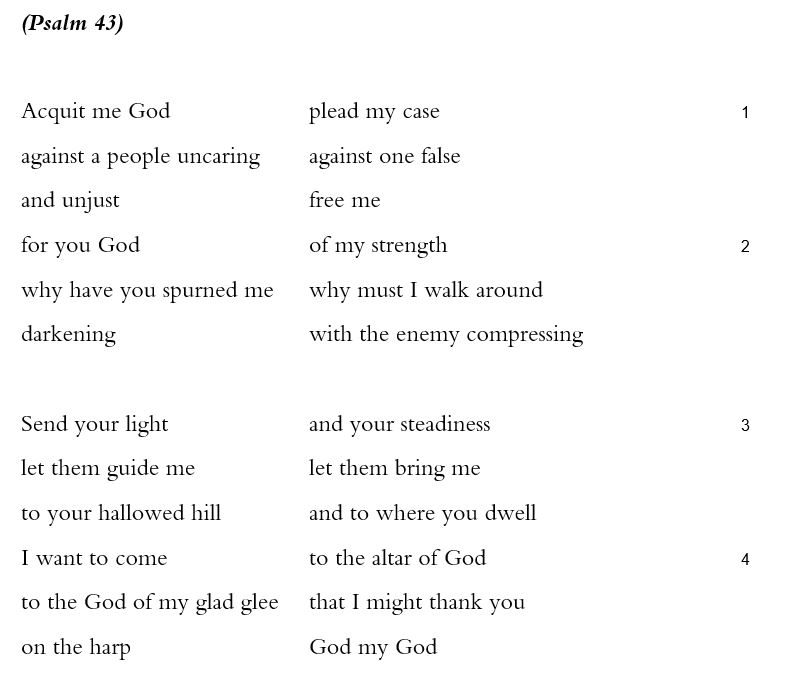
In the first two verses of Psalm 43, ‘el is part of the name of God, `Elohim. It returns four times in 43:3-4, where it points with stepwise closeness to God’s presence in Jerusalem: “to your hallowed hill | and to where you dwell… to the altar of God | to the God of my glad glee.” All told, the name of God appears 27 times in this double psalm, 7 of those in Psalm 43. That’s a resonant start for the so-called Elohist Psalter, this second collection of the book of Psalms. The step-by-step closeness works in reverse through the whole song, which imagines a return to Jerusalem from exile, contrasting the procession of worshippers (42:4) with their “darkening” walks among oppressors (42:9, 43:2). Deftly, the double psalm manages to be both towards and away from at the same time, anticipating the light without denying the dark.
 The Book of Psalms