(director: on “The Lilies”; of the Qorachites: skilled, a song of love)
* * *
What are we doing, reading Psalms? Taking part in a worship tradition? Or overhearing, out of historical curiosity or aesthetic purposelessness? What do we expect and what do we find? A text like Psalm 45 confronts us the way the Song of Songs confronts us, at the limits of purposiveness and the purposeless. If we expect the Bible to be “religious” or “spiritual” or theologically relevant, then our encounter with a sensuous song that celebrates the marriage of an ancient king forces a choice. Either we adapt our categories and how we apply them— the Bible, the religious, liturgy, theology— or we cram a poem like this into those categories, forcing it to be what we expect it to be. Is a psalm like this in the Psalter because it is messianic or allegorical, code and metaphor for the love between God and Israel his bride, or wildly anachronistic code for Christ and a Christian Church several hundred years from being born? Or is the psalm included in the Psalter because of its disinterested beauty, a powerful song too potent not to have been anthologized?
Obviously “we” is a problematic word.
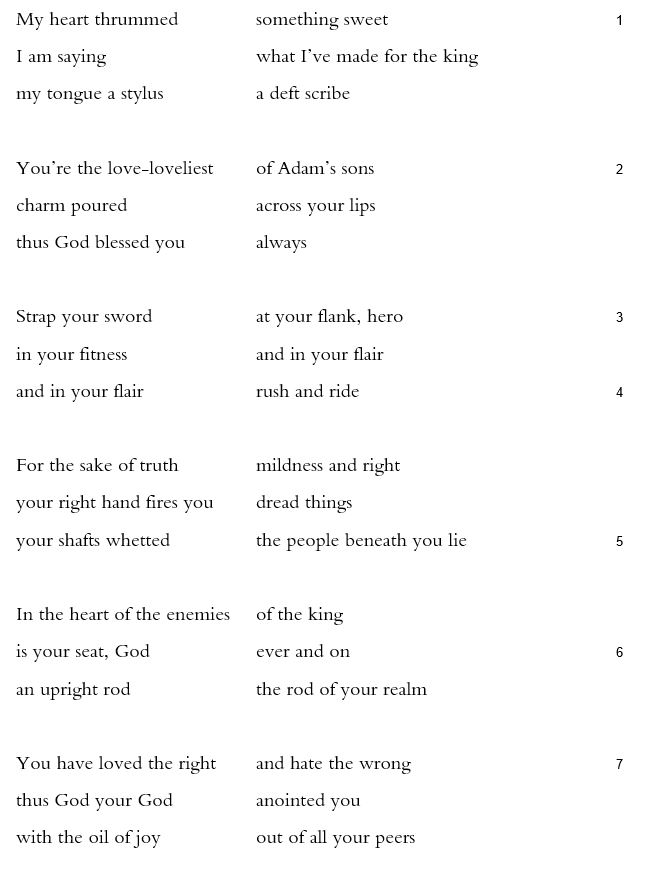
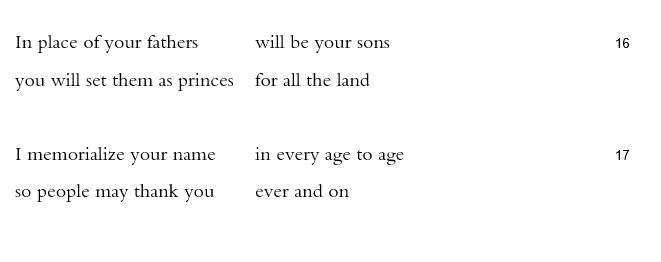
The first-person speaker who grandly introduces this song by pronouncing his prowess—“my tongue a stylus | a deft scribe” (1)—announces his purpose in the final verse: “I memorialize your name | in every age to age / so people may thank you | ever and on” (17). But memorialize whom? God? Surely not the king. And memorialize how? How is a psalm that maybe addresses God in the second person only once—at the start of verse 6, and even then only maybe—a memorial to help people thank God? The three verses that do explicitly mention God suggest distinct purposes. Verse 2, which celebrates the king and his beautiful lips, concludes that “thus God blessed you | always.” Verses 5 and 6, which break up the text confusingly, locate God’s seat “in the heart of the enemies of the king.” And verse 7 asserts that the king knows right from wrong, “thus God your God | anointed you.” Thus four theological explanations lie on the table: this psalm remembers God’s name, or it celebrates God for having authored the king’s physical beauty, or for having provided the king with political and military might, or for having chosen a moral king.
And maybe all of those explanations make sense.
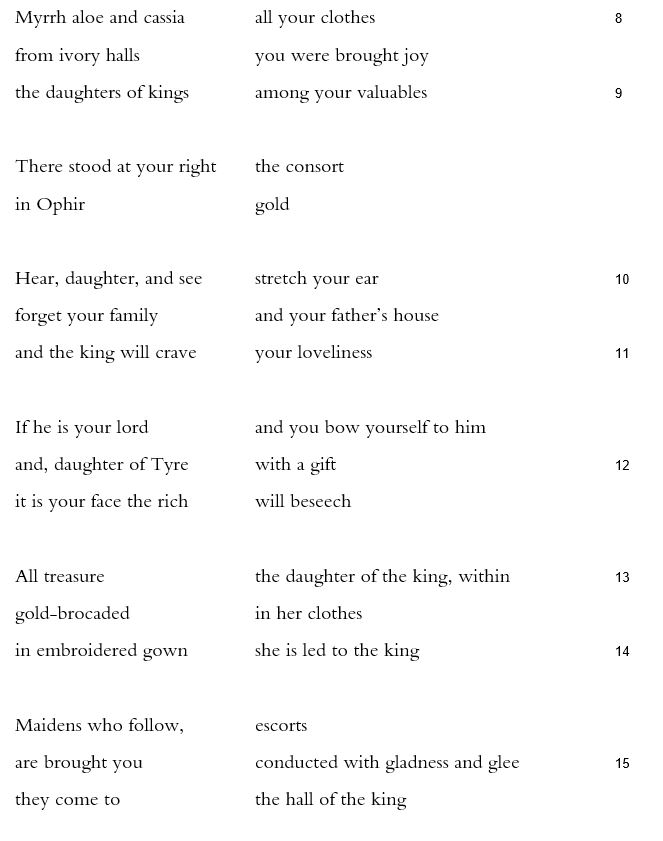
Still, the psalm is built in uneven halves, six tercets plus a couplet addressing the king (2-9), four tercets addressing his bride, the daughter of Tyre (10-15), plus a final couplet to the king (16). The king’s verses stress his political and procreative power by emphasizing phallic signifiers of that power: his sword (3), his right hand (4) his arrows (5), his scepter (6). (The mention of a “stylus” in verse 1 led to my use of masculine pronouns for the psalmist, but who knows.) The princess’s verses stress subservience to her potent husband (12), but also her beauty (11, 12), her riches (12-13), and her new preeminence over “maidens who follow, | escorts” (14). If the point of the king’s verses is to show his divine favor, nevertheless those verses culminate with things, lovely smelling things, property, and more property: “the daughters of kings | among your valuables” (8-9). Chief among these valuables is the queen in her Arabian gold. The point of the princess’s verses—she seems likely to be this queen consort—is that for the low, low price of her “family | and [her] father’s house” (11) plus a dowry or tribute (12), she can have all this and more, from her “treasure…within,” which works equally well as a heart of gold or as a euphemism, to the favor-currying of the affluent (12).
Ultimately what the king gets is offspring, and a kind of continuous life: “In place of your fathers | will be your sons” (16). Maybe this is a psalm of peace, then, a royal vision of an endless reign. In that case, it really is the king who is memorialized, rather than God precisely, the king being thanked “ever and on” at the end of the psalm. The psalm we have doesn’t name any particular king, so the word “name” opens possibilities. Maybe something has been lost, or God is meant though last mentioned half a song ago, or else “name” stands for fame and wealth, and power most of all.
 The Book of Psalms