(to Jeduthun, a David lyric)
* * *
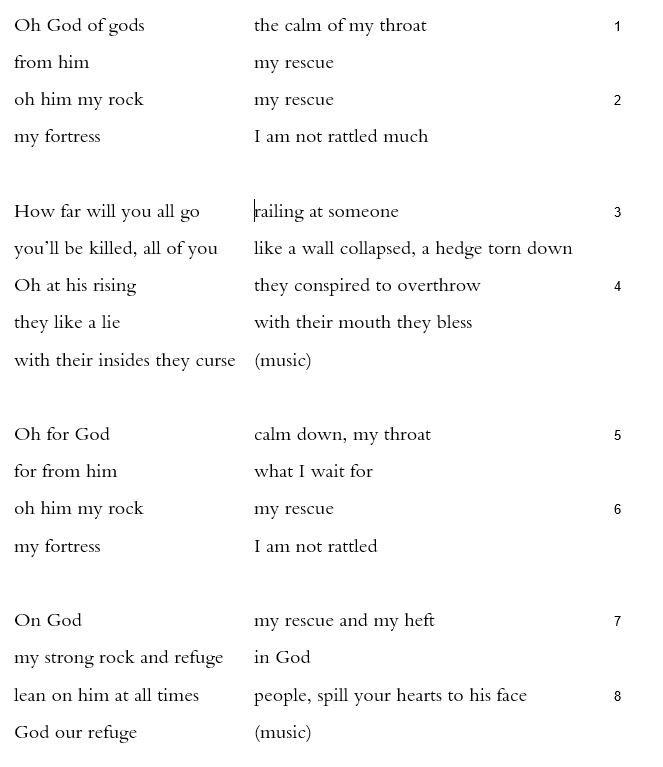
“Once God spoke | twice I heard this,” the speaker of Psalm 62 says near the end of this duplicative, twice-heard poem (62:11). The first and third stanzas, verses 1-2 and 5-6, are near-doubles that work as a refrain. Partly the lines repeat: “from him | my rescue / oh him my rock | my rescue / my fortress” (1b-2 =5b-6). But differences between verses 1a and 5a seem less like variations on a theme and more like textual variants, “Oh God of gods | the calm of my throat” becomes “Oh for God | calm down, my throat.” To be fair, that first version might just be a preposition and the name “God”—“Oh to God.” But if the first stanza does locate God within the company of plural gods (‘el ‘elohim can easily be read this way) before the third stanza refers to just a singular God (l‘elohim), then that third stanza functions almost as a kind of corrective, an erasure of those other gods.
The fourth stanza, verses 7-8, elaborates on verses 5-6. It takes up the words “God,” “my rescue,” and “my rock” and does so insistently. It names God three times instead of once, adds “and my heft” to “my rescue,” and turns “my rock” into “my strong rock and refuge | in God… God our refuge.”
Seeing the first and third stanza as a kind of repeated chorus, with the fourth stanza as a kind of second chorus, we can see the second and fifth stanzas, verses 3-4 and 9-10, as curiously parallel. Both are plural: “How far will you all go” and “they conspired to overthrow” in the second stanza, “Oh air are the lowborn | the highborn a lie” in the fifth. Neither mentions God explicitly, but a powerful presence is felt. In verse 4, unnamed others are warned
How far will you all go | railing at someone
you’ll be killed, all of you | like a wall collapsed, a hedge torn down
Oh at his rising | they conspired to overthrow
they like a lie | with their mouth they bless
with their insides they curse.
Who are these others? Against whom do they rail and conspire and lie? And who will kill them?
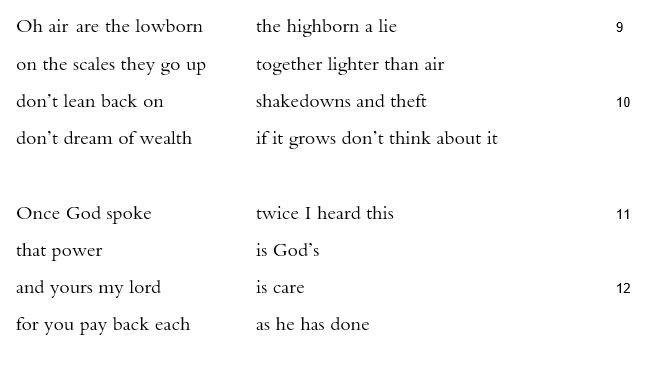
These questions are not answered by the fifth stanza, which turns all humans to vapor upon “the scales” of what we assume is divine justice: “on the scales they go up | together lighter than air” (9).
Explicitly, these two stanzas are about people. The plural conspirators in verse 3 rail against a person, `al ’ish, while “lowborn” and “highborn” are literally benei ’adam and benei ’ish. It’s humans, after all, who speak a lie (kozav 4, kazav 9) and who trust or rely on “shakedowns and theft” (10). And yet the mere possibility that `elohim in verse 1 could be plural—see, for example, Psalm 82— colors the “others” of verse 3 as lesser gods, mutinous gods. The “he” implied by “Oh at his rising” becomes not a person but God. Read this way, the distinction between the lowborn and the highborn in verse 9 takes on mythic significance. Plural, lowercase ‘elohim weigh no more than mortals.
This reading finds double meaning in the final stanza’s twin assertions “that power | is God’s / and yours my lord | is care” (11b-12a). Power belongs neither to renegade gods nor to upstart mortals, nor could either of these groups tip the scales of justice, nor can they be relied on for chesed, care. In the context of the poem, this final stanza emphasizes that neither conspiratorial lying nor the briberies and robberies of the rich can prevent God’s system of retributive justice, in which “you pay back each | as he has done” (12).
Detached from this psalm, the final lines could be marshalled as prooftexts for claims about an afterlife or for attempts to explain suffering as punishment for crimes. Those uprooted interpretations, however, lose much when ripped from the whole psalm. That “each” at the end of the psalm, it is the word ’ish returning from verse 9, the “highborn,” returning from verse 3, the person the conspirators attacked. The insubstantial scales are the crucial image here, everything lighter than air. The scales depend on power, the poem says God says. The speaker suggests we hear this twice, before adding, in the speaker’s own voice, “and yours my lord | is care” (12). Caveat lector.
 The Book of Psalms