(director: a David lyric)

* * *
Psalm 64 has a narrative pleasure that’s obvious—a tight story of revenge—and a marvel of sounds that are hidden in English.
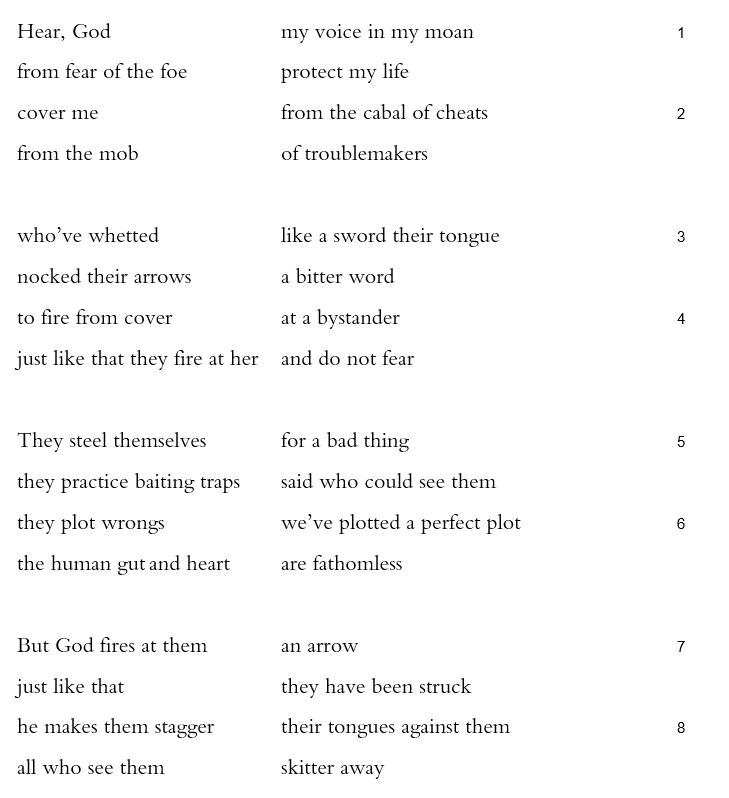
The story is taut and clear. The curtain opens. The speaker, surrounded, is calling for help. Villains, armed to the teeth, wield metaphorical weapons: “who’ve whetted | like a sword their tongue / nocked their arrows | bitter words” (3). They aim at the innocent: “just like that they fire at her” (4). By the middle stanza, their tactics become both less direct and yet more blatant: “they practice baiting traps | said who could see them / they plot wrongs | we’ve plotted a perfect plot” (5b-6a). These bad ones who gang up on the speaker have gotten cocky, slinking there in the shadows. They perseverate about their “plotting.”
In the fourth stanza, God responds in kind, a hidden archer if ever there was, and “fires at them | an arrow / just like that | they have been struck” (7). The effect is surreal, even cartoonish: “he makes them stagger | their tongues against them / all who see them | skitter away” (8). In payback for plural figurative arrows (3), God shoots one literal arrow (7). It pierces what was one collective tongue (3), cutting it into plural tongues (8), which they appear to trip over (or perhaps their tongues trip over them!). The crowd disperses. Stanza Five—almost called it Scene Five—shows the people fearing, as the “cheats” and “troublemakers” did not. The curtain falls on the singular just person, around whom now not the bad, but the good, gather and effuse.
What really makes this psalm, however, is not its pat plot but its verbal dexterity, a dazzle of puns on the words “fear” and “see,” and a half-dozen other similarities that loop threads through verses to tie the whole together. In verse 2, for instance, the speaker asks God, “cover me” (tastireni). Two verses later, the deceitful mob hurls its insults “from cover” (bammistarim). In this case, the English word “cover” manages to get both senses of the Hebrew seter, to protect and to keep secret. In the case of the Hebrew word tam, there’s no English word that conveys both innocence (“bystander” in 4) and perfection (“perfect” in 6), so the English version loses that ironic barb. We do get just fine the word pit’om for “suddenly” or “just like that” in verses 4 and 7, which marks both the instant of crime and of punishment. But we don’t see in translation the word qerev, rendered here as “gut” in verse 6, calling back the word cherev, “sword,” from verse 4. And we can’t notice in English the unscrambling by which wayyakshiluhu in verse 8, “he makes them stagger,” resolves itself in hiskilu in verse 9, “they consider.” In this wordplay, in a poem on the theme of language misused, and in the divine contrapasso, arrow for arrow, the psalm calls to mind the Tower of Babel story.
Psalm 64’s most significant pyrotechnics are touched off in verses 2 and 3 with merei`im and devar mar: “from the cheats” and “a bitter word.” These sound clusters erupt first in verse 4, with lirot…yoruhu vel’o yira’u: “to fire… / they fire at her | and do not fear.” In the first half of verse 5, the “bitter word” comes back as devar ra`, “a bad thing.” In the second half of verse 5, both yoruhu “they fire” and yira’u “they [do not] fear” return from verse 4 as mi yir’eh lamo, “who could see them,” the words that the troublemakers say to convince themselves they’re invulnerable. Their verbal archery, lack of reverence, and not-half-as-secret-as-they-think self-confidence are lashed together. In verse 7, God’s response, vayyorem, “he fires at them,” is not just the slinging of an arrow. It punishes their lack of reverence and of sight as well. After all, the upshot of the punishment is that “all who see them…” (kol ro’eh vam) flee, and “all mortals fear them” (wayyir‘eu kol adam). The ra` of badness, the ra’ah of sight, the yara’ of reverence, and the yarah of shooting—all catch fire together in a tour de force.
 The Book of Psalms