(director: strings, a lyric, a song)
* * *
This brief benedictory song celebrates a very particular triangle. At the start and end of the psalm, there’s “us,” an unnamed first-person plural, always the object of a verb (twice in verse 1, once each in 6 and 7). Throughout the psalm, there’s “God,” named six times (1, 3, 5, 7, and twice in 6). And in the middle verses there’s “they”: the “others” (2), the “nations” (twice in 4), the “peoples” (once in verse 4, twice each in 3 and 5).
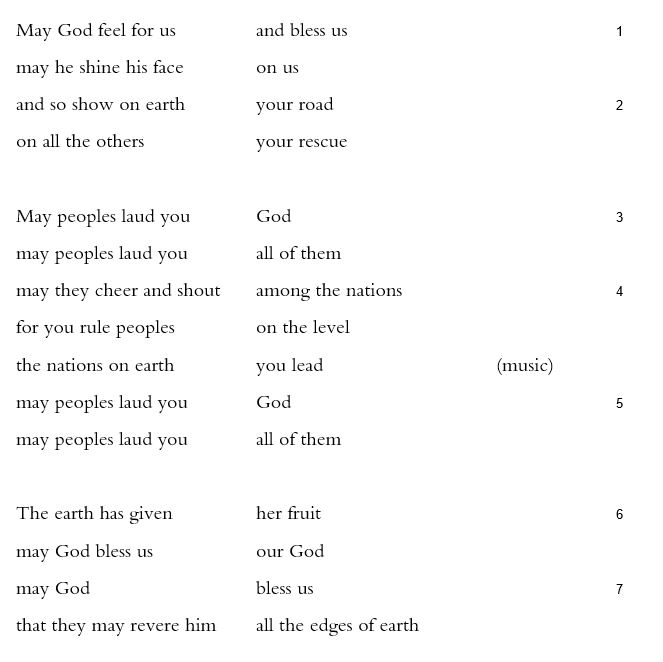
This us-God-they triangle implies specific kinds of logical arrangement. In the opening stanza, the speaker (or speakers) wish for God’s blessing for “our” sake: “May God feel for us | and bless us / may he shine his face | on us” (1). And yet the second verse reveals that this favor is not just for “us,” but for “them”: “and so show on earth | your road / on all the others | your rescue” (2). In the middle stanza, the speaker wants others to praise God because God leads everyone fairly. This wish, the refrain of verses 3 and 5, frames the three central lines of the song:
may they cheer and shout | among the nations
for you rule peoples | on the level
the nations on earth | you lead
The final stanza recalls the first, returning to “us” before ending with the rest of the world, “all the edges of earth.” It reveals one final wish, “that they may revere him” (7).
So this tight triangle expresses a precise, parochial universalism. Local blessings and a face that shines on “us,” these also shine for “them,” showing a road and a rescue, rule and reverence. Nevertheless the song doesn’t hope for everyone to be blessed or felt-for equally. Us and Them are not erased, but triangulated. God blesses us, so they praise God, the logic goes.
Understood this way, the role of “earth” in this psalm is ambiguous. The word erets can mean the whole world, or its land, or it can mean just the land, the Land of Israel. All four times the word appears in this psalm, in verses 2, 4, 6, and 7, it can refer to the known world of lands and peoples, or to a particular territory, one section of that world. For a psalm of such limited universalism, the difference matters. How far do the boundaries of road, rescue, rule, and reverence extend? How far goes the blessing?
 The Book of Psalms