(director: of David, a lyric, a song)


* * *
Like the shorter, less specific psalm that precedes it, Psalm 68 cares about the relationship between God and “us” and “them,” not any personal, individual relationship. Like Psalm 67, what matters to this song are the dynamics of local and universal. How can Israel’s God be both here and everywhere? How can a God be both located and mobile? How can a God dwell in one mountain when everyone knows other mountains have gods of their own?
The song hangs on the tension between the stationary and the moving. At stake are questions of God’s presence and identity, encapsulated already in verse 1 with a clear allusion to the Ark of the Covenant.
“They set out from the mount of the Lord on the road for three days, the Ark of the Covenant of the Lord setting out before their face on the road for three days to scout them a place to rest, the cloud of the Lord above them by day at their setting out from the camp. Whenever the Ark set out, Moses said, Rise, Lord, so that your foes scurry and your haters flee from your face. Whenever it rested, he said, Return, Lord, to the ten thousands, the thousands of Israel.” (Num 10:33-36, my italics)
With the Ark, the Lord moved and rested, rested and moved. In Psalm 68, the question seems to be, which mountain is the “mount of the Lord”? How does one hill claim pre-eminence? Even, how did God— ark or no— get from one mountain to the next?
Throughout the psalm, one cluster of verbs underscores movement, another staying still. The poem begins with God’s rising and the enemies’ radiant dispersal, to the point of disappearance (1-2). By the second stanza, images of settlement—God’s “hallowed habitat” (5), God “giving | loners families,” and “only rebels have settled | in the scorches” (6)—contrast with images of God’s motion, “the Rider of the Clouds” (4), “leading captives | to freedom” (6). Movement comes in the form of roots like “ride” (rakhav: 4, 17, 33), to walk (halakh: 21, 24 x2), to go out (yatsa’: 6, 20), to go up (`alah: 18), to bring back (shuv: 22 x2; shavah: 18 x2). Settlement takes the form of verbs for sitting (yashav: 6, 10, 16), resting (shakhav: 13), and dwelling (shakhan: 6, 16, 18). By the end of Stanza 3, for instance, as in the passage from Numbers, God’s movement seems both liberating and preparatory. Orphans, widows, loners, and captives all are brought to a home. The cloudbursts that followed from Sinai have “steadied” the land, the “property” where “your creatures | have lived” (8-10).
In Stanza 4, word is sent and women bear good news, while kings retreat and retreat. In opposition to this motion, there’s a staying home: “she who stays home | splits the spoils / when you all lodge | in the sheepfolds” (11-13). The stanza ends with movement: “when Strength spreads out | kings from there / it snows | on Zalmon” (14). This motion, with a change of color, may be what that lovely image of the wings of the dove is really about. The contrast of dark mountain and snow cover is like the contrast of the wings of a resting turtle dove and those wings in flight.
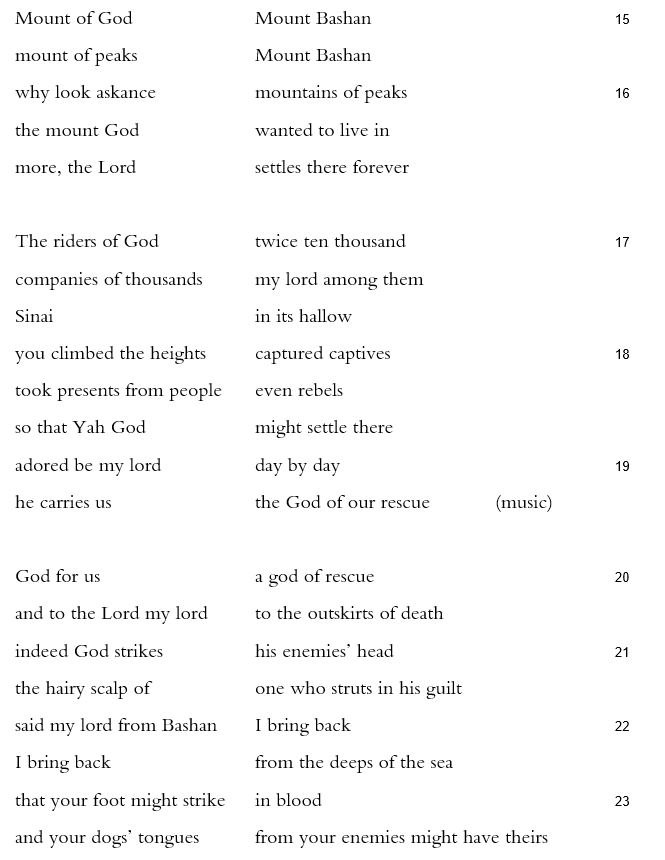
The payoff of these images of settling down and taking flight becomes clear as we approach the center of the psalm. Zalmon—wherever that is—gives way in Stanza 5, verse 15, to Mount Bashan, wherever that is. Either might be a specific place, associated with other deities and shrines: Mt. Zaphon, linked to Baal; Mt. Tabor, Mt. Hermon, Mt. Meron. Or both might be designations for a whole category of mountains notable to biblical audiences for being neither Mt. Sinai nor Mt. Zion, the true mountain homes of Israel’s God, the Lord. The jealous glance of Mount Bashan is met in perhaps the psalm’s most important line by “the mount God | wanted to live in / more, the Lord | settles there forever” (16). The poem doesn’t need to name the mountain where it claims God wanted and continues to dwell.
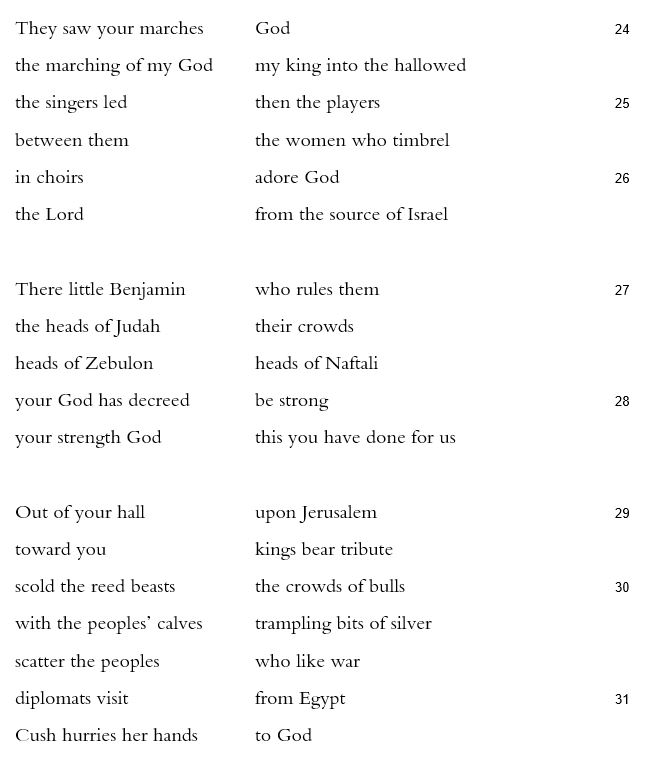
Thus this psalm’s overall organizational logic comes clear. All of God’s movement has been purposive, away from captivity towards rescue, away from Sinai and Bashan, towards the processional that leads to Jerusalem: “They saw your marches | God / the marching of my God | my king into the hallowed” (24). Stanza 6 names Sinai, but its description could equally well refer to Zion: “you climbed the heights | captured captives / took presents from people | even rebels / so that Yah God | might settle there” (18). Stanza 7 names Mount Bashan, but it’s syntactically ambiguous whether Bashan is where “my lord” speaks, or whence he “brings back” (22). Stanza 8 identifies liturgical roles (“the singers led | then the players / between them | the women who timbrel” 25), while Stanza 9 names tribal leaders “little Benjamin… the heads of Judah… heads of Zebulon | heads of Naftali” (27), mapping land from south to north. Stanza 10 names Jerusalem at last: “Out of your hall | upon Jerusalem / toward you | kings bear tribute” (29). The exact meanings may be unclear—what are “the reed beasts | the crowds of bulls / with the peoples’ calves | trampling bits of silver” (30)? Are these symbols? rites? idols? Still, the shape and direction are obvious. Others’ sacred mountains, their practices, their peoples and their gods, all of these are shown Jerusalem, which has dislocated them all.
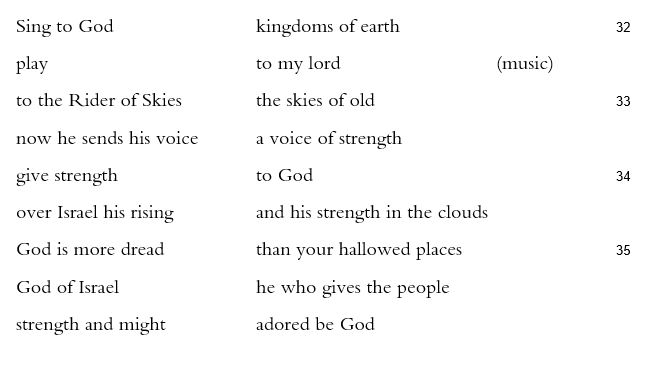
“Sing to God | kingdoms of earth,” the final stanza begins (32), but its two key points come later. First, in verse 33, there is an important opposition between what was and what is. “The Rider of Skies | the skies of old / now he sends his voice | a voice of strength.” That “now” is the word hein, “behold,” which marks a rupture in space or time. What differs from the mountains and gods of the past and the mountain and God of now? There’s a clue in the psalm’s shift from the repeated word “face” in the first verses of the poem (1, 2 x2, 3, 4, 7, 8 x2) to the repeated word “strength,” used in the final verses (28 x2, 33, 34 x2, 35). The face of God was Sinai; Zion is a voice of strength. Visual encounter has ceded to orality, the power of voice.
The second key point of the psalm’s last stanza appears in one of its many hard-to-render lines: “God is more dread | than your hallowed places / God of Israel | he who gives the people | strength and might” (35). Most translations miss the comparative element, opting instead for something like “O God, [thou art] terrible out of thy holy places” (KJV). It’s easy to miss the comparison, because why would God be compared to God’s holy places? But “God” here (‘elohim) does not equal “God of Israel” (’el yisr’ael), as indeed “God” did not in verse 8: “at the face of God | Israel’s God” (’elohim ’elohei yisr’ael). Missing this leads to—or results from—a misreading of the entire psalm. All of the hallowed places of neighbors across the map—Sinai, Zalmon, Bashan, even Jerusalem—are less to be reverenced than God, which the psalm asserts as the God.
No other psalm names God this often. Even in the so-called Elohistic Psalter (Pss 42-83), it stands out. ‘Elohim appears 25 times, ‘El 5 times, YHWH and Yah only 3 and 2 times. This naming is so insistent it asks to be understood. In a psalm that spends so long dislocating and relocating, dwelling and moving, a psalm that replaces presence with power, the naming of God serves a similar function: it displaces other Gods, other names. Its potent ambiguity is to be both plural and singular, all of the deities and one of them. Baal is subsumed—the Rider of the Clouds. Shaddai is subsumed. Even Yah, the Rider of the Skies, is absorbed. The gods are taken into God, even as the diplomats who visit from Egypt and Cush. In the process they become “bits of silver” or are taken into God, whose defining trait in this psalm is strength.
 The Book of Psalms