(director: of David, to remember)
* * *
This brief psalm is almost identical to Psalm 40:13ff. This fact raises a number of questions. Why repeat? Why repeat lines from near the end of the first collection in the Psalter (Psalms 1-41) here, near the end of the second collection (Psalms 42-72)? (Note that 40 and 70 also quote or are quoted by Psalm 35.) Differences between the two versions are slight, but what might they mean?
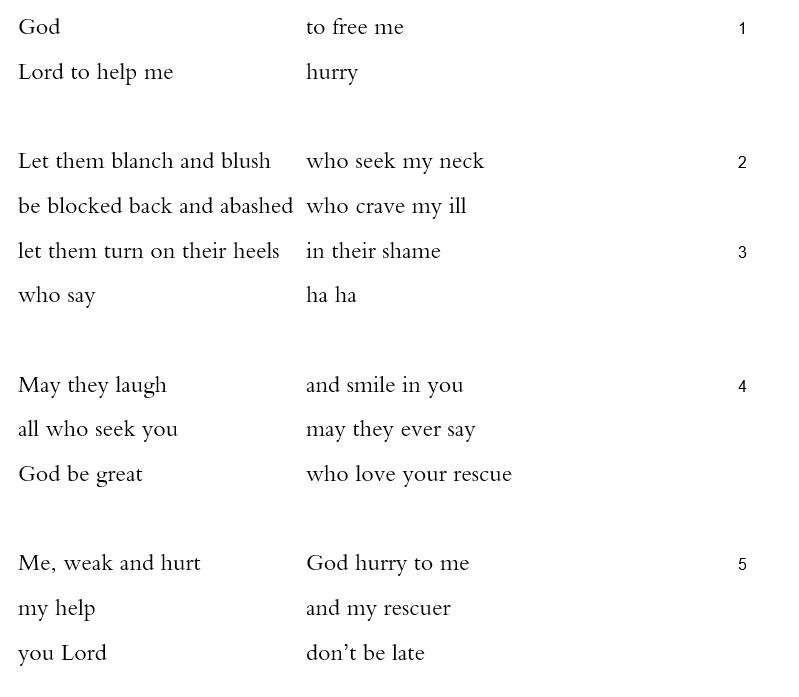
First, it’s clear that this version holds together well. It’s two stanzas of urgent imperatives— God told twice to hurry (1,5)— surrounding negative wishes for those “who seek my neck” (2) and positive wishes for those “who seek you” (4). The central contrast is between the bad, “who say | ha ha” (3), and the good, “may they laugh | and smile in you” (4), two kinds of laughter.
Large-scale repetition like this, reproducing several verses nearly verbatim, would seem to be a structural device, though its purpose is unclear. It’s worth noting that Psalm 39-41 and Psalms 69-71 bear several similarities, combining laments and pleas with consolations. In each case, these lines appear at the center of the three-psalm unit. Perhaps their distillation of the scene of rescue concatenates the themes. Perhaps the two units served some special liturgical purpose. Or perhaps one was intended to echo the other, though to what end is conjecture. Plenty of scholars express confidence that these lines would have been spoken by a king or by a priest, the scholars purporting to date them. For such claims, evidence is undermatched.
The last word in the psalm’s superscription— it could easily be the first word of the text of the psalm itself— is “to remember,” which is ambiguous. Who is to remember? God? The psalmist? The community? Is this evidence that Psalm 70 “remembers” Psalm 40? Does one Psalm revise the other? The common theory that the Elohist Psalter “suppressed” the Lord’s personal name and replaced it with “God” doesn’t seem to hold here. Both versions use the names differently, but the same number of times. Do we have two separate traditions, marked by regional or some other variation? What’s the difference, for instance, between teshuahtekha in 40:16 and yeshuahtekha in 70:4? The semantic range is hard to distinguish. The rest is speculation.
 The Book of Psalms