(an Asaph lyric)
* * *
The central collection of psalms in the Psalter (Pss 73-89) begins with this meticulous, searching lyric that is wise beyond years and ahead of us all. Its narrative of transformation is held together by a cluster of cues. They shape its discoveries and underscore its contrasts.
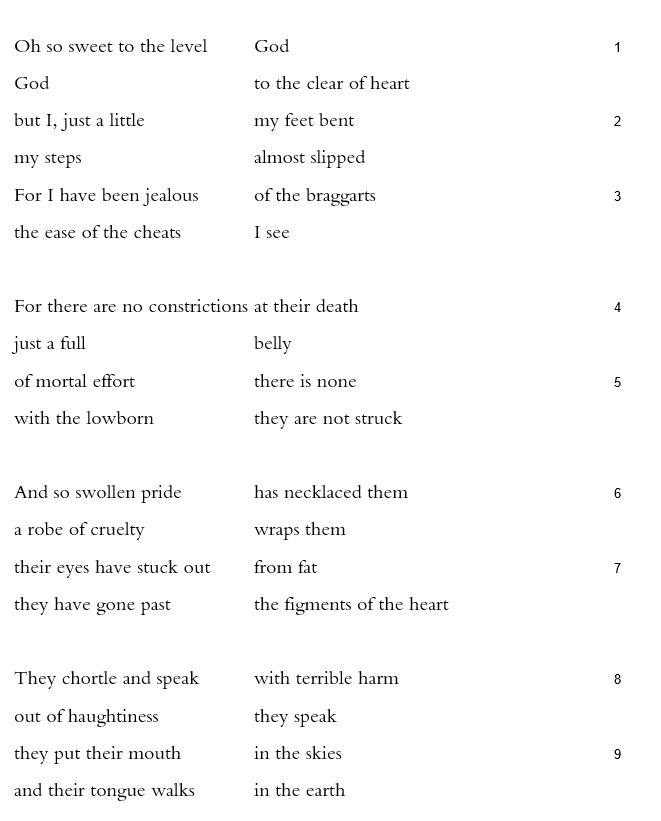
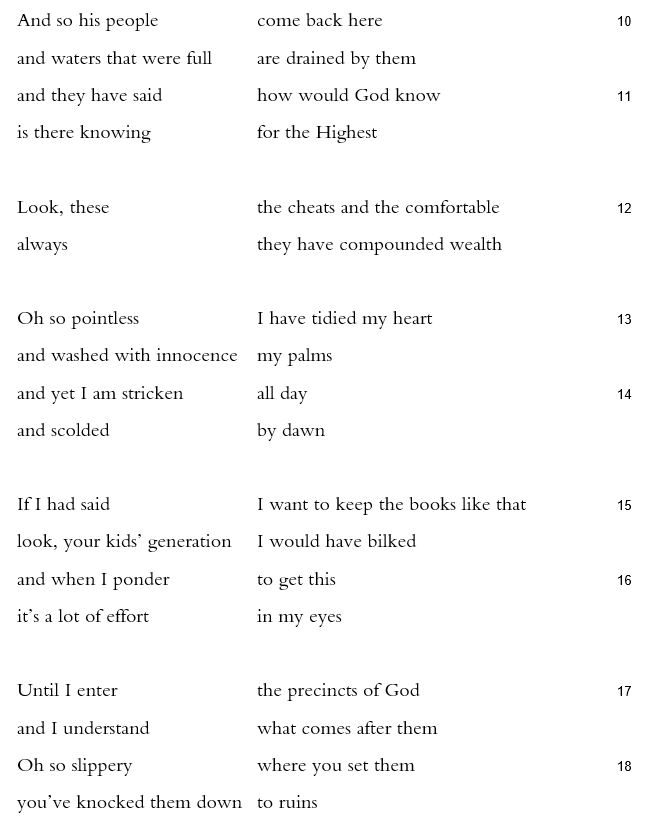
The basic story is easily told. God may be good to the “level” and “clear of heart,” the speaker begins, but she herself is half a step from falling from upright. Her stumbling comes from seeing two fatal flaws in the theory of retributive justice. The first is what to do when good things happen to bad people. She describes cheats: their excess of ease and their swaddles of fat and unkindness choke and enrobe them (4-7). Their devouring of the common goods of speech and water is captured by the startling image of a mouth stretching to the skies while a tongue drags on the ground (8-11). Against these “the cheats and the comfortable” (12), the speaker resents her own situation, the second flaw of retributive justice, what to do now that bad things have happened to her, despite her having “tidied my heart / and washed with innocence | my palms” (13).
Two whole systems are indicted here, hoarding and piety, in which bad people accumulate riches while the good instead care about their own cleanliness.
If I had said | I want to keep the books like that
look, your kids’ generation | I would have bilked
and when I ponder | to get this
it’s a lot of effort | in my eyes (15-16).
The precision of this accounting imagery comes from the Hebrew verbs of verse 15: ’asapperah and bagadeti, “let me tally” and “I had deceived.” In one move, the speaker exposes the lies of the balance sheets of the wealthy, who compound capital at the expense of the next generation, as well as the lies on the balance sheets of any theodicy that links morality and wealth. The effort (`amal, 16) of understanding these injustices of acquisition and ideology contrasts with “mortal effort” (ba`amal enosh, 5), which the bad never face. The numbers just don’t add up.
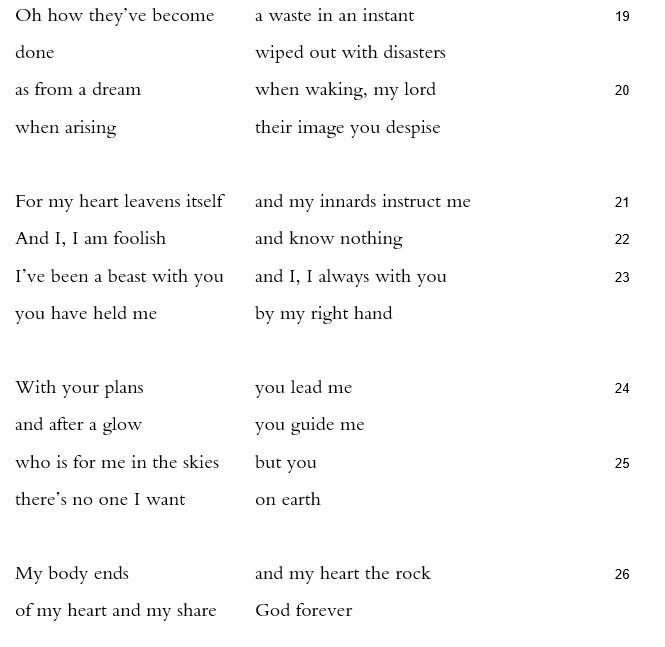
In verse 17, however, the speaker finally starts to understand what she sees. An aftermath faces “them,” a plural “they” who are most likely “the cheats and the comfortable” from verse 12, though the nearest plural noun is “precincts of God” (or “sanctuaries,” miqdeshei-’el). The rest of the poem completes the speaker’s tale. She who had almost slipped because of her jealousy at the ease of the cheats now realizes it is “Oh so slippery | where you set them / you’ve knocked them down | to ruins” (18).
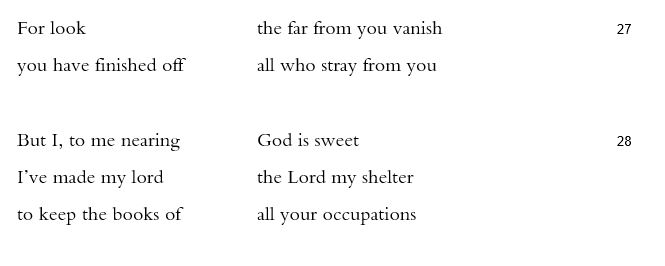
By the end of the psalm, her transformation is complete. Having begun with the sentiment that God is “oh so sweet to the level” (1), she ends perceiving that “to me nearing | God is sweet” (28). Proximity displaces piety. Having exposed the awful accounting by which the unjust affluent take all the marbles, leaving nothing for the just or the children to come, she comes unto “the Lord my shelter / to keep the books of | all your occupations” (28).
The details of the speaker’s realization are trickier to parse than the overall story. What exactly has she learned? She’s no longer jealous of cheats because of “what comes after them” (17), a fate that is gestured at, though it’s clearly not good. “Oh how they’ve become | a waste in an instant / done | wiped out with disasters” (19). Her overall indictment of injustice seems solid. Nothing in the second half of the poem contradicts the points she has made against the cruelty and pride of the rich. Rather, what she’s realized has something to do with her perception of the presence of God, the futility of absence from God, and a sense of the limits of life and of knowing.
Two passages in her coming to awareness are especially profound. The latter is verse 26: “My body ends | and my heart the rock / of my heart and my share | God forever.” That’s beautifully blurry. Is it the body only that ends, while “my heart… and my share” IS God forever? This reading splits the speaker inside and out. It relies upon reading the first vav, the vav before the first “my heart” as a “but”—“my body ends | but my heart…” Or is the second vav contrastive? My body ends, flesh and heart, the stone of my heart, “but my share | is God forever”? This second reading splits the speaker’s personal life from her legacy, which lasts with God forever. Or, finally, the contrast might lie between everything before “God forever” and “God forever”: all of me comes to end, my heart and my share, but God is forever. The text itself does not decide.
The other passage that is deep and wise also concerns the heart.
For my heart leavens itself | and my innards instruct me
And I, I am a fool | and I know nothing
I’ve been a beast with you | and I, I always with you
you have held me | by my right hand (21-23).
The action of the heart and the “innards” (lit. “kidneys”) occurs in two reflexive verbs that are simultaneously precise and ambiguous. What happens in the speaker’s heart or mind is a fermenting, not really a grieving or a bittering: chamets refers to a yeasting action, and in the reflexive stem the figure is of the heart lifting itself through a patient rise. What happens in the speaker’s innards is a piercing (shanan), a particular piercing used reflexively only here. The most frequent use of the verb, in the qal stem, is used for the sharpening of arrows, a kind of whittling, whetting action. But the most famous use of the verb, in the pi’el stem, is in Deuteronomy 6, in which it also follows the word “heart”: “And let these words be, which I am commanding you today, in your heart, that you instruct them to your children…” (Deut 6:6-7). Thus here, the speaker is simultaneously internally soured and struck, enlivened as dough and taught. These doubled reflexive verbs give way to doubled attention to the speaker as a subject. “And I” (ve’ani) opens both verse 22 and verse 23, where it contrasts the speaker’s animal nature—“I’ve been a beast with you”—with the Lord’s presence—“you have held me | by my right hand.”
Powerfully, the ve’ani construction shows up twice more in Psalm 73, in one of several repetitions that organize the poem. The “but I” in the psalm’s third line is matched by the “but I” in the psalm’s third-from-the-last line, heightening the speaker’s transformation and revealing the poem’s large-scale chiastic shape. The word “sweet” (or “good”) is also repeated at the beginning and end, in connection with a double naming of God—’el and ‘elohim in verse 1, ‘elohim and adonai YHWH in verse 28. Other repetitions include the “Oh so” (akh) interjection in verses 1, 13, and 18, and even 19 (’eikh), which contrasts the supposed merit of piety, “Oh so sweet,” with the speaker’s critique, “Oh so pointless,” with the unforeseen outcome facing the cheats, “Oh so slippery | where you set them” and “Oh how they’ve become | a waste in an instant.” Four verses begin with “For” or “Oh” (ki): 3 and 4 in the first half, 21 and 27 in the second. Two verses (6 and 10) begin with “and so” or “thus” (lakhen). And there are three iterations of hineh, in verse 12 (“Look, these | the cheats and the comfortable”), verse 13 (“look, your kids’ generation”), and verse 27 (“For look | the far from you vanish”). These structures overlap in a poem that never answers its own unanswerable questions: “how would God know / is there knowing | for the Highest” and “who is for me in the skies | but you.”
Maybe God knows, but the speaker certainly does not. And probably no one is “in the skies | but you.” In any event, what matters to the speaker is not “what comes after them,” the bad, but nearness, the presence of the present.
 The Book of Psalms