(director: to The Witness Lilies, an Asaph lyric)


* * *
Two images govern Psalm 80: the grapevine, an extended figure for Israel that’s common in the former and writing prophets, and the face, which shows up seven times throughout the psalm, sometimes obvious, sometimes hidden. Other metaphors arise, to be sure, tropes for leadership like “shepherd… leading Joseph like a flock” (1) and “your right hand,” doubled in verses 15 and 17. There is “the bread of tears,” in a line that appears to one-up— or, rather, to three-up— a line from Psalm 42: “and you make them drink | tripled tears” (5; cf. 42:13). And there is that particularly lyrical quatrain within the longer conceit of Israel as a grapevine:
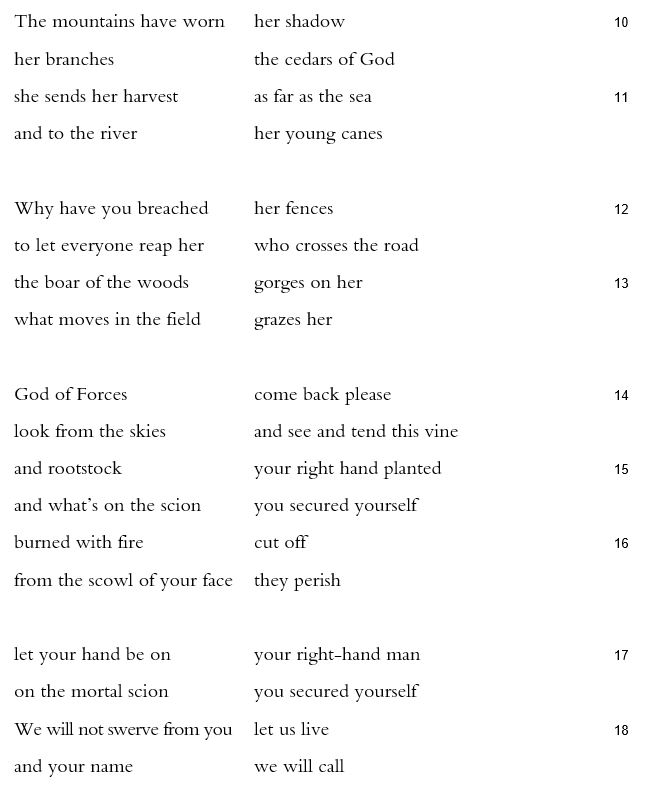
The mountains have worn | her shadow
her branches | the cedars of God
she sends her harvest | as far as the sea
and to the river | her young canes (10-11).
Despite the vertical mountains and cedars, the stanza is thoroughly horizontal, from the shadows and branches to the sea and the river, even to the left- and right-branching canes from which new growth comes. The images grow and spread as the stanza moves from the perfect-form “have worn” to the imperfect-form “sends.”
The vine takes over the whole psalm. A trope becomes a symbol before our eyes, as so much of the plant is used: transplanted rootstock (8-9), spreading branches and canes (10-11), plundered fruit (12-13), and especially the scion, that “son” (ben) of the vine, the grafted part that leafs out and flowers and bears fruit) 15-17. It’s a productive metaphor, one that rewards the attention the psalm gives it. Through it, Israel’s history is retold. The grapevine comes from Egypt to a land where room must be made—the imperfect form of “you bring” and “you displace others” generates an immediacy that ought not be lost. Israel the vine spreads, only to have her barriers broken through. Later, when the valuable fruiting parts of the vine have been destroyed, it is the grafting that matters most:
look from the skies | and see and tend this vine
and rootstock | your right hand planted
and what’s on the scion | you secured yourself
burned with fire | cut off
from the glare of your face | they perish (14-16).
Importantly, the vine has not been uprooted entirely. To bear fruit, it needs a new scion. Verse 17 identifies the vine as a “he,” the ben that is a ben, human offspring, to be grafted onto the rootstock that remains: “let your hand be on | your right-hand man / on the mortal scion | you secured yourself” (17). In its own way, the closure of Psalm 80 celebrates non-Ephraimite leadership every bit as much as does the closure of Psalm 78. While Psalms 78 and 79 both culminate with shepherding (78:70-72; 79:13), Psalm 80 begins with a pastoral image only to leave it behind for something more rooted, more placed. And yet the psalms together call for a kind of leadership by grafting, new shoots to come from old stock.
It’s both the promise of fruit to come and the literal phrase in verse 17 rendered here as “the mortal scion” that allow Psalm 80 to be read not just metaphorically but allegorically, not just symbolically and prophetically but eschatologically. The phrase ben ’adam has a rich history in the Bible, most often associated with the books of Ezekiel and Daniel (used nine times in Ezek 2 and 3 alone, nearly ninety times in the entire book; cf. Dan 10:16, 18). But the phrase appears almost always without apocalyptic significance (e.g., Ps 33:13, Gen 11:5, KJV: “the children of men”; cf. Gen 6:2,4 “daughters of the adam”; Ps 107:8, 15, 21, 31, Num 23:19, Job 16:21).
The afterlife of that term, ben ’adam, “son of man,” and the development of apocalyptic literature lends this particular psalm eschatological significance for some readers—the burning, the cutting off, the son of man seated at the right hand. For its earliest audiences, however, the oblique reference to “let your hand be on | your right-hand man / on the mortal scion | you secured yourself” would have been read not as code for the end of times, but as a call for immediate rescue by a human liberator touched by the hand of God.
Ultimately, however, what Psalm 80 cares about most is God’s face . The refrain asks God in various names—God (3), God of Forces (7), Lord God of Forces (4, 19)—three times to “bring us back / shine your face | and let us be rescued.” To these three desired appearances of God’s face is contrasted the other explicit use of the word “face,” verse 16’s mention of “the scowl of your face” as the cause of the death of the scion: “burned with fire | cut off / from the scowl of your face | they perish.” It is not that God’s face is absent. The light of God’s face is not shining.
In two other places, the word “face” takes on other meanings. First, it’s in the dead metaphor “before” in “gleam before Ephraim | and Benjamin and Manasseh” (1-2) where a face is again associated with shining. Here, however, it’s a face wanting to be shined upon. And finally, the root paneh for face appears twice in a row in verse 9, pinnita lefaneha, “you’ve cleared away | away from her.” The “away | away” repetition tries to capture the verbal play of the original, which has to do with turning. The word “face” in biblical Hebrew always carries a trace of its root meaning of turning— as in the English phrase “let’s face it.” Shrewdly, strangely, Psalm 80 links its two main images here near the middle of the psalm, with the turning of the faces in the soil, part of the act of making room for the vine’s roots to root. Motion towards meets motion away, and in the dark adamah, the ground, is the face-to-face that must shine if the vine will again bear fruit.
 The Book of Psalms