(director: of the Qorachites, a lyric)
* * *
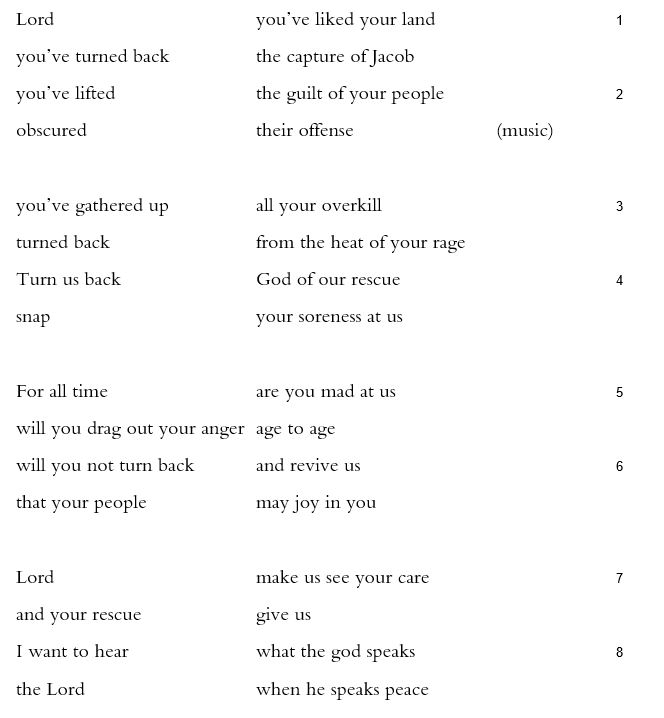
If the frequency of keywords matters to a psalm’s meaning, Psalm 85 cares most about “turning.” So do many biblical narratives– from Jacob and Joseph to Moses and Balaam, to Ruth and David– and poetry throughout the Prophets and Writings. The root shuv is used five times here, all in the first four of seven stanzas. Having “turned back | the capture of Jacob” transitively and intransitively “turned back | from the heat of your rage,” God is urged in an imperative to “turn us back” (1, 3, 4). The final two uses of shuv are wishes, one for God, one for the people, introduced by adverbs of negation: “will you not turn back | and revive us” and “let them not turn back | to foolishness” (6, 8). In other words, a central biblical story is retold here in brief: past rescue leads to a call for present and future rescue—a call, a hope, a fear, a “will you not”—all of which is followed by an obligation that seems spoken by God: I will turn if they will turn. And so it fits that the fivefold use of “turn” in the first two sections of the psalm, stanzas 1 and 2, and stanzas 3-5, is woven through with the threefold use of “people” (2, 6, 8) and of “rescue” (4, 7, 9).
From the middle of the psalm to the end, however, the keywords that repeat are abstractions like “care” (7, 8, 10), “peace” (8,10), “faithfulness” (10,11), and “justice” (10, 11, 13). These words don’t just repeat. They are actively, vividly brought together as they will be several times towards the end of Book 3 of the Psalter (Psalms 86, 88, and 89):
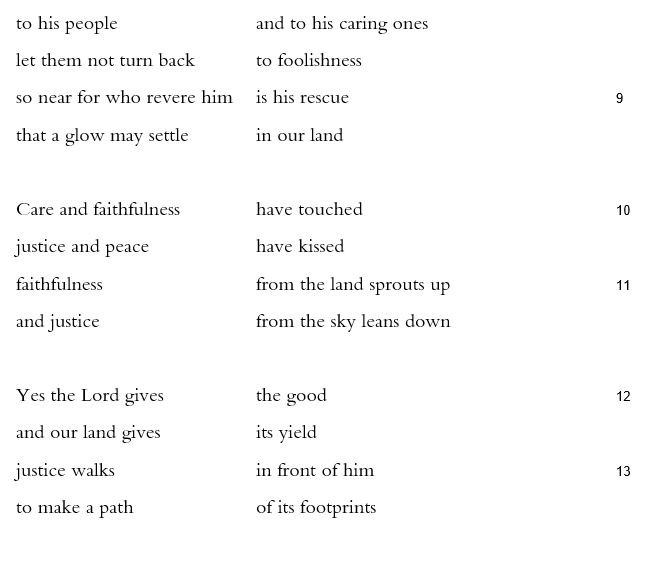
Care and faithfulness | have touched
justice and peace | have kissed
faithfulness | from the land sprouts up
and justice | from the sky leans down (10-11).
Care and peace, chesed and shalom, have been named already in the psalm’s central stanza. There is care, which the speaker wants the Lord to make visible. And there is peace, which she wants the Lord to speak, not just “to his people” but to “his caring ones” (8). The beauty and power of chesed and shalom is that they are relational: the Lord’s care is visible and audible in the chasidav, the ones who care and are cared for. In other words, when “care” and “peace” drop out of verse 11, in Psalm 85’s second-to-last stanza, it’s not because we don’t know where they come from but because we already do. If care and truth/fidelity/faithfulness touch, and faithfulness “from the land sprouts up,” then care must come down from above. If justice and peace kiss, and justice “from the sky leans down,” peace must operate from the bottom-up. What began as a psalm of turning becomes a psalm of encounter. What began as a request for rescue becomes a wish to see care and hear peace, which becomes a meditation on horizontal and vertical axes of fidelity and justice.
Of these four principles, it is justice that the last stanza focuses on. While verses 10-11 move from the horizontal to the vertical plane, verses 12-13 reverse course. Verse 12 is down and up: “Yes the Lord gives | the good / and our land gives | its yield.” Verse 13 returns to the horizontal as it returns to the image of walking from the previous psalm: “justice walks | in front of him / to make a path | of its footprints.” The psalm ends with that singular possessive pronoun attached to “footprints,” an ambiguous pronoun that can refer to the Lord or to justice, which deepens (lengthens?) its power. The Lord walks behind justice, his footprints justice’s. In a psalm that calls for the Lord to rescue people and to reveal care and peace, the arrival of justice anticipates and signals.
Similarly open-ended is the center of the psalm, the turn itself, the wish: “I want to hear | what the god speaks / the Lord | when he speaks peace” (8). Everything from “what” to “when” is strange: mah yedabber ha’el YHWH ki yedabber. The construction ha’el YHWH is unique, “the god the Lord,” a kind of backwards version of the common “Lord God,” YHWH ’elohim. Because the interrogative mah and the conjunction ki always have tremendous semantic range, the speaker’s desire to hear extends from how or what the God Lord speaks, to oh how he speaks, to whether he speaks. It’s a remarkable stretching of meaning that includes everything from a confident assertion (“I want to hear the powerful Lord speak for oh! he speaks peace!”) to a textual garble to a wonder or worry (“how does El speak the Lord if he speaks?”)
In addition to the keywords named already, both “the Lord” (1, 7, 8, 12) and “the land” (1, 9, 11, 12) are named four times. It may not be possible to pin down a single meaning at the heart of Psalm 85. It is possible, however, to see and hear pervasive significance in the meetings of the Lord and the land, from the favor shown in the past (1) to the desired “glow,” the kavod that the speaker hopes “may settle | in our land” (9), to the visionary sprouting up and pouring down of fidelity and justice as the Lord gives and the land gives and in between a path is made.
 The Book of Psalms