(of the Qorachites, a lyric, a song)
* * *
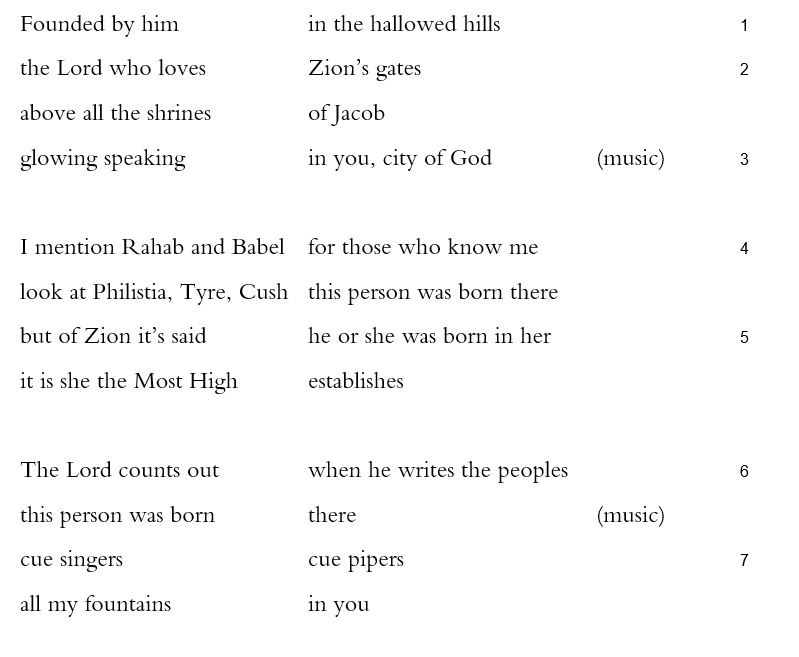
Readers often miss the cohesion and singular pleasures of the taut Psalm 87. Its structure is meticulous and not, as many scholars have long proposed, a mess: “badly injured… the half-verses have been torn apart and senselessly coordinated” (Kraus II 184). The psalm depends most significantly on prepositions and pronouns, most significantly the three that nestle in Zion: “in you” (3), “in her” (5), “in you” (7).
The first stanza begins with yesudato, an exact word impossible to get fully and succinctly in English, a feminine passive participial noun with a masculine possessive suffix: literally, “his her being founded” or, better “her having been founded of him” (1). From the first word, therefore, we anticipate both a masculine and a feminine antecedent (postcedent, to be technical). It’s not necessary to wait long: both the Lord and Zion are named in the very next line: “the Lord who loves | Zion’s gates” (2a). The tendency of translations to supply the verb “to be” as a linking verb or copula in one or both of these first two lines, or to render participials as conjugated verbs, is impatience at best. The entire first stanza is constructed around a series of five participles: “founded by him” (1), “who loves” (2a) “the shrines” (2b), “glowing speaking” (3). The structure works by delay, as the long left branch of a left-branching sentence. The first stanza is a tidy chiasm, with “her having been founded by him” mirrored by “in you, city of God” at the end of verse 3. The hills of sacredness, “the hallowed hills” of verse 1, parallel “glowing speaking,” matching the two key theological abstractions of qodesh and kavod. Centered in the stanza is the centralization of worship that displaced worship of the Lord from the high places of the north, locating it in Zion.
The second stanza brings the main clause the first stanza delayed: “I make remember,” the Lord says, “for those knowing me” (4a). If you would know me, the line suggests, remember whom I have defeated: Rahab and Babel, conquests early and late. That these two names are followed by three foreign lands—”Philistia, Tyre, Cush”— allows the lands to be read both as further examples of victories and as examples of those whose peoples have come now to Zion. More, however, these peoples are brought up, here near the psalm’s middle, because of a linguistic quirk. For people from these other nations, the idiom is “this person was born there,” yulad sham—a phrase that sounds almost like “Jerusalem” (4b). By contrast, “of Zion it’s said | he or she was born in her,” yulad bakh (5a). The difference is between an impersonal adverb, one that points outside, over there, and a pregnant preposition with a personal pronoun, one is born with her, of her, by her, in her.
The final line of the second stanza does multiple things. It repeats the third-person personal pronoun hu’, which fits all genders, referring simultaneously to Zion, her, and to any person born in Zion and even potentially to any person born even elsewhere: “it is she the Most High | establishes” (5b). The second stanza thus begins and ends with clauses, active verbs, even as the word “establishes” recalls the metaphor of a foundation with which the psalm began.
Because the first two stanzas fold back so nicely on each other—“establishes” picks up “founded by him”; Zion is named twice (2a, 5a); Jacob’s shrines parallel the names of other nations (2b, 4); “mention… for those who know me” parallels knowing and memorializing with “glowing speaking” while centering “city of God” (4a, 3)—the psalm’s third stanza feels at first like a coda. But that coda transforms our experience of the psalm. We change our mind about the center and the edges of the structure. The foundations and hills from verse 1 now become “fountains,” as do the people born “in you” (7b). Now, too, the “glowing speaking” becomes both counting and writing (6a). It even becomes the singers and the pipers (7a) who shatter the fourth wall, leading to and commenting on the scene of worship. By the end it is Zion who is centered, as the poem’s center has shifted. Its closing word repeats the psalm’s most important preposition + pronoun from the end of the first stanza, “in you.”
 The Book of Psalms