(a didactic of Ethan the Ezrahite)



* * *
The problem that Psalm 89 considers in its sort-of-dialogue— namely, how an unconditional promise that supposedly lasts forever could become both conditional and broken— is already present in 2 Samuel 7 and 1 Kings 8-9, the passages on which the psalm is based. David, having just consolidated power by relocating the Ark of the Covenant in Jerusalem, offers to build the Lord a temple. Instead, the Lord, in a nighttime oracle to the prophet Nathan, promises David a lasting kingdom: “Your house and your kingdom will endure forever before you; your throne will be established forever” (2 Sam 7:16). David’s successor, his son Solomon, does indeed build and consecrate the temple. He prays at length, after which the Lord makes oracular promises similar to those made to his father: “if you walk before me faithfully with integrity of heart and uprightness, as David your father did… I will establish your royal throne over Israel forever… But if you all or your descendants turn from me and do not observe the commands and decrees I have given you… then I will cut off Israel from the land I have given them and will reject this temple…” (2 Kgs 9:4-9 passim). Similar promises, and yet different. How could the Lord vow an eternal throne without condition, only to change the terms of the deal a generation later?
There are a variety of ways to try to solve this puzzle. Certainly, the long Solomon narrative is itself an attempt to accommodate the ideal of a Davidic covenant with the historical experience of siege, collapse, and exile. Perhaps there was no promise? Or maybe the promise was always conditional, or terms like “endure” and “forever,” “kingdom” and “throne” were ambiguous or misread? Or perhaps, as one might argue, eternally unfalsifiably, at any given moment from before the razing of Solomon’s temple to whatever year this is now plus one, destruction was all part of the grand plan of restoration.
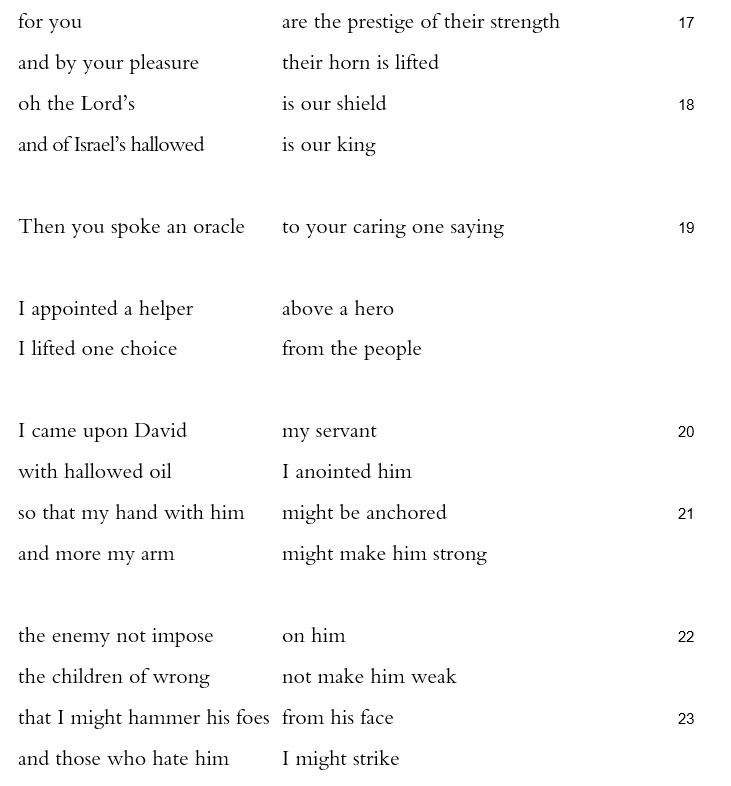
To Psalm 89’s credit, it eliminates easy solutions. Its long central section (19-37) narrates the Davidic “pact”(28, 34, cf. 3, 39) in God’s first-person voice. Its movement is both temporal and outside of time. It begins with the word “then” and a series of perfective verbs, “I appointed… I lifted… I came upon David… I anointed him” (19-20). There follows a torrent of imperfect verbs that express both a historical present, a past subjunctive that reveals a purpose, as well as a present and a future: “so that my hand with him | might be anchored / and more my arm | might make him strong” (21). To translate these in the future tense is to presuppose a solution the psalm does not decide on. Later in the series of verbs, the present and future senses do dominate:
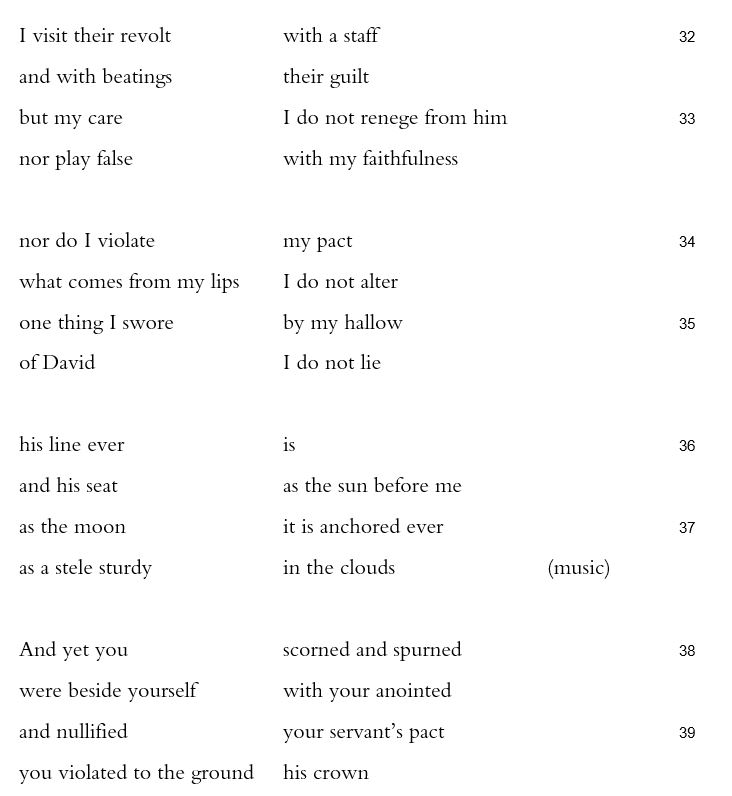
my care | I do not renege from him
nor play false | with my faithfulness
nor do I violate | my pact
what comes from my lips | I do not alter
one thing I swore | by my hallow
of David | I do not lie (33-35).
There is both an eternal present tense here and a sequence in time: having vowed, I do not and will not break my vow. In the Lord’s eyes, in other words, the covenant with David was never broken, is not broken, and never could be broken.
Strategically and structurally, however, this promise is flanked by sections that see things differently, to put it mildly. With the exception of verses 3-4, which introduce the problem, the psalm’s first movement (1-18) emphasizes neither the Davidic promise nor the power of monarchy, but the Lord’s unique power, the Lord’s “care” and “faithfulness” (paired in 1, 2, “faithfulness” alone in 5, 8; “care” paired with “trust” in 14). Eight times, this section names the Lord (1, 5, 6 x2, 8 x2, 15, 18); six times it calls the Lord the emphatic pronoun “you” (9 x2, 10, 11, 12, 17; cf. “your name” in 12, 16). Repeatedly, this first section anticipates vocabulary that will be used in the psalm’s central section, attributing powers to the Lord alone. “Ever and on | I anchor your line / and build age to age | your seat,” the Lord speaks of the pact with David (4), which was done “so that my hand with him | might be anchored” (21). “I appoint his line | lasting / his seat | like the days of the skies” (29); “his line | ever is / and his seat | as the sun before me / as the moon | it is anchored ever” (37). To these points, the psalm’s first section responds in advance: “for I have ever said | care is built in the skies/ you anchor your faithfulness | in them” (2). As with Psalm 87, the preposition plus pronoun is emphatic: “in them” accents the skies as the seat of power, just as “yours” (lekha 11 x2, 13 ) accents the Lord. About halfway through its first section, in verse 9, Psalm 89 turns to God’s acts of power, extending them throughout history, far earlier than a mere monarchy, and lifted far farther above. Verse 11 begins a pair of stanzas that more pointedly exalt God and sideline David: “Yours the skies | and more yours the earth” becomes
Yours is an arm | with might
your hand is strong | your right hand is uplifted
justice and law | the anchor of your seat
care and trust | precede your face (13-14).
The first section culminates with its most antimonarchic stanzas. Instead of to a king, verses 15-18 turn to the people. It is the people who joy, who “are lifted” (16), and it is the Lord who does it all: “by the light of your face… by your name… by your justice… and by your pleasure” (15-17). “Oh the Lord’s | is our shield / and of Israel’s hallowed | is our king” (18), the section ends, suggesting that the Lord alone is Israel’s king.
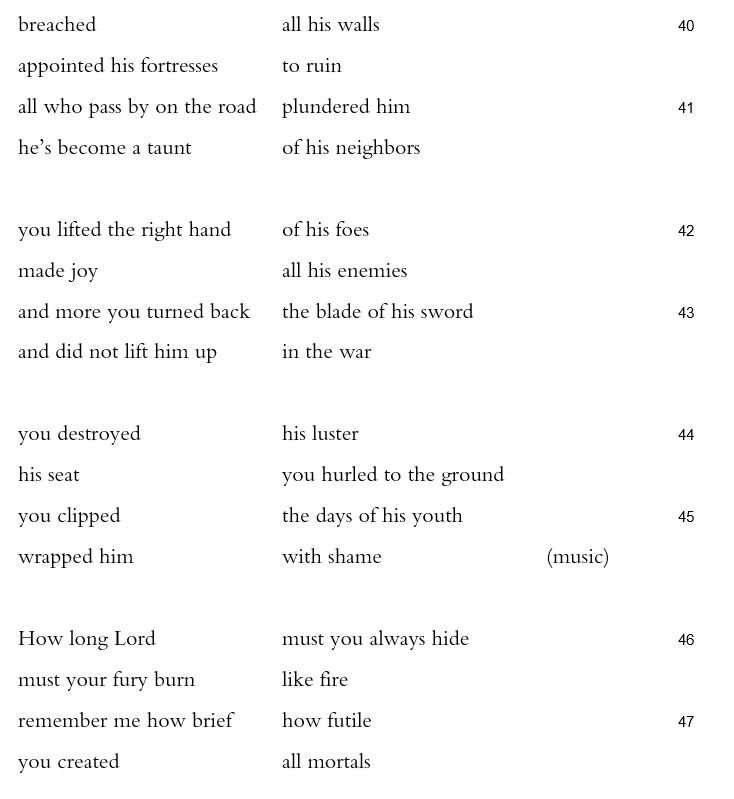
The psalm’s third (38-45) and fourth (46-51) sections are not nearly so ambiguous. The third section counters the center section’s imperfect verbs with perfect forms, emphasizing past evidence over present claims. Despite the Lord’s promise to David, the third section says with some ire,
And yet you | scorned and spurned
were beside yourself | with your anointed
and nullified | your servant’s pact
you violated to the ground | his crown (38-39).
Again, language from the psalm’s central section is quoted and undermined. “His seat,” which is “lasting… like the days of the skies” according to 29 and “as the sun before me” according to 36, is pointed to in verse 44: “his seat | you hurled to the ground” (44). In some cases, even claims from the first section are undercut. In verse 42, for example, “you lifted the right hand | of his foes” belies both the promise— “I anointed him / so that my hand with him | might be anchored” (21) and “that I might hammer his foes” (23)— and the praise— “your hand is strong | your right hand is uplifted” (13). There is here no attempt to explain away the puzzle of a broken covenant. In this respect, Psalm 89 is a kind of Job in reverse, a speech from Elihu, a speech from whirlwind, followed not by Job’s relenting, but by his complaint.
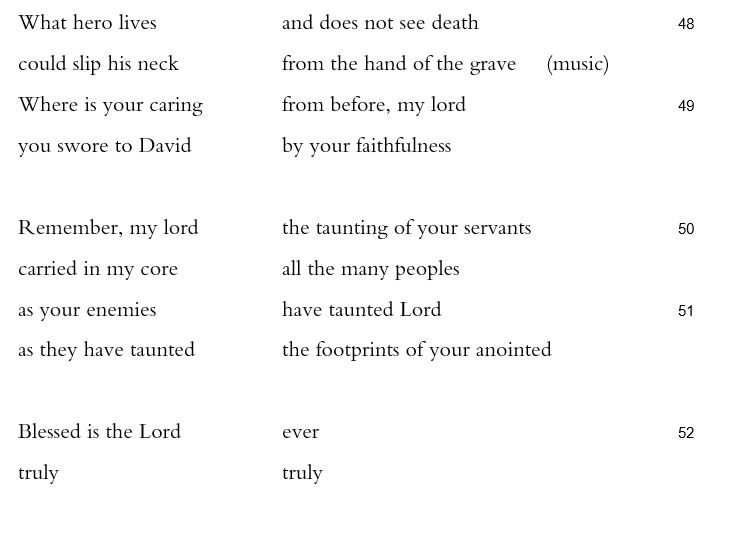
The psalm’s final section consists of hard questions, a pair of calls to remember, and a lingering image that can be read in different ways. The questions form a chiasm, two outer questions about God’s absence (46, 49) surrounding an inner, doubled question: “What hero lives | and does not see death / could slip his neck | from the hand of the grave” (48). The question, given the psalms that precede and follow this one, Psalms 88 and 90, and given the facts of existence, seems rhetorical: no one lives and does not see death. For readers inclined to messianic eschatologies, however, the question seems to offer a secret, prophetic solution that can be pulled out of context from this part of the psalm: there must be some son of David who could “slip his neck | from the hand of the grave.” And yet the call to remember that precedes this question weighs against this reading: “remember me how brief | how futile / you created | all mortals” (47). And yet— yet another “and yet”— the psalm ends with an image, a phrase, that works in multiple directions: “the footprints of your anointed” (51). Those eager to find hints of messianism in Psalm 89, or just those taken by the center of the poem will see those footsteps as aimed towards a restorative future. Those more taken by the first or third sections will see the image as a haunting from a lost monarchic past. Our reading depends in part on whether we assume the psalm offers answers or poses questions.
Whatever answers the psalm may offer, what matters more seems to be its final articulation of the crucial question. Instead of asking how a permanent pact might have been violated, the final section of the psalm reframes the problem in a way that’s both simple and profound: “Where is your caring | from before, my lord / you swore to David | by your faithfulness” (49). The desire for a new king or a restored past is understandable, but it’s not what matters most. The underlying issues is fidelity, the continuity of care.
 The Book of Psalms