* * *
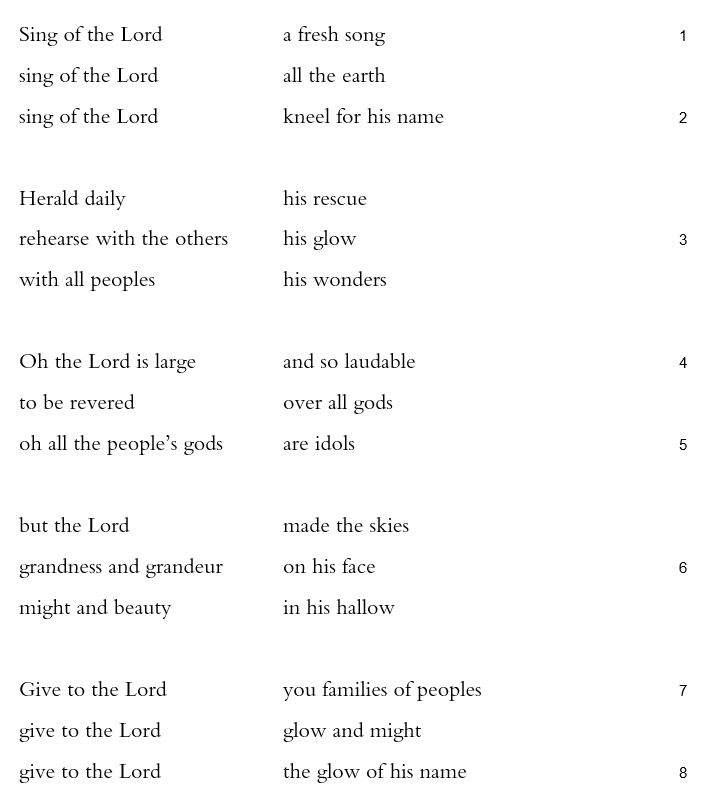
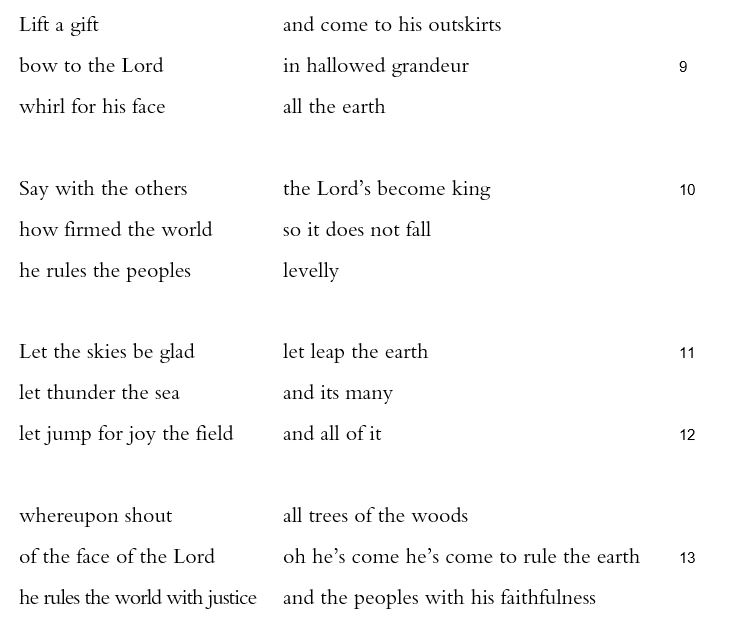
The most joyous of psalms, Psalm 96 builds in imagination until even the trees cry out, ki-va’, ki-va’, “oh he’s come he’s come” (13). Again and again it calls the whole earth (or “land”) to celebrate (1, 9, 11; “the skies… the sea | and its many / the field | and all of it,” 11-12), including all the people of the world (3, 7; “the others” 3, 10). Unlike the psalms that precede it, there is not a sorrow or a hesitation. Unalloyed delight is part of what makes it “fresh” (96:1; cf. 33:3, 40:3, 149:1; 98:1, 144:9).
The psalm’s formal features are a particular pleasure. This translation sees nine tercets, arranged as two sets of four tercets plus a coda. That is, there are two twelve-line groups plus a three-line envoi, with all the numerical satisfactions that come from twelve-line groups that work as two sets of six, or three quatrains, or four tercets. Rhythms overlap in enjoyable ways. Psalm 96 lends itself to rediscovery.
Its most evident parallel is between the triple imperative “sing” (1a, 1b, 2a) and the triple imperative “give” (7a, 7b, 8a), each of which ends with “his name” (2a, 8a). Three more imperatives promptly follow the “sing” verbs—“kneel for his name/ Herald… rehearse” (2-3a)—and five more follow the “give” verbs: “lift.. come… bow…whirl… say” (8b-10a), for a total of fourteen imperatives, twelve of which appear at the beginning of a line. These groupings constitute a theory and practice of liturgy, focusing on proclamation in verses 1-3 and on performance in verses 7-10a. The first group gives way to celebration of the Lord’s preeminence “over all gods” (4) and of God’s creation of the skies (5). The second becomes praise of the world’s foundation (10), which stretches from the skies through all the earth:
Let the skies be glad | let leap the earth
let thunder the sea | and its many
let jump for joy the field | and all of it (11-12a).
Both sections name the Lord five times (1a, 1b, 2a, 4a, 5b; 7a, 7b, 8a, 9a, 10a) and say “might” (6b, 7b), “name” (2a, 8a), “face” (6a, 9b; each time near the word “grandeur” 6a, 9a), “hallow”/“hallowed” (6b, 9a), and “all the earth” once each (1b, 9b).
Strikingly, each group of twelve lines makes sense as two six-line stanzas—what worshippers ought to do (1-3; 7-9) and why (4-6; 10-12)—but also as four three-line stanzas: repeated imperatives (1-2a, 7-8a), extended imperatives (2b-3, 8b-9), the Lord and the cosmos (4-5a, 10), the Lord and the created world (5b-6, 11-12a). Even more impressively, the sets work almost as well as three four-line stanzas (1-2, 3-4, 5-6; 7-8, 9-10b, 10c-12a), with subtle shifts of emphasis.
No matter how we parse its lines, the psalm closes not just by calling back features of both sections such as the Lord’s name and face (13a), but by extending the second section and revealing it to be an extension of the first. The shouting trees, in other words, are an instance of the earth’s joy, which is of a piece with the glee of the skies, all part of the logic of creation. That key term ’az at the start of the final three lines (“whereupon” in this translation) is the poem’s “therefore” as well as its “at that time” and “in that way” and “in that place.” It is not primarily a marker of the future, let alone some far distant eschatology, as some interpret this psalm, diminishing it. Those trees are not prophets of eventual end-times. They sing in the choir, now, full-throated participants of a world ruled “with justice… and with his faithfulness” (13b).
 The Book of Psalms