* * *
Of the three “Lord king” psalms (with Psalms 93 and 99), Psalm 97 is the most jarring, especially when its verb forms are rendered accurately, darting back and forth from completed actions to continuing ones. Like the psalms that immediately precede it, it considers how the Lord’s ascendancy affects the rest of the world. Divine enthronement, it suggests, has always been part of the fabric of the created world. Rather than expressing apocalyptic eschatology with its storms and stress, Psalm 97 points from the past to the present tense, not to future judgment but to worship.
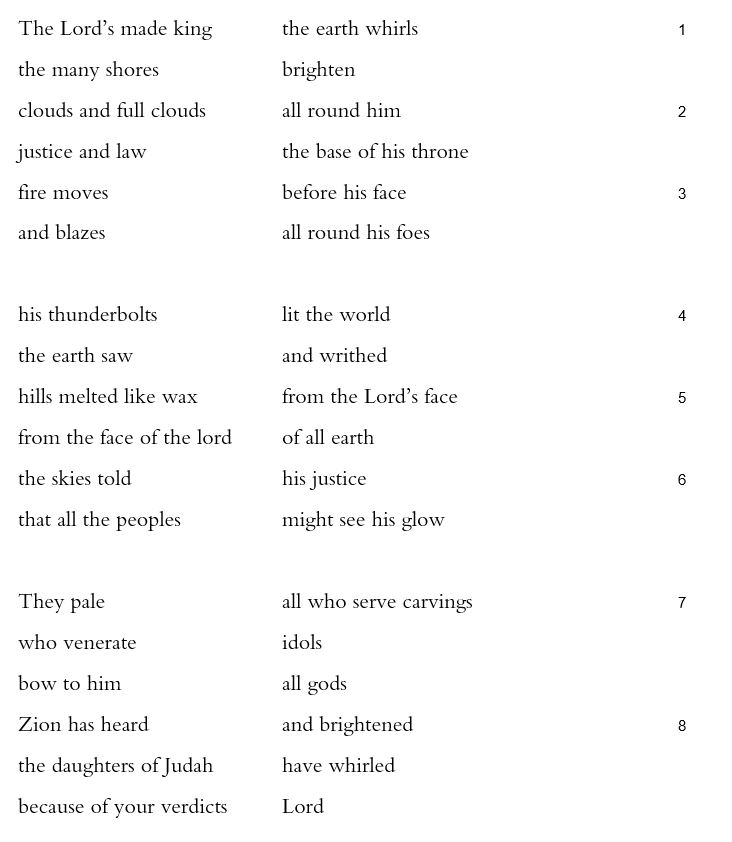
The important images of the psalm radiate. The Lord having been crowned, the land responds outward: “the earth whirls / the many shores | brighten” (1). Both gil (“whirl”) and samach (“brighten”) signify joy, but by different figures: the earth’s joy is its circling around, the joy of distant shores is to be made bright. (I know it’s not a given that the root samach conveys turning bright, or that it does so in more than a residual, etymological way, just as the word “glad” descends from roots that mean “gleam” without our ever thinking about it.) Verses 2 and 3 portray the encircling, spreading movement of the Lord’s nimbus, that aura of the throne with its fire that consumes enemies, all moving outward from the “justice and law” on which the throne rest in vivid visual metaphor.
The second stanza (4-6) similarly moves outward— again, from the light of the Lord’s face (3, 5). It moves now not as fire but as lightning. These verses, however, are all cast in the perfect tense as completed action. A reader could argue that the theophany here is an apocalyptic vision of future events that are seen as completed—“what is determined is done” (Dan 11:36). But the simpler reading, the more likely reading, is that these storms are part of the past, the work of creation. So many of the psalms that surround Psalm 97 appeal to stories of creation. Their point is that, just as the earth “saw | and writhed” at the lighting up of the world (4), so now “the earth whirls.” Just as “the skies told | his justice / that all peoples | might see his glow” (6), so now that the Lord is enthroned, “the many shores | brighten” (1) and fire “blazes | all round his foes” (3). The poem links the beginning with now, not now with someday.
The third stanza, verses 7 and 8, presents the opposing responses of those who worship the Lord only and those “who serve carvings / who venerate | idols” (7). The idolaters “pale,” whereas, like the ends of the earth in verse 1, Zion has “brightened / the daughters of Judah | have whirled” (8). More to the point, because of the Lord’s coronation, Zion IS the earth; the daughters of Judah—Jerusalem’s townships—ARE the earth’s many shores.
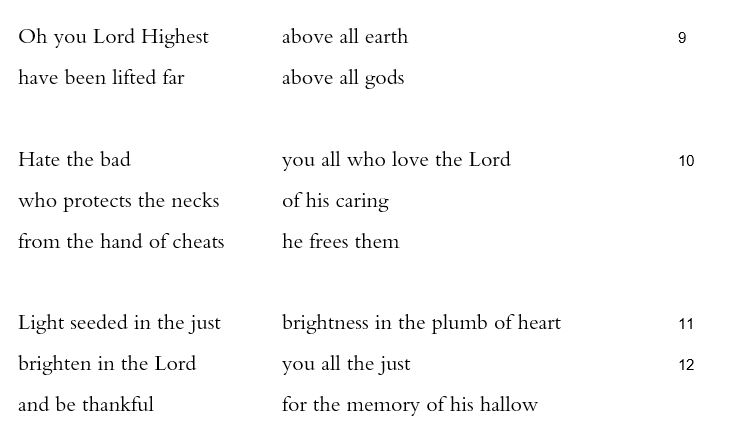
Verses 9 and 10, direct, clear, and relatively uncomplicated, announce the twin covenantal principles of the Lord’s realm: exaltation as Highest over earth and gods; and protection from the bad of the Lord’s caring and cared-for.
The last three lines of the psalm convey these principles more interestingly, picking up on the radiant imagery of the first three stanzas: “Light seeded in the just | brightness in the plumb of heart / brighten in the Lord | you all the just” (11-12a). All of that light from the fire and lightning of God’s face, which has spread around the world, is sown in those who are just. It shines in the joy of the morally upright, the level, the “plumb of heart.” Justice, too, has reached from the base of the throne to the very skies, only to be planted within.
 The Book of Psalms