(lyric)
* * *
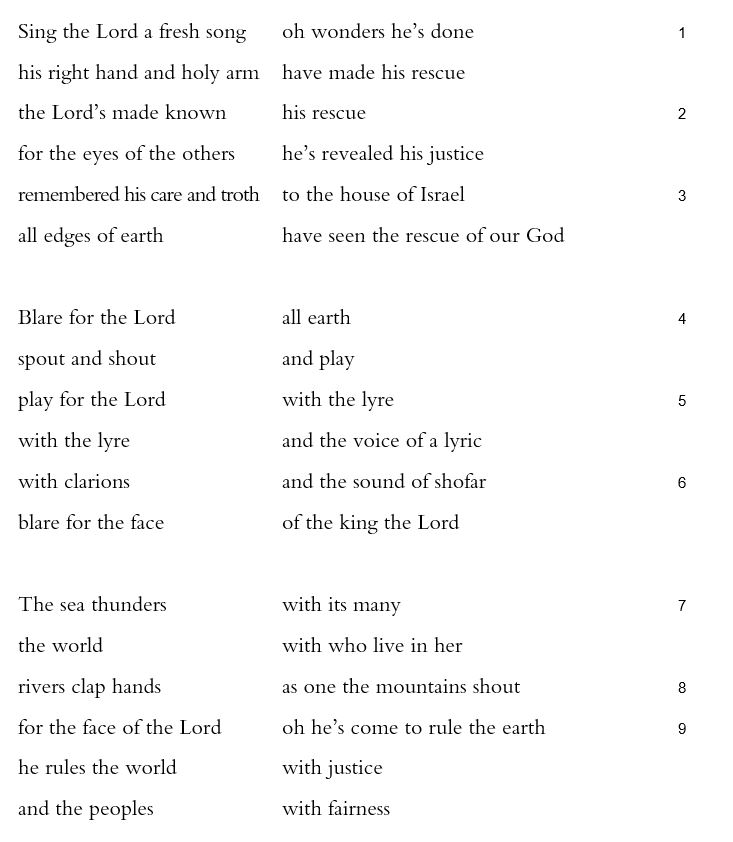
Given evidence of careful placement here in Book Four of the Psalter, Psalm 98 has to be seen as part of an editorial pattern. Like Psalm 92, this song shares “lyric” in its superscription. Like 96, it’s a “fresh song.” Each of these three (92, 96, 98) is followed by a “Lord king” psalm (93, 97, 99). Like Psalms 96 and 100, this psalm ends on a theological abstraction: “fairness” here (98:9), “his faithfulness” in the two psalms that are equidistant from it (96:13, 100:5). Given its similarities to other “fresh” songs— not just Psalm 96, which is near, but also Psalm 33, which is far— Psalm 98 demands to be read alongside other psalms and songs. And given the prominence of a much older new song that starts the same way, shiru l’YHWH, “Sing to the Lord”/ “Sing of the Lord,” it makes sense to turn to the Song of the Sea, particularly Miriam’s collective reply to Moses’ first-person hymn in Exodus 15.
“Sing to the Lord | oh overwhelming he overwhelmed / horse and rider | he tricked in the sea,” Miriam sings with the women who follow her (Exod 15:21). Moses’ version, much more expansive, celebrates the drowning of Pharaoh’s army which initiates the Lord’s program of assault against enemies:
You reached out your right | earth engulfs them
with your care you led | the people you released
with your might you guided | to your hallowed home
peoples have heard | and quivered
pain has gripped | who live in Philistia
thus are nervous | Edomite heads
the rams of Moab | terror grips them
they have fainted | all who live in Canaan. (Exod 15:12-15)
It goes on. If we assume that Miriam’s song is expanded by Moses’ song—or, at least, by these parts of the Song of the Sea that predict (and present as completed) the conquest of the land of Canaan—then these verses are themselves a new song. They shape the escape from Egypt as part of the Lord’s victory for the Lord’s people over the others of the world.
Psalm 33 alludes so often to the Song of the Sea that its revisionary relationship is plain: Psalm 33 pacifies the Song of the Sea. The actions at the Reed Sea, liberating the people from the Egyptians, were not the disruptive opening salvo of God’s program of violence against all nations. Rather, they were part of a plan of ordering that dated back to creation.
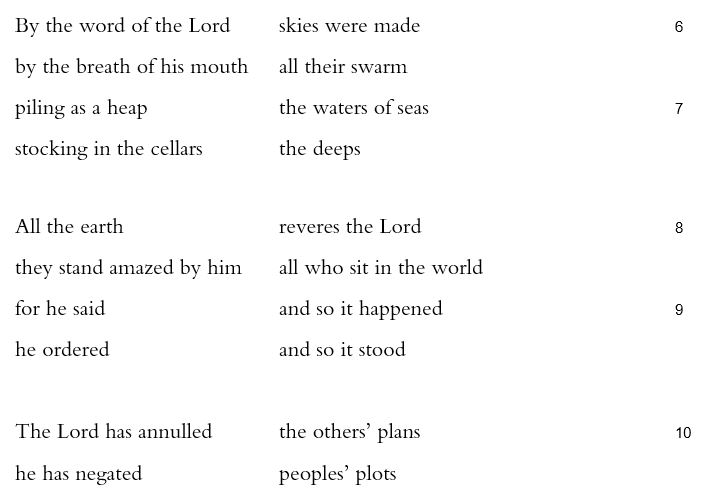
Now that the people have already crossed into the land, the emphasis is not on overwhelming enemies, but on celebrating peaceable deliverance from them. There is mention of a king in Psalm 33, but only in a generic way:

The fresh songs in Book Four come with a different purpose. Though they stretch back to Moses and the Exodus (see the superscription to Psalm 90, see 95:8-11, and 99) and use the precise term “wonders” for the Lord’s rescuing actions (98:1; cf. 96:3), they describe as a New Exodus a situation in which now the Davidic dynasty no longer sits on a physical throne because the Lord has been made king instead, has been king all along. As in Psalm 33, the politics and theology are far more universal than local. But unlike Psalm 33, the concern is not with protection against enemies but with the justice and equity of the new-but-it-was-always-there realm of the Lord. This realm extends to the earth itself:
The sea thunders | with its many
the world | with who live in her
rivers clap hands | as one the mountains shout
for the face of the Lord | oh he’s come to rule the earth (98: 7-9a).
To the desperate queries of Psalm 89, Psalm 98 is an integral part of the response. There is no longer a human king on a tangible throne. This absence, however, just makes the reign of the Lord truly clear. The promise to David in 2 Samuel 7:12, “I will raise your seed after you” (cf. Ps 89:29, 36) is subtly addressed by the end of Psalm 97 and the beginning of Psalm 98. “Light seeded in the just,” part of an imperative command to “be thankful | for the memory of his hallow,” relocates the Davidic lineage inside those who are just (97:11-12). And here in Psalm 98, it is the Lord’s right hand which has made his rescue, along with his “holy arm” (98:1). The house of David is displaced by “the house of Israel” (3), and it is the Lord who “rules the world | with justice / and the peoples | with fairness” (9). That this psalm is lodged between two psalms that begin “The Lord king” squares with its expression “the king the Lord” (6), leaving little room for worries about— or hopes for— the restoration of any human monarch.
 The Book of Psalms