(lyric of thanks)
* * *
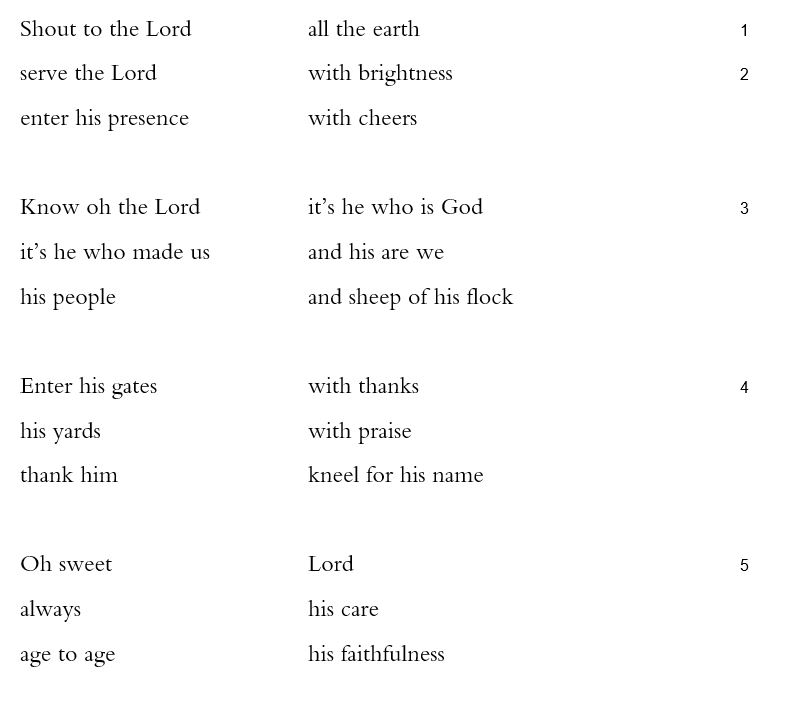
The crest of the wave of psalms that begin Book Four, Psalm 100 is as taut as can be. A single twelve-line composition, it works as three quatrains, even better as four tercets. In four tercets, the psalm’s seven plural imperatives are patterned 3-1-3 across the first three stanzas. The trio “shout” (1), “serve,” and “enter” (2) is mirrored by “enter,” “thank,” and “kneel” (4), the abstract “serve” pairing with the abstract “thank,” a riotous shout stilling to a kneel. In the middle of these six imperatives— linked by proximity more to the first group of three— is the verb “know,” the psalm’s central imperative. This knowing has three tenets: “it’s he who is God / it’s he who made us | and his are we” (3). And yet there is only one declarative verb within this sequence of what is to be known: “that the Lord, he, God, he, made us, his, we,” a word-for-word rendering might go, awkwardly indicating how emphatically the pronoun chain “he… he… his… we” reinforces the singular point that creation implies a particular relation. Taken all together, the structure of imperatives locates knowing between serving and thanking, weaving those mental actions within more physical actions, shouting, entering, entering, kneeling.
Balanced in the first and third of these first three tercets are four “with” statements: “with brightness… with cheers” (2), “with thanks… with praise” (4). The series invites reflection, a whole seminar on liturgy and psychology. Does “brightness” beget cheering the way gratitude begets praise, like some SAT pair of analogies? Or are the first two attitudes preconditions for the second two?
Likewise, in the second and fourth stanzas are balanced “his” statements: “his people | and sheep of his flock” (3), “his care… his faithfulness” (5). Does being “his people” relate to “his care” the way being sheep of “his flock” relates to “his faithfulness”? Essays are due next Friday.
While it’s true that biblical Hebrew allows the reader to supply the verb “to be”— it permits the copula to be elided, to put it technically— the absence of verbs in the final stanza is surely significant. The entire psalm has only eight verbs, the seven imperatives plus God’s act of making. The final stanza, then, works not to predicate anything of the Lord, but to present “his name” with all that that implies:
Oh sweet | Lord
always | his care
age to age | his faithfulness (5)
As with the second stanza, the reader can assume three copulas here (i.e. “Oh sweet is the Lord/ always is his care/ age to age is his faithfulness) or none. Having none, the last stanza completes the clause that began in verse 4, “kneel for his name: oh sweet Lord.”
 The Book of Psalms