


* * *
A handful of little verbal similarities offer one, surface-level explanation for why Psalm 105 should follow Psalm 104, though the difference in quality and sensibility between the two psalms could not be more profound. The mirrored sequence from Genesis to Exodus of creation story, narratives of patriarchs, and the Exodus offers another explanation. But there is a deeper reason why this highly selective, ethnocentric retelling of Israel’s prehistory should follow what precedes it, that magnificent psalm celebrating the world filled with God. That vision, particularly its erasure of “the errant” and “rogues” from the earth (104:35), contributes to this psalm’s ideological justification of an errand into the wilderness that dispossessed others of their home.
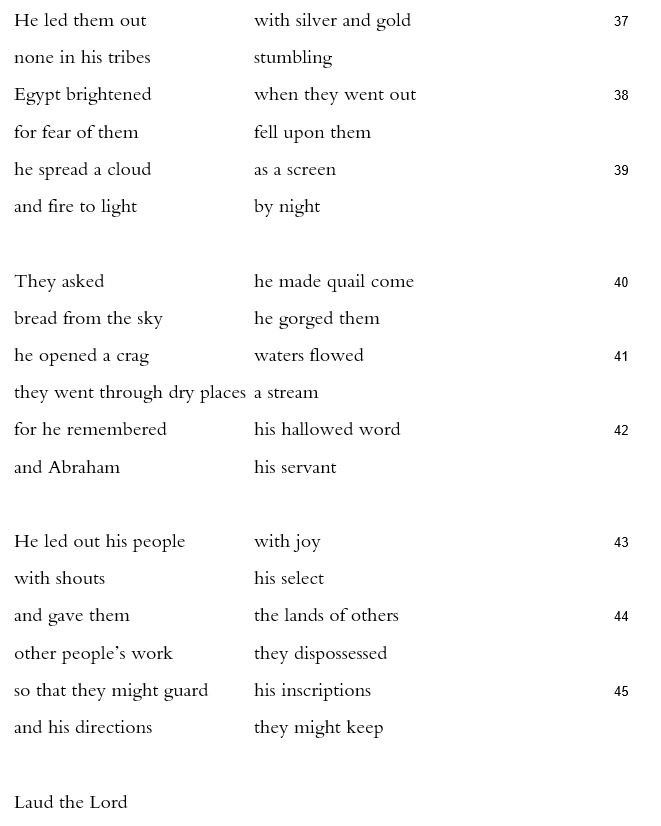
There are points of verbal contact between the two psalms, particularly near the end of Psalm 105. The “flames of fire” (105:32; cf. “flaring fire,” 104:4), the locust larvae “without number” (105:34; cf. “untold,” 104:25), and the quail and bread with which the Lord “gorged” the people of Israel (105:40; cf. 104:13, 16, 28) all link the two psalms. The watering of the desert is more significant: “he opened a crag | waters flowed / they went through dry places | a stream” (105:41) recalls “sending creeks | through ravines / between mountains | they go” (104:10). But while each of these details in Psalm 104 adds to that psalm’s thematic cohesion, their counterparts in Psalm 105 seem incidental.
Psalm 105 cares far more about the stories it excerpts. It highlights the Lord’s covenant with Abraham “and his vow | to Isaac” (9), presumably the threefold promises in Genesis 12, 15, and Genesis 26:3-5, promises of blessings, descendants, and most importantly, land. In Psalm 105, the promise of land becomes central to the Jacob cycle of stories, “saying to you I give | the land of Canaan / as the parcel | of your estate” (11). This version of the Joseph story omits brothers entirely (!), concentrating on the reversals of master-servant relationships, Joseph’s neck twice locked and unlocked from irons (18, 22). The retelling of the Exodus emphasizes plagues (28-36), omitting the Lord’s appearances at the burning bush and, most strikingly, Sinai.
Instead of encounters with God, Psalm 105 leads directly to the legend of the conquest of Canaan.
He led out his people | with joy
with shouts | his select
and gave them | the lands of others
other people’s work | they dispossessed
so that they might guard | his inscriptions
and his directions | they might keep (43-45).
Despite the mention of “his inscriptions / and his directions,” the poem spends most of its time justifying the occupation of “the lands of others.” It sets in stone not the tablets of the law, which it elides, but part of the promise to Abraham, the claim to the land:
He stood it for Jacob | as an inscription
for Israel | a lasting pact
saying to you I give | the land of Canaan
as the parcel | of your estate
there being few | in number
barely any | but migrants there (10-12).
All the rhetorical gestures that cloak invasion as manifest destiny are there: we were here first, God’s select; the others were the real aggressors, as dangerous as the Egyptians were; the place was basically empty. The justifications ring as hollow as they always do, for conquistadors, Puritans, and Putins, with all their pretexts for dispossession.
To Hermann Gunkel’s claim that “the poem is certainly no great work of art,” Mitchell Dahood counters that the poem contains “a number of literary subtleties” and that factors like “the effective separation of composite phrases in parallel verse members” and “the competent use of chiasmus” “bespeak uncommon literary artistry” (III.51). Faint praise cannot recuperate a poem so bent on occupying others’ lands that it has to rely on tendentious reductions of Genesis and Exodus. How else does one justify invasion, occupation, and genocide, but by excising every story of siblings and children, eviscerating the great story of emancipation, not to mention ignoring commandments that promote justice while condemning murder and theft? In response to Gunkel and Dahood, who cares whether Psalm 105 is aesthetically good or bad? It’s reprehensible.
 The Book of Psalms