


* * *
Book Four of the Psalter ends not with a bang, nor with a whimper, but with harangue, a whole litany of charges. Psalm 106 accuses Israel down a long and slippery slope of crimes. It slides from character traits like desire, envy, recalcitrance, and impatience to such practices as tolerance and accommodation of other peoples, which it considers dangerous and wrong. The failure to commit genocide, in the eyes of this psalm, has given way to miscegenation between ethnicities, intermarriage. These have led directly—again, so claims the psalm—to infanticide and exile. Complaining and protesting lead to a failure to trust priests, which leads to cultural pluralism, a process that inexorably gets filthy, dirty, and debauched. If Psalm 105 is insidious, Psalm 106 is sinister.
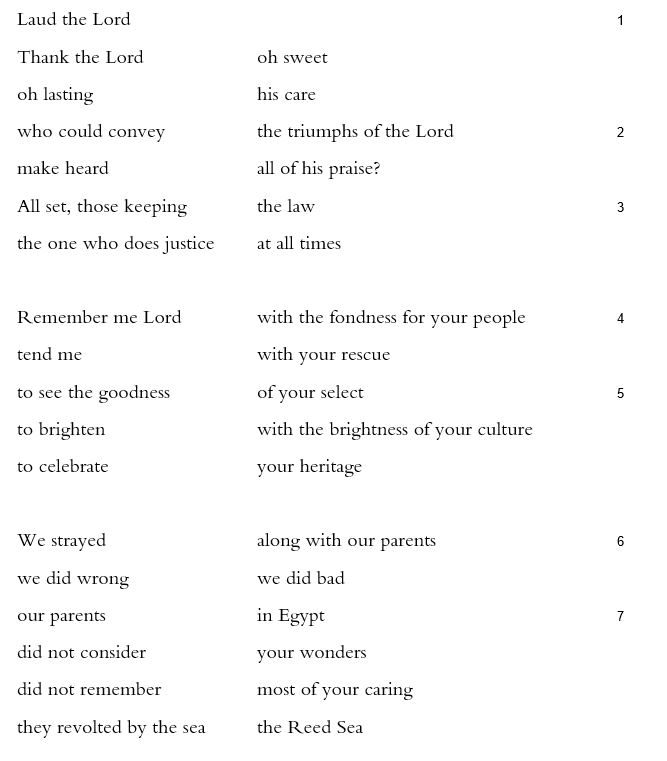
There is a doubled frame to the psalm, and there are deft moments, so it is important for our own sake not to leap to moral response. The opening and closing show gratitude and praise for the Lord’s care (1-2) and compassion (45-46), and the call for remembrance and rescue (3) is answered by remembrance (45) and a repeated call for rescue (47). Even here, however, ethnocentrism arises in ways it hadn’t in prior psalms:
tend me | with your rescue
to see the goodness | of your select
to brighten | with the brightness of your culture
to celebrate | your heritage (4b-5).
The three infinitives reveal, already near the psalm’s start, what this psalmist thinks are the purposes of rescue, all three of them emphasizing exceptionalism, “your select… your culture… your heritage.” And while the Lord’s remembering at the end of the psalm is undeniably tender, divine rescue in this psalm retains its disdain for foreigners: “Rescue us | Lord our God / and take us away | from the others” (47).
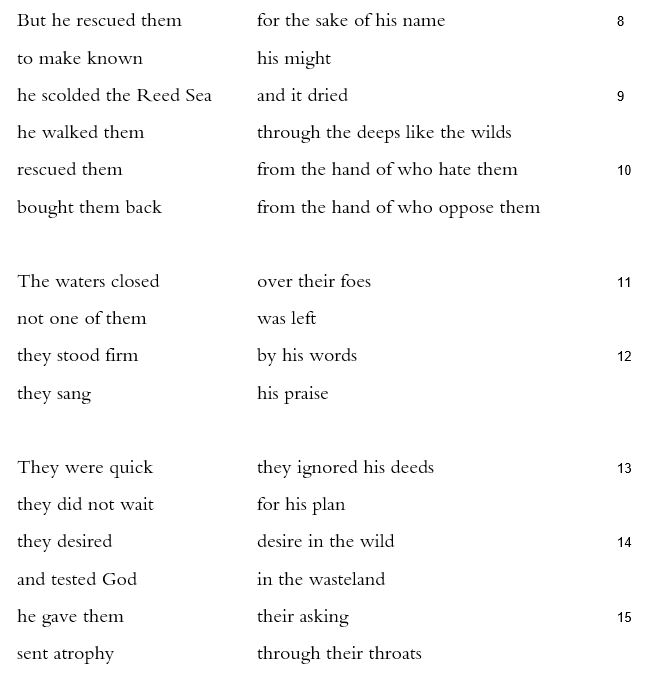
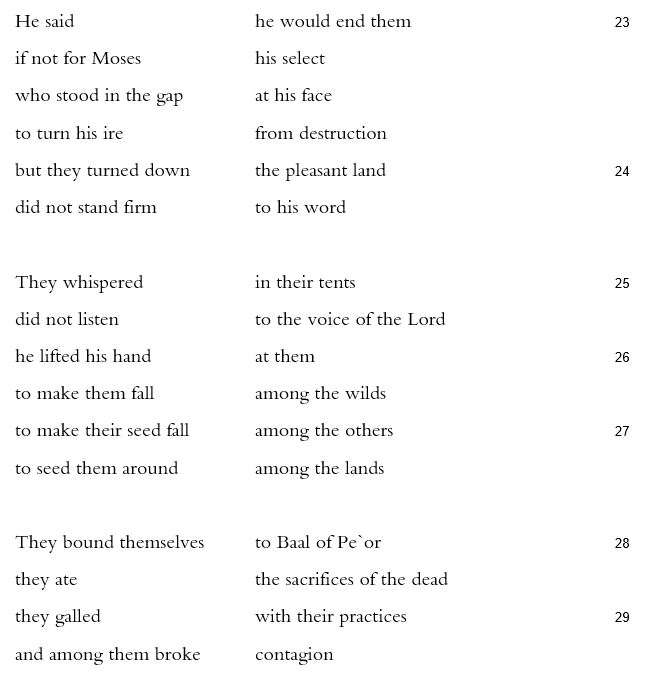
Most of the poem’s bile spills out not at foreigners, but at the Israelites themselves, who are walked through another highly selective history (see Psalm 105) that now emphasizes their wrongdoing at every turn. To read both Psalm 105 and Psalm 106 is to wonder if the two psalmists knew the same Exodus and Numbers. Instead of excerpts picked to emphasize the people’s resilience to external enemies in the transition from being servants to becoming masters, Psalm 106 features excerpts to show the people’s pattern of becoming their own worst enemy, deserving of exile and servitude. The children of Israel, “our parents | in Egypt,” begin their stubbornness before and after the parting of the sea (7, 13), continuing through the complaints in the wilderness (14-15) and other rebellions (16-24) and conspiracies (25-33), leading not to liberation and promised land, but to compromise (34-36) and child sacrifice (37-38), exile and defeat (39-42). Interestingly, the priest Aaron, “the hallowed of the Lord” (16), is distanced from the syncretism/idolatry of the golden calf, while Aaron’s grandson Phineas is praised for his “just” deed of spearing the Israelite man Zimri along with Cozbi the Midianite woman (Numbers 25). Both events, the golden calf and the double homicide, resulted in the slaughter of thousands. And yet perhaps the most telling word in these passages is the word “contagion” taken from Numbers (29, 30), describing not a literal contagion, but Midianite cultural influence.
If it’s important not to leap too quickly to moral condemnation of Psalm 106, it is imperative not to shirk such condemnation. It requires no great insight to point out that every justification of genocide, ethnic cleansing, and racism is deplorable, even criminal. Nor does it condone child sacrifice or encourage disloyalty or unleash contagion to point out that Exodus reads differently than does this psalm.
One response to this psalm’s contemptuousness is read it less often than any other. Another is to read instead the book of Ruth.
 The Book of Psalms