(a song of steps, of David)
* * *
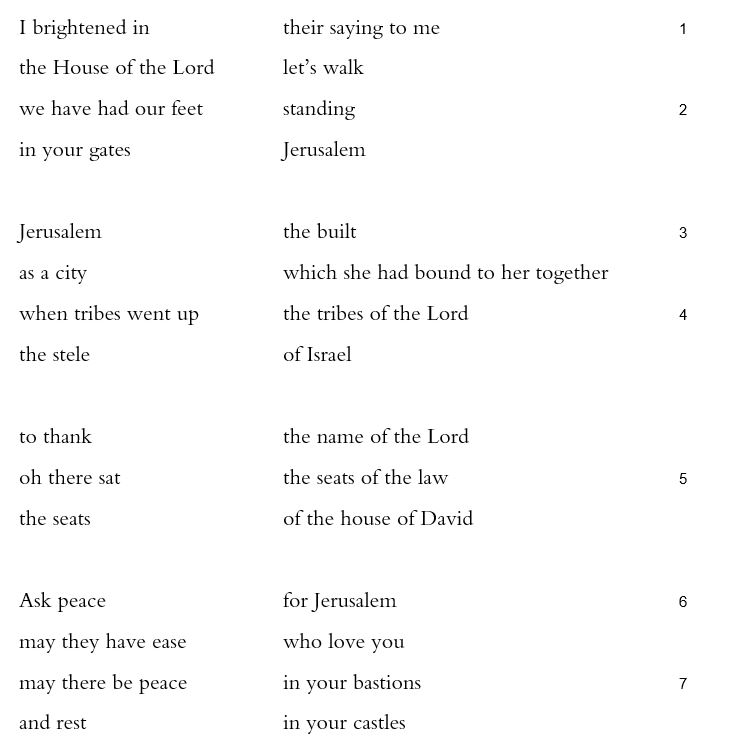
In Psalm 122, a shared walk to the temple in Jerusalem, in the present tense, calls to mind past-tense unity, leading to an impassioned plea for present and future peace. In addition to this narrative movement from present experience (1) to cultural memory (2-5) and back to the urgent now (6-9), the psalm is tightly knit by a host of subtle techniques. Tight knitting itself may be the psalm’s most important theme, shown first in that strange and lovely formulation of verse 3b, “as a city | which she had bound to her together” (ke`ir shechubberah lah yachdav). Once, the line implies, Jerusalem bound her tribes to her, and Jerusalem was their binding.
Invisible in English are the many verbal repetitions that knit the name Jerusalem (yerushalayim) to the word “peace” (shalom). These puns emphasize the shin and the mem, or shin and lamed, or all three letters at once. Verse 4, for instance, begins with shessham shebatim, “when [or where] tribes,” and ends with l’sheim YHWH, “to the name of the Lord.” Verse 5 starts, “oh there sat | the seats of the law,” ki shammah yashbu kis’ot lemishpat. Verse 6 is most explicit and most concentrated: sha’alu shalom yerushalayim; yishlayu ohavayikh, “Ask peace | for Jerusalem / may they have ease | who love you.” Verses 7 and 8 both name “peace”; verse 7 adds the word shalvah, or “rest.” Collectively, then, both when and where, the word “name” and the the law, and ease, rest, and asking, all are bound verbally together with both Jerusalem and peace.
A number of these repetitions are patterned. Psalm 121 had six uses of the word shomer, “to guard,” arranged in two groups of three, plus four instances of the Lord’s name. Psalm 122 also names the Lord four times (1, 4a, 4c, 9), adding Jerusalem three times (2, 3, 6), “peace” three times, and “house” three times (1, 5, 9). The three mentions of the house set the temple at the psalm’s beginning, middle, and end, with its historical identity as “house of David” centered in verse 5. There in the psalm’s center, another pattern culminates: the echo of Psalm 1:1’s movement from walking (121:1) to standing (121:2) to sitting (121:5), marking the remembering, the reimagining, of the first temple as an act of wisdom and morality.
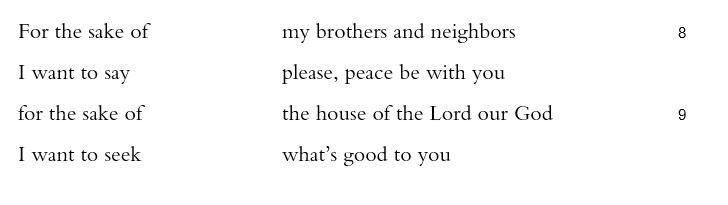
A whole theology or politics might be built on the final two verses, verses 8 and 9, the twinned purposes of the speaker’s walk through the city to the temple. If it is easy to play on words, it is much harder to really wish for peace. And it’s downright dangerous to equate Jerusalem with peace or to view the binding together in verse 3 as anything but ideology dressed up as memory. In Jerusalem, so much blood has risen, so very much has fallen.
As Philip Larkin suggests in “Church Going,” a temple may be destined, once “disbelief has gone,” to become “A shape less recognizable each week,/ A purpose more obscure.” And yet Psalm 122’s final pairing of two cohortative verbs, “I want to say” and “I want to seek,” with their contents, “please, peace be with you” and “what’s good to you,” show that this destination can indeed be “A serious house on serious earth.” Seeking what’s good for one’s neighbor takes poem and psalm beyond words.
 The Book of Psalms