
* * *
To think about Psalms 135 and 136 is to consider the relationship between history and poetry, between the blessing and praise of Psalm 135 and the thanking of Psalm 136, and between the instants of gratitude and the constant of care.
Too often— in analyses of Psalm 136 in particular, but more broadly in biblical studies and in culture at large— history and poetry are portrayed as opposed to one another: history as substance and actuality, poetry as imagination or style. One the body, the other the clothes. According to one particularly wooden formula, “the words ‘history’ and ‘poetry’ are irreconcilable terms. ‘History’ proper refers to nonrecurrent events within an unrepeatable context. ‘Poetry’, on the other hand is a literary genre, a restricted way of formulating verbalised knowledge” (Van Rensburg, “History As Poetry” 80). (That scene in Dead Poets Society where Robin Williams’s character has his students rip pages from their textbook.)
Even a sophisticated, insightful analysis of Psalm 136 relies on conceptions such as (a) history being “a narrative that preserves a past,” differentiating psalms “that contain historical traditions” from those that “incorporate historical references,” distinguishing two colors of Tupperware, and (b) Psalm 136 being an example of how “earlier traditions are poeticized… the process of poeticizing earlier texts containing historical traditions,” as if “poeticizing” is self-explanatory (Brettler 393). But poetry is no more ornamented than history, no less real, no less a product, no less a making-sense of time. History and poetry are modes of rhetoric; both use language, all apologies to Auden, to make things happen. Both select. Both arrange. Both are stylized, remembered, pronounced. Texts we call historical may traffic more in causalities in the past, while texts we call poetic may elide causality and remain silent about the past altogether. But both are modes of speaking and writing that often recreate or invent the past for the sake of the present.
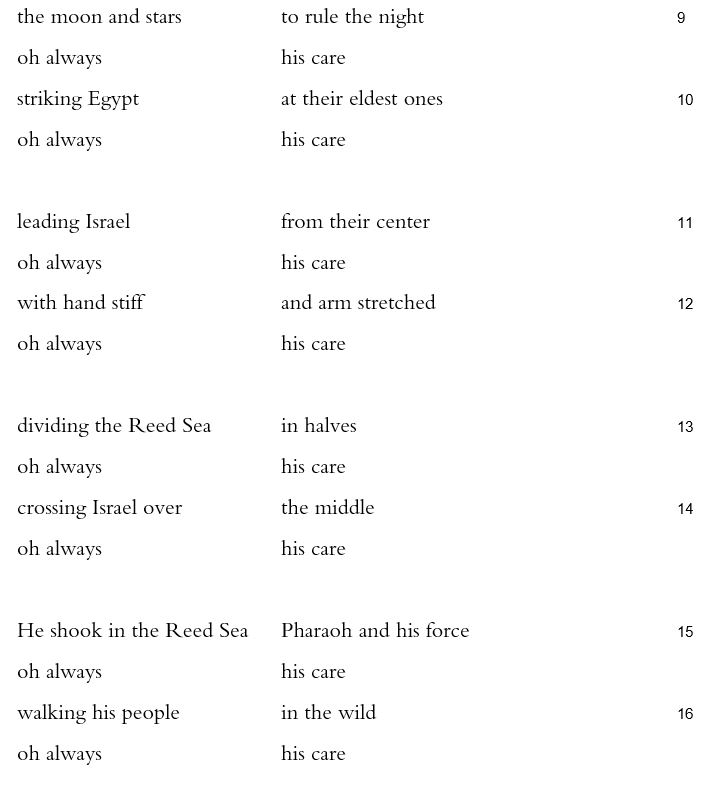
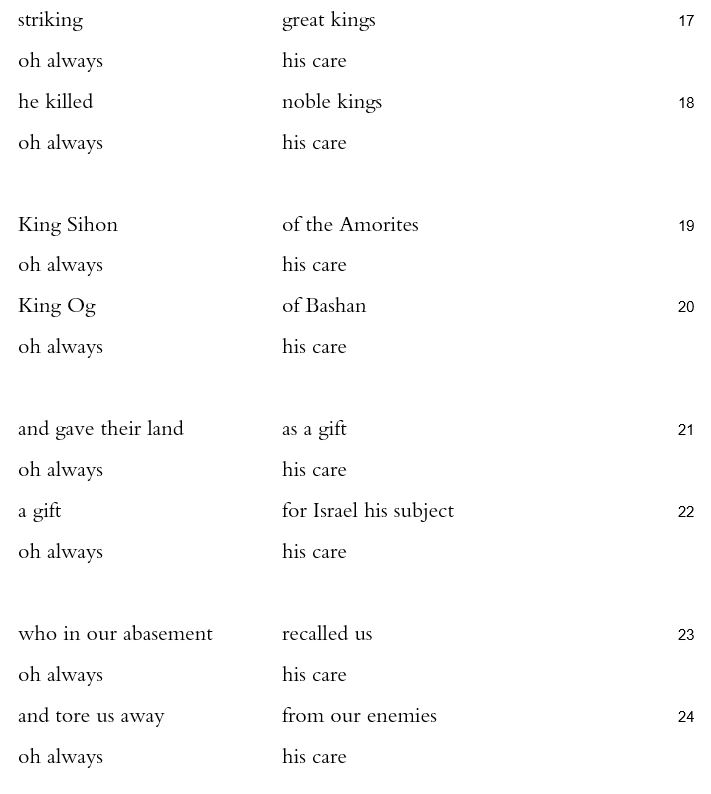
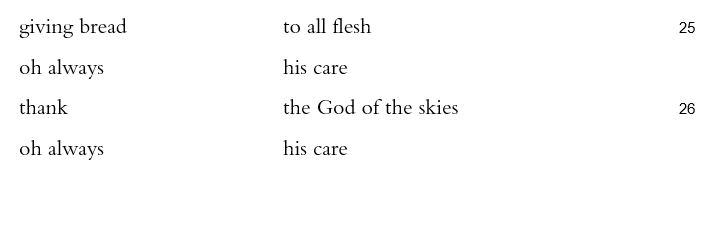
Both history and poetry also often treat time not as chronology, but as a moment or as eternal. In the modes of theophany, epiphany, liturgy, and recitation, the fleeting present tense is all that is. History is not “incorporated” in poetry: rather, the linguistic present absorbs the past as soon as it conjures it. Like all memory, the past must be retold in the present if it is to exist at all. Psalm 136, for its part, is dominated by statements that only make sense in and of the present tense: its fourfold imperative “Thank” (1a, 2a, 3a, 26a), its fourteen participles (4a-14a, 16a, 17a, 25a) and its verbless phrases, which appear three times in the first half of a verse (19a, 20a, 22a) as well as in the refrain in the second half of every verse: “oh always | his care.” All of these stand apart from time as chronology, which is represented by the conjugated verb. The psalm’s refrain may indeed “poeticize” history, but only if poeticize means to replace the history it invents with timelessness, engulfing the past into eternity. The scene of grateful repetition, in other words, participates in what Benjamin calls messianic time, what Plotinus calls the eternal now.
So much of what Psalm 136 does by reciting bits of text from Deuteronomy and other poetic reinventions of Israel’s past is to layer texts on other texts, relighting neural pathways to make some memories seem inevitably linked, even teleological. Marc Zvi Brettler has shown convincingly that Psalm 136 clearly alludes to and borrows from Deuteronomy 10:17-11:5, even if not why the psalm might do so. That earlier passage contains this remarkable, strange, even poetic verse: “That you may know today– oh not your children who have not known and have not seen the punishment of the Lord your God, his hand stiff and arm stretched…” (Deut 11:2). The Moses of Deuteronomy tells the people in Midian that they should consider their own obligations in the present day because of all that they themselves— not their children, don’t think about them— have known and seen of signs and wonders. And yet the entire passage is both a didactic reworking of select moments cherrypicked from Israel’s past, a second giving of the law, and a journey directed towards the future, the land toward which Israel is heading, the others Israel is told to dispossess, the children conspicuously presented in Deuteronomy 11:2 as not there, who return in 11:19 and 11:21. The purpose of revisiting, revivifying this passage in Psalm 136 may not be easily linked to a particular cultural context or window of time— clearly postexilic, but when? But the rhetorical purpose of the poem and history is clear: “oh always | his care” makes Israel’s covenant with the Lord permanent no matter the day. The citations of Deuteronomy remind Israel that if continuing care is the Lord’s part of the deal, continuing gratitude is part of Israel’s part.
More than benediction and praise, thanking is a social obligation. In Hebrew, the term yadah derives from the word “hand,” perhaps from the raising or extending of hands, though the associations of hands and gratitude multiply: handing it to someone, giving them a hand, putting hands together, the sign in American Sign Language of one hand coming from the mouth to meet the other hand. If Psalm 136 is older than Psalm 135, then lasting divine care necessitates first, in Psalm 136, a particular covenantal response that begins by throwing hands of thanks, and later, in Psalm 135, a particular liturgical response that raises the voice and bends the knee. If the dependency of the two psalms lies the other way around, then Psalm 136 functions, as the order in the Psalter suggests, as a kind of return.
 The Book of Psalms