(director: of David, lyric)
* * *
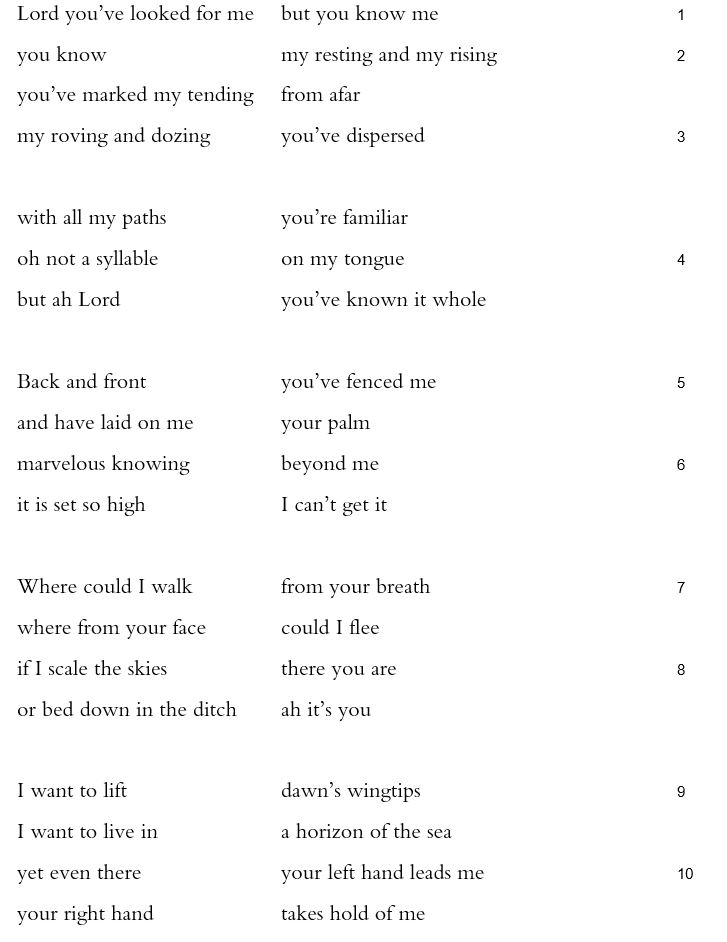
Whether authored by one person at once or by dozens over time, Psalm 139 coheres around a single broad theme— the inescapable length and breadth and depth and height of God’s knowing— and by a handful of stitch-words. Because its most confusing seams occur two-thirds to three-quarters of the way through the poem, in verses 16-19, the psalm feels like a whole that falls apart, making it tempting to excerpt powerful pieces, a verse or half-verse at a time. That temptation is a mistake. There are so many potent moments, it’s best to follow them through. More, the social and psychological cost, the human cost, of careless excerpting is in the case of this particular psalm immense.
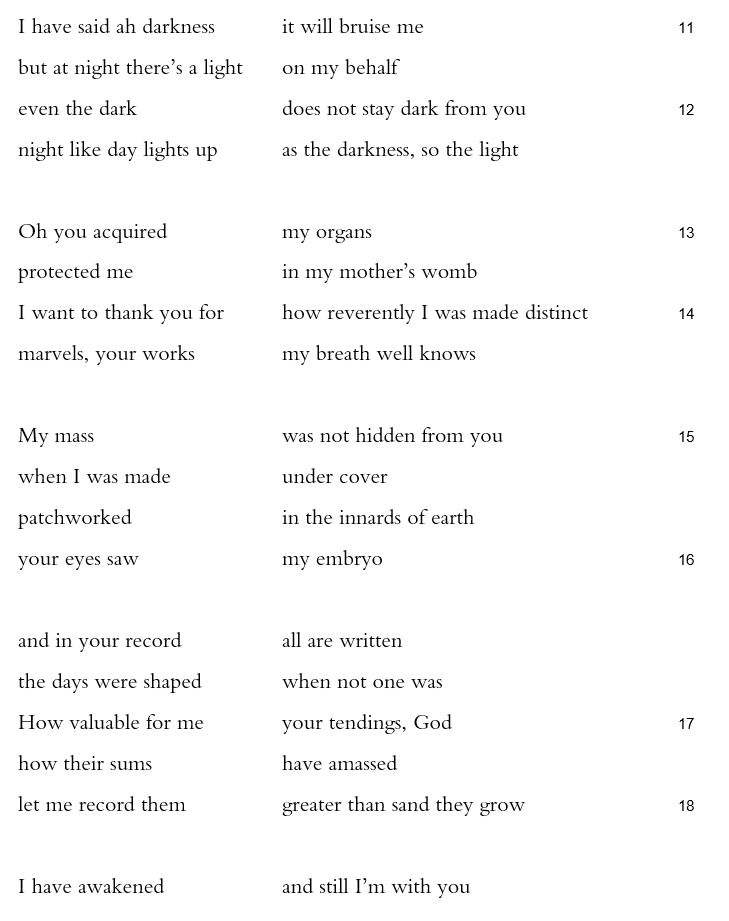
At least two distinct pieces seem to have been sewn together, each with its own ways of thinking about what it is or at least what it’s like to be known and fully fathomed. The first piece, verses 1-16, works by merisms, mapping God’s complete familiarity with the speaker’s whole self by marking the maximal limits of space and time. These verses convey wonder (6, 14) and gratitude (14) for divine knowledge, which they present as already achieved.
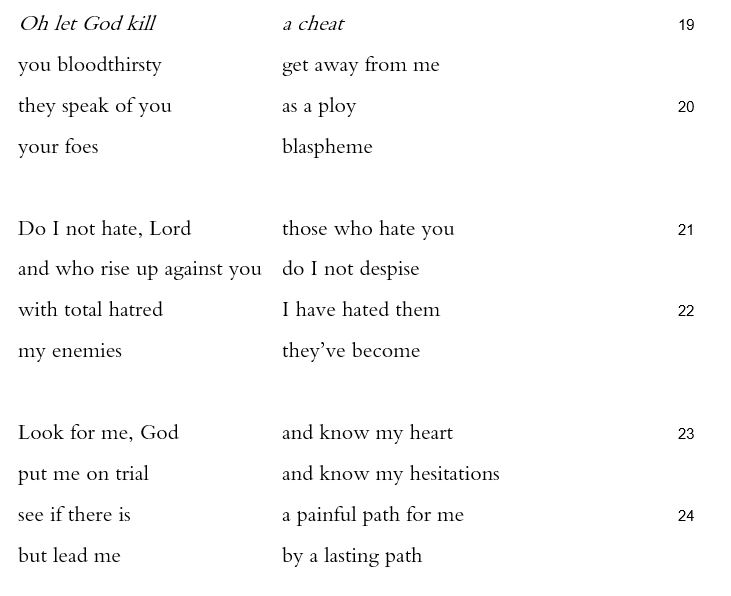
Verses 19-24 take the more common approach of appealing to one’s innocence: the speaker pleads contempt of enemies described as God’s foes (20) as well as their own (22). Instead of celebrating divine omniscience, this second piece asks for a special inquest to determine the future: “see if there is | a painful path for me” (24a). About morality, the main concern of the last six verses, the first sixteen verses say nothing.
Between these two parts, verses 17-18 have a fabric that seems their own. They are less a bridge than another island. Verse 17 and the first half of verse 18 see God not as a knower but as unknowable. The second half of verse 18, “I have awakened | and still I’m with you,” is not easily assimilated to any of the other three parts, with no clear relationship to omniscience or ineffability or the hatred of the bad.
Nevertheless, persistent verbal connections tug the psalm’s parts together. Its beginning and end are linked by the pairing of the verbs “look for” (1, 23a) and “know” (1, 2a, 23a, 23b), the latter of which occurs three more times in the psalm for a total of seven appearances (4, 6, 14). The beginning and end are also framed by “rising” (2) and rising up against” (21), and by the common word derek (“all my paths” in verse 3; “a painful path” and “a lasting path” in verse 24), both of which reveal motion to be a key part of the psalm.
The word rei`ah, from a root (or roots) with enormous semantic range, appears in the singular with a first-person suffix in verse 2—“my tending”—and in the plural with a second-person suffix in verse 17—“your tendings.” Its precise meaning in both cases is unclear, unique in the Bible to these two verses, though derivation seems to suggest pasturing and grazing (ra`ah) or association and friendship (rei`eh) rather than badness (ra`a`), while the poem’s context implies something abstracted, even ideational: “you’ve gotten my drift,” a more colloquial draft of this translation once tried. Regardless of its meaning, the repetition of rei’ah stitches verse 17 back to verse 2.
Similar repetition of the root `atsam stitches verse 17 (“have amassed”) back to verse 15 (“my mass”), with another plural word, looping back to pick up its partner in the singular. In addition, in passing, note “your breath” (7) and “my breath” (14), “your record” (16b) and “let me record” (18a), and the pairing of indicative “leads” (10) and “saw” (16) with imperative “see” and “lead” (24). Cumulatively, these duplications and keywords show the effort of making the psalm cohere.
By contrast, the first sixteen verses hold together on their own. This is especially true when we track how much of the diction here is drawn from a pastoral register. That is, most of this psalm works remarkably well if it is understood, just as Psalm 23 is understood, to be the song of a sheep to her shepherd. Psalm 139 begins with the Lord searching for what the Lord already knows by familiarity: the speaker’s movements: “my resting and my rising… my roving and dozing” (2a, 3a). As noted above, the etymology of lerei`i in verse 2b, “my tending,” suggests a more literal meaning of “my herd instincts” or “my grazing intentions,” “my pasture tendencies,” which a shepherd could doubtless mark “from afar” from familiarity with sheep tracks. The word tsartani in verse 5 literally means “you put me in a paddock” or “fenced me in.” A pastoral reading reveals vividly and concretely the Lord’s palm (5), the “marvelous knowing | beyond me” (6), the sheep’s experience of proximity to the shepherd’s “breath” and “face” (7), the scaling of crags and napping in glens (8), the left hand that “leads me / your right hand | [that] takes hold of me” (10), and even the “light | on my behalf” (11).
If the speaker is understood as a well-known and cared-for sheep and the Lord a caring, knowing shepherd, verses 13-17 take on nuances most readings miss. Ever since the domestication of livestock, a shepherd knows a lamb well before its birth, from the ruddle of the ram that tups a ewe in heat, to the visual and behavioral cues of gestation on through to lambing, imprinting, and beyond. The verb “acquires” in verse 13 captures both ownership and generativity: Eve “acquires” Cain in Genesis 4:1 (almost as if she doesn’t know how it happened); in Genesis 25:10, Abraham “acquires” a plot to bury Sarah. A shepherd breeds ewes (13a), “protects” them (13b), helps during birthing by cutting the newborn lamb’s cord (“how reverently I was made distinct” 14a) and ensuring he can breathe his first breaths (14b). During gestation, a shepherd sees the mother’s belly swell, sees her colostrum, and sees and feels and knows the outline of the fetal lamb (“my mass… my embryo” 15a, 16a). Good shepherds write this all down, recording days and values (16b-17). Even a lamb might want to keep track in the only way it can: we count sheep in ledgers and late nights; sheep mark our attending with their hooves in the dirt (“greater than sand they grow” 18a). Understood this way, even the curious verse 18b makes sense as imprinting, a newborn lamb, eyes on its shepherd: “I have awakened | and still I’m with you.”
Not even this sheep-and-shepherd reading of Psalm 139 knows quite what to do with verse 19, however. If 18b is a leap, 19a is a lurch: “Oh let God kill | a cheat” comes so far out of nowhere it seems rather to belong in vocabulary and theme to Psalm 140. Dahood gamely celebrates verses 18b-19 as three varieties of wish, parsing the lines as “I want to awaken… Let God kill… may you bloodthirsty get away,” which is as grammatically wily as it is semantically weird. My solution here, dissatisfying though it may be, is nearly the opposite of Dahood’s, seeing 19a as a line of quoted speech, a curse uttered against enemies by “you bloodthirsty,” hateful not just because it takes the Lord’s name too lightly (20b echoes Exod 20:7 or Deut 5:11), but because it treats life and divinity too carelessly, with only partial knowledge (cf. Ps 16:4). Many other readers, however, barely register the rupture, as if sliding from meticulous perinatal compassion to lethal imprecation were common or made the slightest sense.
Squinting, however, or looking from afar, it is possible to reconcile the psalm’s parts by seeing the broadest of shared themes—the sublime unknowability of divine intentions, the infinitude of divine knowing, the fierce loyalty the lamb shows his shepherd. If Psalm 139 is turned, and its metaphor is not necessarily knowing pastures and each individual sheep over all terrain and through all time, but knowing by sounding deep waters, then maybe what happens in verse 19 is a kind of sinking down through innermost thoughts, until we come at last to such grim thoughts as killing and cheats and enemies. If so, verse 19 becomes an example of the trial the speaker asks for in the psalm’s last lines: “and know my heart…and know my hesitations” (23a, 24a).
The crucial takeaway of this psalm, however, is that the mortal first-person singular, the part, comes with hard epistemological limits in a way that the limitless second-person singular, you, the whole, does not. In 1 Corinthians 13:12, Paul asserts in a midrashic rereading of texts like Psalm 139 that “now I know in part, yet then I will know well, exactly as I have been known well.” What this psalm itself emphasizes is that first part, the partiality of human knowing.
This fact alone, the limits of knowledge, ought to radically curtail the use to which this psalm is too often put, in anachronistic claims that verses 13-16 argue against a woman’s right to choose what to do with her body. Jewish and Christian traditions have made any number of claims about the moment a life begins. Life only ever continues, according to this psalm, a psalm utterly disinterested in identifying a single point of origin. This is not a reasoned case that life begins at conception, nor that life begins at the breathtaking moment the umbilical cord is cut and in terror and wonder everyone waits for that first gulp of air. Woe to you, who clip prooftexts in bad faith! This is not a psalm of moments.
 The Book of Psalms