(lyric, of David)
* * *
Nothing in the formulaic first verse of Psalm 141 prepares the reader for the distinctive voice and tone of the poetry to come. Not a word in the first verse is unique; every move is typical. But in verse 2, things change:
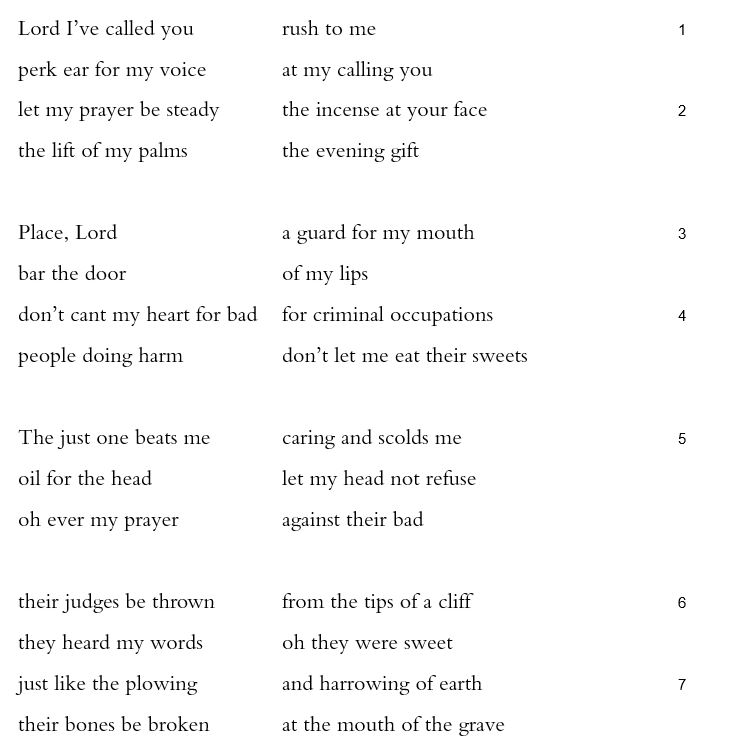
Let my prayer be steady | the incense at your face
the lift of my palms | the evening gift
It’s a rare verse that can shape its four half-lines into two patterns at once: a point-for-point parallel and a 1+3, one abstraction plus three details. There’s perfect parallelism between the verse halves, as the steadying prayer is met by the lifting of palms, while the sacrificial gift picks up the smoky incense as darkening evening meets the divine face. At the same time, however, all three details in the last three half-lines ground the first half-line’s prayer for steady prayer—wavering incense, lifted and likely quavering palms, the tendered sacrifice. The verse is nearly always read dynamically as two statements advocating replacement: “let my prayer be like incense before you, the lifting of my palms like the evening sacrifice.” Not that that interpretation doesn’t work: it works well, especially given that the word “lift” or “lifting” is used elsewhere of smoke (Judg 20:38-40) or tribute (2 Sam 11:8). But formal equivalence here displays the dynamism of the verse and voice better than dynamic translation can.
This poem’s particular voice is tricky to catch because of its subtlety, darkness, and humor. After verse 1 encourages attention to language (“perk ear for my voice”) and verse 2 sets up a prayer presumably built of language as well as gesture, verse 3 asks language to be patrolled almost to silence, “a guard for my mouth / bar the door | of my lips.” In verse 4, this control of the mouth deepens, in both what might go in— “don’t let me eat their sweets”—and what might come out— “don’t cant my heart for bad.” A call becomes prayer, which is to be protected from within and without.
In verse 5, the poem’s center, protection and discipline become punishment. “The just one beats me,” it seems to start— maybe a statement, maybe a prayer— before adding the noun chesed, “caring.” How does that parse? Is it better as “He beats me, the just one caring” or as “The just one beats me caring,” like the brutal expression “to beat sense into”? Or do we need more before we can make syntactical sense: “Justice hits; caring scolds”? It’s possible to read the line as a garble or as a witticism, as either passive acceptance of abuse or dark sarcasm: “He smacks me: this is called justice.” The very center of the center of the psalm makes this punishment an ironic crowning anointment: “and scolds me / oil for the head | let my head not refuse.” Here, too, is a mess or a puzzle or a sardonic game. R’osh ’al-yani r’oshi is as mysterious a cluster as it is musical, with a series of letters that anagram “Israel” and play on two names of God, both ’el and `elyon. The speaker appears to be taking—or trying to take—discipline as a sign of justice and care and as a signal of election or sanctification among those “doing harm” (4, 9).
What, then, is the continual (or renewed) “prayer | against their bad” mentioned in verse 5c? Is it a prayer that precedes this line or a prayer that follows? Which prayer? “Let my head not refuse” is the most proximate possible referent, but (a) it may not even be a prayer (“oil so topnotch my head can’t pass it up”) and (b) it does not sound like a prayer “against their bad,” but rather a prayer to accept something good. Verse 4 is indeed a prayer against their bad: “don’t cant my heart for bad… don’t let me eat their sweets,” but why jump backwards over 5a and 5b? Is the point to relate the refusal of criminals’ delights with the acceptance of beatings by the good?
It is possible, however, that this prayer against the badness of “them” anticipates the lines that follow, which turn the perfect-form verbs of verses 6 and 7 into prayers already or again-to-be answered:
their judges be thrown | from the tips of a cliff
they heard my words | oh they were sweet
just like the plowing | and harrowing of earth
their bones be broken | at the mouth of the grave.
These lines might narrate completed events, which would be the typical use of the suffixed forms of “to throw,” “to hear,” “to be sweet,” and “to be broken.” But what events? And why narrate them here? Most English translations resort to the future tense here for the execution of the judges executed and sometimes even for the breaking of bones (“our bones” in the Masoretic Text, “their bones” according to the Septuagint). Some kind of subjunctive makes more sense here, along the lines of the so-called precative perfect: “oh ever my prayer | against their bad / [is that] their judges be thrown | from the tips of a cliff.” The events are grim and the tone is sardonic, with the speaker’s “sweet” words (6b) and the “mouth” of the grave (7b) recalling the “sweets” (4b) of the villains and the speaker’s own “mouth” (3a). The broken bones could be our remembered bones, sticking out of the soil like planting tools, or the wished-for bones of the villains’ judges. In any event, this is the delicate, sarcastic prayer that answers the bad people’s delicacies: that foreign rulers be pitched from the rocks much like the enemies’ infants at the end of Psalm 137.
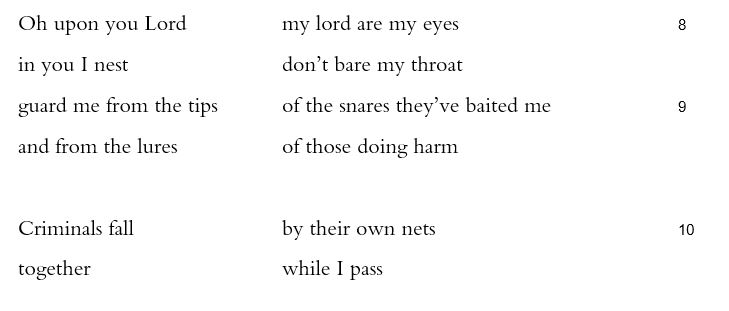
The psalm’s final three verses pull back to something much more expected: a prayer to elude the traps “of those doing harm” (9). This ending reads very much like a disguise, as does the beginning, commonplace rhetorical appeals at the psalm’s start and closure that effectively drag branches over the tracks of the verses between, verses that slide treacherously from steadied prayer and self-restraint among the “criminal occupations” of “people doing harm,” to the execution of the traitors or the sacrilegious.
 The Book of Psalms