

* * *
Psalm 147 is a barrage of quotations from all over what was becoming— what the psalm’s own work helped become— the Hebrew Bible. It excerpts or alludes to other psalms, poetry from Job to Jeremiah and the latter chapters of Isaiah, and important passages from Exodus, Numbers, and Deuteronomy. While not exactly a psalm of psalms the way the Song of Songs is superlative as well as anthological, yet there is method in it. In its elliptical style, its expectations of its readers, and a thoroughgoing textuality that converts chronological history to liturgy, the psalm has as much in common with developing traditions of midrash as with the poetry it cites. Its approach, in fact, seems continuous with that of Ben Bag Bag in the Pirkei Avot, who encourages readers of the Torah: “Turn it and turn it, for all is within it.”
The psalm announces its themes in its first verse by pairing clips from the first verses of Psalm 33 (“from the plumb | a hymn is lovely”) and Psalm 133 (“how stunning | how sweet”) and from the third verse of Psalm 135 (“oh sweet Lord / hymn his name | oh stunning”). Each of these sources is itself a revisionary psalm, drawn from near the end of what seem like smaller collections, Psalms 25-34 from Book 1, and the Songs of Steps, Psalms 120-134, from Book 5. Psalm 33 undoes the martial Psalm 18, a psalm of David, by appealing to creation and to the Exodus. Psalm 133 and Psalm 135, one a psalm of David, the other a Hallelujah psalm, both also appeal to creation and the Exodus, celebrating the gathering at the temple in Zion. Psalm 147 begins, then, by gathering texts that gather other texts and traditions, whose very theme is gathering.
Gathering is precisely where Psalm 147 goes next in verses 2 and 3. Language from Isaiah (Isa 11:12, 56:8, 61:1,4) implies that the rebuilding of Jerusalem is achieved not by stonework or by population but by assembly for worship, the wounded staggering towards healing embrace. Verse 2’s unusual subject-object-verb order, “the Lord / the castoffs of Israel | enfolds,” enacts this encompassing movement, even as the sequence of opening verses makes the building of Jerusalem continuous with the acts of worship, both of which are continuous with God’s rescuing interventions of creation and the Exodus. The images of gathering multiply. Counting the stars (4) as a figure for the people of Israel calls to mind, at least for us, Genesis (esp. Gen 1:16, 15:5, 22:17), Deuteronomy (Deut 1:10, 10:22, 28:62), and Nehemiah (9:23). “Reckoning” the people calls to mind a glittering Jerusalem vision of Jeremiah (33:10-18) and a terrifying Jerusalem vision of Isaiah (65:9-15). Calling the people by name evokes Isaiah 40 (esp. Isa 40:23), which similarly sees the return from Babylon as a new Exodus and a new creation. And most importantly, God’s reading out of names invokes the entire book of Exodus itself. Literally, verse 4 ends “to all of them names he calls,” with Names being the first word and Hebrew title of the book of Exodus.
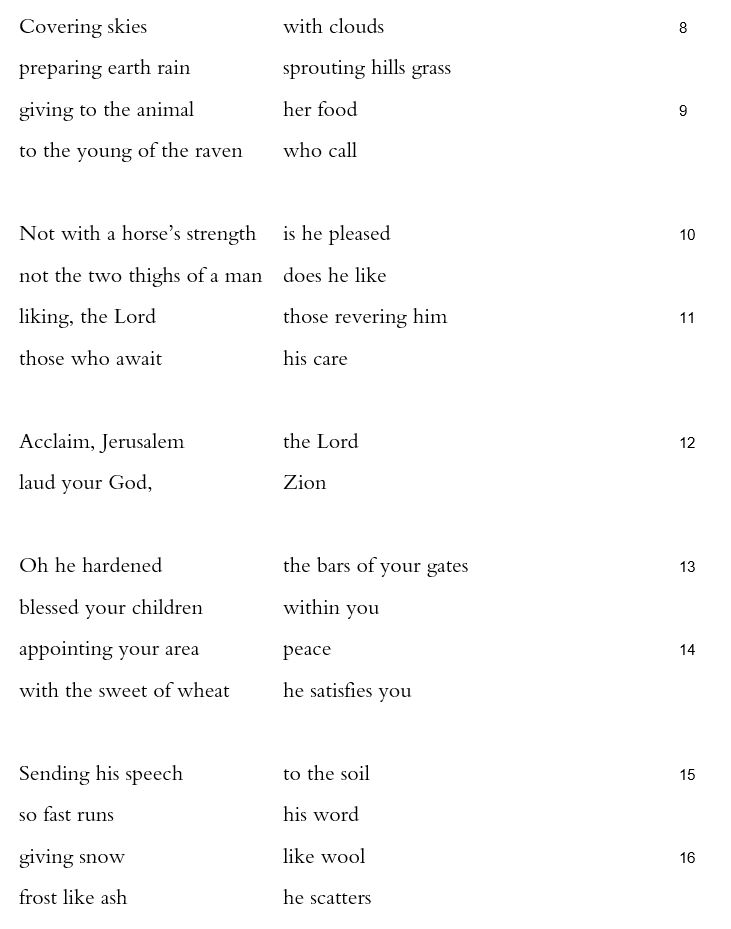
Allusions to the books of the Torah run throughout Psalm 147. The encouragement to “sing back” in verse 7 appears only here and in Numbers 21:17 in the brief Song of the Well, sung when Moses gathered the people at the Lord’s request: “Then Israel sang this song, ‘Go up, you well | sing you back all to her.’” The root of the verb `anah, “to sing in response,” which commonly means “answer,” calls to mind another song associated with Moses, Miriam’s song, which she “answers”: “Sing to the Lord | oh overwhelming he overwhelmed / horse and rider | he tricked in the sea” (Exod 15:21). The similar-looking word “weak” (`anavim) in verse 6 of Psalm 147 also suggests Moses, whom Numbers 12:3 calls “very weak” (`anav me’od). Such subtle cues may just be overtones in the reader’s ear, but the “covering skies | with clouds” of Psalm 147:8 unmistakably echo Exodus: “Moses went to the mountain; a cloud covered the mountains. The glow of the Lord settled on Mount Sinai. The cloud covered it six days. And he called to Moses on the seventh day from the middle of the cloud” (Exod 24:15-16).
In the second half of Psalm 147 as well, the Torah is an important presence. The “bars” in verse 13 are first mentioned in the building of the tabernacle in Exodus 26, 36, then later in Nehemiah 3 in the rebuilding of city gates. The “hardening” of those bars recalls the hardening of Pharaoh’s heart, and Moses’ words to the Israelites near the end of Deuteronomy, encouraging them to “be hard” (Deut 31:6), as well as the repairing of breaches in 2 Kings 12 and 22, not to mention the approximately three-dozen times the root chazaq occurs in 2 Chronicles and again in Nehemiah 3. And yet nowhere in Psalm 147 is the presence of Moses more significant than in verses 15-20, which read like an icy riff on the opening of the Song of Moses, “May my instruction fall like rain, my speech condense like the dew like showers on the sprouts like downpours on the grass.” (Verses 19 and 20 also cite Deuteronomy: Deut 33:10 “tell your ordinances to Jacob”; Deut 29:26 and 32:17 “they do not know them”).
Psalm 147 clearly also knows Isaiah 55’s gorgeous version of speech-as-precipitation, in which the Lord describes the Lord’s word:
for as descends shower or snow | from the skies and does not return
but oh has soaked the soil | and brought forth and bloomed
and given seed to who sows | and bread to who eats
just so is my word | that goes from my mouth
and does not return to me | empty
but has done what I liked | and achieved why I sent it
oh in brightness you go | in you peace you are carried on
the mountains and ranges | burst with song before you
and all the trees of the plains | clap hands (Isa 55:10-12).
It is possible to read Psalm 147 as simply a welter of remembered verses and passages meaningful to both writer and early audiences. The Septuagint considered it two separate psalms, the first ending at verse 11. It is also possible to read it as a code whose secrets are lost to time and inattention, or found only by those in the know. Its seventeen participles and play on the root `od in verse 6 (“keeping going… all the way”) make it stylistically continuous with Psalm 146. Its ten divine names, eight instance of “Lord” and two of “God,” make it seem at least like an editorial unity. But it is the threefold repetition of “his word” in verses 15, 17, and 19, combined with the extensive reference to other texts, especially those that blend creation, redemption, song, worship, and the building of Jerusalem, that make Psalm 147 seem not just an editorial unity, but a textual unifying, pulling Torah and Prophets and Writings together.
The assumption that the word of God and the Bible are simply coterminous is one of those sentence equations that manages to harm both of the terms it equates. Psalm 147 is an earnest latecomer to the long, slow work of canonization. It encourages the building of Jerusalem, and demonstrates in miniature the building up of the Bible. And as it culminates with a vision of a divine word that pours fast, now freezing, now thawing, now speaking specifically to Jacob, it makes abundantly clear that its regard for the written word is great, its celebration of divine action that transcends writing greater still.
 The Book of Psalms