• Page list
    • Posts
    • The Book of Psalms

The Book of Psalms

  • July 2nd, 2023

    Psalm 114

    * * *

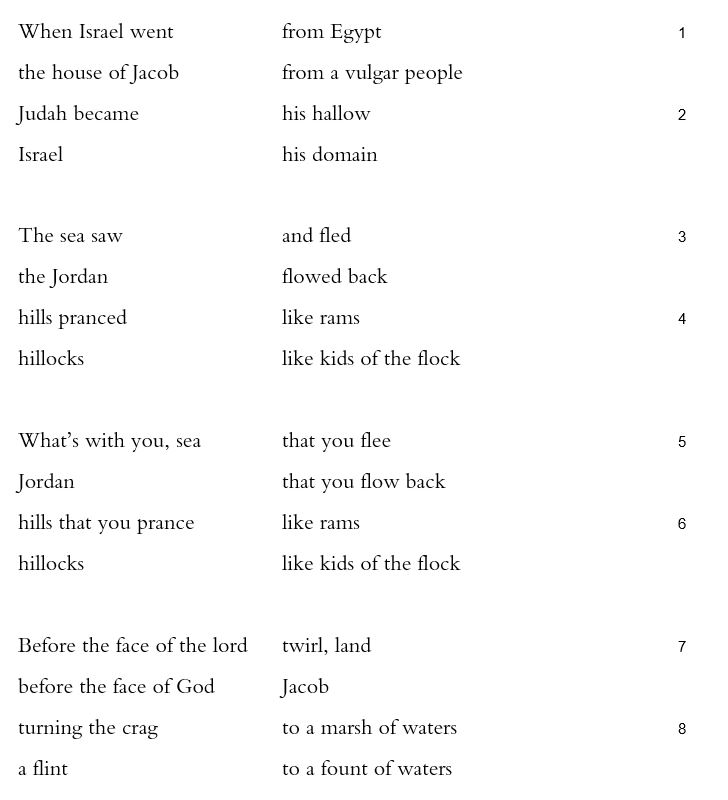
    The first stanza of Psalm 114 is quoted in a famous letter to Dante’s patron Cangrande della Scala, as the author (who may not be Dante) justifies the Commedia as a “polysemous work,” one that means both literally and allegorically:

    “if we look at the letter alone what is signified to us is the departure of the sons of Israel from Egypt during the time of Moses; if at the allegory, what is signified to us is our redemption through Christ; if at the moral sense, what is signified to us is the conversion of the soul from the sorrow and misery of sin to the state of grace; if at the anagogical, what is signified to us is the departure of the sanctified soul from bondage to the corruption of this world into the freedom of eternal glory.”

    Twenty-first-century readers of Psalm 114 are unlikely to share these exact modes of interpretation. Some may schematize interpretation differently, following the medieval system of pardes, for example (peshat—the plain sense, the surface; remez—the hinted, a sense below; derash—the sought-for senses of midrash; sod—the sense concealed), or guiding thought by the meticulous methods of specialist scholars. Still, everyone agrees: there’s more to this psalm than meets the eye.

    Even on its literal levels, “what is signified to us” proliferates and puzzles. It’s a psalm of pairs and parallels, to an unusual degree. Everything has a partner, from Israel and Jacob in verse 1, Judah and Israel in verse 2, Israel-Jacob and Judah-Israel in that first stanza, to the doubled triples crag-marsh-waters / flint-fount-waters of the final verse. The middle two stanzas track just about point for point, with three verbs and all seven nouns reiterated, the key difference being that the third stanza interrogates what the second stanza describes. If literal means historical, the going-out that the psalm commemorates is not just the “departure… during the time of Moses,” but the crossing of the Jordan after Moses’ death (Joshua 3). Both “literal” and “historical” also indicate when the psalm was sung and written, which clearly, according to the psalm’s first words, must have been later than those events of legend but is otherwise impossible to pin down. Why, when, and for whom does the psalm memorialize the heaping of waters at the Reed Sea and at the Jordan? Why wonder in that third stanza, unless to show wonder? And why command the earth to writhe? Is the point to see Moses’ act of striking the rock not as a pretext for preventing his entry, but as providence, the watering of a rocky land?

    These questions do not arise with allegory. They come from reading the letter. They all root in the literal—why one Judah inside two Israels plus a Jacob (two Jacobs if we count verse 7); why, though Judah is “his hallow,” is Israel merely “his domain”? And yet, rooted in the literal, the questions stem and bloom elsewhere.

    In other words, this is not a psalm interested in “redemption through Christ” or “the conversion of the soul” or the 613 commandments or the Ein Sof. What it does is to invite reciters to see the land between the Jordan and the sea as a mythic site of restoration. Like Genesis 1— which also begins with a b– preposition attached to an infinitive construct (bets’eit Ps 114:1; bere’shit Gen 1:1) and which also features the verb hayetah in its second verse (“and the earth was | empty and void”  Gen 1:2; “Judah became his hallow”)— Psalm 114 is a creation story. Reversing Genesis 1, Psalm 114 begins with dominion (“Israel | his domain,” mameshlotav, Ps 114:2; cf. limemshelet, “to rule the day… to rule the night,” Gen 1:16, velimshol “to rule day and night”) and ends with waters and waters (cf. mayim lamayim, “the waters from the waters” Gen 1:6). Every marsh and spring, in this poem of re-creation, becomes a former crag and flint; every knoll a kicking lamb.

    If a reader craves some schema to differentiate and order modes of interpretation, what could be more helpful than asking hard simple questions? What does a poem say and how? When and where, with what and for whom? Why? How does it differ from what I thought it would say? Why this with that? What’s missing? And the question that surges through Turgenev and Tolstoy and beyond, what is to be done, what to do? All other schemas impose.

    Share:

    • Share on X (Opens in new window) X
    • Share on Facebook (Opens in new window) Facebook
    Like Loading…

    About Me

    My name is Mark Minster. I’m an English and Comparative Literature professor with a background in ministry and in poetry. I teach courses on writing, reading, religion, and nature.

    Recent Posts

    • Psalm 150
    • Psalm 149
    • Psalm 148
    • Psalm 147
    • Psalm 146

    Newsletter

  • July 1st, 2023

    Psalm 113

    * * *

    For a poem whose main image is sitting still, a psalm with only two conjugated verbs, Psalm 113 swiftly maps the whole world, encompassing time and space. A balanced yet varied structure, the psalm features three stanzas, each its own syntactical unit. The first stanza embeds a jussive wish, “let the name the Lord be | adored” (2a), between three non-finite verbs for praise: “Laud… laud… be lauded” (1a, 1b, 3b; two imperatives and a participle). The second stanza relies on an implied copula between the interrogative “who” and “like the Lord | our God” (5), a question surrounded by a passive participle and two causative participle-plus-infinitive phrases: “lofted… making soaring | to sit in/ making sinking | to look around” (4a, 5b, 6a). The final stanza nests its clause, “he lofts the poor” (7b) within a third participle-plus-infinitive construction, “lifting from dust… to seat him” (7a, 8a), followed by a final participle, “seating” (9). With only a single declarative verb, “he lofts,” swirled around by non-finite forms, the psalm achieves stillness within motion, simplicity within complexity.

    Most of the rest of the work of the psalm takes place in prepositions, which locate the lofting in time as well as on the vertical and horizontal axes of space. The first stanza features a pair of “from… until” phrases, the prepositions m- + `ad: the temporal merismus “from now | on till ever” (2b), followed by the map “from the rising of the sun | on till its setting” (3), which marks the length of the day, the height of the sky, and the width of the world, all of which are appropriate for the praise of the name of the Lord. The second stanzas begins at the zenith of the vertical axis, with a pair of `al prepositions: “over all the others | the Lord/ over the skies | his glow” (4). The effect extends the height of the possible, above “the others”— itself a term that maps other cultures on the horizontal”— then above that above, above even the skies. That second stanza ends with a pair of b- prepositions that spread the stretched vertical axis horizontally: “through the skies | and through the earth” (6b). The final stanza returns to the prepositional m- prefix— “from dust… from the ash pile” (7), a vertical pair, pointing upward from the nadir— and adds a pair of ’im phrases: “with nobles / with the nobles | of his people” (8).

    These dimensions, the scope of time and space, are sketched out, too, by the psalm’s most compelling lines. The three hif`il participle + infinitive phrases—“doing x in order to y”—all articulate the psalm’s theme of rising: “making soaring | to sit in / making sinking | to look around” (5b-6a), and “lifting from dust | the low / from the ash pile | he lofts the poor / to seat him with nobles” (7-8a). Like the rising and setting of the sun near the end of the first stanza, these phrases combine up and down motion with horizontal spread. The sun rises and sets even as it crosses horizons. The Lord makes rising, ironically, to have a place to sit and dwell. The Lord makes sinking, why? To have a look around. And the Lord raises the weak and lowly to seat them among the nobles, whose plural spreads them all around.

    Most compelling of all is the poem’s final verse, “seating a woman infertile | in a home / a mother of children | glad” (9). The Lord’s seated in the skies, the impoverished person is seated among the nobles, and now is seated a woman who is `aqeret, a word that conveys infertility but more literally means “uprooted.” If the poor are uplifted, those adrift are homed. A psalm that spends so long up above with sun and skies ends down in the middens and in the situating of a woman in a home, where she is surrounded horizontally and moved forward in time, with “children | glad.”

    It would be easy to note all these dimensions in the psalm and then, for those of us who’ve read Eliade or even just the Zion psalms, to imagine this one woman’s seating as a kind of axis mundi, a sacred center of the world, an omphalos. It also calls to mind Hannah and 1 Samuel 2, a song this psalm seems to know. New Testament readers will recognize Psalm 113 as an ancestor of the Magnificat. There is a reason this psalm initiates Hallel. Something so cosmic culminates in such domesticity, which seems anywhere and everywhere, this nucleus of some woman’s pregnancy, someone low being lofted from dust, encircled by such electrical orbits of soaring and sinking and by imperatives to praise.

    Share:

    • Share on X (Opens in new window) X
    • Share on Facebook (Opens in new window) Facebook
    Like Loading…

    About Me

    My name is Mark Minster. I’m an English and Comparative Literature professor with a background in ministry and in poetry. I teach courses on writing, reading, religion, and nature.

    Recent Posts

    • Psalm 150
    • Psalm 149
    • Psalm 148
    • Psalm 147
    • Psalm 146

    Newsletter

  • June 30th, 2023

    Psalm 112

    * * *

    Hard on the heels of the Bible’s only other single-line acrostic, Psalm 112 shifts focus from the Lord, “feeling and tender” (111:4), to the virtuous person, the upright, the level, who is also “feeling and tender | and just” (112:4). While Psalm 111 celebrates the deeds of the Lord, particularly “all his mandates / being upheld | always and ever” (111:7b-8a), Psalm 112 characterizes the ideal devotee: “firmed his heart | leaning on the Lord / upheld his heart | he does not fear / as long as he sees | his enemies get theirs” (112:7b-8). Psalm 111 ends with the rhetoric of a wisdom psalm: “the start of sense | reverence for the Lord” (111:10). Psalm 112 begins with a similar convention: “all set, one revering | the Lord” (112:1). Peas in a pod, these two poems, though it is unknowable whether the two are the work of the same hands. Whoever fashioned this second psalm took the ribs of the first: “always standing” (111:10; 112:9), “and his justice | always standing” (111:3, 112:3).   

    But where the first psalm links the fidelity of the Lord to the perpetuity of laws, which are to be “studied | by all who revel in them” (111:2), the second psalm turns to the person who “has reveled much” “in his orders” (112:1), linking prosperity to justice. Psalm 111 names justice once. Psalm 112 makes justice its full refrain (112:3, 9), and adds two mentions of the just person (4, 6) near the center of the psalm. This just person is characterized repeatedly in economic terms. He has “riches and wealth | in his house” (3). He is moved emotionally but not physically: “one feeling | who lends / he sustains his things | with right / oh ever | he is not budged” (5-6a). And he is generous: “he has dispensed | he has given to the poor” (9a), “his horn | is lifted with heft” (9c). This heavy horn at the end of the psalm completes the vigorous seed at the start—the promise of bounty fulfilled. It is affluence, shared.

    The more it’s studied, however, the darker this psalm’s vision of a just economy becomes. Any compression of virtue and wealth into a single variable comes with inequitable consequences, especially in the implied association of poverty and depravity. The rich just person “gives” to the poor (9a) and “lends” (5), but without asking after the unevenness of wealth. Wealth comes to the good, the psalm implies, while the bad “sees | and seethes / he grinds his teeth | and wastes away” (10). This is the exact rhetoric of the so-called “politics of envy,” which paints have-nots as jealous of their moral and financial betters.

    Even worse, the reader must decide what to make of this threatening line: “he does not fear /as long as he sees | his enemies get theirs” (8b). The line is ambivalent in its preposition, “as long as” could be “until,” and strange in its tying of the heart of the just person who “does not fear” (lo’ yir’a) to yire’h, the seeing of the fate of the enemies. Who are these enemies? The next line has disturbing implications: “he has dispensed | he has given to the poor” (9). How does the syntax read? Is the one whose heart is firm unafraid because his enemies get theirs? Or is it that he will not fear until  his enemies get theirs? Or is the sense that, until (or as long as) he sees revenge on his enemies, he will give to the poor? Are these poor in fact his enemies, or others he sees as lusting after his wealth?          

    It may well be true, as the psalm concludes, that “the lust of cheats | is lost” (10). We might just be talking about different cheats.

    Share:

    • Share on X (Opens in new window) X
    • Share on Facebook (Opens in new window) Facebook
    Like Loading…

    About Me

    My name is Mark Minster. I’m an English and Comparative Literature professor with a background in ministry and in poetry. I teach courses on writing, reading, religion, and nature.

    Recent Posts

    • Psalm 150
    • Psalm 149
    • Psalm 148
    • Psalm 147
    • Psalm 146

    Newsletter

  • June 29th, 2023

    Psalm 111

    * * *

    There are any number of satisfying patterns in a poetics of pairs. One line with two halves contains all the possibilities that have been explored by students of biblical poetry since at least Robert Lowth: map, echo, balance, magnify, reverse. A typical verse in the Psalms made of two lines offers four half-lines, a progression more exponential than arithmetic. Four lines, eight halves, do more than double the poet’s options. An English sonneteer of the 17th century might spend ages arranging the eight + six of the Italian form or the three times four plus two of its Shakespearean twist. Given the challenge of shaping twenty-two lines, one for each letter of the alef-bet, the psalmist making an acrostic can try two fives and two sixes, four fours and two threes, three fives and a seven, seven threes and a one. Maybe there’s gematria and gnostic meaning involved, and obviously history and culture have their say, but there’s something in the art of patterning that pleases across cultures— us and the bowerbirds.

    The artifice of the acrostic is on full display in Psalm 111 and its helpmeet Psalm 112. In both psalms, each line starts with a new letter, a visual satisfaction on the page. Not to demean the psalm or the genre, but it’s not incredibly hard to do, especially if one deals almost entirely in formulas, categories, and abstractions. Nevertheless, Psalm 111 is built for study. It’s possible to read the poem as interlinked pairs, each line a chiseled refrain:

    I want to thank the Lord | with a whole heart    

    in the huddle of the virtuous | and the crowd          

    in the huddle of the virtuous | and the crowd     

    great deeds | of the Lord    

    great deeds | of the Lord              

    to be studied | by all who enjoy them (1-2).

    It’s a psalm of lines, after all, which can seem choppy if read wrong.

    But read slowly, it’s a festival of nouns, pronouns, and participles. That “huddle of the virtuous | and the crowd” takes us from the smaller circle of those behind the scenes to the larger congregation, on out to “all who enjoy them.” That “them,” the third-person plural suffix at the end of verse 2, returns in verse 10 attached to another participle, “all who do them,” but without a clear antecedent this time: all who do what? The psalm becomes a quiz, something “to be studied,” a search for an implied antecedent. So we read backwards, hunting plural nouns, of which, given the psalm’s compression, there are many: “the start of sense | reverence for the Lord / the smart of good,” verse 10 begins, without any finite verbs to keep the chain from being a plural whole. “All who do sense, reverence, the smart of good,” one answer might read. Back to verse 9, “a reward… his pact… his name” is another possible chain of singular nouns to consider as a plural antecedent for “all who do them.” If it’s just plural nouns we’re looking for, verse 7 offers “mandates” and verse 4 “marvels.” But the best antecdent for “all who do them,” `oseihem, is in plain sight: the word “deeds,” ma`asei, the same “them” as “all who enjoy them” back in verse 2. It appears three times in the poem: once in verse 2, and twice in the lines closest to the psalm’s center, in “the force of his deeds” (6a) and “the deeds of his hands” (7a). These two “deeds” surround the psalm’s only infinitive construction: “to give them | the inheritance of the others” (6b). This central line includes the psalm’s only free-standing pronoun, lahem, “to them,” which refers directly to “his people,” which precedes it, but indirectly also to “all who enjoy them” and “all who do them,” looping the people and the Lord’s deeds in mutual pronominal reference.

    More importantly, by relying so heavily on pronouns, nouns, and participles, this easy puzzle of a psalm manages to stay mostly outside of time. Nouns and pronouns are static. Participles are continuous. The poem clearly cares about continuity outside of time. Note the balanced repetition of “always” (3, 8, 10) and “ever” (5, 8, 9). There are only seven conjugated verbs in the entire psalm: “I want to thank,” “he made,” “he gave,” “he remembers,” “he made… know,” “he sent,” and “he ordered.” Of these seven verbs, the five perfective forms reinforce the Lord’s deeds, marvels, and mandates. The two imperfect verbs, “I want to thank” and “he remembers,” representing actions yet to be completed, speak for themselves.

    Share:

    • Share on X (Opens in new window) X
    • Share on Facebook (Opens in new window) Facebook
    Like Loading…

    About Me

    My name is Mark Minster. I’m an English and Comparative Literature professor with a background in ministry and in poetry. I teach courses on writing, reading, religion, and nature.

    Recent Posts

    • Psalm 150
    • Psalm 149
    • Psalm 148
    • Psalm 147
    • Psalm 146

    Newsletter

←Previous Page
1 … 8 9 10 11 12 … 37
Next Page→

Blog at WordPress.com.


Loading Comments...
 

    • Subscribe Subscribed
      • The Book of Psalms
      • Already have a WordPress.com account? Log in now.
      • The Book of Psalms
      • Subscribe Subscribed
      • Sign up
      • Log in
      • Report this content
      • View site in Reader
      • Manage subscriptions
      • Collapse this bar
    %d