Book Four of the Psalter ends not with a bang, nor with a whimper, but with harangue, a whole litany of charges. Psalm 106 accuses Israel down a long and slippery slope of crimes. It slides from character traits like desire, envy, recalcitrance, and impatience to such practices as tolerance and accommodation of other peoples, which it considers dangerous and wrong. The failure to commit genocide, in the eyes of this psalm, has given way to miscegenation between ethnicities, intermarriage. These have led directly—again, so claims the psalm—to infanticide and exile. Complaining and protesting lead to a failure to trust priests, which leads to cultural pluralism, a process that inexorably gets filthy, dirty, and debauched. If Psalm 105 is insidious, Psalm 106 is sinister.
There is a doubled frame to the psalm, and there are deft moments, so it is important for our own sake not to leap to moral response. The opening and closing show gratitude and praise for the Lord’s care (1-2) and compassion (45-46), and the call for remembrance and rescue (3) is answered by remembrance (45) and a repeated call for rescue (47). Even here, however, ethnocentrism arises in ways it hadn’t in prior psalms:
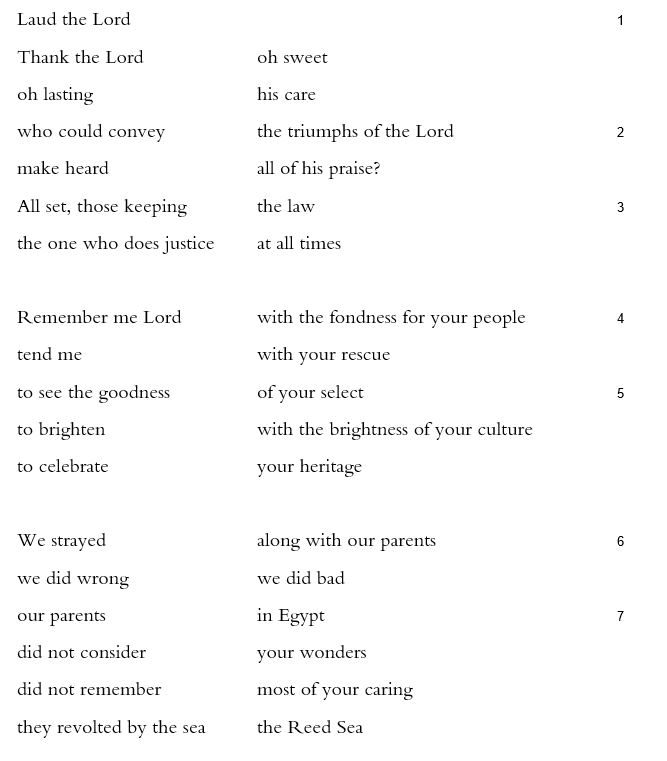
tend me | with your rescue
to see the goodness | of your select
to brighten | with the brightness of your culture
to celebrate | your heritage (4b-5).
The three infinitives reveal, already near the psalm’s start, what this psalmist thinks are the purposes of rescue, all three of them emphasizing exceptionalism, “your select… your culture… your heritage.” And while the Lord’s remembering at the end of the psalm is undeniably tender, divine rescue in this psalm retains its disdain for foreigners: “Rescue us | Lord our God / and take us away | from the others” (47).
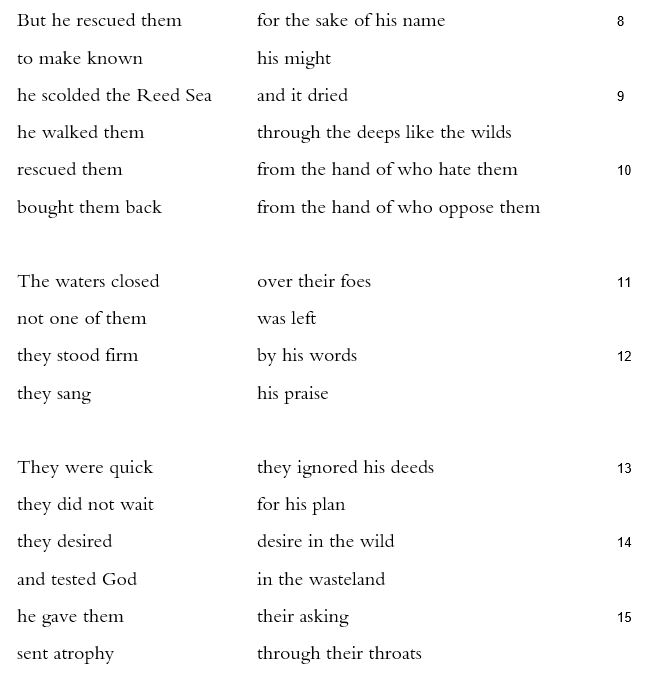
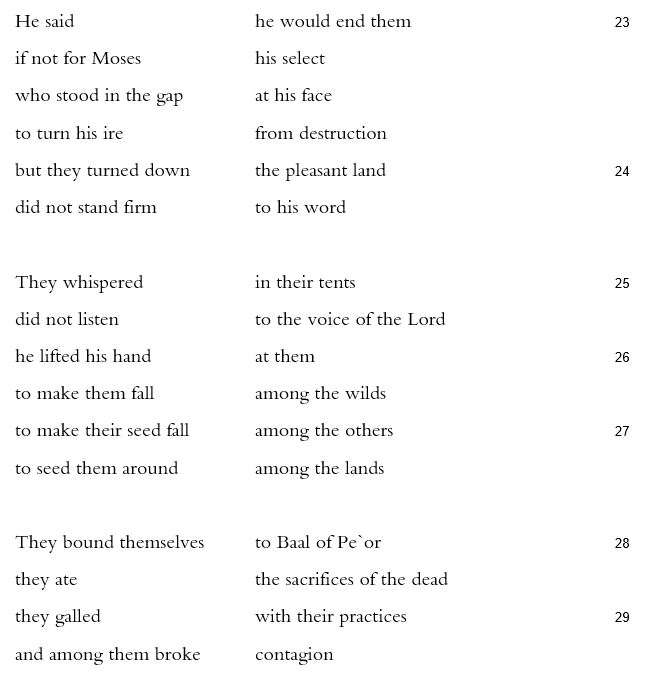
Most of the poem’s bile spills out not at foreigners, but at the Israelites themselves, who are walked through another highly selective history (see Psalm 105) that now emphasizes their wrongdoing at every turn. To read both Psalm 105 and Psalm 106 is to wonder if the two psalmists knew the same Exodus and Numbers. Instead of excerpts picked to emphasize the people’s resilience to external enemies in the transition from being servants to becoming masters, Psalm 106 features excerpts to show the people’s pattern of becoming their own worst enemy, deserving of exile and servitude. The children of Israel, “our parents | in Egypt,” begin their stubbornness before and after the parting of the sea (7, 13), continuing through the complaints in the wilderness (14-15) and other rebellions (16-24) and conspiracies (25-33), leading not to liberation and promised land, but to compromise (34-36) and child sacrifice (37-38), exile and defeat (39-42). Interestingly, the priest Aaron, “the hallowed of the Lord” (16), is distanced from the syncretism/idolatry of the golden calf, while Aaron’s grandson Phineas is praised for his “just” deed of spearing the Israelite man Zimri along with Cozbi the Midianite woman (Numbers 25). Both events, the golden calf and the double homicide, resulted in the slaughter of thousands. And yet perhaps the most telling word in these passages is the word “contagion” taken from Numbers (29, 30), describing not a literal contagion, but Midianite cultural influence.
If it’s important not to leap too quickly to moral condemnation of Psalm 106, it is imperative not to shirk such condemnation. It requires no great insight to point out that every justification of genocide, ethnic cleansing, and racism is deplorable, even criminal. Nor does it condone child sacrifice or encourage disloyalty or unleash contagion to point out that Exodus reads differently than does this psalm.
One response to this psalm’s contemptuousness is read it less often than any other. Another is to read instead the book of Ruth.
My name is Mark Minster. I’m an English and Comparative Literature professor with a background in ministry and in poetry. I teach courses on writing, reading, religion, and nature.
A handful of little verbal similarities offer one, surface-level explanation for why Psalm 105 should follow Psalm 104, though the difference in quality and sensibility between the two psalms could not be more profound. The mirrored sequence from Genesis to Exodus of creation story, narratives of patriarchs, and the Exodus offers another explanation. But there is a deeper reason why this highly selective, ethnocentric retelling of Israel’s prehistory should follow what precedes it, that magnificent psalm celebrating the world filled with God. That vision, particularly its erasure of “the errant” and “rogues” from the earth (104:35), contributes to this psalm’s ideological justification of an errand into the wilderness that dispossessed others of their home.
There are points of verbal contact between the two psalms, particularly near the end of Psalm 105. The “flames of fire” (105:32; cf. “flaring fire,” 104:4), the locust larvae “without number” (105:34; cf. “untold,” 104:25), and the quail and bread with which the Lord “gorged” the people of Israel (105:40; cf. 104:13, 16, 28) all link the two psalms. The watering of the desert is more significant: “he opened a crag | waters flowed / they went through dry places | a stream” (105:41) recalls “sending creeks | through ravines / between mountains | they go” (104:10). But while each of these details in Psalm 104 adds to that psalm’s thematic cohesion, their counterparts in Psalm 105 seem incidental.
Psalm 105 cares far more about the stories it excerpts. It highlights the Lord’s covenant with Abraham “and his vow | to Isaac” (9), presumably the threefold promises in Genesis 12, 15, and Genesis 26:3-5, promises of blessings, descendants, and most importantly, land. In Psalm 105, the promise of land becomes central to the Jacob cycle of stories, “saying to you I give | the land of Canaan / as the parcel | of your estate” (11). This version of the Joseph story omits brothers entirely (!), concentrating on the reversals of master-servant relationships, Joseph’s neck twice locked and unlocked from irons (18, 22). The retelling of the Exodus emphasizes plagues (28-36), omitting the Lord’s appearances at the burning bush and, most strikingly, Sinai.
Instead of encounters with God, Psalm 105 leads directly to the legend of the conquest of Canaan.
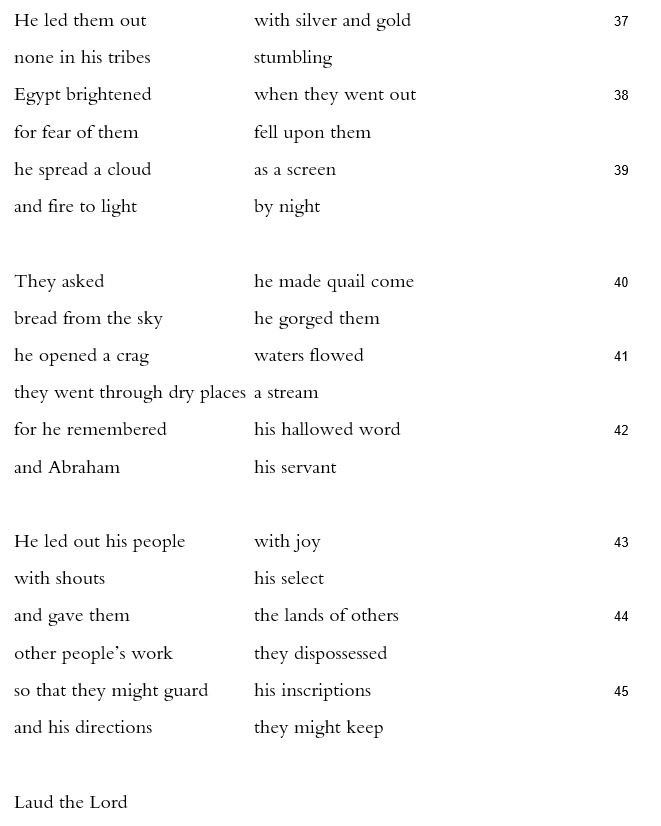
He led out his people | with joy
with shouts | his select
and gave them | the lands of others
other people’s work | they dispossessed
so that they might guard | his inscriptions
and his directions | they might keep (43-45).
Despite the mention of “his inscriptions / and his directions,” the poem spends most of its time justifying the occupation of “the lands of others.” It sets in stone not the tablets of the law, which it elides, but part of the promise to Abraham, the claim to the land:
He stood it for Jacob | as an inscription
for Israel | a lasting pact
saying to you I give | the land of Canaan
as the parcel | of your estate
there being few | in number
barely any | but migrants there (10-12).
All the rhetorical gestures that cloak invasion as manifest destiny are there: we were here first, God’s select; the others were the real aggressors, as dangerous as the Egyptians were; the place was basically empty. The justifications ring as hollow as they always do, for conquistadors, Puritans, and Putins, with all their pretexts for dispossession.
To Hermann Gunkel’s claim that “the poem is certainly no great work of art,” Mitchell Dahood counters that the poem contains “a number of literary subtleties” and that factors like “the effective separation of composite phrases in parallel verse members” and “the competent use of chiasmus” “bespeak uncommon literary artistry” (III.51). Faint praise cannot recuperate a poem so bent on occupying others’ lands that it has to rely on tendentious reductions of Genesis and Exodus. How else does one justify invasion, occupation, and genocide, but by excising every story of siblings and children, eviscerating the great story of emancipation, not to mention ignoring commandments that promote justice while condemning murder and theft? In response to Gunkel and Dahood, who cares whether Psalm 105 is aesthetically good or bad? It’s reprehensible.
My name is Mark Minster. I’m an English and Comparative Literature professor with a background in ministry and in poetry. I teach courses on writing, reading, religion, and nature.
The most sublime of all psalms, a triumph of biblical poetry, Psalm 104 is also the most potent natural theology ever written, its purpose not to deduce nor prove God’s existence but to celebrate the world as a surfeit of movement and light.
The poetry dazzles from the start. Its praise of the Lord in verse 1 includes the marvelous sound cluster, gadalta me’od hod vehadar lavashta, “you are vast and very / in fine finery | you are arrayed.” It’s so many dentals, such open vowels. Hod echoes me’od, and is echoed by vehadar: “very/ in fine finery.” The labial sounds of the verb lavashta (“you are arrayed”) quietly call back the word nafshi, “throat” from the beginning of the verse, linking God’s garments with the speaker’s speaking self. Verse 2 is similarly sonorous, carrying on with the o and a sounds: `oteh ’or kassalemah noteh shamayim kayri`ah, “wrapping light | like a cape/ extending skies | like a curtain.” The rhymes wed “wrapping” with “extending,” “cape” with curtain. The repeated shin/sin sounds continue from verse 1, now associating “throat” and “you are arrayed” with “cape” and “skies.” The word “curtain” picks up the guttural-with-r combination of the word “light.” If the sense is that the Lord is both wrapped in and unfurling the light and the sky, verbal dexterity underscores both parts, the enfolding and unfolding. Like a purloined letter, both cape and curtain reveal what they conceal.
Most of the psalm’s power and loveliness is not lost in translation. Genesis 1 orders creation through meticulous patterns of opposition and separation, the waters above separated from the waters below. Here, however, the waters spill. They spill carefully, perhaps, and they do have their places, but they spill nonetheless, from verse 6 all the way to verse 15, metamorphosing into animals and plants, into bread and wine and oil and bread. The waters “flit off” and “flee” (7), “they scale mountains | they go down dales” (8). They become “creeks | through ravines / between mountains | they go” (10). “They make drink | all the life of the field/ they slake the thirst | of the onagers” (11). The giving waters remind one of Keats’s autumn, which conspires with the sun “to load and bless | With fruit the vines that round the thatch-eves run… And fill all fruit with ripeness to the core.” What lines feel more like that ode than this psalm’s verses 13 and 14?
making mountains drink | from his lofts
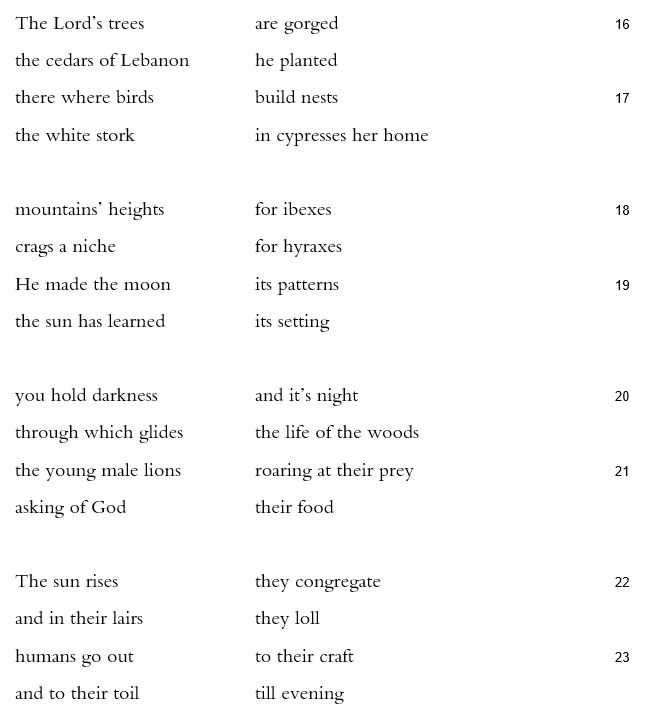
of the fruit of your works | the earth is gorged
sprouting grass | for the herd
and greens | for the help of mortals.
The water brings fertility and food in a way that seems at first anthropocentric, as teleological as the Priestly creation story in Genesis 1, a kind of argument from design: “wine | he brightens the human heart / to glisten faces | oil / bread | the human heart upholds” (15). All of the water and all the green suddenly seem directed towards human fulfillment in this nearly ritual verse, the heart of a person pleased with bread and wine, drops of oil lingering around the mouth. And yet the “he” of verse 15 can refer both to God and to the wine itself, which weakens the purposiveness. By comparison with Genesis 1, the psalm claims absolutely nothing about human dominion.
That the poem concerns much more than human fulfillment is clear because the poem keeps going. It leads not to bread and wine, but to trees and birds (“the white stork | in cypresses her home,” 17), and to the yearling lions “roaring at their prey / asking of God | their food” (21). Lions say grace. The sea does as well. “For you | they all wait / to give them food | in its time” (27).
The swelling conclusion of the poem is neither pat nor perfect, neither crowning the human nor treating God, or knowing, or order with the kind of theological certainty that Hume rightly despises. Rather, the poem closes with the scene of its making, the psalmist expressing first-person wishes and explaining why:
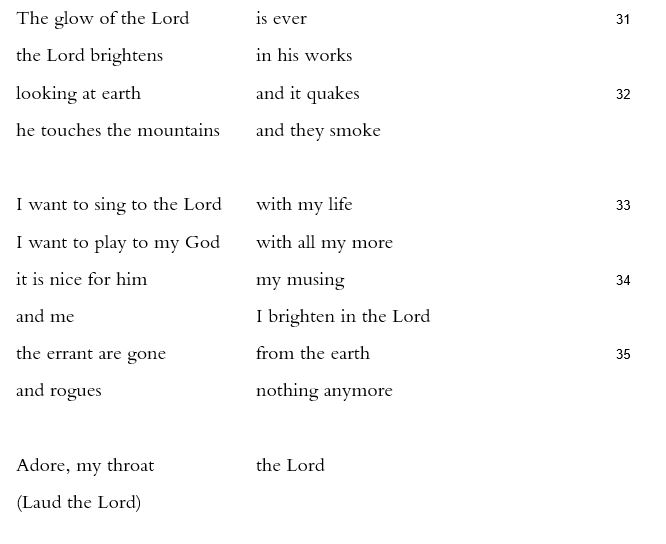
I want to sing to the Lord | with my life
I want to play to my God | with all my more
it is nice to him | my musing
and me | I brighten in the Lord
the errant are gone | from the earth
and rogues | nothing anymore (33-35).
The pairing of ashirah (“I want to sing”) and azeimmerah (“I want to play”) is conventional, but the rest gets more and more surprising. The speaker’s life (33) calls back “the lives” of the sea (25), the “life of the woods” (20), and “all the life of the field” (11). In verse 33, her own “life” is paired with the word be`odi, a construction built of the prepositional prefix “with” or “for,” plus the first-person possessive suffix “my,” which surround the adverbial substantive `od, a word that conveys continuity as well as excess, the notion of still more besides. Its appearance here anticipates the `od of verse 35, where its negation help erases bad from the world. To the attentive reader, it also echoes other parts of the psalm, the similar sound of me’od, the Lord’s “very”(1) and ve`ed, the “on” in the “ever and on” of the earth’s foundation (5). Together, the speaker’s life and continuity, her exceeding of herself, call to mind the Lord’s self-exceeding and the continuity of the world, a continuity and a greater-than that both exclude the bad.
The passage’s middle and final verses surprise even more. “It is nice for him | my musing / and me | I brighten in the Lord” (34). Like verse 33, these verbs may be aspirational, jussive (“may it be nice for him”) and cohortative (“may I brighten in the Lord”), but they also read as declaratives. As declaratives they blur, amplifying meaning: “my musing” and “I” are nice for him, my musing is nice for him and for me. The speaker’s brightening joy recalls the wine and heart of verse 15 as it recalls the beautifully ambiguous phrase from verse 31, “the Lord brightens | in his works.”
On a first reading, verse 35 feels frankly out of place from all of this, abruptly turning to cheats and sinners, the wayward and the wrong. Just like verse 34, however, the verse is both a wish and a surprising declaration. “May all the errant be gone,” an optimist prays for the world. And yet, under the aspect of Psalm 104, perhaps the errant are already gone. What do the rogues amount to? Their character is privative, whereas the world is abundance.
The world is filled with light and motion. God moves (2-4); the waters move (7-10); plants sprout (14); animals nest and move (12, 17-18, 20-22, 25-27), including humans (23). God unfolds and enfolds light (2) and bodies of light (19-20), which move, making night and day (20-23). This light is the Lord’s glow, the Lord’s brightening (31). But more important than both the light and the movement are all of the images of filling and satisfying, images of surfeit. “Of the fruit of your works | the earth is gorged” (13), the psalm insists, later adding that “the Lord’s trees | are gorged” (16) and that the Lord opens a hand and all “are gorged with good” (28). This is Genesis 1, but more. God doesn’t just create light and see that it is good. The world is light and good, stuffed to excess.
To call Psalm 104 a natural theology may be a stretch if the term is narrowly conceived as a product of Western medieval and early modern rationalist theologians or of those willful 19th and 20th century Rip Van Winkles who imitate them. There is something much wiser about Gerhard von Rad’s insistence that the very idea of nature is alien to the Hebrew Bible. With no nature, how could there be either a natural theology or even a supernatural? Indeed, the luster of this particular psalm is how its spilling of water and light becomes the filling and feeding of the living of the earth, how these lives reply to the body of God, their wind taken and given. There is no nature because these are lives, not things, not objects contrasted with human or divine subjects. Just as importantly, the poem doesn’t argue. It celebrates and muses. And in its musing, ALL is supernature, lives are gorged, so gorged with good that the proper response is to brighten in the Lord, to see the rotten and rogues as nothing anymore.
My name is Mark Minster. I’m an English and Comparative Literature professor with a background in ministry and in poetry. I teach courses on writing, reading, religion, and nature.
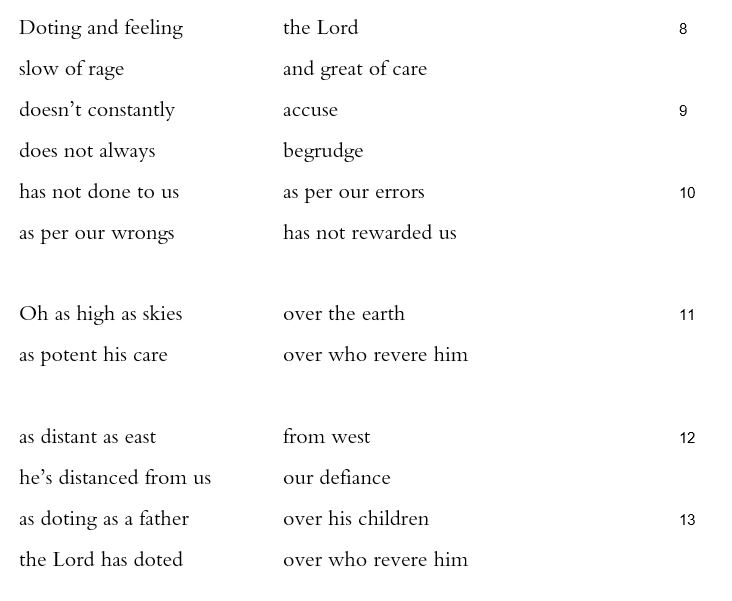
Like Psalm 102, to which it seems a response, Psalm 103 features a trio of similes. Instead of three lonely birds, however, the comparisons at the heart of Psalm 103 map distance in three dimensions: the maximal heights of the Lord’s care (11), the maximal horizons to which the Lord banishes evidence of rebellions from those who care (12), and the intimacy we assume is also maximal, the compassionate womb-love (“doting”) an ideal father has “over his children” (13). The Lord’s towering care, limitless generosity, and paternal tenderness—these are the core of the psalm.
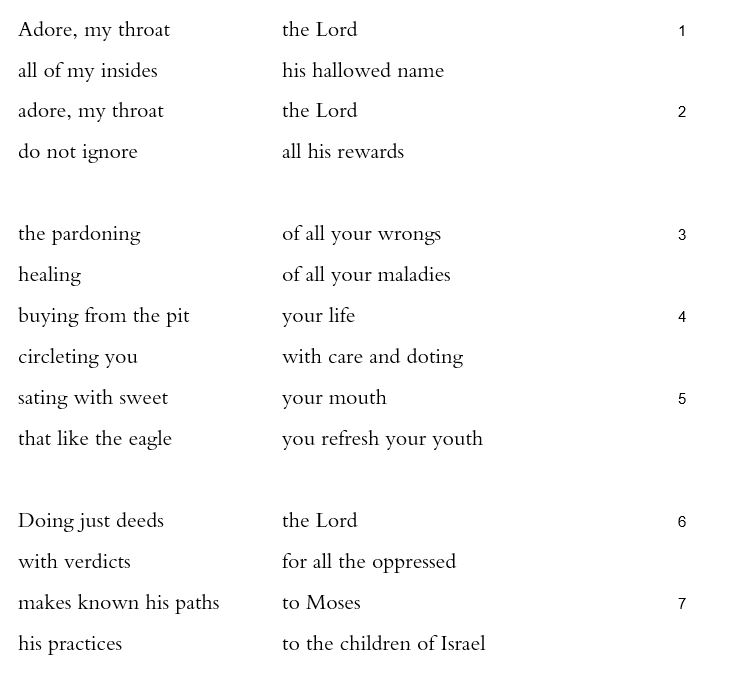
As in Psalm 102, what precedes the center forms a relatively cohesive unit. The Lord’s “rewards” (2) are listed in a six-line stanza as a tight series of participles that could be translated, as here, with gerunds that emphasize the deed (e.g., “the pardoning | of all your wrongs,” 3a) or with “who” clauses that emphasize the doer (who pardons | all your wrongs). The first five participles move narratively swiftly upward from bad to good, “pardoning… healing… buying from the pit… circleting you… sating with sweet” (3-5). The sixth participle, “doing,” gets its own larger syntactical unit in a four-line stanza:
Doing just deeds | the Lord
with verdicts | for all the oppressed
makes known his paths | to Moses
his practices | to the children of Israel (6-7).
This naming of Moses and the children of Israel, together with the paired terms “just deeds” and “verdicts” (6), “paths” and “practices” (7), clearly points to the origins of the law. And since the six-line stanza that follows this one mirrors important parts of the stanza that precedes it (“your wrongs,” 3, “care and doting,” 4; “doting… care,” 8, “our wrongs,” 10), the entire unit concerns the law. Its point seems to be that the law does not exist to introduce sin, as Paul will later cleverly claim in Romans. Rather, the law is what God does, part of the participial narrative of caring and liberating. It is who God is, “doting and feeling… slow of rage | and great of care” (8).
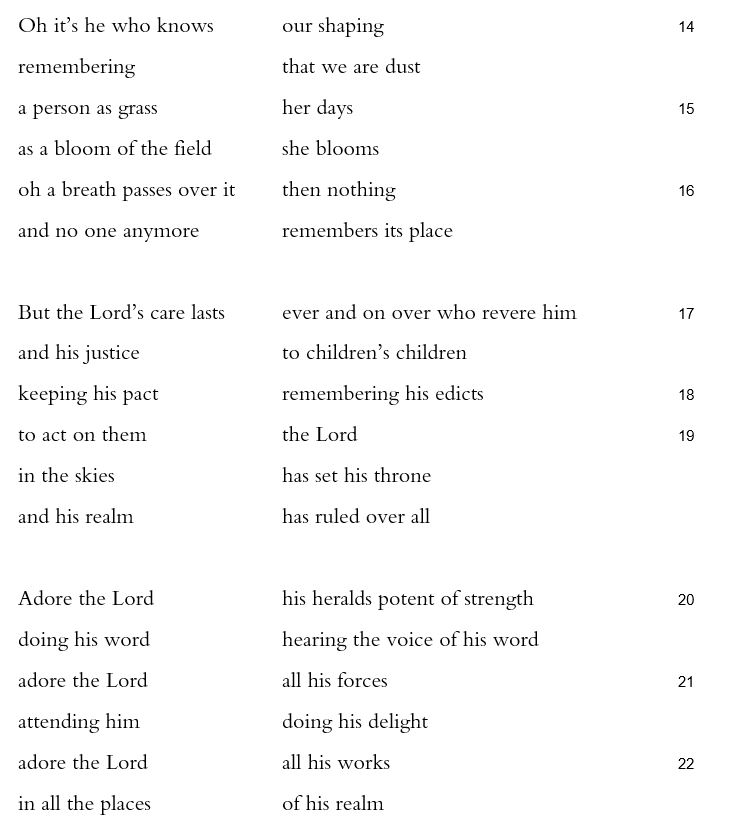
As in Psalm 102, what follows the center also forms a unit. This second unit shows not just structural, but thematic similarity with the previous psalm, contrasting human ephemerality (“we are dust/ a person as grass | her days” (103:14b-15a; cf. 102:11-12) with the perpetuity of the Lord’s care and justice (103:17; 102:12). And yet the participle sequence that began in the first half of Psalm 103 continues. As “doing” had its own stanza, now “remembering,” the seventh participle, has its own stanza (14-16). If the first half considers the Lord’s care as it relates to the law, what the Lord “does,” the second half concentrates on care as remembering: remembering human mortality. In the subsequent stanza, the law returns in a pair of plural participles that convey what “who revere him” and “children’s children” do: “keeping his pact | remembering his edicts” (18). Slyly, the Lord’s remembering in 14 and the people’s remembering in 18 surround the absence of remembering in verse 16—the image of a forgotten bloom as a figure for mortality.
Four more plural participles show up among the singular “adore” imperatives that frame the psalm. The Lord’s “messengers” are those “doing his word | hearing the voice of his word” (20); the Lord’s “forces” are those “attending him | doing his delight” (21). Among the psalm’s many repetitions— “all,” “over,” “adore, “Lord,” “doting,” and “care” all appear at least four times—perhaps none are as significant as “doing” and “remembering.” They indicate the efforts of both God and the people, balancing the psalm’s emphasis on tender care with an emphasis on responsibility. The overall psalm suggests that the law exists not to punish, and yet those messengers and forces at the end raise compelling questions.
My name is Mark Minster. I’m an English and Comparative Literature professor with a background in ministry and in poetry. I teach courses on writing, reading, religion, and nature.







 The Book of Psalms