• Page list
    • Posts
    • The Book of Psalms

The Book of Psalms

  • June 20th, 2023

    Psalm 102

    * * *

    A striking collage of personal lament and Zion’s praise, Psalm 102 holds together powerfully if we hear the lament as spoken in Zion’s voice. “Lord | hear my prayer,” the psalm begins generically, in the voice of conventional address (1). In verses 3-11, however, clichés gradually fade. A tight five-stanza complaint follows, with images of fire and dry grass, smoke and shadow (3-4a, 10-11) surrounding images of bodily wasting, and forgotten or ashen bread (4b-5, 8b-9), all surrounding a remarkable trio of bird similes:

    I look like a cormorant | in the wild                                             

    I’ve become like an owl | of a ruin I’ve kept watch                          

    and am as a wren | alone on a roof all day (6-8a).

    Solitary birds, perched or nestled on wilderness and ruin and roof, they linger night and day.

    As a lament, the passage is more metaphorical than informative. The speaker suffers from loneliness, from emaciation and mourning, and from impending mortality, the spread of shadows and evanescence of days. Only in the last of these five stanzas does the speaker return to address God in the second person, revealing bitter hurt: “from your face of fury | and fuming / oh you lifted me | to throw me down”(10).

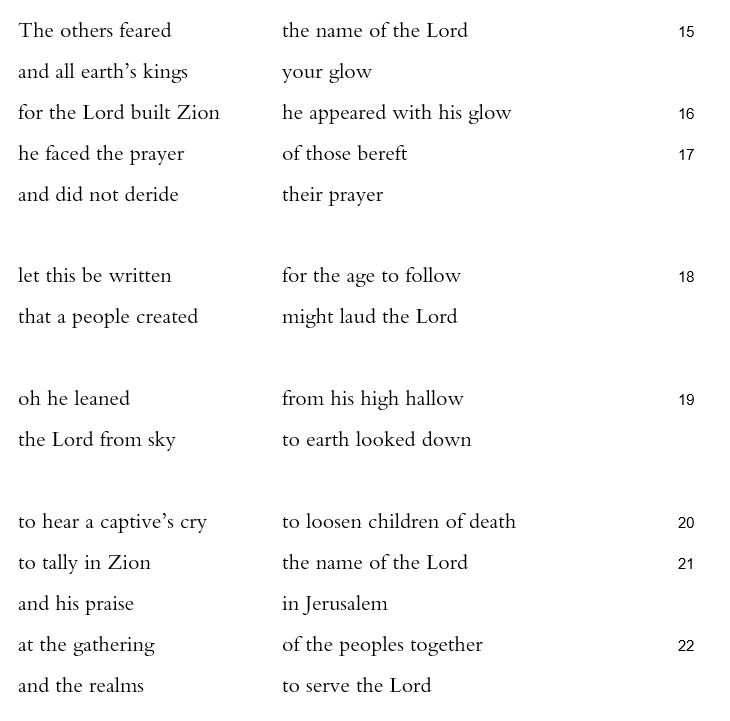
    While this lament in verses 3-11 is prefaced by the formulaic verses 1-2, the broader memory of what Zion was in 15-22 has its own preface in verses 12-14. Instead of the past, it emphasizes both timelessness (“you Lord | ever stay” 12) and the transformative now (“oh the time to feel for her | oh the moment has come” 13). That the moment has come recalls the shout of the trees in Psalm 96:13, “oh he’s come he’s come,” ki va’. Poignantly, the announcement that the time has come for the Lord to pity or feel compassion for Zion is mirrored by, maybe even motivated by, the compassion that the Lord’s servants feel for her “ash” (14, cf. 9). Zion’s ash is the speaker’s ash, her ruins the speaker’s ruins. Verses 15-22 recall the building of Solomon’s Temple, when the Lord “faced the prayer | of those bereft / and did not deride | their prayer” (16-17). The passage also looks back to when “the Lord from sky | to earth looked down,” some past time, either construction or afterward, with a series of infinitive purposes:

    to hear a captive’s cry | to loosen children of death               

    to tally in Zion | the name of the Lord           

    and his praise | in Jerusalem

    at the gathering | of the peoples together

    and the realms | to serve the Lord  (20-22).

    The Zion passage, then, pairs what the temple was with this vision of what the temple was meant to be, and still could be: a kind of listening post as Solomon describes it in 1 Kings 8. The hearing of the captive’s cry is both past and future, as is the loosing of children from the threat of death, that they might tally and serve. Cumulatively, the passage remembers a past in order to look forward to the present, and as it does, it creates a present that looks ahead: “let this be written | for the age to follow / that a people created | might laud the Lord” (18).          

    Both the lament and the Zion sections are vivid and affecting, each finishing with what feels like an end: the dried up grass of verse 11, all the kingdoms and people gathering in verse 22. The psalm’s final movement has to bring the first two together, to make the first section’s personal sense of the lengthening shadows of days meet the second section’s historical sense of Jerusalem’s loss and God’s timelessness. Now that we are in the moment of the psalm, the moment of compassion for Zion, the speaker suddenly cries, “He sapped my path of power | cut short my days / I said my God don’t | snatch me up with half my days / when age after ages | are your years” (24). Again the psalm returns to the past with a purpose: to show what does not change. The earth and “the skies / they end |  but you go on” (25b-26, cf. 11-12). “All things age as clothes | as a coat you slough them off / they slough off | but you are the one / whose years | do not end” (26b-27).

    Powerfully, a psalm with so much ash and rubble, so much loss against such changelessness, ends with an almost Rilkean image of descent and figures for eternity. “Your servants’ children | settle down” (28) is a continuity that shares God’s timelessness with ages to come, the readers implied by verse 18. This verb “settle down,” yishkonu, is echoed by its parallel verb “is set,” yikon, the very last word in the psalm. It’s the word used for a foundation, and what is being founded is “their seed,” the offspring, the line. What but a seed pressed into the ground could serve as such a potent response to the dried grass and bones and dust of Zion’s lament, compensating for loneliness and the cutting short of days? What better way “to loosen children of death” than to see children settling and seeding the ground?
    Share:

    • Share on X (Opens in new window) X
    • Share on Facebook (Opens in new window) Facebook
    Like Loading…

    About Me

    My name is Mark Minster. I’m an English and Comparative Literature professor with a background in ministry and in poetry. I teach courses on writing, reading, religion, and nature.

    Recent Posts

    • Psalm 150
    • Psalm 149
    • Psalm 148
    • Psalm 147
    • Psalm 146

    Newsletter

  • June 19th, 2023

    Psalm 101

    (of David, lyric)

    * * *

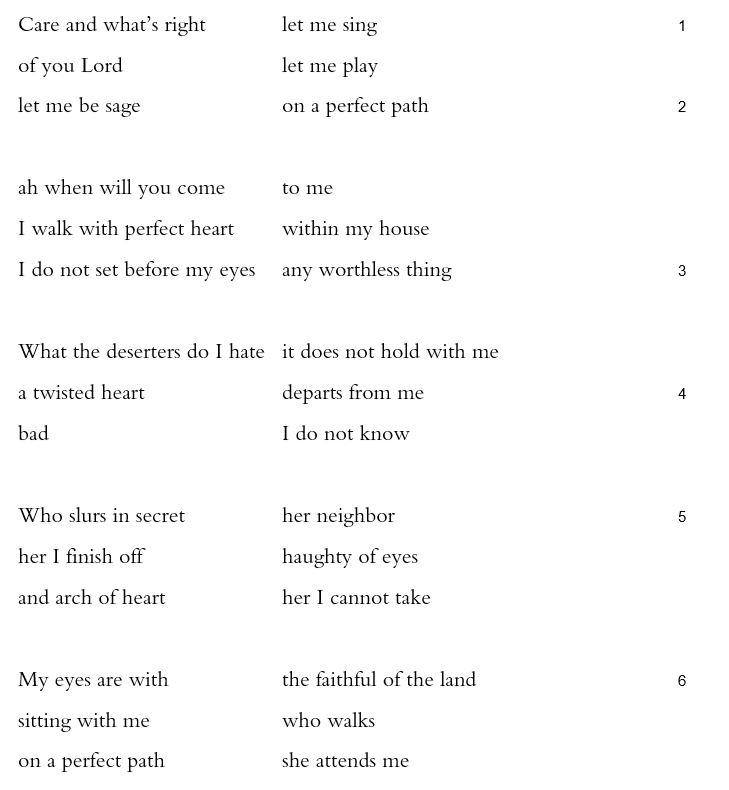
    It’s not quite Arma virumque cano, but Psalm 101 does start by announcing its theme. It isn’t Virgil’s “arms and the man” the psalmist sings, but the ethical pair of chesed and mishpat, the divine relationship between loyal caring and legal rectitude, virtue and propriety brought together. That phrase “Care and what’s right” works both as a balanced pair and as a hendiadys, “right care.” It also squints syntactically with “lyric” in the superscription, “lyric of care and what’s right,” allowing the lyrics themselves to also begin with the more traditional “let me sing” (1; Exod 15:1, Isa 5:1, Ps 13:6). And yet Psalm 89—the psalm that precedes the collection of Psalms 90-100 which precedes this one, the most recent psalm to mention David—begins similarly, “The caring of the Lord | ever I sing (89:1). That verbal similarity suggests a different reading, linking “Care and what’s right” with “of you,” the lekha of the second line. It’s the Lord’s caring and virtue the psalmist sings and plays.

    In the bulk of the psalm, at least in verses 3-8, this relational virtue or caring principle— or perhaps principled caring, virtuous relationship?— is demonstrated by a series of character types and the speaker’s relative distance from each:

    There cannot sit | within my house                 

    a worker of fraud | a teller of lies

    is not sturdy | before my eyes (7).

    Here, for example, are two categories of deceiver, plus two building metaphors. The one who plays false is an unwelcome guest; the one who speaks false lacks a foundation. With both, the crucial rhetorical move is not just to name the types, but for the speaker to pronounce her distance from them. The third stanza witnesses “deserters,” whose collective deed (“what the deserters do”) the speaker despises. “It does not hold with me,” the speaker says, adding in progression, “a twisted heart | departs from me / bad | I do not know” (3b-4). One could map this morality, location and vector, as those who cannot come towards me, and those who must go away “from me.” In verse 6, admittedly a curious place, are the good ones, the nearest of all:

    My eyes are with | the faithful of the land

    sitting with me | who walks

    on a perfect path | she attends me

    The faithful sit “with me.” The walker along the ideal way, she ministers to me. Motion or stillness, what matters is how close the speaker keeps these various character types.

    Similarly, proximity is what’s at stake in the repeated mention of “eyes.” The psalm’s first and last expressions, “before my eyes,” are both negations. With both “I do not set before my eyes | any worthless thing” (3) and “a teller of lies / is not sturdy | before my eyes” (7), the speaker distances and purges. The two middle expressions contrast the boastful, “haughty of eyes / and arch of heart” (5), with the speaker herself, “my eyes are with | the faithful,” literally “my eyes with the faithful” (6).

    But whose eyes are these? Who speaks in this psalm? Some assume a Davidic king speaks, given the superscription and the word “house” (2, 7). But nothing in the psalm itself makes the speaker a king. How could a king know “Who slurs in secret | her neighbor” or how, with any justice, declare “her I finish off” (5)? Does a king make nighttime rounds and “By dawn… finish off | every rogue of the land” (8)? Is that the same as “care and what’s right” or being “on a perfect path” (2,6)? After verse 2, the more likely voice is God’s, the Second Temple a more likely house than a royal palace.

    The psalm thus means on at least two levels. We hear God—whom the last psalms have made clear IS the king—declaring values and rightness, orienting everyone in relation to God: “I walk with perfect heart | within my house / I do not set before my eyes | any worthless thing” (2c-3a). We also hear the human speaker, lingering past the first verse, justifying her own morality by her distance from others.          

    At the moment of transition, between the three opening wishes set clearly in the psalmist’s voice (“let me sing… let me play / let me be sage”) and the long list of declarations from “I walk with perfect heart” (2c) to “By dawn I finish off” (8) comes the psalm’s strangest, loveliest line, indeed probably its only lovely line: “ah when will you come | to me” (2b). That the consonants of “to me” (’elai) look like the consonants of “my God” (’eli) only amplifies the line’s curiosity. Who is asking whom? Is the speaker asking God, or God asking the speaker? How does this yearning for closeness relate to the finishing off and cutting off of enemies? Is the rest of the psalm one long attempt of a speaker focused on relationship to justify herself to a God she feels needs something proved?

    Share:

    • Share on X (Opens in new window) X
    • Share on Facebook (Opens in new window) Facebook
    Like Loading…

    About Me

    My name is Mark Minster. I’m an English and Comparative Literature professor with a background in ministry and in poetry. I teach courses on writing, reading, religion, and nature.

    Recent Posts

    • Psalm 150
    • Psalm 149
    • Psalm 148
    • Psalm 147
    • Psalm 146

    Newsletter

  • June 18th, 2023

    Psalm 100

    (lyric of thanks)

    * * *

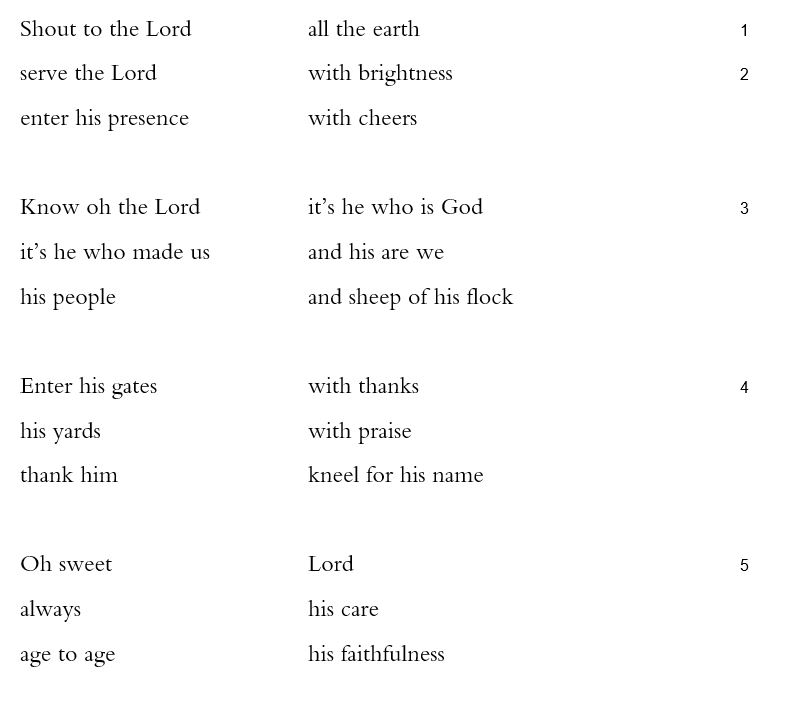
    The crest of the wave of psalms that begin Book Four, Psalm 100 is as taut as can be. A single twelve-line composition, it works as three quatrains, even better as four tercets. In four tercets, the psalm’s seven plural imperatives are patterned 3-1-3 across the first three stanzas. The trio “shout” (1), “serve,” and “enter” (2) is mirrored by “enter,” “thank,” and “kneel” (4), the abstract “serve” pairing with the abstract “thank,” a riotous shout stilling to a kneel. In the middle of these six imperatives— linked by proximity more to the first group of three— is the verb “know,” the psalm’s central imperative. This knowing has three tenets: “it’s he who is God / it’s he who made us | and his are we” (3). And yet there is only one declarative verb within this sequence of what is to be known: “that the Lord, he, God, he, made us, his, we,” a word-for-word rendering might go, awkwardly indicating how emphatically the pronoun chain “he… he… his… we” reinforces the singular point that creation implies a particular relation. Taken all together, the structure of imperatives locates knowing between serving and thanking, weaving those mental actions within more physical actions, shouting, entering, entering, kneeling.

    Balanced in the first and third of these first three tercets are four “with” statements: “with brightness… with cheers” (2), “with thanks… with praise” (4). The series invites reflection, a whole seminar on liturgy and psychology. Does “brightness” beget cheering the way gratitude begets praise, like some SAT pair of analogies? Or are the first two attitudes preconditions for the second two?

    Likewise, in the second and fourth stanzas are balanced “his” statements: “his people | and sheep of his flock” (3), “his care… his faithfulness” (5). Does being “his people” relate to “his care” the way being sheep of “his flock” relates to “his faithfulness”? Essays are due next Friday.

    While it’s true that biblical Hebrew allows the reader to supply the verb “to be”— it permits the copula to be elided, to put it technically— the absence of verbs in the final stanza is surely significant. The entire psalm has only eight verbs, the seven imperatives plus God’s act of making. The final stanza, then, works not to predicate anything of the Lord, but to present “his name” with all that that implies:

    Oh sweet | Lord

    always | his care

    age to age | his faithfulness (5)

    As with the second stanza, the reader can assume three copulas here (i.e. “Oh sweet is the Lord/ always is his care/ age to age is his faithfulness) or none. Having none, the last stanza completes the clause that began in verse 4, “kneel for his name: oh sweet Lord.”

    Share:

    • Share on X (Opens in new window) X
    • Share on Facebook (Opens in new window) Facebook
    Like Loading…

    About Me

    My name is Mark Minster. I’m an English and Comparative Literature professor with a background in ministry and in poetry. I teach courses on writing, reading, religion, and nature.

    Recent Posts

    • Psalm 150
    • Psalm 149
    • Psalm 148
    • Psalm 147
    • Psalm 146

    Newsletter

  • June 17th, 2023

    Psalm 99

    * * *

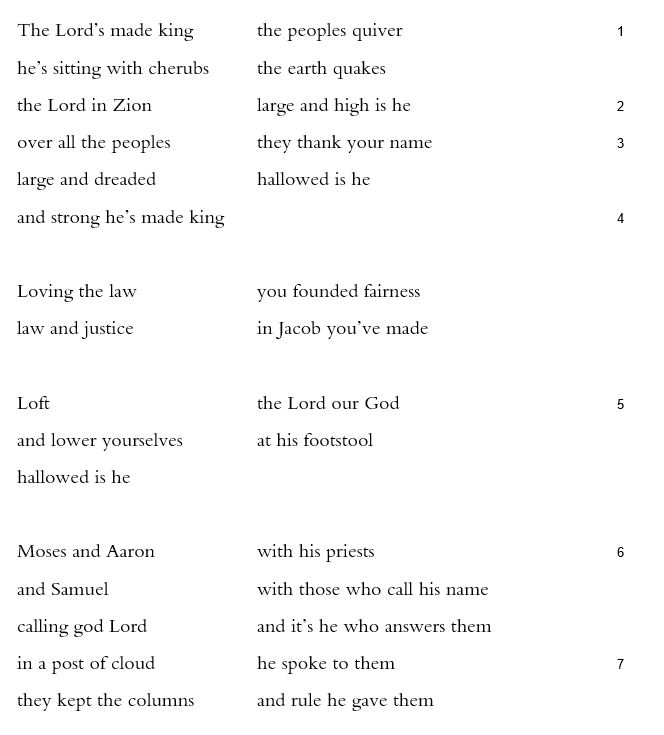
    In its syntax, Psalm 99 is rough going. Commentaries have called it “extraordinarily agitated.” At least at its start, finding its seams is frankly a bear. From the second verse, some half-lines seem like interruptions, pious asides, or call-and-response.

    The Lord’s made king | the peoples quiver     

    he’s sitting with cherubs | the earth quakes                  

    the Lord in Zion | large and high is he   

    over all the peoples |  they thank your name          

    large and dreaded | hallowed is he                              

    and strong he’s made king                                    (1-4a).

    The first two lines are no challenge. The Lord’s crowning is causal, twice. It affects the human and the wider world. Even the next half-line is clear: “the Lord in Zion” adds a third parallel to the Lord’s position. But adjectives, pronouns, and prepositions follow, with overlapping possible predicates: “the Lord in Zion is large and he is high over all the peoples” or “the Lord in Zion is large and high, he above all the peoples” or “the Lord in Zion—large and high is he—is over all the peoples.” What pairs with what gets blurred. How does “they thank your name” fit? Is the Lord’s name “large and dreaded”? It may be polysemous, but it’s also choppy waters.

    Nevertheless, there are ample cues that pattern the psalm as a whole. There’s a graceful kind of three-against-two polyrhythm supplied by a pair of refrains. Like Isaiah’s vision of the divine throne, Psalm 99 features a threefold incantation that celebrates sanctity and sacralization: “hallowed is he,” verses 3 and 5 intone, and verse 9 echoes, “hallowed is | the Lord our God.” (There’s a fourth “hallowed” in verse 9, but it’s grammatically and orthographically distinct.) The psalm also falls roughly in half, each section building to the contrastive lines “Loft | the Lord our God/ lower yourselves” (5, 9).

    Once we notice the halves, it’s easier to see that each half steps through three perspectives: third-person narrative (1-4a, 6-7), then second-person singular address to the Lord (4b-c, 8), then second-person plural imperatives to the assembly (5, 9). Into this structure are set like gems seven mentions of the Lord’s name (1, 2, 5, 6, 8, 9 x2), four instances of the word “God” (5, 8, 9 x2), three of the word “you” (4 x2, 8), plus four of the word “he” (2, 3, 5, 6). (It’s worth pointing out that while the pronoun hu’ sounds insistently masculine in English, it’s not gendered in biblical Hebrew. Not that biblical diction about God overall is less predominantly male or masculinist in other pronouns or parts of speech or in the broader ancient cultural imagination, just that readers and reciters should do with hu’ —and the imagination—as they will.) Overall architecture clearly matters more important to psalmist and editor than does mere clarity.

    What’s suggested by this architecture is that the second half of the psalm is a completion or analogue of the first. There is a progressive logic from the third to the second person, from the Lord to the people, from “you” to “you all.” The Lord being enthroned (1-4a), the psalm argues, priestly infrastructure follows (6-7). The law having been founded on the principle of fairness—and depending on how we read verse 4a, on “strength” (4)— the now-priestly institution of remitting sins follows (“who lifts away,” 8). In this way, the psalm enacts the process of making sacred. It grounds in narrative and divinely sanctions the climactic worship gestures of raising and lowering, getting the people not just to “extol” but to actively raise “the Lord our God” while physically prostrating themselves in worship (5, 9).

    The crucial reason for translating qadosh as “hallowed” rather than “holy” is that holiness implies some numinous essence, some essential trait or plane of existence. Hallowing, by contrast, is a process: historical, liturgical, and in the case of Psalm 99, textual. To acknowledge this difference is not to empty the term “hallowed” of significance. One can still see the process of sacralization as a kind of growing awareness or attunement, even as a wiping clean of the windows of perception. But hallowing is part of the very human act of making meaning, a process one must always historicize.

    Share:

    • Share on X (Opens in new window) X
    • Share on Facebook (Opens in new window) Facebook
    Like Loading…

    About Me

    My name is Mark Minster. I’m an English and Comparative Literature professor with a background in ministry and in poetry. I teach courses on writing, reading, religion, and nature.

    Recent Posts

    • Psalm 150
    • Psalm 149
    • Psalm 148
    • Psalm 147
    • Psalm 146

    Newsletter

←Previous Page
1 … 11 12 13 14 15 … 37
Next Page→

Blog at WordPress.com.


Loading Comments...
 

    • Subscribe Subscribed
      • The Book of Psalms
      • Already have a WordPress.com account? Log in now.
      • The Book of Psalms
      • Subscribe Subscribed
      • Sign up
      • Log in
      • Report this content
      • View site in Reader
      • Manage subscriptions
      • Collapse this bar
    %d