• Page list
    • Posts
    • The Book of Psalms

The Book of Psalms

  • June 16th, 2023

    Psalm 98

    (lyric)

    * * *

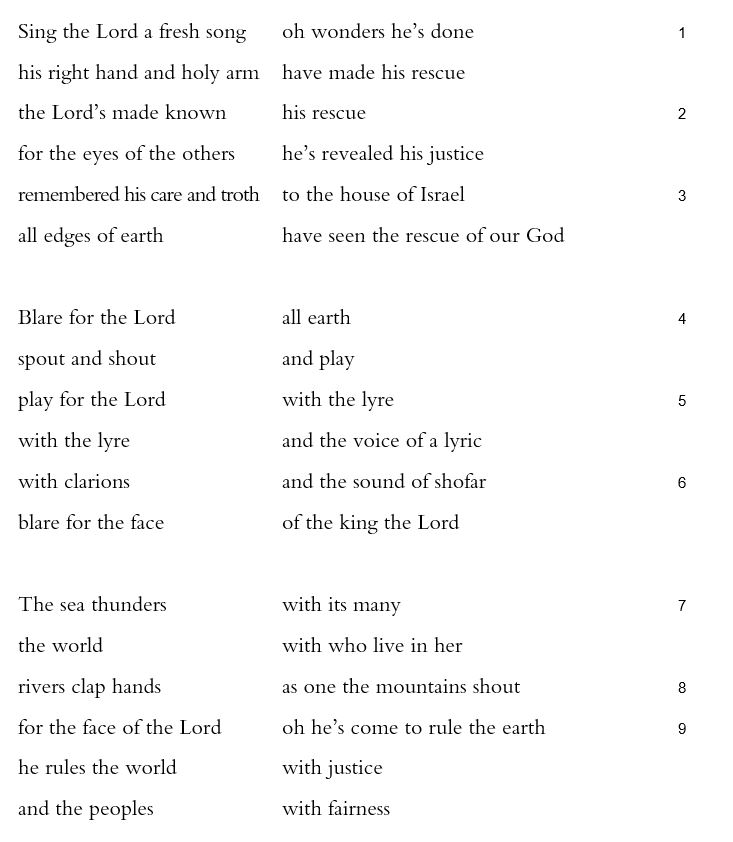
    Given evidence of careful placement here in Book Four of the Psalter, Psalm 98 has to be seen as part of an editorial pattern. Like Psalm 92, this song shares “lyric” in its superscription. Like 96, it’s a “fresh song.” Each of these three (92, 96, 98) is followed by a “Lord king” psalm (93, 97, 99). Like Psalms 96 and 100, this psalm ends on a theological abstraction: “fairness” here (98:9), “his faithfulness” in the two psalms that are equidistant from it (96:13, 100:5). Given its similarities to other “fresh” songs— not just Psalm 96, which is near, but also Psalm 33, which is far— Psalm 98 demands to be read alongside other psalms and songs. And given the prominence of a much older new song that starts the same way, shiru l’YHWH, “Sing to the Lord”/ “Sing of the Lord,” it makes sense to turn to the Song of the Sea, particularly Miriam’s collective reply to Moses’ first-person hymn in Exodus 15.

    “Sing to the Lord | oh overwhelming he overwhelmed / horse and rider | he tricked in the sea,” Miriam sings with the women who follow her (Exod 15:21). Moses’ version, much more expansive, celebrates the drowning of Pharaoh’s army which initiates the Lord’s program of assault against enemies:

    You reached out your right | earth engulfs them

    with your care you led | the people you released

    with your might you guided | to your hallowed home

    peoples have heard | and quivered  

    pain has gripped  | who live in Philistia

    thus are nervous | Edomite heads

    the rams of Moab | terror grips them

    they have fainted | all who live in Canaan. (Exod 15:12-15)

    It goes on. If we assume that Miriam’s song is expanded by Moses’ song—or, at least, by these parts of the Song of the Sea that predict (and present as completed) the conquest of the land of Canaan—then these verses are themselves a new song. They shape the escape from Egypt as part of the Lord’s victory for the Lord’s people over the others of the world.

    Psalm 33 alludes so often to the Song of the Sea that its revisionary relationship is plain: Psalm 33 pacifies the Song of the Sea. The actions at the Reed Sea, liberating the people from the Egyptians, were not the disruptive opening salvo of God’s program of violence against all nations. Rather, they were part of a plan of ordering that dated back to creation.
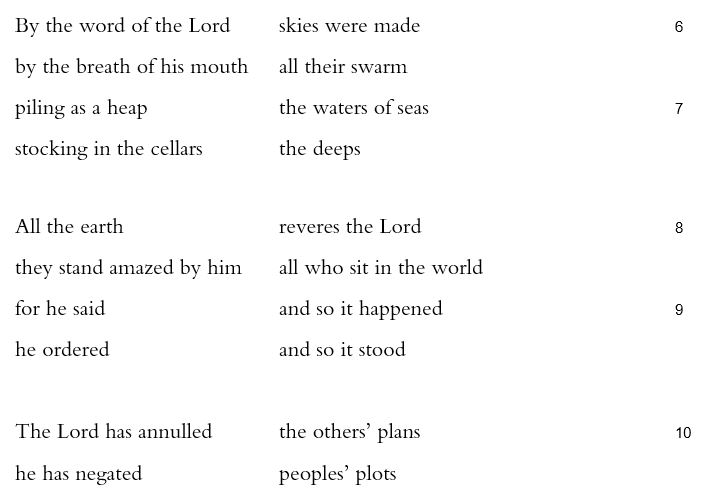
    Now that the people have already crossed into the land, the emphasis is not on overwhelming enemies, but on celebrating peaceable deliverance from them. There is mention of a king in Psalm 33, but only in a generic way:

    The fresh songs in Book Four come with a different purpose. Though they stretch back to Moses and the Exodus (see the superscription to Psalm 90, see 95:8-11, and 99) and use the precise term “wonders” for the Lord’s rescuing actions (98:1; cf. 96:3), they describe as a New Exodus a situation in which now the Davidic dynasty no longer sits on a physical throne because the Lord has been made king instead, has been king all along. As in Psalm 33, the politics and theology are far more universal than local. But unlike Psalm 33, the concern is not with protection against enemies but with the justice and equity of the new-but-it-was-always-there realm of the Lord. This realm extends to the earth itself:

    The sea thunders | with its many

    the world | with who live in her

    rivers clap hands | as one the mountains shout

    for the face of the Lord | oh he’s come to rule the earth (98: 7-9a).

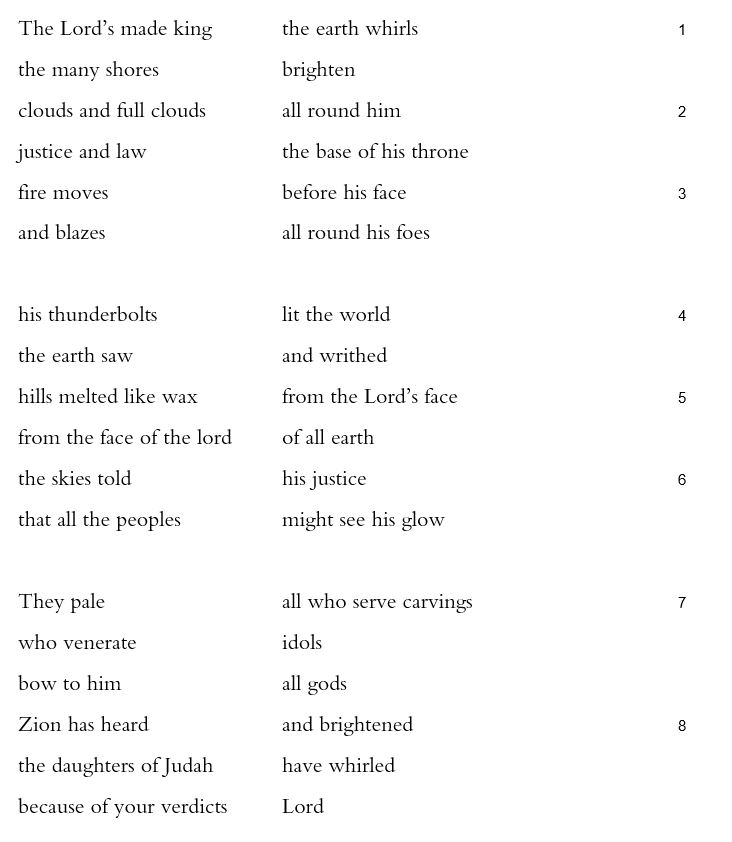
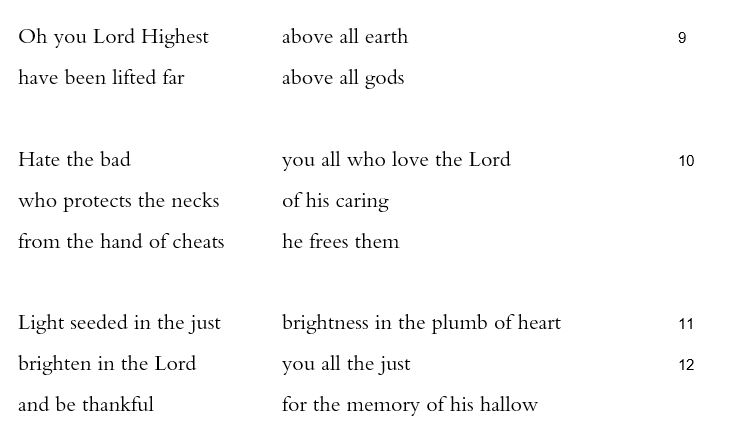
    To the desperate queries of Psalm 89, Psalm 98 is an integral part of the response. There is no longer a human king on a tangible throne. This absence, however, just makes the reign of the Lord truly clear. The promise to David in 2 Samuel 7:12, “I will raise your seed after you” (cf. Ps 89:29, 36) is subtly addressed by the end of Psalm 97 and the beginning of Psalm 98. “Light seeded in the just,” part of an imperative command to “be thankful | for the memory of his hallow,” relocates the Davidic lineage inside those who are just (97:11-12). And here in Psalm 98, it is the Lord’s right hand which has made his rescue, along with his “holy arm” (98:1). The house of David is displaced by “the house of Israel” (3), and it is the Lord who “rules the world | with justice / and the peoples | with fairness” (9). That this psalm is lodged between two psalms that begin “The Lord king” squares with its expression “the king the Lord” (6), leaving little room for worries about— or hopes for— the restoration of any human monarch.
    Share:

    • Share on X (Opens in new window) X
    • Share on Facebook (Opens in new window) Facebook
    Like Loading…

    About Me

    My name is Mark Minster. I’m an English and Comparative Literature professor with a background in ministry and in poetry. I teach courses on writing, reading, religion, and nature.

    Recent Posts

    • Psalm 150
    • Psalm 149
    • Psalm 148
    • Psalm 147
    • Psalm 146

    Newsletter

  • June 15th, 2023

    Psalm 97

    * * *

    Of the three “Lord king” psalms (with Psalms 93 and 99), Psalm 97 is the most jarring, especially when its verb forms are rendered accurately, darting back and forth from completed actions to continuing ones. Like the psalms that immediately precede it, it considers how the Lord’s ascendancy affects the rest of the world. Divine enthronement, it suggests, has always been part of the fabric of the created world. Rather than expressing apocalyptic eschatology with its storms and stress, Psalm 97 points from the past to the present tense, not to future judgment but to worship. 

    The important images of the psalm radiate. The Lord having been crowned, the land responds outward: “the earth whirls / the many shores | brighten” (1). Both gil (“whirl”) and samach (“brighten”) signify joy, but by different figures: the earth’s joy is its circling around, the joy of distant shores is to be made bright. (I know it’s not a given that the root samach conveys turning bright, or that it does so in more than a residual, etymological way, just as the word “glad” descends from roots that mean “gleam” without our ever thinking about it.) Verses 2 and 3 portray the encircling, spreading movement of the Lord’s nimbus, that aura of the throne with its fire that consumes enemies, all moving outward from the “justice and law” on which the throne rest in vivid visual metaphor.

    The second stanza (4-6) similarly moves outward— again, from the light of the Lord’s face (3, 5). It moves now not as fire but as lightning. These verses, however, are all cast in the perfect tense as completed action. A reader could argue that the theophany here is an apocalyptic vision of future events that are seen as completed—“what is determined is done” (Dan 11:36). But the simpler reading, the more likely reading, is that these storms are part of the past, the work of creation. So many of the psalms that surround Psalm 97 appeal to stories of creation. Their point is that, just as the earth “saw | and writhed” at the lighting up of the world (4), so now “the earth whirls.” Just as “the skies told | his justice / that all peoples | might see his glow” (6), so now that the Lord is enthroned, “the many shores | brighten” (1) and fire “blazes | all round his foes” (3). The poem links the beginning with now, not now with someday.

    The third stanza, verses 7 and 8, presents the opposing responses of those who worship the Lord only and those “who serve carvings / who venerate | idols” (7). The idolaters “pale,” whereas, like the ends of the earth in verse 1, Zion has “brightened / the daughters of Judah | have whirled” (8). More to the point, because of the Lord’s coronation, Zion IS the earth; the daughters of Judah—Jerusalem’s townships—ARE the earth’s many shores.

    Verses 9 and 10, direct, clear, and relatively uncomplicated, announce the twin covenantal principles of the Lord’s realm: exaltation as Highest over earth and gods; and protection from the bad of the Lord’s caring and cared-for.

    The last three lines of the psalm convey these principles more interestingly, picking up on the radiant imagery of the first three stanzas: “Light seeded in the just | brightness in the plumb of heart / brighten in the Lord | you all the just” (11-12a). All of that light from the fire and lightning of God’s face, which has spread around the world, is sown in those who are just. It shines in the joy of the morally upright, the level, the “plumb of heart.” Justice, too, has reached from the base of the throne to the very skies, only to be planted within.

    Share:

    • Share on X (Opens in new window) X
    • Share on Facebook (Opens in new window) Facebook
    Like Loading…

    About Me

    My name is Mark Minster. I’m an English and Comparative Literature professor with a background in ministry and in poetry. I teach courses on writing, reading, religion, and nature.

    Recent Posts

    • Psalm 150
    • Psalm 149
    • Psalm 148
    • Psalm 147
    • Psalm 146

    Newsletter

  • June 14th, 2023

    Psalm 96

    * * *

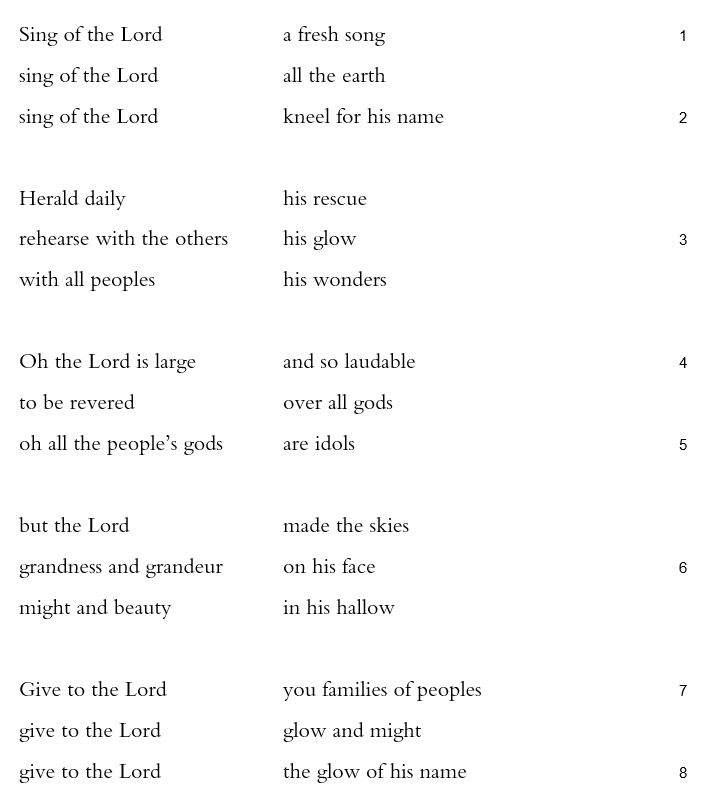
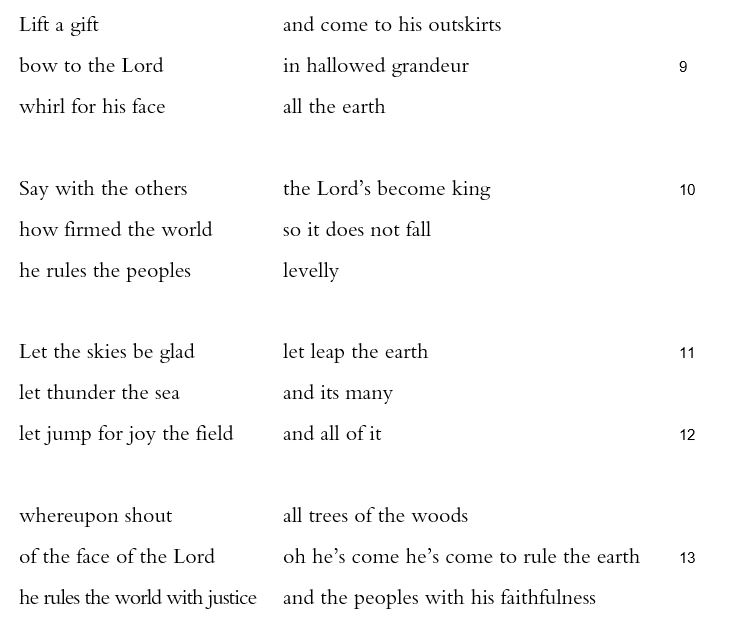
    The most joyous of psalms, Psalm 96 builds in imagination until even the trees cry out, ki-va’, ki-va’, “oh he’s come he’s come” (13). Again and again it calls the whole earth (or “land”) to celebrate (1, 9, 11; “the skies… the sea | and its many / the field | and all of it,” 11-12), including all the people of the world (3, 7; “the others” 3, 10). Unlike the psalms that precede it, there is not a sorrow or a hesitation. Unalloyed delight is part of what makes it “fresh” (96:1; cf. 33:3, 40:3, 149:1; 98:1, 144:9).

    The psalm’s formal features are a particular pleasure. This translation sees nine tercets, arranged as two sets of four tercets plus a coda. That is, there are two twelve-line groups plus a three-line envoi, with all the numerical satisfactions that come from twelve-line groups that work as two sets of six, or three quatrains, or four tercets. Rhythms overlap in enjoyable ways. Psalm 96 lends itself to rediscovery.

    Its most evident parallel is between the triple imperative “sing” (1a, 1b, 2a) and the triple imperative “give” (7a, 7b, 8a), each of which ends with “his name” (2a, 8a). Three more imperatives promptly follow the “sing” verbs—“kneel for his name/ Herald… rehearse” (2-3a)—and five more follow the “give” verbs: “lift.. come… bow…whirl… say” (8b-10a), for a total of fourteen imperatives, twelve of which appear at the beginning of a line. These groupings constitute a theory and practice of liturgy, focusing on proclamation in verses 1-3 and on performance in verses 7-10a. The first group gives way to celebration of the Lord’s preeminence “over all gods” (4) and of God’s creation of the skies (5). The second becomes praise of the world’s foundation (10), which stretches from the skies through all the earth:

    Let the skies be glad | let leap the earth       

    let thunder the sea | and its many

    let jump for joy the field | and all of it     (11-12a).

    Both sections name the Lord five times (1a, 1b, 2a, 4a, 5b; 7a, 7b, 8a, 9a, 10a) and say “might” (6b, 7b), “name” (2a, 8a), “face” (6a, 9b; each time near the word “grandeur” 6a, 9a), “hallow”/“hallowed” (6b, 9a), and “all the earth” once each (1b, 9b).

    Strikingly, each group of twelve lines makes sense as two six-line stanzas—what worshippers ought to do (1-3; 7-9) and why (4-6; 10-12)—but also as four three-line stanzas: repeated imperatives (1-2a, 7-8a), extended imperatives (2b-3, 8b-9), the Lord and the cosmos (4-5a, 10), the Lord and the created world (5b-6, 11-12a). Even more impressively, the sets work almost as well as three four-line stanzas (1-2, 3-4, 5-6; 7-8, 9-10b, 10c-12a), with subtle shifts of emphasis.

    No matter how we parse its lines, the psalm closes not just by calling back features of both sections such as the Lord’s name and face (13a), but by extending the second section and revealing it to be an extension of the first. The shouting trees, in other words, are an instance of the earth’s joy, which is of a piece with the glee of the skies, all part of the logic of creation. That key term ’az at the start of the final three lines (“whereupon” in this translation) is the poem’s “therefore” as well as its “at that time” and “in that way” and “in that place.” It is not primarily a marker of the future, let alone some far distant eschatology, as some interpret this psalm, diminishing it. Those trees are not prophets of eventual end-times. They sing in the choir, now, full-throated participants of a world ruled “with justice… and with his faithfulness” (13b).

    Share:

    • Share on X (Opens in new window) X
    • Share on Facebook (Opens in new window) Facebook
    Like Loading…

    About Me

    My name is Mark Minster. I’m an English and Comparative Literature professor with a background in ministry and in poetry. I teach courses on writing, reading, religion, and nature.

    Recent Posts

    • Psalm 150
    • Psalm 149
    • Psalm 148
    • Psalm 147
    • Psalm 146

    Newsletter

  • June 13th, 2023

    Psalm 95

    * * *

    The first fourteen lines of Psalm 95 are changed entirely by the last ten. Through the first two-thirds of verse 7, the psalm calls for collective praise. It is a celebration of the Lord’s face (2, 6) and hand (4, 5, 7), suffused with Davidic imagery (“the crag of our rescue,” 1; “the people/ of his pasturing | sheep of his hand,” 7), centered on the kingship of the Lord (3), and grounded in the vertical and horizontal axes of creation (4-5; “the Lord who made us,” 6). The three cohortative first-person plural verbs of verses 1 and 2, “let’s shout… let’s roar… let’s greet his face”—four if we count both instances of “let’s roar” (nari`ah and nari`a)—are matched by the three verbs in verses 6 and 7, “let’s bow | let’s bend / let’s kneel at his face.” The pairing is so tidy that the psalm could confidently end in verse 7.

    But everything changes with the phrase “Today when you hear | his voice” (7c). The line leads to verses in that voice, God’s voice in the first-person, which is neither grateful nor gracious with blessings in response to the praise of the psalm’s first part. The voice is severe and monitory. There are no patterned connections between these last lines and the first more-than-half of the psalm. Instead of recalling creation, the psalm links in cultural memory three low points from the Exodus narrative: the hardening of Pharaoh’s heart, the people’s stubbornness in the wilderness (Exod 17), and Moses’s ban from entering the Promised Land, the land of rest (Deut 12:7).

    In doing so, Psalm 95 recalls Psalm 81, which also begins with shouts of praise (“Ring out | for God our strength” 81:1) but similarly turns to stories of rebellion in the wilderness: “and so I sent them off | with their obstinate heart / to walk | with their own devices” (81:12). Psalm 81’s transitions are milder, longer, and its retelling of the Exodus includes excerpts from the Law (81:9-10) as well as the Lord’s desire to feed the people in the wilderness: “He made him eat | sweet bits of wheat / and honey from the cliff | I want to satisfy you” (81:16). Psalm 95, by contrast, is all weariness, annoyance, and prohibition: “Forty years | I bemoaned that age / I said they’re a people | of straying heart” (10). And even if this straying from paths suggests wayward sheep, obliquely pairing verse 10 with the sheep in verse 17, the resonance only highlights the differences between pasturage and wandering.  

    None of this means that the psalm is necessarily two different poems spliced together, though of course it might have been. If anything, Psalm 95 is three psalms: verses 1-7b on their own; 7c-11 on their own; and the interruptive entire psalm. Like prophetic calls to rend hearts not garments, the psalm as a whole interrupts its own liturgical momentum to warn against insincerity and recalcitrance. In doing so, it makes that admonition itself liturgical.

    The passage most clearly alluded to here is Deuteronomy 12, which is set up to foretell the temple:

    But the place that the Lord your God selects out of all your tribes, a place to place his name to live, you must seek and go there, that you might carry there your offerings and sacrifices, your tenths and the raisings of your hand, your votives and voluntaries, and the firsts of your cattle and sheep, that you might eat there before the face of the Lord your God, that you might be glad of all the occupations of your hand, you and your families with which the Lord your God has blessed you.

    You must not do anything like what we are doing here today, each all that’s right in his eyes, for you have not yet come to the rest and bequest which it’s the Lord your God who gives you, so that you might cross the Jordan and live in the land which it’s the Lord your God who bequeaths you, so that he might let you rest from all your foes around, so that you might settle safely, that it may become the place that the Lord your God selects, a place to place his name to live.

    Like Psalm 95, this passage connects a concern with appropriate praise, not to mention the face of the Lord, with the temporal and spatial location of that praise, both “what we are doing here today” and “the rest,” the “place to place his name to live.” What Psalm 95 does uniquely is not just to update the time and place of the Deuteronomic regulations for worship, but to balance seven “let’s” verbs of outward praise (1-2, 6) against the psalm’s one instruction, powerful and inward, “don’t harden your hearts” (8).

    Share:

    • Share on X (Opens in new window) X
    • Share on Facebook (Opens in new window) Facebook
    Like Loading…

    About Me

    My name is Mark Minster. I’m an English and Comparative Literature professor with a background in ministry and in poetry. I teach courses on writing, reading, religion, and nature.

    Recent Posts

    • Psalm 150
    • Psalm 149
    • Psalm 148
    • Psalm 147
    • Psalm 146

    Newsletter

←Previous Page
1 … 12 13 14 15 16 … 37
Next Page→

Blog at WordPress.com.


Loading Comments...
 

    • Subscribe Subscribed
      • The Book of Psalms
      • Already have a WordPress.com account? Log in now.
      • The Book of Psalms
      • Subscribe Subscribed
      • Sign up
      • Log in
      • Report this content
      • View site in Reader
      • Manage subscriptions
      • Collapse this bar
    %d