• Page list
    • Posts
    • The Book of Psalms

The Book of Psalms

  • June 12th, 2023

    Psalm 94

    * * *

    It’s tempting when reading the Hebrew Bible— especially for those who read a little or not well at all— either to whitewash or to wallow in the violence of the Lord. The temptation may be most pronounced among Christians who (in my experience, at least) tend to default to the false binary opposition of angry Old Testament God and “nice” New Testament God. The opposition is encouraged, obviously, by Paul’s brutal claim that the law is a “ministry of death” (2 Cor 3:7). The brutality and outright genocide endorsed by plenty of biblical texts is plain on the page. Why lie? Psalm 94, however, makes the case as subtly and deftly as anything in Romans or Galatians that divine retributive justice is emancipatory, given how easily corrupted courts can be. Morality and law can be at odds, or the law can return to justice.

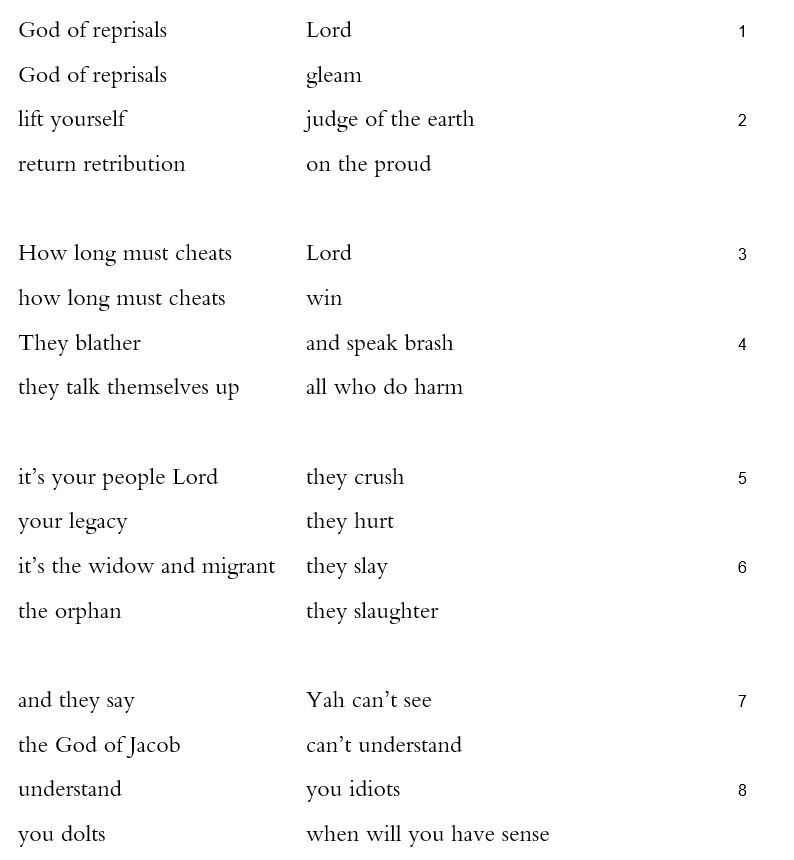
    Repeatedly, the psalm returns to rhetorical questions, leading questions. “How long must cheats | Lord / how long must cheats | win” (3), asks the speaker. She draws no attention to herself until verse 16, and even then says nothing specific about her circumstances: “who rises for me | against the bad ones / who stands for me | against those who do harm.” These doubled questions have obviously desired answers (How long? How long? No more. Who rises? Who stands? The Lord.) They work momentarily backwards from the wrong verdict to the absence of counsel. Even though the Lord does appear in the speaker’s defense in verses 17-19 (“a help for me… your care… your solaces”), the psalm’s final unanswered question works even farther backwards to the statutes of the law itself. “Is some throne of ruin | in league with you / shaping trouble | by means of a rule,” the speaker worries suddenly in verse 20, in striking contrast to the confident appreciation of the stanzas that surround it. It’s a devastating question, wondering whether an unfair verdict isn’t the result of a judge’s misrule but of the rule of law itself. “They conspire | against the neck of the just / innocent blood | they call guilty” (21). The whole system seems rigged.

    The question about a conspiracy with a ruinous throne lingers even after the center of the psalm has already answered it with a barrage of four rhetorical questions:

    you dolts | when will you have sense

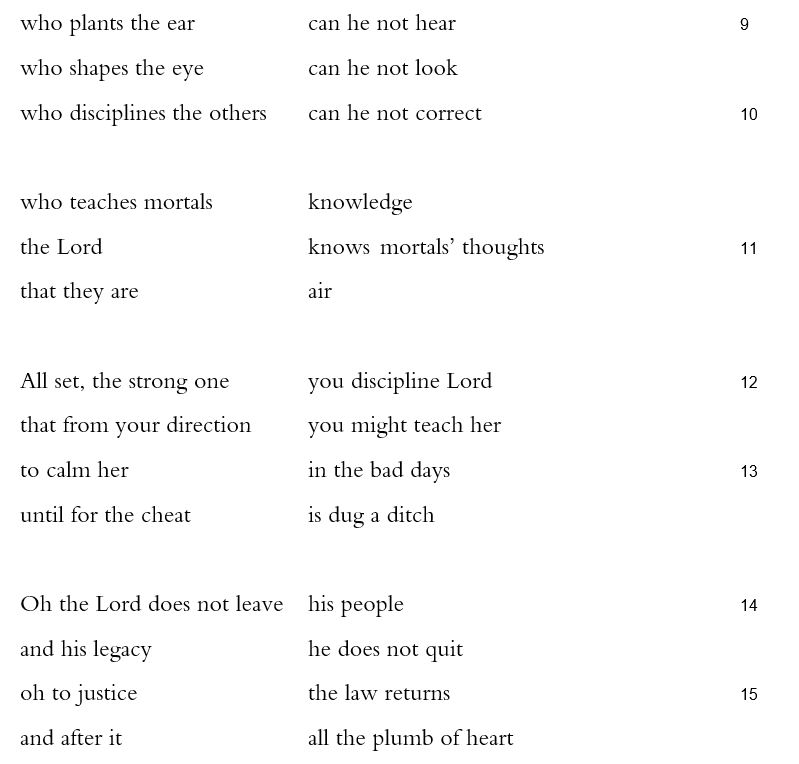
    who plants the ear | can he not hear

    who shapes the eye | can he not look

    who disciplines the others | can he not correct (9-10a).

    There may be even a fifth question in a row, but the text ends with difficulty here in 10b: “who teaches mortals | knowledge,” which seems half a question, half a statement. Either way, this series of muscle-flexing questions culminates with a statement that seems straight out of Ecclesiastes: “the Lord | knows mortals’ thoughts / that they are | air” (11). Thinking and knowing are as abstract as air, by contrast with the senses of vision and hearing that verse 9 invokes. Evidence is visible by definition. Claims of innocence and verdicts and guilty are not. That’s the whole point of a trial. The solidity of justice is called into question, again, at the heart of this psalm.

    It’s the subsequent stanzas, verses 12-15, that clarify the psalm’s position on justice. Terms for law appear twice in this passage, first as torah in the word mitoratekha, “from your direction” (12), then as mishpat in “the law returns” (15). But it’s not just the movement from divine instruction to legality that matters here. It’s the precision of how those terms are used in context. In the first, the law (torah) is part of a logical sequence from punishment to instruction to peace and quiet:

    All set, the strong one | you discipline Lord    

    that from your direction | you might teach her

    to calm her | in the bad days                   

    until for the cheat | is dug a ditch  (12-13).        

    Law is purposive: it keeps the peace. Judgment (mishpat) is part of a second logical sequence that takes us from the Lord’s presence to his inheritance/property and then, remarkably, in a chain from justice to virtue: “oh to justice | the law returns / and after it | all the plumb of heart” (15). Ethics follows law when law follows justice. Making the law just involves retribution: “he has returned on them | their harm” (23). “Return retribution,” the speaker asks at the start of the psalm (2), calling to mind the returns of Psalm 90: “you return people | to powder / and say | return mortals” (90:3) and “return, Lord | how long” (90:13). Here in Psalm 94, this movement of morality and right IS that return— the return of the law to justice, from which follow “all the plumb of heart.” Verse 15 also answers the aching question from Psalm 90 and from Psalm 94’s first verses, “how long” (‘ad matai)— not in temporal terms, but as a powerful abstraction: ‘ad tsedeq, until justice.

    The psalm’s callbacks of Psalm 90 are no accident, nor are its parallels with Psalm 92. A whole network of keywords links the three psalms as part of a larger structure here in Book Four of the Psalter (Psalms 90-106), as Pieter Van Der Lugt and others have argued. If the hard work of Book Four is to address the challenges posed by Book Three, these introductory psalms, Psalms 90, 92, and 94, do so by emphasizing not just the Lord’s care (90:14, 92:3, 94:18), but the importance of wisdom. Wisdom means accepting that life is fleeting. And it means accepting the kind of justice that “idiots” and “dolts” can’t fathom (92:6, 94:8), cultivating “a heart of sense” (90:12; cf. 92:5-6, 11; 94:8, 12-15).

    Share:

    • Share on X (Opens in new window) X
    • Share on Facebook (Opens in new window) Facebook
    Like Loading…

    About Me

    My name is Mark Minster. I’m an English and Comparative Literature professor with a background in ministry and in poetry. I teach courses on writing, reading, religion, and nature.

    Recent Posts

    • Psalm 150
    • Psalm 149
    • Psalm 148
    • Psalm 147
    • Psalm 146

    Newsletter

  • June 11th, 2023

    Psalm 93

    * * *

    Psalm 93 differs dramatically from the psalms that precede it. It feels ancient, archaic, primarily because it repeats like an incantation and its terse clauses fly fast. There are six conjugated verbs in the first verse alone, each half-line its own statement. The first, middle, and last verses have all the psalm’s verbs, leaving the intervening verses to nouns and modifiers and prepositions. Clauses burst, then pause, burst, then pause, and one last time.

    The three-line middle of the psalm has the same subject and verb three times: “rivers” and “lift,” with only two changes:

    Rivers have lifted | Lord             

    rivers have lifted | their voice

    rivers lift | their crashing (3).

    The verb-first experience of the Hebrew presents instants of wonder that arise, moment by moment. “They have lifted” comes first, then the subject “rivers.” Because the psalm began with an inversion, “the Lord” as intensified subject before the verb “reign,” we wonder briefly who has lifted, before wondering whether the rivers have lifted the Lord. But no, that first line of verse 3 is calling the Lord. The voices of the psalm’s reciters re-enact the lifting of voice that the rivers have done. As grammatical subjects stay the same, the object comes into focus: the rivers’ crashing IS their voice, which IS the voice of worshippers, calling “Lord.”

    The second transformation through these three lines is the shift from two perfect-form verbs to an imperfect-form: “have lifted” and “have lifted” become “lift.” The move occurs all over biblical poetry. What has happened still happens, the very emblem of tradition. This is not some cosmic battle with the sea. It is the voice of rising rivers and fertile floods. Its energy and motion contrast well with the solid foundation metaphors at the psalm’s beginning (“how firm the world is” 1) and end (“your stelae | are stood so true” 5), while its emphatic rising is continuous with both the standing up of the law and the temple at the psalm’s end and the coronation imagery at the start.

    If the shift from perfect to imperfect tense is important to register at the center of the psalm, it’s equally important to register it at the beginning of the psalm, where four suffixed, perfective verbs are followed by two prefixed, imperfective verbs: “has been king, “has put on,” “has put on,” and “has strapped it on,” followed by “is firm” and “does not fall.” That “has been king” is tricky in English, but nothing else besides “has reigned” quite works. “The Lord reigns,” the nearly universal translation, captures important features of the Hebrew verb form. Like the verb “to know” in Hebrew, “to be king” is a perfect-form verb that works best in the present tense: “to have known” in English sounds too much of the past, whereas the Hebrew really means more “to have learned,” i.e., “to know.” The point of the Hebrew here isn’t that the Lord is no longer the king, but that the Lord’s being king has always been the case. The most accurate paraphrase of the first half line of Psalm 93 is unwieldy: “It’s the Lord who’s been king all along.”

    Other translators and critics balk at the suggestion that one could use anything other than an eternal present tense here—Kraus, for instance, seems outraged at the idea. But the psalm uses the perfect form as part of a pattern, and its nuance is important. In response to psalms like Psalm 89, which worry about the loss of a human king, Psalm 93 answers, together with Psalms 97 and 99 and more, that the Lord needs no human to be king.

    Share:

    • Share on X (Opens in new window) X
    • Share on Facebook (Opens in new window) Facebook
    Like Loading…

    About Me

    My name is Mark Minster. I’m an English and Comparative Literature professor with a background in ministry and in poetry. I teach courses on writing, reading, religion, and nature.

    Recent Posts

    • Psalm 150
    • Psalm 149
    • Psalm 148
    • Psalm 147
    • Psalm 146

    Newsletter

  • June 10th, 2023

    Psalm 92

    (lyric, a song for Shabbat)

    * * *

    The opening and closure of Psalm 92 celebrate the Lord. “To thank… to hymn… to tell” (1-2), says the first stanza; “to tell,” echoes the last (15). And what the psalm thanks, hymns, tells and tells are three divine virtues: “to tell / by dawn your care / and your faithfulness | by night” (2); “to tell how plumb | the Lord is” (15). Together, these framing verses make a kind of circle, shaping a song of thanks and confession, making it less disjunctive than the middle of the psalm feels.

    After all, the second and second-to-last stanzas sound like different genres. Verses 3 and 4 continue seamlessly the first stanza’s praise, three musical instruments to go with the three stated purposes (3). The second stanza culminates with gladness and a fourth instrument: the speaker’s voice (4). Verses 12 and 13, which lead smoothly to verse 14, instead constitute the kind of reflective wisdom seen in Proverbs and Psalm 1. Rather than a scene of worship, primary aural, in this penultimate stanza there’s an image to contemplate, primarily visual: “like a palm tree | the just leafs out / like a cedar in Lebanon | she grows” (12). If the “telling” at the beginning and end of the psalm indicates a circular or chiastic pattern, surely verses 12-14 aren’t matched with anything in verses 1-4.

    The leafing out of the just person (12), which branches out in time and number to become the rooting, leafing, and fruiting of the whole community of worshippers (13-14), does pair linguistically with the flourishing of the bad in verse 7: “cheats leafing out | like grass.” As in Psalm 1, characteristics of bad and good people are contrasted. Here, however, both the just and cheats appear to flourish. It takes a wise person—that is, not a dolt or a dullard (6)—to understand that the success of rogues and renegades is temporary: “their being uprooted | is on and on / but you are ever up high | Lord” (8).  

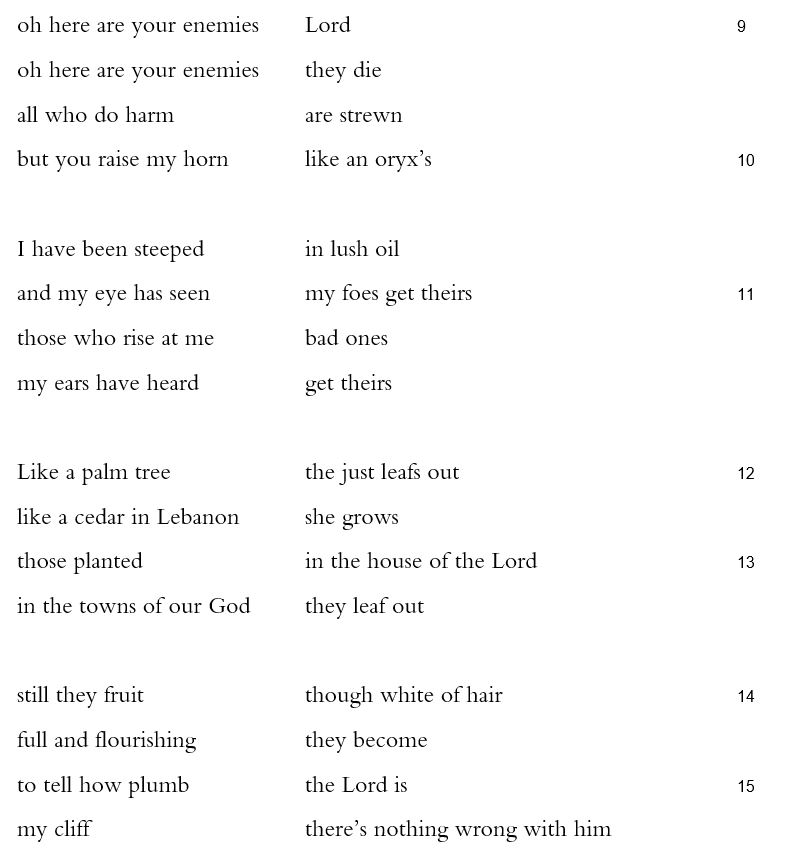
    What the psalm presents, then, are two chiastic structures with two competing (or complementary) centerpieces. In one shape, stanzas 1 and 2 (verses 1-4, which twice name the Lord) pair with stanzas 7 and 8 (verses 12-15, which twice name the Lord), enclosing the middle stanzas with praise-to-wisdom and wisdom-to-praise. Stanzas 3 and 4 (verses 5-8) are mirrored by stanzas 5 and 6 (verses 9-11). These middle stanzas present two problems—that the bad prosper, that the foolish can’t figure out why—and two solutions: “all who do harm | are strewn” (9c); “and my eye has seen | my foes get theirs” (11). Centered in this tidy package is verse 8, all by itself, a one-line verse, flanked by two three-line verses, which tersely says, “and you are ever up high | Lord.” Alternatively, the center might be seen as the pair of lines made by adding “oh here are your enemies | Lord” (9a). If so, these two lines highlight not the Lord’s exaltation, but the contrast between God’s height and the enemies’ depths.

    If Psalm 92’s outer frames are of uneven length, however, and the leafing in verses 12 and 13 pairs with the leafing in verse 7, then stanzas 4 and 7 frame stanzas 5 and 6, centering not verse 8 but verse 10. Like verse 8, verse 10 is flanked by two three-line verses. At the middle of this second chiasm, verse 10 highlights neither the Lord’s exaltation nor the enemies’ depths but the speaker’s own situation: “but you raise my horn | like an oryx’s / I have been steeped | in lush oil” (10). The exact dimensions of this lofting and saturation are not clear, though the moment is striking and clearly celebratory.

    It’s not at all unprecedented for a psalm to break the borders of genres as we define them—hymns of praise and sapiential parables easily cross. Nor is it strange for a psalm to celebrate the Lord’s care and faithfulness with one breath only to revel in others’ death with the next. The glee of “oh here are your enemies | Lord / oh here are your enemies | they die” is grim but not unheard-of (9). Nor is it unique for a biblical passage to have competing structures—the story of Abraham comes to mind, simultaneously centering Sarah’s pregnancy in Genesis 18 AND Hagar’s pregnancy in Genesis 16. Psalm 92 is a reminder to wield our categories lightly.

    Share:

    • Share on X (Opens in new window) X
    • Share on Facebook (Opens in new window) Facebook
    Like Loading…

    About Me

    My name is Mark Minster. I’m an English and Comparative Literature professor with a background in ministry and in poetry. I teach courses on writing, reading, religion, and nature.

    Recent Posts

    • Psalm 150
    • Psalm 149
    • Psalm 148
    • Psalm 147
    • Psalm 146

    Newsletter

  • June 9th, 2023

    Psalm 91

    * * *

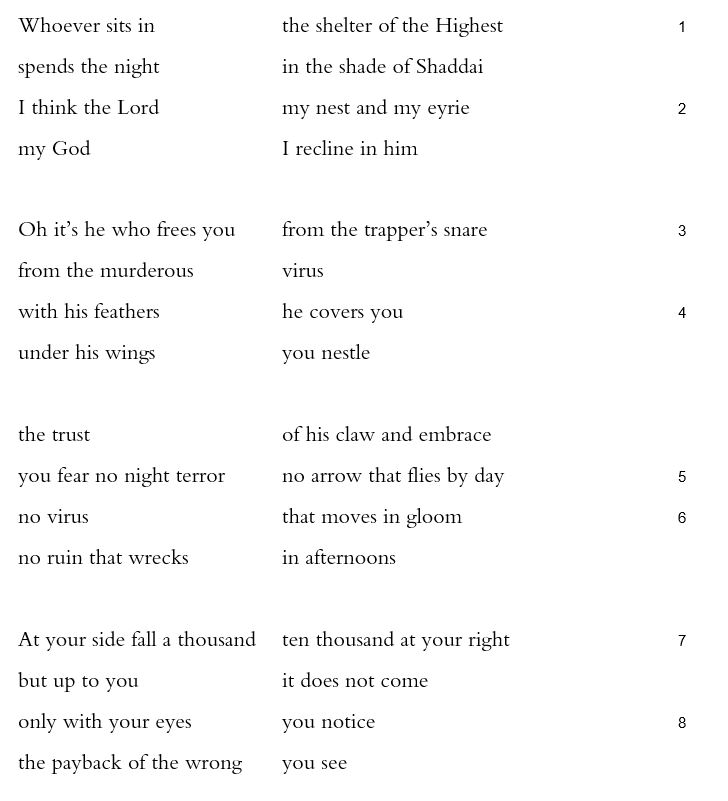
    Three distinct trajectories make Psalm 91 more compelling than it first appears. The first is the unfolding of a single extended metaphor: God as a raptor, God’s devotee the raptor’s fledgling. The scene is a mountain, and the vocabulary ornithological, most explicitly in verse 4: “with his feathers | he covers you / under his wings | you nestle.” The dangers facing a juvenile bird are many, as are the threats to even those grown. But, the psalm asserts, “it’s he who frees you | from the trapper’s snare” (3), that in “the trust | of his claw and embrace”

    you fear no night terror | no arrow that flies by day

    no virus | that moves in gloom  

    no ruin that wrecks | in afternoons   (4c-6).

    Without the literal sense, these lines dissipate to abstraction. What does a small bird fear? Fowlers, archers, beasts of prey. Dahood reads verse “terror,” pachad, as a “pack” of wild animals, but even the words for disease and decay work on a literal level, as anyone knows who has chanced on a finch or sparrow dead from no apparent cause. Raptor imagery carries through the whole psalm, through the tenderness the Lord’s emissaries show the fledgling (“upon their palms | they lift you,” 12) to its immediate inverse, the vision of the juvenile’s future: “upon lion and cobra | you tread / you trample | serpent and young male lion” (13). The vulnerable downy fledgling that will grow wide and proud because its parents brooded and fed it, those parents’ tenderness and strength, the remoteness of their nest—all are developed through the psalm by the elaborate conceit.

    At the same time, the psalm is structured by a progression of verses, beginning, middle, and end, that make the metaphor explicit in several different ways. Verse 1 has the distance of an aphorism: “Whoever sits in | the shelter of the Highest / spends the night | in the shade of Shaddai” (1). Verse 2 leaps to a first-person voice, with God in third person: “I think the Lord | my nest and my eyrie / my God | I recline in him.” The main body of the psalm, verses 3-8 and 10-13 keep God in the third person, but rely on the second person to put the reader in the young bird’s perspective: “Oh it’s he who frees you | from the trapper’s snare” (3). At the psalm’s center, we shift to direct address, God now more immediately in the second person: “Oh you Lord | my nest / the Highest | you made your home” (9). The psalm’s conclusion is even more immediately God’s perspective, in the first person, with the young bird/devotee in the third person. The more we learn of God as a mother or father bird, in other words, the closer God comes: “I want to keep him safe / I set him high | oh he knows my name” (14); “with length of days | I surfeit him / I make him see | my rescue” (16). 

    Easily missed is the third trajectory of the psalm, which consolidates the traits and spheres of originally separate gods under the aegis of a single Lord. The first two verses and the central verse 9 noticeably rename the Lord “my nest,” but this renaming is temporary, for the purposes of accenting God’s security and fidelity, enlivening two common terms for reliability: betach, “recline” (2), and ’emet, “trust” in “the trust | of his claw and embrace” (4). Far less temporary is the psalm’s explanation of the relationship between ’Elyon (“the Highest,” 1,9), Shaddai, YHWH (2, 9), and ’Elohei (“my God” 2). The Lord, originally from Sinai, has relocated to Zion. Worship of multiple gods, or gods of different name or avatar or location, clearly must have overlapped, given the persistence of the Bible’s centralizing tendencies. Psalm 91’s first verse is more than just an instance of synonymous parallelism between two divinities or divine appellations: “the shelter of the Highest… the shade of Shaddai.” It prepares the harder work of explaining how YHWH became synonymous with ’El ’Elyon, the Highest, which the psalm does in verse 9: “Oh you Lord | my nest / the Highest | you made your home” (9). The syntax is ambiguous, but the direction is clear: the Lord has become the Highest by nesting in the Highest’s heights.

    The psalm’s second half looks different, seen this way. The Lord does not just delegate responsibilities to messengers (11). As the insistent first-person singular of the last three verses reveals, “I” am the one who does all these things. One thinks of the raptor’s claws.  

    Share:

    • Share on X (Opens in new window) X
    • Share on Facebook (Opens in new window) Facebook
    Like Loading…

    About Me

    My name is Mark Minster. I’m an English and Comparative Literature professor with a background in ministry and in poetry. I teach courses on writing, reading, religion, and nature.

    Recent Posts

    • Psalm 150
    • Psalm 149
    • Psalm 148
    • Psalm 147
    • Psalm 146

    Newsletter

←Previous Page
1 … 13 14 15 16 17 … 37
Next Page→

Blog at WordPress.com.


Loading Comments...
 

    • Subscribe Subscribed
      • The Book of Psalms
      • Already have a WordPress.com account? Log in now.
      • The Book of Psalms
      • Subscribe Subscribed
      • Sign up
      • Log in
      • Report this content
      • View site in Reader
      • Manage subscriptions
      • Collapse this bar
    %d