• Page list
    • Posts
    • The Book of Psalms

The Book of Psalms

  • June 8th, 2023

    Psalm 90

    (a prayer of Moses, man of God)
    * * *

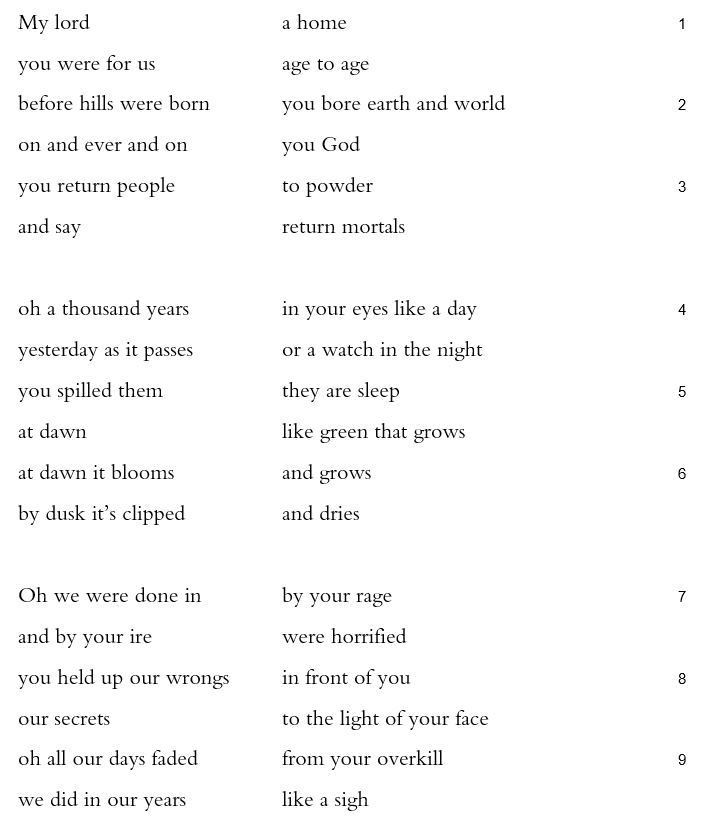
    Ascribing Psalm 90 to Moses accentuates— or invents— its archaic feel. The psalm’s abiding interest in timelessness and transience comes to seem ancient, its voice and wisdom instructive, authoritative. More pointedly, however, the name of Moses invites readers to attend closely to the language of flooding, passing over, and the face-to-face imagery, all of which recreate a story of emancipation.

    Curiously, this psalm so focused on ephemerality begins by invoking space. The first line nestles the word ma’on, a place to live, habitat, between “my lord” and “you,” before nesting “for us” between “you were” and “age to age.” The first two stanzas look to the ground, “the hills,” “earth and world” (2), “powder,” “mortals” (literally, “children of the soil”; 3), and “green that grows” only to be mown (5-6). But the rest of the poem is rootless, absent of places, an array of expressions for time, from “age to age” and “on and ever and on” (1, 2) to “how long” and “all our days” (13, 14). Four times,  “years” and “days”/“day” are paired (4, 9, 10, 15), contrasting how God views time— “oh a thousand years | in your eyes like a day” (4)— with how humans view it— “like the days you hurts us/ the years | that we saw bad / let be seen by your servants | your doing” (15-16). God’s eyes shrink the years to a day. The eyes of human suffering instead see days stretching out to years. Here at the end of verse 15, “bad” (ra`ah) is lodged between two verbs for sight (ra’ah). Earlier, in verse 10, “the days of our years | seventy years” stretch to eighty years before being revealed as “trouble and harm” (10). Life is both too short and too long.   

    Within these competing conceptions of time, it’s easy to miss other repetitions and references to the Israelites’ journey from Egypt to the promised land. The root `eber has meanings that range from passing over (“yesterday as it passes,” 4; cf. “for I will pass over the land of Egypt” Exod 12:1) to an excess of wrath (“your overkill,” Ps 90:9, 11) to the word “Hebrew” itself, used seven times in the first two chapters of the book of Exodus. In Psalm 90’s second stanza, the passing of yesterday is followed by a loanword for flooding: “you spilled them” (5). The two uses of the word “overkill,” itself a kind of flooding, lie on either side of another loanword, gaz, “it is crossed” (10). Verse 14 presents saba`enu baboqer, “surfeit us | at dawn,” yet another kind of excess. Saba` is the root used memorably by Moses in the wilderness: “at dusk meat to eat and bread at dawn to surfeit” (Exod 16:8, cf. 16:12; note the repetition of “dusk” and “dawn,” cf. Ps 90:5-6). In Deuteronomy 6 and 8, Moses again uses the word to describe the promises of the land across the Jordan: “you will eat and you will be full” (Deut 6:11, 8:10, 12). As with so many biblical passages, the psalm reenacts the journey of liberation as a turning: God, who returns “people | to powder / and [says] | return mortals” (3), is asked to “return” and “feel sorry” (13). Even the image of God’s face involves a turning: the word “face,” panekha, in verse 8 is picked up in verse 9 by the verb panu, literally “they turn to face,” the idiom for the twilight failing of the light of day. The darkening of God’s face, the turning from day to night, the ending of one’s years, and the story of the forty years in the wilderness thus all are rhymed.

    Three times, the psalm relies on a particular verbal ambiguity that results from the so-called vav-consecutive, a sequence of different verb forms: either a prefixed verb followed by a suffixed verb with a vav in front, or a suffixed verb followed by vav + a prefixed form. In terms of verb tense, the first sequence is imperfect/present followed by either the past/perfect tense or a second instance of the present tense. This construction appears twice in verse 6: “at dawn it blooms | and grows / by dusk it’s clipped | and dries.” The ambiguity means that the verse could also be rendered, “at dawn it blooms | and has grown / by dusk it’s clipped | and dried.” In verse 11, the second sequence appears: “oh it’s crossed fast / and we flit” could also end “and we flew.” In both cases, the effect underscores the transience of life: things grow and are grown all at once; life has been passed through quickly and quickly we fly and have flown. These routes of evanescence make one want to read Bishop’s “At the Fishhouses” again, or sing “I’ll Fly Away,” or kindle a candle in a medieval skull. Memento mori.

    Share:

    • Share on X (Opens in new window) X
    • Share on Facebook (Opens in new window) Facebook
    Like Loading…

    About Me

    My name is Mark Minster. I’m an English and Comparative Literature professor with a background in ministry and in poetry. I teach courses on writing, reading, religion, and nature.

    Recent Posts

    • Psalm 150
    • Psalm 149
    • Psalm 148
    • Psalm 147
    • Psalm 146

    Newsletter

  • June 7th, 2023

    Psalm 89

    (a didactic of Ethan the Ezrahite)

    * * *

    The problem that Psalm 89 considers in its sort-of-dialogue— namely, how an unconditional promise that supposedly lasts forever could become both conditional and broken— is already present in 2 Samuel 7 and 1 Kings 8-9, the passages on which the psalm is based. David, having just consolidated power by relocating the Ark of the Covenant in Jerusalem, offers to build the Lord a temple. Instead, the Lord, in a nighttime oracle to the prophet Nathan, promises David a lasting kingdom: “Your house and your kingdom will endure forever before you; your throne will be established forever” (2 Sam 7:16). David’s successor, his son Solomon, does indeed build and consecrate the temple. He prays at length, after which the Lord makes oracular promises similar to those made to his father: “if you walk before me faithfully with integrity of heart and uprightness, as David your father did… I will establish your royal throne over Israel forever… But if you all or your descendants turn from me and do not observe the commands and decrees I have given you… then I will cut off Israel from the land I have given them and will reject this temple…” (2 Kgs 9:4-9 passim). Similar promises, and yet different. How could the Lord vow an eternal throne without condition, only to change the terms of the deal a generation later?

    There are a variety of ways to try to solve this puzzle. Certainly, the long Solomon narrative is itself an attempt to accommodate the ideal of a Davidic covenant with the historical experience of siege, collapse, and exile. Perhaps there was no promise? Or maybe the promise was always conditional, or terms like “endure” and “forever,” “kingdom” and “throne” were ambiguous or misread? Or perhaps, as one might argue, eternally unfalsifiably, at any given moment from before the razing of Solomon’s temple to whatever year this is now plus one, destruction was all part of the grand plan of restoration.

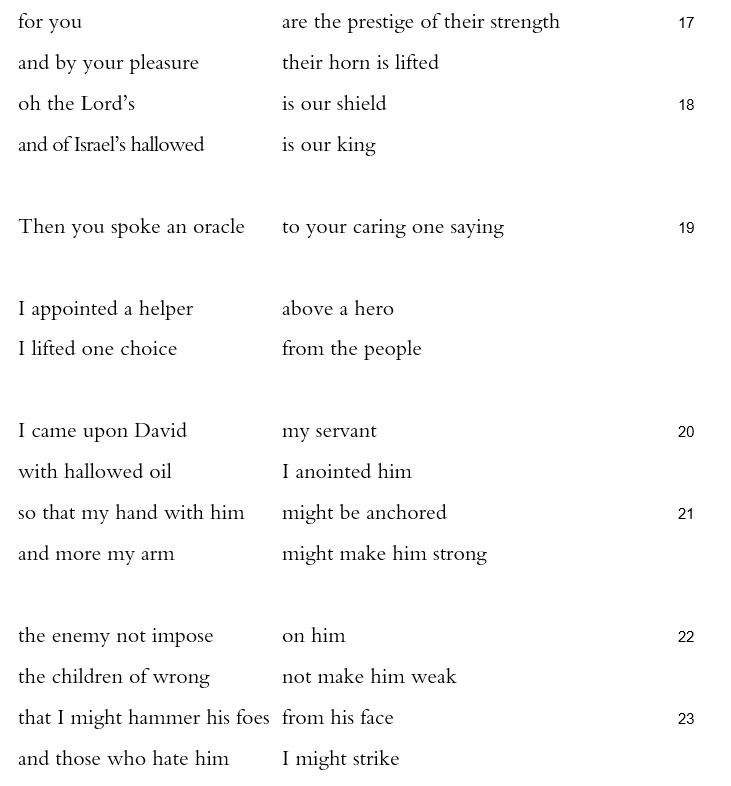
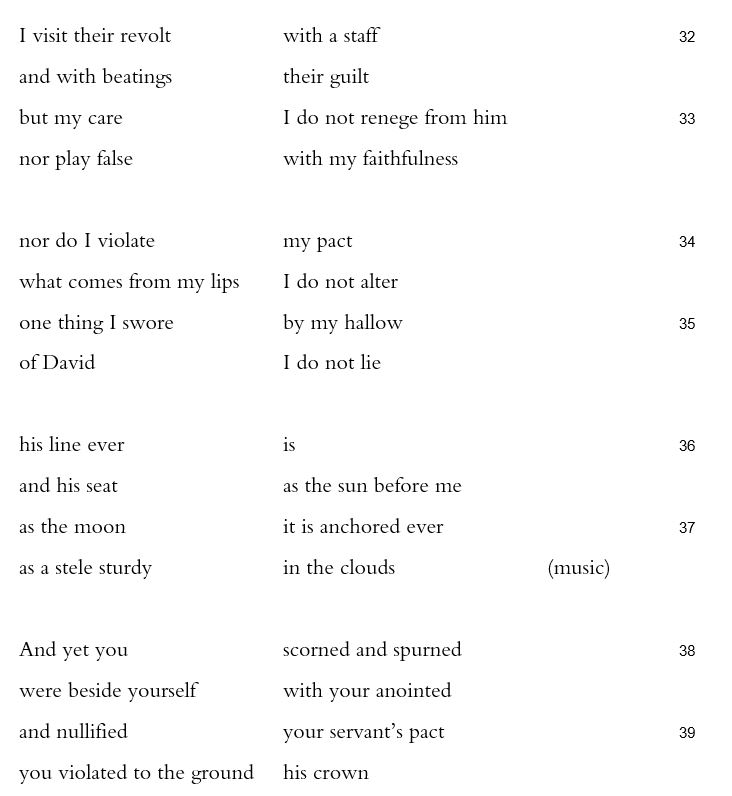
    To Psalm 89’s credit, it eliminates easy solutions. Its long central section (19-37) narrates the Davidic “pact”(28, 34, cf. 3, 39) in God’s first-person voice. Its movement is both temporal and outside of time. It begins with the word “then” and a series of perfective verbs, “I appointed… I lifted… I came upon David… I anointed him” (19-20). There follows a torrent of imperfect verbs that express both a historical present, a past subjunctive that reveals a purpose, as well as a present and a future: “so that my hand with him | might be anchored / and more my arm | might make him strong” (21). To translate these in the future tense is to presuppose a solution the psalm does not decide on. Later in the series of verbs, the present and future senses do dominate:

    my care | I do not renege from him     

    nor play false | with my faithfulness

    nor do I violate | my pact                  

    what comes from my lips | I do not alter

    one thing I swore | by my hallow           

    of David | I do not lie  (33-35).

    There is both an eternal present tense here and a sequence in time: having vowed, I do not and will not break my vow. In the Lord’s eyes, in other words, the covenant with David was never broken, is not broken, and never could be broken.

    Strategically and structurally, however, this promise is flanked by sections that see things differently, to put it mildly. With the exception of verses 3-4, which introduce the problem, the psalm’s first movement (1-18) emphasizes neither the Davidic promise nor the power of monarchy, but the Lord’s unique power, the Lord’s “care” and “faithfulness” (paired in 1, 2, “faithfulness” alone in 5, 8; “care” paired with “trust” in 14). Eight times, this section names the Lord (1, 5, 6 x2, 8 x2, 15, 18); six times it calls the Lord the emphatic pronoun “you” (9 x2, 10, 11, 12, 17; cf. “your name” in 12, 16). Repeatedly, this first section anticipates vocabulary that will be used in the psalm’s central section, attributing powers to the Lord alone. “Ever and on | I anchor your line / and build age to age | your seat,” the Lord speaks of the pact with David (4), which was done “so that my hand with him | might be anchored” (21). “I appoint his line | lasting / his seat | like the days of the skies” (29); “his line | ever is / and his seat | as the sun before me / as the moon | it is anchored ever” (37). To these points, the psalm’s first section responds in advance: “for I have ever said | care is built in the skies/ you anchor your faithfulness | in them” (2). As with Psalm 87, the preposition plus pronoun is emphatic: “in them” accents the skies as the seat of power, just as “yours” (lekha 11 x2, 13 ) accents the Lord. About halfway through its first section, in verse 9, Psalm 89 turns to God’s acts of power, extending them throughout history, far earlier than a mere monarchy, and lifted far farther above. Verse 11 begins a pair of stanzas that more pointedly exalt God and sideline David: “Yours the skies | and more yours the earth” becomes

    Yours is an arm | with might                        

    your hand is strong | your right hand is uplifted

    justice and law | the anchor of your seat                   

    care and trust | precede your face (13-14).

    The first section culminates with its most antimonarchic stanzas. Instead of to a king, verses 15-18 turn to the people. It is the people who joy, who “are lifted” (16), and it is the Lord who does it all: “by the light of your face… by your name… by your justice… and by your pleasure” (15-17). “Oh the Lord’s | is our shield / and of Israel’s hallowed | is our king” (18), the section ends, suggesting that the Lord alone is Israel’s king.

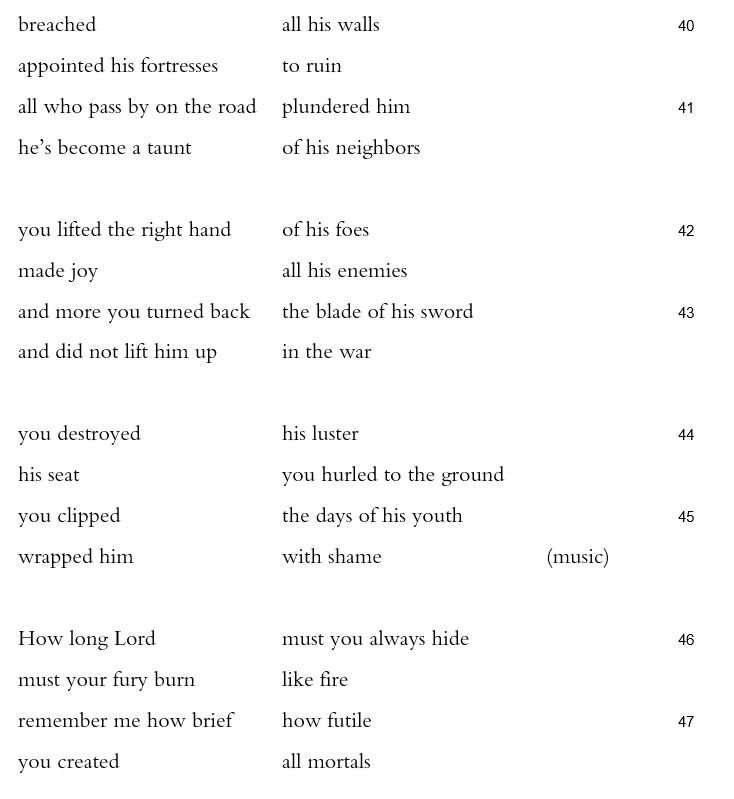
    The psalm’s third (38-45) and fourth (46-51) sections are not nearly so ambiguous. The third section counters the center section’s imperfect verbs with perfect forms, emphasizing past evidence over present claims. Despite the Lord’s promise to David, the third section says with some ire,

    And yet you | scorned and spurned  

    were beside yourself | with your anointed

    and nullified | your servant’s pact     

    you violated to the ground | his crown  (38-39).

    Again, language from the psalm’s central section is quoted and undermined. “His seat,” which is “lasting… like the days of the skies” according to 29 and “as the sun before me” according to 36, is pointed to in verse 44: “his seat | you hurled to the ground” (44). In some cases, even claims from the first section are undercut. In verse 42, for example, “you lifted the right hand | of his foes” belies both the promise— “I anointed him / so that my hand with him | might be anchored” (21) and “that I might hammer his foes” (23)— and the praise— “your hand is strong | your right hand is uplifted” (13). There is here no attempt to explain away the puzzle of a broken covenant. In this respect, Psalm 89 is a kind of Job in reverse, a speech from Elihu, a speech from whirlwind, followed not by Job’s relenting, but by his complaint.

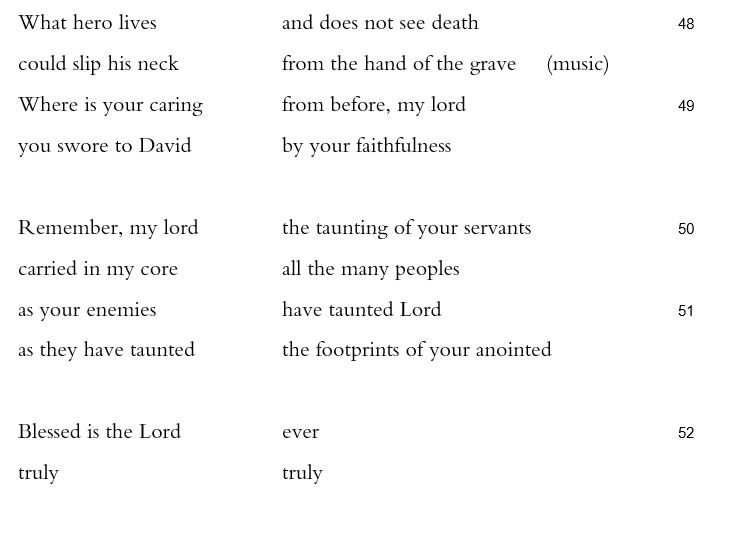
    The psalm’s final section consists of hard questions, a pair of calls to remember, and a lingering image that can be read in different ways. The questions form a chiasm, two outer questions about God’s absence (46, 49) surrounding an inner, doubled question: “What hero lives | and does not see death / could slip his neck | from the hand of the grave” (48). The question, given the psalms that precede and follow this one, Psalms 88 and 90, and given the facts of existence, seems rhetorical: no one lives and does not see death. For readers inclined to messianic eschatologies, however, the question seems to offer a secret, prophetic solution that can be pulled out of context from this part of the psalm: there must be some son of David who could “slip his neck | from the hand of the grave.” And yet the call to remember that precedes this question weighs against this reading: “remember me how brief | how futile / you created | all mortals” (47). And yet— yet another “and yet”— the psalm ends with an image, a phrase, that works in multiple directions: “the footprints of your anointed” (51). Those eager to find hints of messianism in Psalm 89, or just those taken by the center of the poem will see those footsteps as aimed towards a restorative future. Those more taken by the first or third sections will see the image as a haunting from a lost monarchic past. Our reading depends in part on whether we assume the psalm offers answers or poses questions.

    Whatever answers the psalm may offer, what matters more seems to be its final articulation of the crucial question. Instead of asking how a permanent pact might have been violated, the final section of the psalm reframes the problem in a way that’s both simple and profound: “Where is your caring | from before, my lord /  you swore to David | by your faithfulness” (49). The desire for a new king or a restored past is understandable, but it’s not what matters most. The underlying issues is fidelity, the continuity of care.

    Share:

    • Share on X (Opens in new window) X
    • Share on Facebook (Opens in new window) Facebook
    Like Loading…

    About Me

    My name is Mark Minster. I’m an English and Comparative Literature professor with a background in ministry and in poetry. I teach courses on writing, reading, religion, and nature.

    Recent Posts

    • Psalm 150
    • Psalm 149
    • Psalm 148
    • Psalm 147
    • Psalm 146

    Newsletter

  • June 6th, 2023

    Psalm 88

    (a song, a lyric, of the Qorachites; director: to Mahalat, a didactic for humility, of Heman the Ezrahite)

    * * *

    It gets dark here near the end of Book Three (Pss 73-89) but honesty about darkness matters. Besides the biological fact that death comes for us all, acknowledgment of death’s finality is a condition of moral and psychological integrity. The wish to have a whole, unified heart (86:11) means accepting that the nefesh, the soul that is trachea, larynx, glottis, esophagus, mandible, hyoid, sternum, the carotid arteries, is not some separable eternity that floats off while only the body rots. By far most of the Hebrew Bible holds no hope in personal, subjective immortality; if you want to live forever, you’d better have a people. Even politically, for the earliest audiences of the psalms, it must have been imperative to admit, finally, that the Davidic kings were dead and buried. For these audiences and for the Persian and Hellenistic occupiers reading over their shoulders, it must have been important to show that all the monarchic imagery was just memory and figuration for the kingship of the Lord, rather than some politically subversive belief that David himself might come back from the dead. Messianic and eschatological readings of the Psalms exist, but they are mostly willful and tendentious. Book Three closes not by hoping for a new anointed, but by insisting that while Jerusalem and Yahweh remain— in Zion is birth, according to Psalm 87— the literal monarchy is buried and, as Psalm 88 graphically reveals, dead.

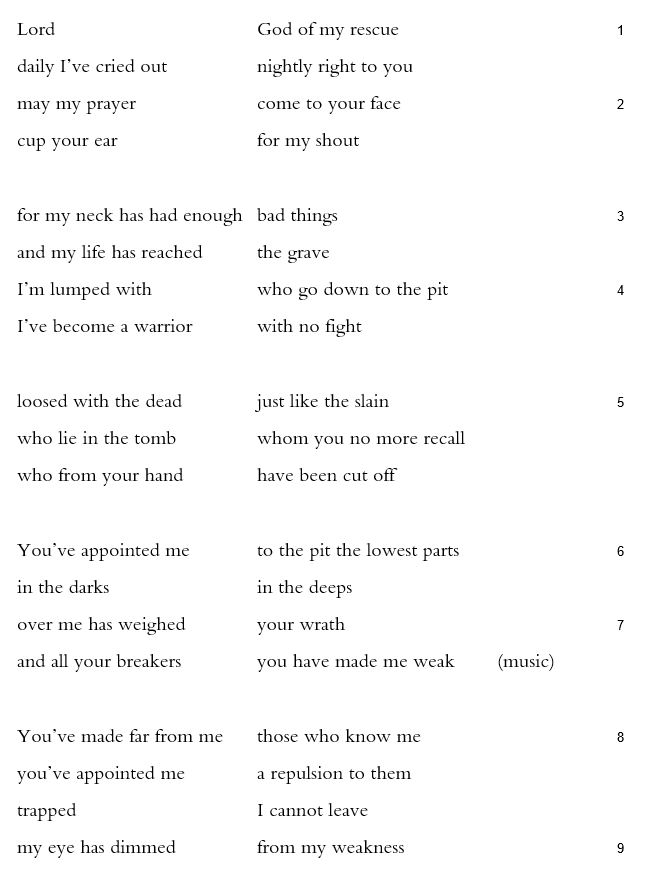
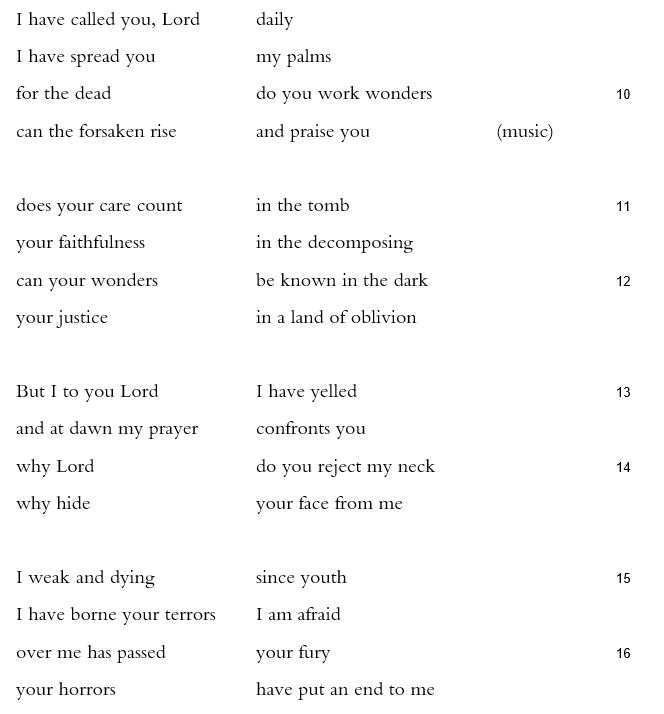
    Psalm 88 reads like a scathing response to the naïve hyperbole of Psalm 86:13, “and you have freed my neck | from the deepest of the grave,” a line that allows literalists of every generation to imagine a bodily resurrection for King David. Literalists continue to hash Psalm 88 itself: “we cannot prove from which fatal disease the petitioner is suffering. There is no mention of leprosy… Very likely the petitioner is afflicted with a serious illness from his youth. It is possible that he lives outside the gates as an outcast” (Kraus II 192). Very likely, rather, the petitioner is dead, a persona, a poetic speaker who voices an author’s polemic against vacuous insincerities about dying and death, such as those centered by Psalm 86. The neck of the speaker of Psalm 88 “has had enough | bad things” (3): “at dawn my prayer | confronts you / why Lord | do you reject my neck” (14). Instead of freeing or rescue (88:1), Psalm 88 is all grave, whether named as she’ol (88:3, 11; cf. 86:13) or the tomb (88:5, 11) or “the pit the lowest parts / in the darks | in the deeps” (88:6; cf. 4). The psalm is a veritable thesaurus of “the dead” (5, 10), “the slain” (5), “the forsaken” (10), “the decomposing” (11), “the land of forgetting” (12), “your terrors… your fury/ your horrors” (15-16), and most significantly, darkness (6, 12, 18).

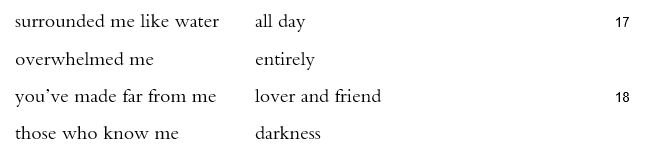
    Or it could be a thesaurus if it were not arranged as a descent, ever darker and deeper. What begins with the “Lord | God of my rescue” and a cry and prayer that might come “right to you… to your face… your ear” (1-2) ends far from there: “you have made far from me | lover and friend / those who know me | darkness” (18). Instead of God’s face, or anyone’s face, it’s darkness; instead of rescue, it’s distance. In the second stanza, the speaker’s life “has reached | the grave” (3), but by the fourth stanza “over me has weighed || all your wrath” (7), and by the second-to-last stanza, “over me has passed | all your fury / your horrors | have put an end to me” (16). The psalm weighs down, a striking contrast from the metaphors of weight built into the theological terms kavod, for the heft of glory, or betach, the leaning back of trust. God begins the psalm as silence, becomes rage, and ends as terrors, the return of the waters of chaos in which the speaker drowns: the horrors have “surrounded me like water | all day / overwhelmed me | entirely” (17). These are not the held-back waters of Genesis and Exodus. They are the flooding undoing of creation.  

    In counterpoint with the descent is the psalm’s insistent repetition and recursion. “Over me” (7), “over me” (16), “over me” (17), the dead or dying speaker intones three times in a parody of a call to “my God” (`alai ~ a’alai). He calls to the Lord daily according to verses 1, 9, and 14, though in verse 14 the verb intensifies. “You’ve made far from me | those who know me” the speaker also says in both verses 8 and 18. “Those who know me” (meyudda`ai) calls back God’s similar participle in Psalm 87:4 (leyode`ai). It also calls to mind the question, “can your wonders | be known in the dark” (12), which itself calls back questions and statements from the beginning of Book Three: “how would God know/ is there knowing | for the Highest” (73:11), and “he will be known | as one who brings upon her / in a copse of trees | axes” (74:5). Linked with “those who know me” among the speaker’s lost friends is “one who loves,” ’oheiv, which also calls back Psalm 87, where it refers to the Lord. (Also referring to Psalm 87 is the counting of the dead in Psalm 88:4, which contrasts with the counting of births in 87:6). Likewise, the word yechad—here, “entirely” (88:17)— calls back the words “alone” and the verb “unite“ or “keep together” from Psalm 86 (86:10, 11). God’s singularity has become God’s absence, the speaker’s isolation.

    Of all this psalm’s corrections of prior psalms, none is more cutting than its reframing of the claim made by the speaker of Psalm 86: `ani ve’evyon ’ani, “weak and in want | am I” (86:1). There, the speaker, allegedly David himself, claimed to be weak (`ani), and therefore asked God to `anah, to answer. The speaker of Psalm 88, by contrast, uses the verb `anah not to ask for a response, but to announce completed action, `innita, “you have made me weak.” He follows this with his own dark pun, `aiyini  da’aba minni `oni, “my eye has dimmed | from my weakness” (9). When we get to verse 15, and the word pair `ani ’ani resumes, it’s clear that this speaker, in the actual grave, actually is weak.

    The word the psalm seems to dance around in this profound wordplay is the word for nothingness, ’ein. It appears as the speaker characterizes himself in verse 4 as a man ’ein `eyal, of no strength. It is surely no accident that this second word, a rare word, a loan word for vigor, coming immediate after a negative, sounds like a deliberate way of naming God.

    Share:

    • Share on X (Opens in new window) X
    • Share on Facebook (Opens in new window) Facebook
    Like Loading…

    About Me

    My name is Mark Minster. I’m an English and Comparative Literature professor with a background in ministry and in poetry. I teach courses on writing, reading, religion, and nature.

    Recent Posts

    • Psalm 150
    • Psalm 149
    • Psalm 148
    • Psalm 147
    • Psalm 146

    Newsletter

  • June 5th, 2023

    Psalm 87

    (of the Qorachites, a lyric, a song)

    * * *

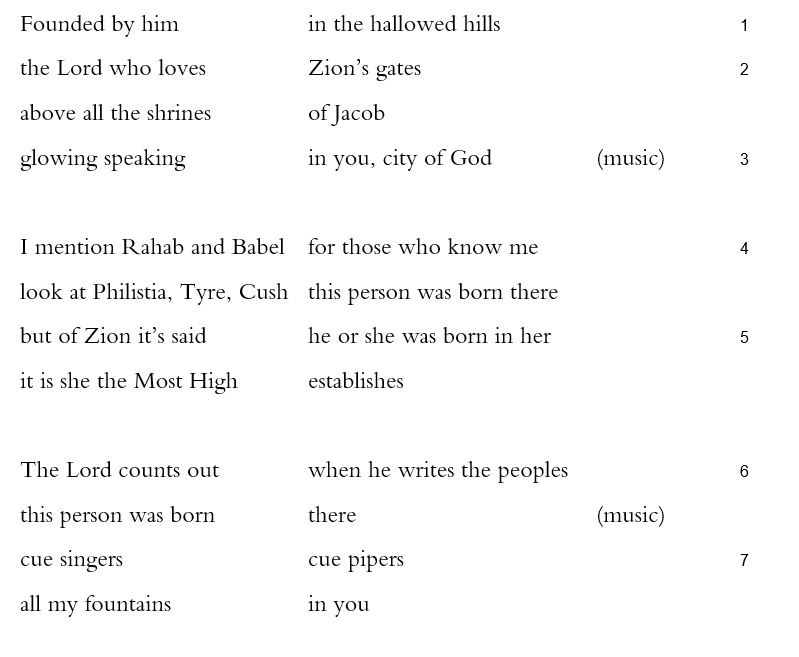
    Readers often miss the cohesion and singular pleasures of the taut Psalm 87. Its structure is meticulous and not, as many scholars have long proposed, a mess:  “badly injured… the half-verses have been torn apart and senselessly coordinated” (Kraus II 184). The psalm depends most significantly on prepositions and pronouns, most significantly the three that nestle in Zion: “in you” (3), “in her” (5), “in you” (7).

    The first stanza begins with yesudato, an exact word impossible to get fully and succinctly in English, a feminine passive participial noun with a masculine possessive suffix: literally, “his her being founded” or, better “her having been founded of him” (1). From the first word, therefore, we anticipate both a masculine and a feminine antecedent (postcedent, to be technical). It’s not necessary to wait long: both the Lord and Zion are named in the very next line: “the Lord who loves | Zion’s gates” (2a). The tendency of translations to supply the verb “to be” as a linking verb or copula in one or both of these first two lines, or to render participials as conjugated verbs, is impatience at best. The entire first stanza is constructed around a series of five participles: “founded by him” (1), “who loves” (2a) “the shrines” (2b), “glowing speaking” (3). The structure works by delay, as the long left branch of a left-branching sentence. The first stanza is a tidy chiasm, with “her having been founded by him” mirrored by “in you, city of God” at the end of verse 3. The hills of sacredness, “the hallowed hills” of verse 1, parallel “glowing speaking,” matching the two key theological abstractions of qodesh and kavod. Centered in the stanza is the centralization of worship that displaced worship of the Lord from the high places of the north, locating it in Zion.

    The second stanza brings the main clause the first stanza delayed: “I make remember,” the Lord says, “for those knowing me” (4a). If you would know me, the line suggests, remember whom I have defeated: Rahab and Babel, conquests early and late. That these two names are followed by three foreign lands—”Philistia, Tyre, Cush”— allows the lands to be read both as further examples of victories and as examples of those whose peoples have come now to Zion. More, however, these peoples are brought up, here near the psalm’s middle, because of a linguistic quirk. For people from these other nations, the idiom is “this person was born there,” yulad sham—a phrase that sounds almost like “Jerusalem” (4b). By contrast, “of Zion it’s said | he or she was born in her,” yulad bakh (5a). The difference is between an impersonal adverb, one that points outside, over there, and a pregnant preposition with a personal pronoun, one is born with her, of her, by her, in her.

    The final line of the second stanza does multiple things. It repeats the third-person personal pronoun hu’, which fits all genders, referring simultaneously to Zion, her, and to any person born in Zion and even potentially to any person born even elsewhere: “it is she the Most High | establishes” (5b). The second stanza thus begins and ends with clauses, active verbs, even as the word “establishes” recalls the metaphor of a foundation with which the psalm began.

    Because the first two stanzas fold back so nicely on each other—“establishes” picks up “founded by him”; Zion is named twice (2a, 5a); Jacob’s shrines parallel the names of other nations (2b, 4); “mention… for those who know me” parallels knowing and memorializing with “glowing speaking” while centering “city of God” (4a, 3)—the psalm’s third stanza feels at first like a coda. But that coda transforms our experience of the psalm. We change our mind about the center and the edges of the structure. The foundations and hills from verse 1 now become “fountains,” as do the people born “in you” (7b).  Now, too, the “glowing speaking” becomes both counting and writing (6a). It even becomes the singers and the pipers (7a) who shatter the fourth wall, leading to and commenting on the scene of worship. By the end it is Zion who is centered, as the poem’s center has shifted. Its closing word repeats the psalm’s most important preposition + pronoun from the end of the first stanza, “in you.”

    Share:

    • Share on X (Opens in new window) X
    • Share on Facebook (Opens in new window) Facebook
    Like Loading…

    About Me

    My name is Mark Minster. I’m an English and Comparative Literature professor with a background in ministry and in poetry. I teach courses on writing, reading, religion, and nature.

    Recent Posts

    • Psalm 150
    • Psalm 149
    • Psalm 148
    • Psalm 147
    • Psalm 146

    Newsletter

←Previous Page
1 … 14 15 16 17 18 … 37
Next Page→

Blog at WordPress.com.


Loading Comments...
 

    • Subscribe Subscribed
      • The Book of Psalms
      • Already have a WordPress.com account? Log in now.
      • The Book of Psalms
      • Subscribe Subscribed
      • Sign up
      • Log in
      • Report this content
      • View site in Reader
      • Manage subscriptions
      • Collapse this bar
    %d