• Page list
    • Posts
    • The Book of Psalms

The Book of Psalms

  • June 4th, 2023

    Psalm 86

    (a prayer, of David)
    * * *

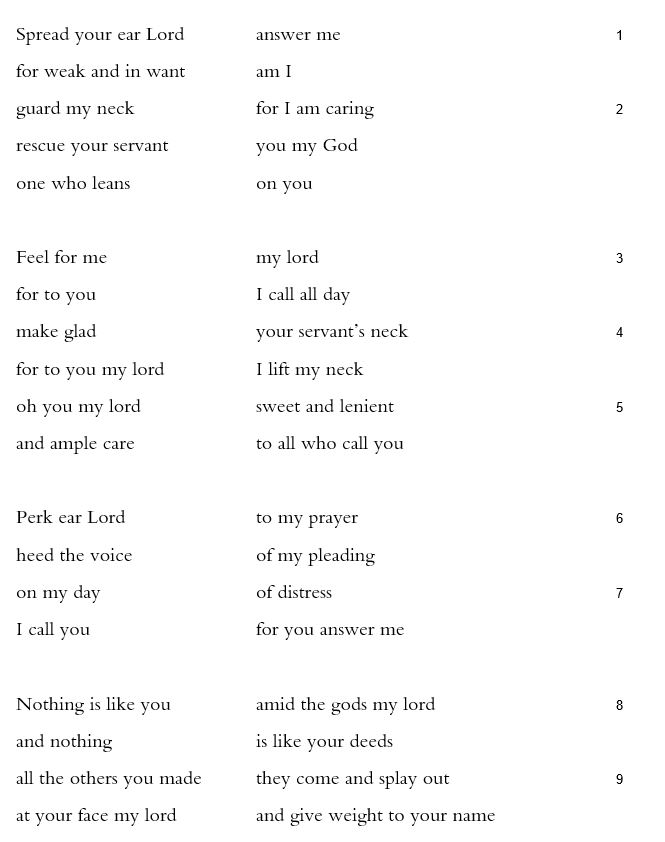
    There is a striking gap between the expectations Psalm 86 comes bearing, given its location near the culmination of the central book of the Psalter (73-89), and its inescapable lack of quality. Framed by two pairs of Qorachite psalms, the only Book Three psalm designated by superscription as “of David,” the psalm ought to be particularly significant. Instead it’s blithe and generic, derivative and thin. When the speaker, a posturing monarch, claims to be “weak and in want,” he seems rather to be talking about the psalm itself (1).

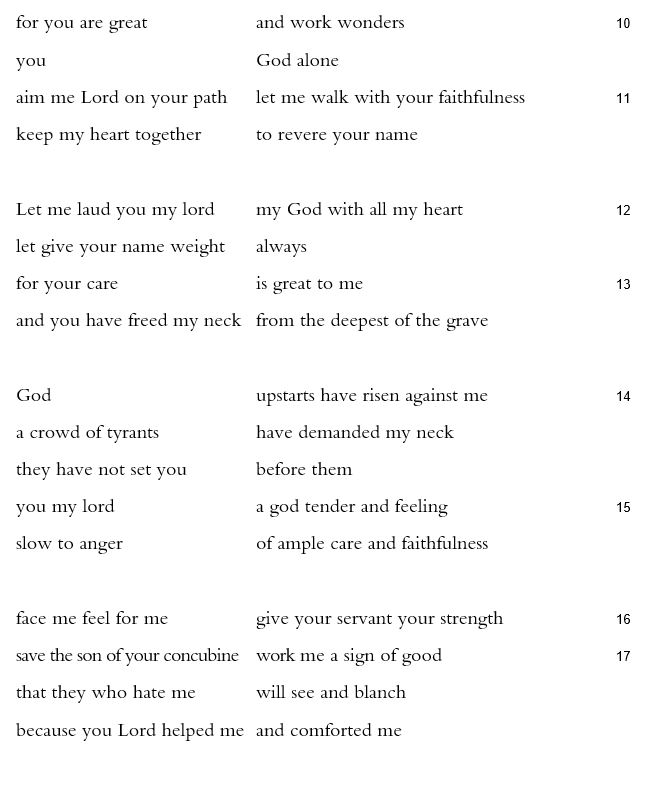
    The threat that has led the speaker to call out to God in the first place is not clear until the psalm’s third movement: “upstarts have risen against me / a crowd of tyrants | have demanded my neck” (14). For our sympathies, everything depends upon who these rebels and ruffians are: foreign invaders demanding tribute? vassals asserting their independence? striking mineworkers? insurrectionists? syncretists? regicides?

    For the first two-thirds of Psalm 86, not only do we not know who “they who hate me” are, we have trouble learning anything distinctive about the speaker. In the psalm’s first movement, the speaker beseeches favor and feeling without giving a reason. He wants God to answer (1, 6-7), to protect his neck and make it glad (2, 4), and to feel for him (3), but the only explanations are circular. He says, answer me (1) for I am calling you (3), for I am calling you because you answer (7). “Answer me/ for weak and in want | am I,” he also says, `aneni ki `ani ve’evyoni ’ani, making wordplay do the work of associating the first-person pronoun with the imperative to answer, linking the two by the claim of being destitute.

    Nearly all of the first three stanzas is spent on repetitive, conventional gestures of deference and beseeching. The speaker is “your servant” (2, 4), represented here only by his throat (2, 4 x2, cf. 13, 14), which appeals to God (2) as Lord (1, 6) but more as “my lord” (3, 4, 5). Quotations and conventions abound in every verse, from the prayer of Hezekiah “Spread your ear Lord” (Ps 86:1, 2 Kgs 19:16; cf. Pss 31:2, 71:2, 88:2), to the phrases “weak and in want” (Pss 86:1, 40:17, Deut 24:14, Job 24:14, and more), “guard my neck” (Pss 86:2, 25:20), “for I am caring” (Ps 86:2, Jer 3:12), “feel for me” (Pss 86:3, 6:2, 31:9, and more), “to you | I call” (Pss 86:3, 28:1, 30:8), “to you my lord | I lift my neck” (Pss 86:4 = Ps 25:1, with the change from “Lord” to “my lord”), “ample care” (Ps 86:5, 15, Num 14:18, Joel 2:13), “perk ear… to my prayer” (Pss 86:6, 17:1, 55:1), “on my day | of distress” (Pss 86:7, 77:2), “I call you | for you answer me” (Pss 86:7, 17:6, with a change of verb form). It’s more pastiche than pathos.

    The central section of the psalm, the most interesting part, is nevertheless still generic, still reliant on quotations, but now shot through with flattery. The “others” of the world are depicted in obsequious pose (9), as the speaker celebrates the glory (“weight,” 9, 12) of the Lord’s name (9, 11, 12) and whole categories of deeds and wonders (8, 10). Twice the word “great” is used (10-13). If one scanned the Deuteronomistic History for ceremonial prayers of kings from David (2 Sam 7:22 || Ps 86:8)  and Solomon (1 Kgs 8:23 || Ps 86:8; 1 Kgs 8:39 || Ps 86:10) to Hezekiah (2 Kgs 19:15,19 || Ps 86:10), one might construct something similar. The very middle of the psalm, while it does rely on excerpts from other psalms—“aim me Lord on your path,” for example (86:11 = Ps 27:11)—ably links two lines about speaker’s heart (11, 12) while pairing “you alone” (86:10, cf. Ps 83:18, 2 Kgs 19:15,19) with the unique verb “unite” or “keep together” (Ps 86:11, cf. Ps 83:5). The Lord’s singularity and the speaker’s integrity resonate. It’s a nice moment.

    Overall, however, the psalm is casual about its monarchical tendencies, even naïve. If a Davidic king is indeed in the circle of those who are weak and in want, swarmed by upstarts and tyrants, what must the rest of the people feel? To be clear, the problem is not that the psalm is conventional. Many psalms are traditional and many traffic in clichés, as do many prayers. The problem is that, even as a found poem or pastiche, the psalm feels empty. If, as seems likely, the psalm was written well after the collapse of the Israelite monarchy, during rule by foreign governors or occupying armies, nostalgia for home-rule must have been common and difficult to express without seeming seditious. It’s possible that a vaguely messianic prayer gave voice to subversive desires. Any subversiveness in Psalm 86, however, is lost by its vagueness, and by the insincerity of its first-person singular whose repeated use of “your servant” (2, 4, 16) barely disguises the speaker’s disregard for other people, or his will to power.
    Share:

    • Share on X (Opens in new window) X
    • Share on Facebook (Opens in new window) Facebook
    Like Loading…

    About Me

    My name is Mark Minster. I’m an English and Comparative Literature professor with a background in ministry and in poetry. I teach courses on writing, reading, religion, and nature.

    Recent Posts

    • Psalm 150
    • Psalm 149
    • Psalm 148
    • Psalm 147
    • Psalm 146

    Newsletter

  • June 3rd, 2023

    Psalm 85

    (director: of the Qorachites, a lyric)

    * * *

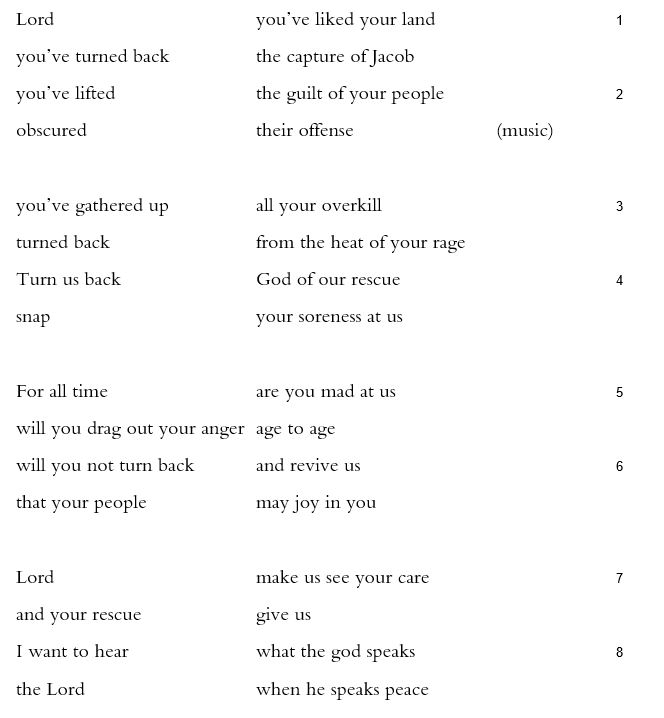
    If the frequency of keywords matters to a psalm’s meaning, Psalm 85 cares most about “turning.” So do many biblical narratives– from Jacob and Joseph to Moses and Balaam, to Ruth and David– and poetry throughout the Prophets and Writings. The root shuv is used five times here, all in the first four of seven stanzas. Having “turned back | the capture of Jacob” transitively and intransitively “turned back | from the heat of your rage,” God is urged in an imperative to “turn us back” (1, 3, 4). The final two uses of shuv are wishes, one for God, one for the people, introduced by adverbs of negation: “will you not turn back | and revive us” and “let them not turn back | to foolishness” (6, 8). In other words, a central biblical story is retold here in brief: past rescue leads to a call for present and future rescue—a call, a hope, a fear, a “will you not”—all of which is followed by an obligation that seems spoken by God: I will turn if they will turn. And so it fits that the fivefold use of “turn” in the first two sections of the psalm, stanzas 1 and 2, and stanzas 3-5, is woven through with the threefold use of “people” (2, 6, 8) and of “rescue” (4, 7, 9).

    From the middle of the psalm to the end, however, the keywords that repeat are abstractions like “care” (7, 8, 10), “peace” (8,10), “faithfulness” (10,11), and “justice” (10, 11, 13). These words don’t just repeat. They are actively, vividly brought together as they will be several times towards the end of Book 3 of the Psalter (Psalms 86, 88, and 89):

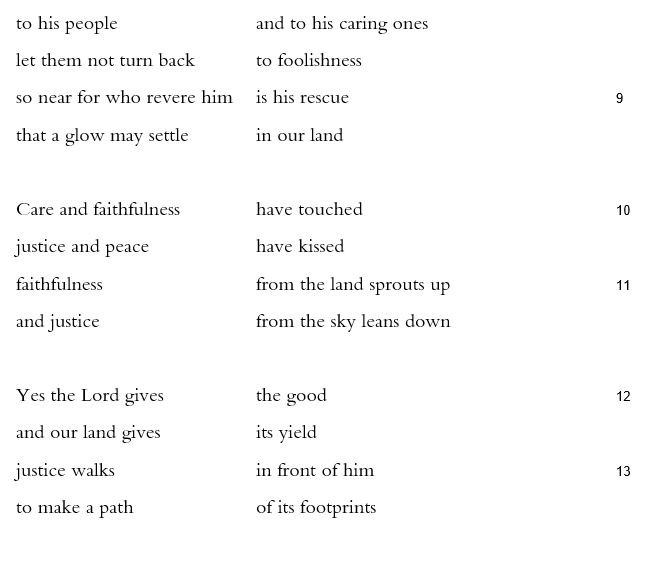
    Care and faithfulness | have touched 

    justice and peace | have kissed

    faithfulness | from the land sprouts up       

    and justice | from the sky leans down    (10-11).

    Care and peace, chesed and shalom, have been named already in the psalm’s central stanza. There is care, which the speaker wants the Lord to make visible. And there is peace, which she wants the Lord to speak, not just “to his people” but to “his caring ones” (8). The beauty and power of chesed and shalom is that they are relational: the Lord’s care is visible and audible in the chasidav, the ones who care and are cared for. In other words, when “care” and “peace” drop out of verse 11, in Psalm 85’s second-to-last stanza, it’s not because we don’t know where they come from but because we already do. If care and truth/fidelity/faithfulness touch, and faithfulness “from the land sprouts up,” then care must come down from above. If justice and peace kiss, and justice “from the sky leans down,” peace must operate from the bottom-up. What began as a psalm of turning becomes a psalm of encounter. What began as a request for rescue becomes a wish to see care and hear peace, which becomes a meditation on horizontal and vertical axes of fidelity and justice.

    Of these four principles, it is justice that the last stanza focuses on. While verses 10-11 move from the horizontal to the vertical plane, verses 12-13 reverse course. Verse 12 is down and up: “Yes the Lord gives | the good / and our land gives | its yield.” Verse 13 returns to the horizontal as it returns to the image of walking from the previous psalm: “justice walks | in front of him / to make a path | of its footprints.” The psalm ends with that singular possessive pronoun attached to “footprints,” an ambiguous pronoun that can refer to the Lord or to justice, which deepens (lengthens?) its power. The Lord walks behind justice, his footprints justice’s. In a psalm that calls for the Lord to rescue people and to reveal care and peace, the arrival of justice anticipates and signals.

    Similarly open-ended is the center of the psalm, the turn itself, the wish: “I want to hear | what the god speaks / the Lord | when he speaks peace” (8). Everything from “what” to “when” is strange: mah yedabber ha’el YHWH ki yedabber. The construction ha’el YHWH is unique, “the god the Lord,” a kind of backwards version of the common “Lord God,” YHWH ’elohim. Because the interrogative mah and the conjunction ki always have tremendous semantic range, the speaker’s desire to hear extends from how or what the God Lord speaks, to oh how he speaks, to whether he speaks. It’s a remarkable stretching of meaning that includes everything from a confident assertion (“I want to hear the powerful Lord speak for oh! he speaks peace!”) to a textual garble to a wonder or worry (“how does El speak the Lord if he speaks?”)

    In addition to the keywords named already, both “the Lord” (1, 7, 8, 12) and “the land” (1, 9, 11, 12) are named four times. It may not be possible to pin down a single meaning at the heart of Psalm 85. It is possible, however, to see and hear pervasive significance in the meetings of the Lord and the land, from the favor shown in the past (1) to the desired “glow,” the kavod that the speaker hopes “may settle | in our land” (9), to the visionary sprouting up and pouring down of fidelity and justice as the Lord gives and the land gives and in between a path is made.

    Share:

    • Share on X (Opens in new window) X
    • Share on Facebook (Opens in new window) Facebook
    Like Loading…

    About Me

    My name is Mark Minster. I’m an English and Comparative Literature professor with a background in ministry and in poetry. I teach courses on writing, reading, religion, and nature.

    Recent Posts

    • Psalm 150
    • Psalm 149
    • Psalm 148
    • Psalm 147
    • Psalm 146

    Newsletter

  • June 2nd, 2023

    Psalm 84

    (director: on the Gath harp, of the Qorachites, lyric)

    * * *

    This psalm lurches interestingly. It’s so caught between different verse patterns and readymade phrases that it would be tempting to call it a hodgepodge or even a mess rather than “a lively exchange of various forms, motifs, and themes” (Kraus II 166). But the psalm’s uneven rhythms mirror its deepest concern, the tension between residence and mobility.

    It is as if the Ark of the Covenant itself were speaking, the seat of power of YHWH Sabaoth, the Lord-in-Battle-Gear, having just been relocated from bloody theaters of war and high places like Shiloh and Shechem to what will become Solomon’s Temple. Or maybe what we hear is the voice of the sixth-century BCE architects of the Second Temple, returned from exile, nostalgic for militarism and monarchy. Either way, Psalm 84 works by recognizing both the desire for movement and the desire for a home. Its longing for Zion is less a conventional piety and more a scene of conflict between the longing for a dwelling and memories of walking around.

    The psalm seems to be arranged first around a sequence of places belonging to the Lord of Armies: “your quarters” (1), “the Lord’s enclosures” (2), “your altars” (3), “your home” (4), Zion (7), “your enclosures,” and “the gate | of the house of my God” (10). In tension with these locations— really, all are just metonyms for a single location, implying variety within unity— are two key passages about mobility.

    The first is the misunderstood stanza in verses 5-7 about the person with “highways in his heart.” Often this is construed as a love for pilgrimage or it’s amended willfully to “trust in their heart” (Kraus) or “from whose heart are your extolments” (Dahood). Hermann Gunkel writes thickly, “Even with the best intentions one cannot carry highways in one’s heart.” (Surely he never drove Highway 1 south from Santa Cruz through Big Sur, nor the Flaggy Shore that Seamus Heaney describes in “Postscript,” let alone the Dingle Peninsula or Donegal, never hiked the Appalachian Trial nor Offa’s Dyke. Nor, more to the point, did he walk hundreds of miles as a pilgrim or nomad or refugee.)

    The psalm’s images are strange but precise. People, plural, who pass over a vale of tears, water it. This passing-over momentarily inverts the story of the crossing of the Reed Sea— instead of having waters held back, they add to the flood. And yet, these tears become “a spring / and even blessings | which the first rain sheathes” (6). How could highways not be in one’s heart, to see a grievous crossing make the wilderness fertile? Are these people the children of Israel coming to the promised land, or pilgrims forced from the shrines of the northern kingdom, or refugees from Babylon, or willing pilgrims or tourists, visiting station after station? Either way, highways are indeed in their heart, as each is either “seen before God,” yeira’eh ’el ’elohim, as the circumspect Masoretic vowels say, or yir’eh ’el ’elohim as the consonantal text says, “sees the God of Gods” (or even “El sees God in Zion”).

    Verse 10 frames movement and stasis as a comparison, which would seem strange if there were no tension between the two. The contrast pits being stationary at the temple (“a day in your enclosures… standing at the gate | of the house of my God”) against traveling around with the military. The phrase “sweeter than a thousand” sends some translators in search of a substantive to anchor “a thousand”—“a thousand at home” (Kraus), “a thousand in the Cemetery” (! Dahood, banging on again about Death). But ’eleph contains its own substance; more than a numeral, it designates a military unit, a regiment, a battalion. It’s better to be closed in for a day than to spend a thousand days with a thousand soldiers, in other words, and better to stand like a bouncer outside the temple than to bivouac, “wandering around | in the tents of wrong.” The Assyrian loanword dur seems to indicate circular motion rather than “dwelling.” What makes the tents “wrong”? Again, the reference could be either to the Exodus or to the Exile or to the northern shrines shunned by the centralizing Yahwists. 

    Though verse 10 clearly prefers rooting in Zion to circling about with the military, the psalm concludes with blessings for a particular kind of movement and a particular staying in place. The Lord gives both “sun and shield,” both openness and protection, both “favor and glow,” according to verse 11. And to whom? “He holds back nothing sweet | from those who walk soundly… all set, the one who leans on you” (12). The reclining movement of trust is motion within stillness, while walking soundly requires a kind of stillness within motion. These same paradoxes are visible in the birds of verse 3, emblems of both liberty and domesticity, wing and nest, who have nested charmingly, ironically, precariously in the altars of the Lord of Armies.

    Share:

    • Share on X (Opens in new window) X
    • Share on Facebook (Opens in new window) Facebook
    Like Loading…

    About Me

    My name is Mark Minster. I’m an English and Comparative Literature professor with a background in ministry and in poetry. I teach courses on writing, reading, religion, and nature.

    Recent Posts

    • Psalm 150
    • Psalm 149
    • Psalm 148
    • Psalm 147
    • Psalm 146

    Newsletter

  • June 1st, 2023

    Psalm 83

    (a song, an Asaph lyric)

    * * *

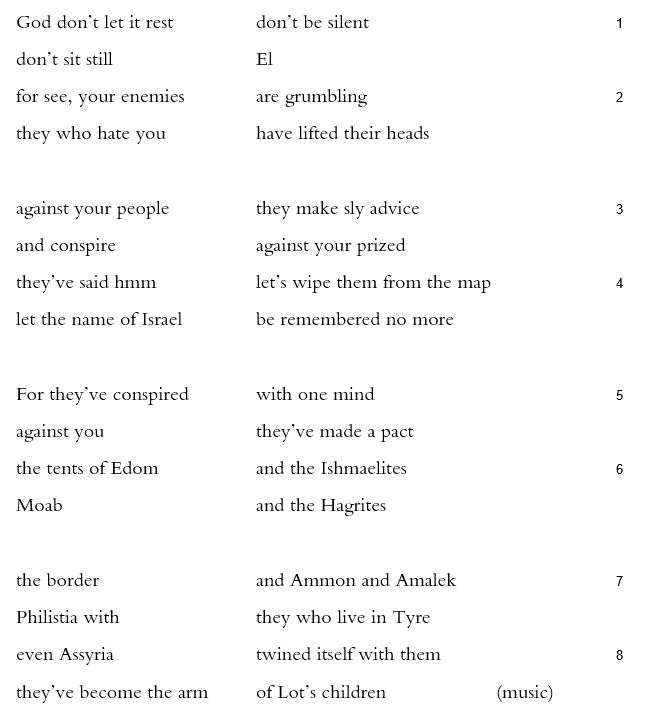
    As the final psalm in the sequence from Psalm 42-83, a grouping often called the Elohistic Psalter for its heavy use of the name ’elohim (“God”), Psalm 83 derives much of its meaning from association with the first psalm (or “psalms”) of the collection, Psalm 42-43. As the final Asaph psalm, it recalls the preceding psalm, Psalm 82, as well as the first Asaph psalm, Psalm 50.  Less apparently, Psalm 83 also relies on structural and thematic parallels with the story of the Tower of Babel in Genesis 11. Together these references make the case that those enemies who have conspired against Israel have sought to usurp what belongs to the name of Israel’s Lord, the only power over all other gods. Those enemies’ presumptuousness, the psalm implies, will be punished by scattering.

    The psalm begins where Psalm 82 left off, linking negation and the gods: ’elohim ’al domi-lakh ’al techerash ve’al tishqot ’el, “God don’t let it rest | don’t be silent / don’t sit still | El” (1). Here as elsewhere we see the potent ambiguity of the name ’elohim which can be singular or plural or both, depending on context. “God don’t let it rest” looks in English like a clause with a verb that would decide the number, “God” or “gods.” But that initial construction in verse 1 contains no clues about number, literally saying “God/gods no rest to her,” where the female object marker is unstated, as happens sometimes. With the name ’el, the widespread Near Eastern name for God, there are two powerful dangers. The first is the ambiguity that, except for a difference of vowels audible but invisible in the original consonantal text, the name is identical with ’al, the adverb “not.” Thus a line like verse 1 has the consonant chain aleph + lamed five times, twice for divinity, three times for negation, but with the lurking sense that the verse is five names for nothing and three ways of saying silence. It reads like Paul Celan.

    The other powerful danger of the name ’el is that it was so widespread, or seems to have been. As the name of everyone’s God, it may have been invitingly universal, but reflects no specificity for Israel.  Psalm 50’s solution to this problem is to call God ’el ’elohim YHWH, “God of gods the Lord,” to say “Our God comes | and does not keep quiet,” and to imagine God taking the witness stand: “I want to speak, Israel / let me testify against you | God your God me” (50:1, 3, 7). Psalm 50 ends with a promise of a revealed name: “who offers thanks | honors me / and a name I will show | a path to God’s rescue” (50:23).

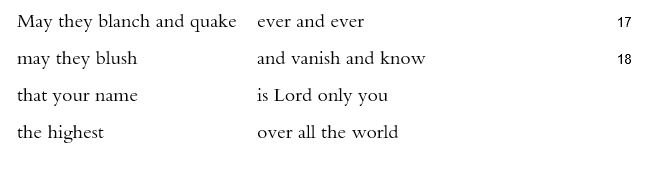
    Prior psalms in the Elohistic Psalter approached this same set of problems, how to handle a God who can be or seem both singular and plural, near and far, present and absent, by repeating the name of God 27 times, as Psalm 42/43 does, and by asking where God has gone (42:3, 10; 43:23-24). Like the current psalm, Psalm 42/43 also played with near-homonyms for the name of God, from the deer ’eyyal (42:1) to the prepositions `al and ’el (42:5, 42:11, 43:5). In Psalm 83, the repetition of `al, the “against” in “against your people… against your prized” (3) and “against you” (5), reminds the reader of the wordplay at the beginning of the unit. These `al patterns culminate in the last verse of the Elohistic Psalter, 83:18, with the divine name `elyon which is now made an attribute of YHWH, the Lord, lifted `al kol ha-’arets, “over all the world”: “your name | is Lord only / the highest | over all the world.”

    That phrase `al kol ha’arets shows up in similar form three times in the story of the tower of Babel “over the face of all the earth” (`al penei kol ha’arets, Gen 11:4,8,9; cf. Gen 1:29, 7:3; `al kol penei ha’arets Gen 41:56). The whole earth, according to Genesis 11:4, sought to build themselves a city and tower with its “head” in the skies and to make “ourselves a name.” Conspiring, the people twice say habah followed by tongue-twisters that play on the name of Babylon: habah nilbenah lebeinim, “come, let’s brick some bricks,” and habah nibneh lanu… vena`asu lanu “come, let’s build us… let’s make us…” (Gen 11:3-4). Habah, the Lord responds sharply in 11:7, with his own literal tongue twister, neiredah venabelah sham sefatam, “come, let’s go down and mix there their tongue.” Thus, the story concludes, the partial tower is named Babel, for sham balal YHWH sefat kol ha’arets, “the Lord confused the tongue of all the world.”

    Every part of this story is valuable for Psalm 83, beginning with the aspirational conspiring of the others, the nations who lift their “head” (2-3) and say, “hmm | let’s wipe them from the map” (4, literally “they’ve said come, let’s cut them down from a nation”). These others don’t just threaten the people of Israel, according to the psalm. They threaten God: nirasha lanu, they say, “let’s seize us,” ’et ne’ot ’elohim, “the meadows of God.” That is, also: “let’s seize us | the meadows of the gods.” To this centripetal motion of adversaries who seek to work as one (“they’ve conspired | with one mind,” 5; cf. Gen 11:1, 6), the Lord is invited to respond again by dispersing the peoples of the whole world, not with a balal, but with a bahal: “with your stormwinds | quake them” (tebahalem, Ps 83:15), “May they blanch and quake” (veyibbahalu, 18). Rather than seeking a name for themselves, these conspirators have sought to erase Israel’s name: “let the name of Israel | be remembered no more” (4). The punishments the speaker calls for from the Lord are violent, to be sure, but centrifugal almost to the point of being cartoonish: “chase them thus | with your tempest / with your stormwinds | quake them” (15).

    The ultimate purpose of these punishments is revealed in the repeated mention of the Lord’s name at the end of the poem: “so they ask your name | Lord” (16) and “may they blush | and vanish and learn / that your name | is Lord only / the highest | over all the world” (17-18). A project of usurpation that began in Babylon, continues, according to this psalm, through “Lot’s children” (8). If there is to be a true temple to a true God, the psalm suggests, space needs to made by and for the name of the Lord. The invading nations who hoped to converge “together” (yachdav 5; cf. Gen 13:6) are to be thwarted, the psalm hopes, by the work of the God whose name is YHWH “only you” (lebaddekha, Ps 83:18; cf. Isa 37:16, 20). The payoff, in a psalm with so many names of enemies, in a collection within the book of Psalms with such varied, ambiguous names for God, is to converge on one name and one name only.

    Share:

    • Share on X (Opens in new window) X
    • Share on Facebook (Opens in new window) Facebook
    Like Loading…

    About Me

    My name is Mark Minster. I’m an English and Comparative Literature professor with a background in ministry and in poetry. I teach courses on writing, reading, religion, and nature.

    Recent Posts

    • Psalm 150
    • Psalm 149
    • Psalm 148
    • Psalm 147
    • Psalm 146

    Newsletter

←Previous Page
1 … 15 16 17 18 19 … 37
Next Page→

Blog at WordPress.com.


Loading Comments...
 

    • Subscribe Subscribed
      • The Book of Psalms
      • Already have a WordPress.com account? Log in now.
      • The Book of Psalms
      • Subscribe Subscribed
      • Sign up
      • Log in
      • Report this content
      • View site in Reader
      • Manage subscriptions
      • Collapse this bar
    %d