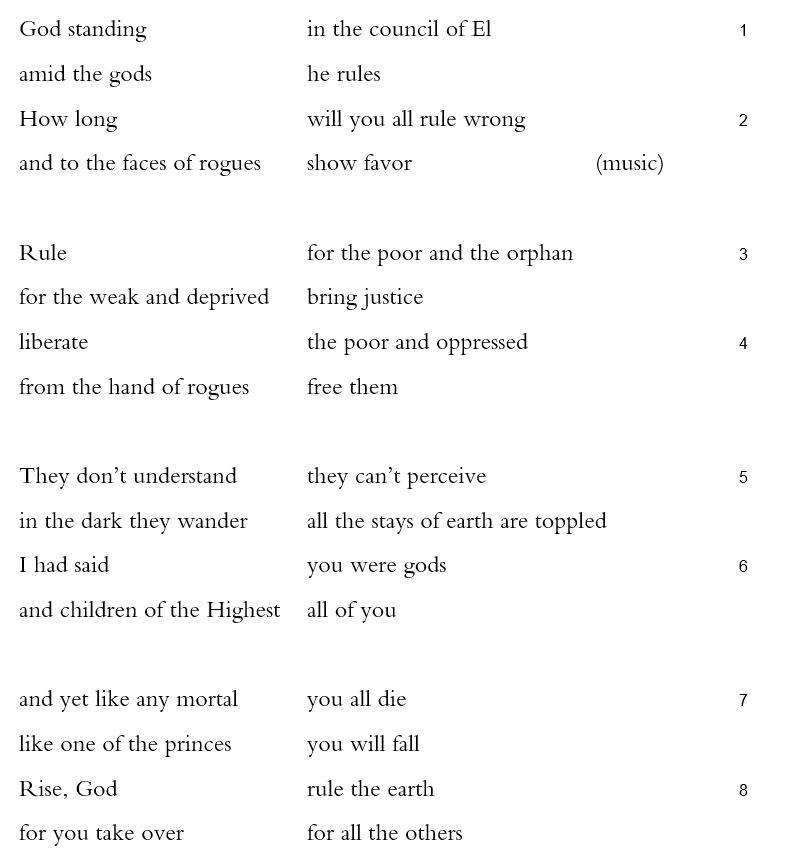
Psalm 82 is the best example in Psalms of the value of cherishing ambiguity, not just tolerating it. Where does God (’elohim) stop and the gods (’elohim) begin? There are no quotation marks here, no attributive tags to delimit who speaks when. So is it God who speaks in verses 2-7, or in verses 2-5, or 2-4, or just verse 2, or not at all? Are “they” who “don’t understand” in verse 5 the “gods” from verse 2 or the “rogues” from verses 2 and 4, or both? To what extent are the gods, all of them, just a device, a projection that looses the powerful moral of the psalm— indeed, of the Bible as a whole— those quadrupled plural imperatives of verses 3 and 4?
Rule | for the poor and the orphan
for the weak and deprived | bring justice
liberate | the poor and oppressed
from the hand of rogues | free them.
We have options. It could well be God (’elohim) who stands and admonishes the gods (’elohim) in the council of God (’el), wearily wondering when these pretenders will stop providing cover for scoundrels. But the psalm works equally well if the speaker of verse 2 is the psalmist as well, “How long | will you all rule wrong.” It’s the psalmist, ultimately, who wants the gods— and God— to bring justice to the poor. And yet the psalm also imagines that it’s God who wants this justice to come from the gods, among whom God stands. Because the imperatives are plural, everyone who recites the psalm repeats the commands to everyone around. Rule for the margins, bring justice, liberate, free. Later, whoever speaks in verses 6 and 7 presents the realization that, having said “you were gods / and children of the Highest | all of you” there is still an “and yet….” This realization is both God’s denunciation of other gods, God’s rising over them, and the psalmist’s demotion of the entire divine council.
The witty turn in verse 5 at the psalm’s center is especially ambiguous. “They don’t understand | they can’t perceive / in the dark they wander | all the stays of earth are toppled” blends ambiguous pronoun reference with squinting modification. Both of these traits, in ordinary referential prose, are grammatical errors to be avoided. Who are “they”? Proximity to an antecedent implies the human “rogues,” resha`im being the most recent plural noun (4). But “they” makes at least even more sense as “the gods” from verse 1, the gods who were charged with the four plural imperatives enjoining justice and freedom. Thus the cheaters and the gods are indistinguishable for us in their idiocy. Neither group can “perceive,” let alone “perceive / in the dark,” for both groups “in the dark wander.” Darkness works both ways. And so both groups “are toppled,” the word that comes next in Hebrew, before we learn that it is the very foundations of the world that are being shaken, shaken in a moment of comic genius, by the bumbling of blind, rogue gods. The foundations of mythology itself are toppled by gods like the crashing wooden sets of Keystone Cops.
It’s a remarkable moment in a remarkable psalm, both comedic (it is tempting to render “council” in verse 1 as “boardroom”) and earnest, both antiestablishment and authorizing of power: “Rise, God | rule the earth / for you take over | for the all the others” (8). Its layers really make it, thematically as well as narratively. That a human psalmist should command God to take charge, displacing gods who are displaceable as any human authority, is probably the psalm’s finest doubled meaning. It’s also a tremendous setup for Psalm 83, the final Asaph psalm.
My name is Mark Minster. I’m an English and Comparative Literature professor with a background in ministry and in poetry. I teach courses on writing, reading, religion, and nature.
At two poles of interpretation, Psalm 81 is either a cohesive whole or disjointed pieces. Seeing it as unified, some scholars have argued that it must have part of an actual liturgical rite, actually recited at a specific time— the beginning of the month at the new moon, or the first of the year, or Passover. Others, doubtless bothered by its strange dialogical leaps, see Psalm 81 as at least two separate psalms, split in the middle of verse 5 and probably elsewhere as well. Some of these interpreters even perform reconstructive surgery with the most oblique lines, moving “Widen your mouth | I want to fill it,” for example, as if a different location might make more sense (10). Neither approach, however, fully appreciates the dark, associative wit of this psalm, its sardonic theology of a God ignored.
Aptly, this psalm that emphasizes God’s people’s failure to hear begins with their noise. The first stanza calls for typical sounds of praise, loud voices and a trio of instruments (1-2). The second stanza adds the ram’s horn to signal a special feast (3). The celebratory commotion is then commented on as the narrator says, “this is a rite… what’s right.. an edict,” tracing the festival back to Egypt (4-5b). And then, without warning, a first-person voice breaks into the ceremony. “I hear a tongue | I’ve never known,” says someone, though who is not clear (5c). It’s God’s voice from verse 6 through presumably the rest of the psalm, saying of Israel, “I have taken the load | off his shoulder.” So “I hear a tongue” might be God speaking. Or it might be someone speaking about God, and thus the line does double duty. If God here recalls meeting Israel “at his exit | from the land of Egypt,” then the “tongue | I’ve never known” emphasizes God’s encounter with his people’s language for the first time. Or if it’s a human speaker announcing the interruption of divine speech, then this hearing-without-knowing is exactly symptomatic of Israel’s problem. Both readings work; the psalm does not decide. Importantly, this line includes the psalm’s first use of the word “hear,” which will appear again four times, once as an imperative and three times as a counterfactual: “hear” (8); “I swear you won’t hear me,” ’im tishma` li, which looks like an oath formula, though it could could also mean “if you would hear me” (8); “and they did not hear,” velo’ sham`a (11), and “if only my people | hearing me,” lo `ammi shomei`a li (13). Despite, or because of, their festive music, the people don’t hear.
This voice that people don’t hear is layered with ambiguities and with deft movement. Verses 6, 7, and 16 rely— as does the entire passage from 11-14— on a shift from perfect-form verbs to imperfect-form verbs: e.g., “I have taken the load | off his shoulder / his grip on the basket passes over” (6). Imperfect verbs in biblical Hebrew can convey past action, but translations lose vital data when they leave out the shift. A load has just come off the people’s shoulder; their grip is still loosening. The people “called,” but God says, “I answer you… I try you” (7). In verse 8, God speaks legalese, though it is not certain whether he testifies or compels Israel to testify. “I want to take the stand with you,”ve’a`idah bekha, means both “I call to witness” and “I witness.” Having called to testimony, God says— or asks— ’im tishma` li, which means both “if (only) you (would) listen to me” and “that you won’t hear me,” the ’im a marker of an implied vow.
Through these layers are woven quotations. God’s speech is strewn with allusions and excerpts from passages the people should have heard. Verses 8 and 9 quote from the most important legal passages (’im tishma` li Ps. 81:8 = Exod 23:22; lo’ tishtachaveh Ps 81:9 = Exod 23:24, 34:14, and Deut 5:9). Many of the quotations are inexact. Verse 9’s line “there shall not be with you | any strange God,” lo-yihyeh bekha el zar is almost the more famous lo-yihyeh lekha elohim (Exod 20:3; Deut 5:7). Even God’s dramatic self-revelation on Sinai is quoted only partially verbatim: “I am the Lord | your God / lifting you up | from the land of Egypt.” “Lifting you up” is hama`alka (Deut 20:1) rather than ’asher hotsei’tika (Exod 20:2 = Deut 5:6, cf. Gen 15:7) What does this inexactness mean? Is it God’s point that hearing requires something other than exact recitation? Is it the psalmist actually misremembering crucial passages from Exodus and Deuteronomy, encouraging participants in a rite to take part in mishearing? Or is the misremembering purposive for some other reason? When, in verse 11, Israel “did not hear” and “did not agree,” the paired verbs shama` and ’abah call to mind both Pharaoh (Exod 7:13, 22; 8:15, 19; 9:12; and 10:27) and God (“But the Lord your God did not agree to listen” Deut 23:5). Verse 12, “so I sent them off | with their obstinate heart” also calls to mind both Pharaoh (whose own hard heart refuses to send off Israel) and God (bishrirut libbam echoes Deut 29:19, and more proximately Jer 7:24. Verse 13’s “if only” recalls both God’s complaint in the Song of Moses— “if only they were wise” (Deut 32:29)— and the people’s complaint in the wilderness: “if only we had died in the land of Egypt” (Num 14:2). Verse 16 also nearly quotes from the Song of Moses, both “sweet bits of wheat,” meicheilev chittah (cheilev kilyot hittah, Deut 32:14), and “honey from the cliff,” umitsur devash (devash missela` Deut 32:13). With all of these references, either God or the psalm is up to something, something less like liturgy and more like irony.
Fittingly, too, this psalm of allusive, ironic, layered divine speech spends its most curious verses on the figure of the mouth. The mouth is so important to both praise and complaint. It is the source of what must be listened to, a source of nourishment, and even of danger and death. Even stranger than the hearing of a language “I’ve never known” are the mouth-related line “Widen your mouth | I want to fill it” (10) and the psalm’s final verse, “He made him eat | sweet bits of wheat / and honey from the cliff | I want to satisfy you” (16). Both lines leap out of the texture of the psalm, distinct from what surrounds them. Both express divine desire, suggesting terror as well as tenderness. It is impossible to forget God’s response to complaints in the wilderness, literally stuffing people to death (Num 11), impossible to forget the lines on feeding from the Song of Moses:
He nourished him with honey from the rock
And with oil from the flinty crag
With curds and milk from herd and flock
And with fattened lambs and goats
With choice rams of Bashan
And the finest kernels of wheat (Deut 32:13-14)
The whole of that poem in Deuteronomy gets dark. The people forget this nourishment, which is richly ironic given that, “filled with food, they became heavy and fat” (32:15). They serve gods who eat the fat of sacrifices and drink poison wine (32:32, 38), which results in divine punishment, making arrows drunk on blood, his sword eats flesh (32:42).
But sure, the poem suggests. Play those instruments. Make noise.
My name is Mark Minster. I’m an English and Comparative Literature professor with a background in ministry and in poetry. I teach courses on writing, reading, religion, and nature.
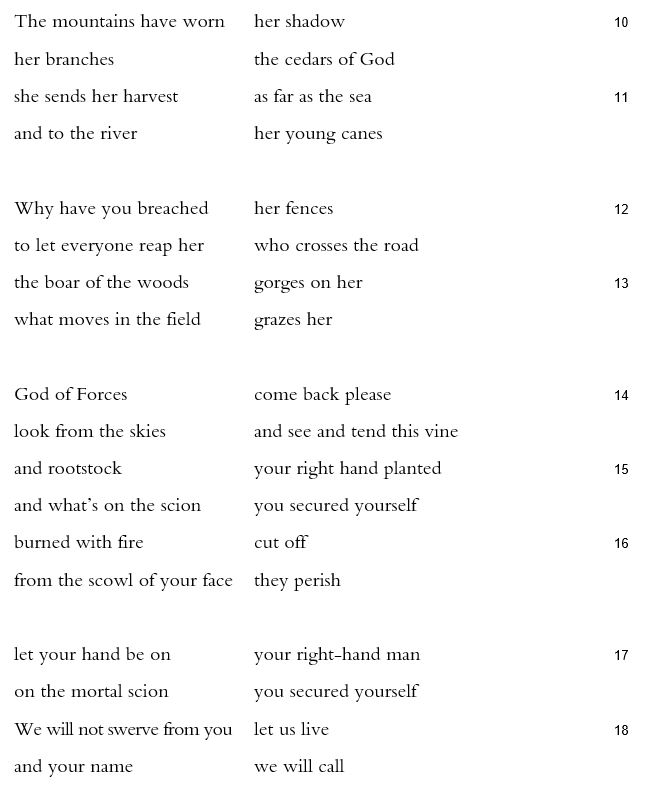
Two images govern Psalm 80: the grapevine, an extended figure for Israel that’s common in the former and writing prophets, and the face, which shows up seven times throughout the psalm, sometimes obvious, sometimes hidden. Other metaphors arise, to be sure, tropes for leadership like “shepherd… leading Joseph like a flock” (1) and “your right hand,” doubled in verses 15 and 17. There is “the bread of tears,” in a line that appears to one-up— or, rather, to three-up— a line from Psalm 42: “and you make them drink | tripled tears” (5; cf. 42:13). And there is that particularly lyrical quatrain within the longer conceit of Israel as a grapevine:
The mountains have worn | her shadow
her branches | the cedars of God
she sends her harvest | as far as the sea
and to the river | her young canes (10-11).
Despite the vertical mountains and cedars, the stanza is thoroughly horizontal, from the shadows and branches to the sea and the river, even to the left- and right-branching canes from which new growth comes. The images grow and spread as the stanza moves from the perfect-form “have worn” to the imperfect-form “sends.”
The vine takes over the whole psalm. A trope becomes a symbol before our eyes, as so much of the plant is used: transplanted rootstock (8-9), spreading branches and canes (10-11), plundered fruit (12-13), and especially the scion, that “son” (ben) of the vine, the grafted part that leafs out and flowers and bears fruit) 15-17. It’s a productive metaphor, one that rewards the attention the psalm gives it. Through it, Israel’s history is retold. The grapevine comes from Egypt to a land where room must be made—the imperfect form of “you bring” and “you displace others” generates an immediacy that ought not be lost. Israel the vine spreads, only to have her barriers broken through. Later, when the valuable fruiting parts of the vine have been destroyed, it is the grafting that matters most:
look from the skies | and see and tend this vine
and rootstock | your right hand planted
and what’s on the scion | you secured yourself
burned with fire | cut off
from the glare of your face | they perish (14-16).
Importantly, the vine has not been uprooted entirely. To bear fruit, it needs a new scion. Verse 17 identifies the vine as a “he,” the ben that is a ben, human offspring, to be grafted onto the rootstock that remains: “let your hand be on | your right-hand man / on the mortal scion | you secured yourself” (17). In its own way, the closure of Psalm 80 celebrates non-Ephraimite leadership every bit as much as does the closure of Psalm 78. While Psalms 78 and 79 both culminate with shepherding (78:70-72; 79:13), Psalm 80 begins with a pastoral image only to leave it behind for something more rooted, more placed. And yet the psalms together call for a kind of leadership by grafting, new shoots to come from old stock.
It’s both the promise of fruit to come and the literal phrase in verse 17 rendered here as “the mortal scion” that allow Psalm 80 to be read not just metaphorically but allegorically, not just symbolically and prophetically but eschatologically. The phrase ben ’adam has a rich history in the Bible, most often associated with the books of Ezekiel and Daniel (used nine times in Ezek 2 and 3 alone, nearly ninety times in the entire book; cf. Dan 10:16, 18). But the phrase appears almost always without apocalyptic significance (e.g., Ps 33:13, Gen 11:5, KJV: “the children of men”; cf. Gen 6:2,4 “daughters of the adam”; Ps 107:8, 15, 21, 31, Num 23:19, Job 16:21).
The afterlife of that term, ben ’adam, “son of man,” and the development of apocalyptic literature lends this particular psalm eschatological significance for some readers—the burning, the cutting off, the son of man seated at the right hand. For its earliest audiences, however, the oblique reference to “let your hand be on | your right-hand man / on the mortal scion | you secured yourself” would have been read not as code for the end of times, but as a call for immediate rescue by a human liberator touched by the hand of God.
Ultimately, however, what Psalm 80 cares about most is God’s face . The refrain asks God in various names—God (3), God of Forces (7), Lord God of Forces (4, 19)—three times to “bring us back / shine your face | and let us be rescued.” To these three desired appearances of God’s face is contrasted the other explicit use of the word “face,” verse 16’s mention of “the scowl of your face” as the cause of the death of the scion: “burned with fire | cut off / from the scowl of your face | they perish.” It is not that God’s face is absent. The light of God’s face is not shining.
In two other places, the word “face” takes on other meanings. First, it’s in the dead metaphor “before” in “gleam before Ephraim | and Benjamin and Manasseh” (1-2) where a face is again associated with shining. Here, however, it’s a face wanting to be shined upon. And finally, the root paneh for face appears twice in a row in verse 9, pinnita lefaneha, “you’ve cleared away | away from her.” The “away | away” repetition tries to capture the verbal play of the original, which has to do with turning. The word “face” in biblical Hebrew always carries a trace of its root meaning of turning— as in the English phrase “let’s face it.” Shrewdly, strangely, Psalm 80 links its two main images here near the middle of the psalm, with the turning of the faces in the soil, part of the act of making room for the vine’s roots to root. Motion towards meets motion away, and in the dark adamah, the ground, is the face-to-face that must shine if the vine will again bear fruit.
My name is Mark Minster. I’m an English and Comparative Literature professor with a background in ministry and in poetry. I teach courses on writing, reading, religion, and nature.
Unlike the psalms that precede it, Psalm 79 centers on not remembering: “Don’t remember at us | our prior wrongs / hurry, let come at us | your tendernesses / for we have been so | abased” (8). The curious irony is that these three lines are preceded by two lines— indeed, most of the first seven verses of the psalm— that do just the opposite, helping God remember the destruction of Solomon’s Temple in Jerusalem: “oh they feasted on | Jacob / and razed | his home” (7). Remember the destruction, the psalm says, but forget “our prior wrongs.” It’s a history that asks God to remember only those wrongs done by “the others” (1, 6, 10 x2). And as the second half of the psalm turns from trauma to revenge, it’s that partiality of memory that becomes so dangerous.
The psalm is a careful chiasm. The structure highlights its logic of provocation met by hawkish disproportionate response. The psalm’s first imperative, “spill your fury | on the others / who haven’t known you | and on the realms / who haven’t called | in your name” (6), is paralleled in the second half by a burst of imperatives and jussives:
hurry, let come at us | your tendernesses
for we have been so | abased
help us | God of our rescue
for the honor of your name | free us
overlook our mistakes | for the sake of your name (8-9).
The failure of “the others” to call “in your name” (6) is contrasted with “the honor of your name” and “for the sake of your name” (9). These name-motivated imperatives that appeal to God’s vanity are preceded and followed by the poem’s three questions, arranged, as with the word “name,” with one (`ad mah) in the first half and two in the second half (lammah and ayyeh): “How long Lord” (5) and “Why let the others say | where’s their God” (10).
Nearly half of the poem takes place in verses 2-4 and 10-12, the psalm’s two main panels. The early part points to the bodies, “your servants’ corpses… your caring ones’ flesh” (2). It points to the blood, “they’ve spilled their blood | like water / all around Jerusalem | and no one to bury them” (3). And it points to the people’s loss of esteem in the eyes of their “neighbors”: “we’ve become a joke… a jape and a jest/ to those who surround us” (4). The bodies and blood return in the later part: “let it be known | among the others in our sight / the vengeance of blood | of your servants spilled” (10). The passive participle “spilled” refers both to the blood that was spilled and the blood of vengeance that is about to be spilled. The word “joke” (or “taunt”) from verse 4 returns twice in verse 12: “pay back | our neighbors / seven times | in the chest / their joke | they joke at you my lord.”
Sevenfold revenge for mockery in verse 12 is one thing. “Vengeance of blood” in verse 10 is something else. The psalm clearly advocates for both. Others can continue to debate the ethics of these kinds of retribution. But verse 11, which stands between the other two calls for revenge, stands apart: “Let come to your face | the prisoner’s scream / from the force of your arm.” At first glance, that scream seems to come from one of the Lord’s caring ones, whose deaths the first half of the psalm relives. But the completed syntax makes clear that God is being invited to relish the sound of prisoners suffering “from the force” of God’s own arm. And the last line of verse 11 is truly haunting: “make more than enough | the children of death.” While the imperative hoter is admittedly ambiguous in its meaning, given that the root yatar means to leave a remainder or to be left, its use in other places clearly indicates abundance to the point of excess (vehoter Exod 36:7 and 2 Kgs 4:43; vehotirekha Deut 30:9). So although it is possible that this line may be read as a plea for God to hear his own people’s screams and to preserve his children from death, this reading seems secondary in the context of other lines calling for blood. The more likely reading is the darker, more dangerous one, that God is encouraged to revel in brutality.
At its beginning and end, in verses 1 and 13, the psalm returns to the scene of the temple. What at the beginning had been profaned, by the end seems to have been restored. At the same time, a psalm that appeals to God’s vanity as well as his loyalty ends with the promise of praise, which seems close to dependent upon the longer, more detailed fantasy of revenge.
My name is Mark Minster. I’m an English and Comparative Literature professor with a background in ministry and in poetry. I teach courses on writing, reading, religion, and nature.





 The Book of Psalms