• Page list
    • Posts
    • The Book of Psalms

The Book of Psalms

  • August 5th, 2023

    Psalm 146

    * * *

    The Book of Psalms concludes with a coda of five psalms of Hallelujah (lit. “laud the Lord”), Psalms 146-150. Five books of the psalter, five final psalms, and in Psalm 146, five lines in a row that name and describe the Lord with noun + participle phrases, phrases simultaneously adjectival and absolute, with verbs not bound by time:

    the Lord | loosing the bound                                   

    the Lord | eye-opening the blind

    the Lord | lifting the stooped                                   

    the Lord | loving the just

    the Lord | guarding migrants (7c-9a).

    Such pentads mirror the five books of the Torah, seeking to borrow authority and implicitly claiming similarity of design and purpose, defining a people, defining the law. Pairing liturgy with a law that is embedded in a narrative of liberation lends the songs legal and liberatory significance, deepening and thickening the work of praise.

    Most importantly, Psalm 146 accentuates one of the Torah’s crucial implications: that, because each human life ends even as divine attention by definition endures, the work of liberation must cross generations. There is no subjective immortality, this psalm insists. The speaker wants to sing for “my God” “with my life” and “with my keeping going” (2), and so the psalm turns to verses that conclusively leave that first-person behind to elaborate on what “keeping going” entails. It’s not about some other world. The second stanza starkly reminds the speaker as well as the audience that all flesh is grass, everyone dies: “his breath leaves | he goes back to his soil / on that day | his thoughts vanish” (3). This is far from a vision of any individual’s eternal soul or personal resurrection, and yet far from nihilism as well. Instead, happiness accompanies the shift from “my God” to “the God of Jacob… the Lord her God,” the “help” and “hope” of anyone (5).

    If “life” and “keeping going” are not at all about some private afterlife, neither is rescue or salvation merely individual. Help roots in the work of creation, which is participially continuous with the work of redemption. The bulk of Psalm 146 is a backbone of nine participial phrases that embody the timelessness of divine actions and identity: “guarding faithfulness | ever / making verdicts | for the oppressed / giving bread | to the hungry” (6b-7b).

    Little parallels pull this list together. The “making” of sky, land, and sea (6a) is stitched to the “making” of the law, which is supposed to prefer “the oppressed” (7a). The “guarding” of fidelity, troth (6b), is linked to the “guarding” of that trio that stand in Deuteronomy for society’s most vulnerable: refugees and others bereft (9). And there are those five three-word lines that put “the Lord” grammatically first, the downtrodden third, a participle mediating between (7c-9a).

    Immediately following this list, in 9b, the root of what is translated here as “keeps going” returns, now shorn of its first-person singular suffix (“my keeping going” in 2b). Both words are remarkable constructions. The first is doubtless shaped from the powerful adverb `od, which means “still” and “more” and “again”— thus, be`odi can be paraphrased as “while I still [am]” or “in my more than” or “with my continuity” (2b). The other, “orphan and widow | he keeps going,” conjugates the verb `ud to ye`oded, likely formed from `od, that seems in context to mean either to restore or to allow to continue.

    The life perpetual, in other words– which frames the continuous rescuing that the Lord shows to the oppressed, the hungry, the captive, the injured, the just, and the vulnerable– does not mean one speaker’s individual life. God’s attentiveness is participial, Psalm 146 claims, making mortal life itself more-than. It does so not by tacking onto the length of one person’s days, but through the caring justice of continual help. The two “keeping going” constructions frame that divine help. More, they themselves are framed in turn by the poem’s shift, first verses to the last, from “my God | my keeping going” (2b) to “your God, Zion | age to age” (10b). The psalm begins, that is, in soliloquy: “Laud, oh my throat | the Lord” (1b). It ends by addressing others, with praise for a God who is not about being privatized.

    Share:

    • Share on X (Opens in new window) X
    • Share on Facebook (Opens in new window) Facebook
    Like Loading…

    About Me

    My name is Mark Minster. I’m an English and Comparative Literature professor with a background in ministry and in poetry. I teach courses on writing, reading, religion, and nature.

    Recent Posts

    • Psalm 150
    • Psalm 149
    • Psalm 148
    • Psalm 147
    • Psalm 146

    Newsletter

  • August 4th, 2023

    Psalm 145

    (a psalm, of David)

    * * *

    The only psalm that calls itself a psalm (in verse 21 as well as the superscription), Psalm 145 is essential for both Judaism and Christianity, foundational for Jewish worship and daily prayer as well as for the key theme of Jesus’ teaching in the Synoptic Gospels: the realm of God. The most abstract of all psalms, its power is conceptual and auditory rather than concrete or visual. Or rather, the visual strength of Psalm 145 is in its textuality, its words and letters arranged in an alphabetic acrostic whose center spells out its two most important words. Verses 10-14 start with the letters yod, kaf, lamed, and mem. In reverse order, these letters spell the word mlky, “my king,” which underscores the kingship theme that’s explicit in the psalm’s first and middle verses (1, 11, 12, 13). In alphabetical order, kaf and lamed spell kol, the word “all,” used seventeen times in the psalm, fourteen times from verse 10 until the end. Thus, very literally, the poem shapes the claim that God’s realm both leads to and encompasses all.

    Like every other acrostic linked to David by superscription (Pss 9-10, 25, 34, 37), Psalm 145 is imperfect. A verse is absent for the letter nun. While numerous ancient manuscripts supplied a nun verse, the assumption that the psalm’s imperfection is a weakness is not necessarily warranted. After all, the verse that does appear, among other places, in the Septuagint and the 11Q5 Psalter from Qumran, is forgettable and flat: “Faithful, the Lord | in all his words / caring | in all his works.” (Among other drawbacks, the second half of this verse is identical to the second half of verse 17.) The absence of a nun verse in the Masoretic Text has been explained variously as an accident, as an editor’s decision or author’s intention, and even, by midrash in the Talmud’s Tractate Berakhot 4b, as a purposeful omission because of what would have been written instead: “Rabbi Yochanan said: Why is there no nun…? Because it contains [Israel’s falling]. As it is written: ‘The virgin of Israel has fallen and she will rise no more’ (Amos 5:2).” (See James Kugel’s important essay, “Two Introductions to Midrash.”)

    Regardless of the explanation, reductive or expansive, one effect of the skipped letter is to reduce the number of verses in Psalm 145 from 22 to 21, putting into question the center of the psalm. Valuable scholarly articles by Lindars, Declaissé-Walford, Kimelman, and others have posited competing models of the psalm’s architecture, its stanza patterns, outer edges and inner core. The word “name,” shem, appears three times, twice at the beginning, once at the end (1, 2, 21). The verb barak, “bless,” for instance, which is rendered here as “adore,” occurs twice at the beginning, once near the middle, and once again at the end (1, 2, 10, 21). Similarly the word `olam, translated here as “ever” shows up twice at the beginning, once at the end, and once near the middle in a superlative plural “evers” (1, 2, 13, 21).

    Clearly the psalm is framed by verses 1 and 2 and verse 21. This leaves eighteen verses, which appear to be arranged in a satisfying pattern of (4+3) + 4 + (3+4). A stanza on divine magnitude and power, evidenced in the past (verses 3-6), leads to a stanza on “the memory | of your great sweetness,” less about moral goodness than the Lord’s attentiveness (7-9). The third main stanza (14-16), the most concrete of the poem, energizes the Lord’s attention to all beings through a series of active participles, while the fourth stanza abstracts again, turning from the Lord’s devotion to the devotion of those who call, revere, and love him (17-20).

    None of these main stanzas, it is worth pointing out, says a word about kingship, at least not explicitly. That theme is embedded in the psalm’s central four verses, which are arranged around the turn from verse 11 to verse 12. Verse 11 ends with “their” speech, where “they” seems to refer to “all your works / and your caring” from verse 10, while verse 12 begins with the knowing of the benei-ha’adam, literally the sons of the Adam, those born of the soil, the vassals. Thus, grammatically, while “they speak” fits what precedes it in verse 11 (“your show of strength | they speak”) and “to make the lowborn know” fits what follows it in verse 12 (“to make the lowborn know | his shows of strength”), the two words fit together as well as action-and-purpose: “they speak / to make the soilborn know.” This center is framed by “your show of strength” and “his shows of strength” which in turn are flanked by “the glory of your realm” and “the glory of the grandeur of his realm” (11-12). That this is the psalm’s center is reinforced by the kaf-to-lamed acrostic, which, again, spells the word “all.”

     At the same time, alternative chiastic centers can be identified. One comes in the transition from verse 9 to 10, “over all his works / They thank you Lord | all your works,” framing the psalm’s only mention of thanksgiving. Another comes in the transition from 12 to 13, in the three-in-a-row of malkuto / malkutekha malkut kol-`olamim, “his realm / your realm a realm of | all the evers” (which unavoidably calls to mind the similar-sounding, similarly self-referential “Malkovich Malkovich Malkovich” scene from Being John Malkovich). As with the case of the missing nun, any single interpretation may be less valuable than the plural possibilities, a “yes, and” altogether fitting for a psalm of so much “all.”   

    Share:

    • Share on X (Opens in new window) X
    • Share on Facebook (Opens in new window) Facebook
    Like Loading…

    About Me

    My name is Mark Minster. I’m an English and Comparative Literature professor with a background in ministry and in poetry. I teach courses on writing, reading, religion, and nature.

    Recent Posts

    • Psalm 150
    • Psalm 149
    • Psalm 148
    • Psalm 147
    • Psalm 146

    Newsletter

  • August 3rd, 2023

    Psalm 144

    (of David)

    * * *

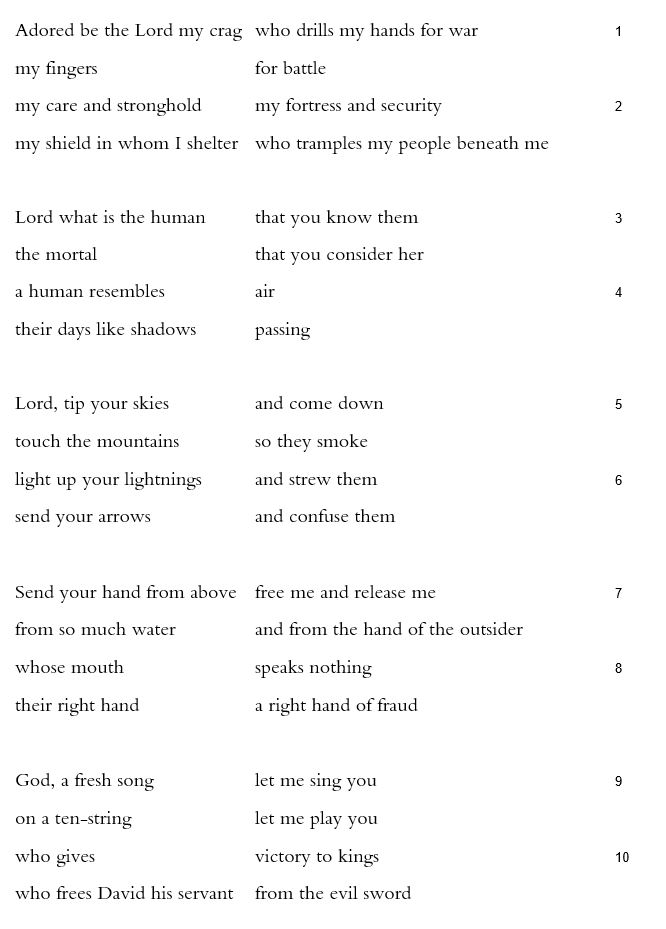
    Psalm 144 has as many jump cuts as a film montage or trailer. Splicing may be its most important technique: within verses, between verses, and between the first eleven verses with their mottle of quotations and the strikingly visionary poetry of the final four verses. To a greater degree than most other psalms, interpretation depends on whether we see the form as primarily chiastic, static, a series of frames around a center that makes sense of the whole, or as primarily narrative, dynamic, a sequence of moments that aims from beginning to end. Seen as a concentric structure, Psalm 144 seems like a code whose answer decoded is David, the former and wished-for king. Seen as a gradual unfolding, however, the psalm is more like a time-lapse series of stills, which revisits David’s psalms to revise and replace them, leaving behind a vision of freedom from the sword.

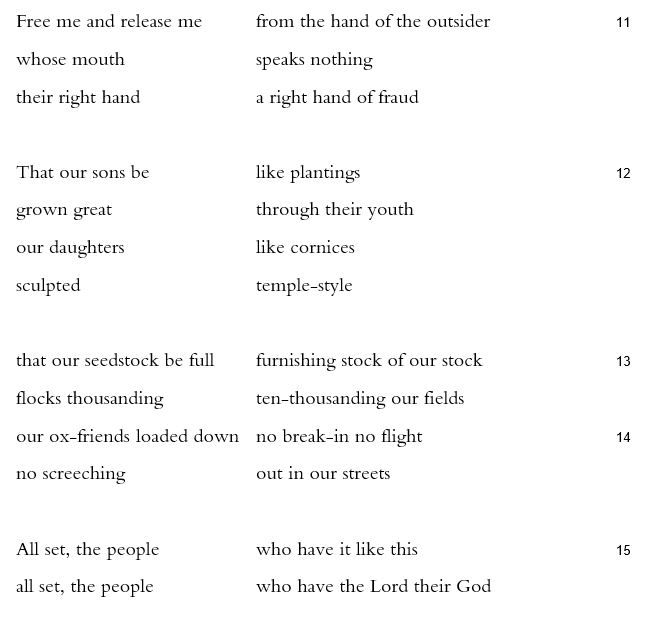
    The middle of the psalm is marked by a refrain, a duplication that has often been dismissed as a copyist’s error:

    Free me and release me | from the hand of the outsider          

    whose mouth | speaks nothing                    

    their right hand | a right hand of fraud   (11, cf. 7-8).     

    In verses 9 and 10, between these dangerous hands and worthless mouths, is the psalm’s center, with its implied hands and mouth of music:

    God, a new song | let me sing you         

    on a ten-string | let me play you

    who gives | victory to kings                                       

    who frees David his servant | from the evil sword (9-10).               

    In that crucial verse 10, the participle happotseh, “who frees,” comes from the same root as the imperative petseini, “free me,” in the refrain in verses 7 and 11. These are the only three verses in the Hebrew Bible where the verb patsah, “to open,” takes on the sense of freeing, elsewhere always opening like a mouth. Framed in this way, the open mouth that sings a new song meets the dexterous fingers on the ten-string harp, both contrasting with the emptiness of the outsider’s hand and mouth.

    A chiastic approach works less well for most of the rest of the psalm. The theophanic storms of verses 5 and 6 have little in common with the standing sons and daughters of verse 12, though both are vertical images, one full of wild motion, the other stillness. The wisdom theme of human evanescence in verses 3 and 4, if paired with the vision of fertility and flourishing in verses 13 and 14, lacks the kind of keyword repetition associated with tight textual frames. The beginning (1-2) and end (15) pit war against peace, but only in the broadest of ways.

    In this broad way, however, the sequence of themes in the psalm’s first half seems to be matched and countered by the sequence in its second half. A prayer of preparation for war (1-2) relies on a vision of human life as “days like shadows | passing” (4), which in turn gives way to cosmic intervention (5-7). In the second half, prayers are not for war but for growth and stability (12); life is not futile, but fertile (13-14); instead of divine thunder, there is “no break-in no flight / no screeching | out in our streets” (14). The wisdom is not that all is air, but that the good life makes “all set, the people,” plural (15a, 15b).

    If this kind of broad pattern sounds as familiar as many of the verses from the first half of Psalm 144, it is because both come directly from Psalm 18 (||2 Samuel 22). Psalm 18 is the powerful, old, martial psalm of David which also has two halves: God’s rage, then the king’s sword. It moves from divine lightning and archery (18:14, cf. 144:6) to the king’s own bending of a bow, his hands trained for war (18:34, cf. 144:1). Psalm 144 shrewdly reverses the order of that movement, beginning with a militarism that it adjusts, increasing David’s violence and decreasing God’s. It adds “my fingers for battle” (144:1) and changes “who tramples the peoples beneath me” (18:47) to “who tramples my people beneath me” (144:2) to quotations from David, but changes God’s appellation “my cliff” (18:2) to “my care” (144:2) and leaves out fiery coals (18:13).

    The first half of Psalm 144 sews together other quotations from other psalms, to be sure, which is part of what makes it feel anthological or like a montage. But Psalm 18 is the one that matters most to Psalm 144, the psalm it quotes most, the psalm whose vision of a David trained for war it works so hard to reverse, to revise. David is made to sing a new song, in which God is celebrating for freeing “David his servant | from the evil sword” (10). This freeing makes possible the gorgeously wrought image of daughters “like cornices / sculpted | temple-style” (12).

    Despite the uses to which this psalm has been put, this is not a resurrected David, let alone the return in triumph of a Davidic son: it is sons rooted and daughters stood true. Its vision of peace depends not on messianic eschatology but on the opening of a mouth to sing and on the opening of a hand once trained for war to drop its awful sword.

    Share:

    • Share on X (Opens in new window) X
    • Share on Facebook (Opens in new window) Facebook
    Like Loading…

    About Me

    My name is Mark Minster. I’m an English and Comparative Literature professor with a background in ministry and in poetry. I teach courses on writing, reading, religion, and nature.

    Recent Posts

    • Psalm 150
    • Psalm 149
    • Psalm 148
    • Psalm 147
    • Psalm 146

    Newsletter

  • August 2nd, 2023

    Psalm 143

    (lyric, of David)

    * * *

    Psalm 143 is a valuable reminder that defining reason and emotion in mutual opposition— a common practice in popular understandings of poetry, music, scriptural traditions, and whatever we mean when we say “religion”— has no basis in either the body or the Bible, whose texts and cultures did not think, or feel, that way.

    Each of the six ki-clauses in this psalm, for example, marks a logical turn in an argument even as it aches: “do not take to trial | your servant,” and why? Because “before your face | no one alive is just” (2). The word ki works as “because” or “if” or  “when,” but it always means “oh”: “Make me hear at dawn | your care / oh I lean on you” (8). The particularly poignant verse 10 thinks as linearly as a geometry proof even as it moves with the associative logic of deep feeling: “teach me | to do what you want / oh you my God | your breath is sweet.” Even the meticulous verse 4, which relies not on a conjunctive exclamation but on two reflexive verbs, two prepositions with first-person suffixes, and two metonymical first-person subjects, hurts: “so that my breath | catches inside me / within me my heart | destroys itself.” Both breath (ruach) and heart (leb) figure life, then as now, in ways that obviate any separation of thought and feeling.

    Figuring life is what Psalm 143 does. It’s a profoundly moving and richly theological poem that explores, more exactly, life-in-death. There is the one heart undoing itself (4), and the breath that falters just as it did in Psalm 142 (143:4 || 142:3), but “breath” recurs twice more. “My breath has vanished,” the speaker says in verse 7, moving from the ambiguous tense of the vav-construction in verse 4 (“so that my breath | catches” could equally well be “my breath | caught”) to a perfect-form verb. The final breath in the psalm is not the speaker’s, but God’s, the object of longing: “your breath is sweet” (10). Like “breath,” the word “life” appears three times in narrative logic in Psalm 143, first to mean everyone (kol-chai, negated by the verbal adjective l’o to “no one alive,” 2), then the life the speaker is losing or has lost (“ground to the ground | my life,” 3), and finally the life the speaker wants to hold to (“Lord give me life,” 11).

    Even more pronounced is the fivefold repetition of the word nafshi translated here as “my throat” (3, 6, 8, 11, 12). Because the psalm is likely a late composition despite its superscription (it quotes other passages extensively; it’s positioned late in the book of Psalms), it is tempting to render nefesh by its later, top-heavy, abstract, Hellenistic, rabbinical, Jewish and Christian and Muslim senses of “soul” or “self” or “essence.” But its importance here is thought and felt so bodily. The speaker craves the Lord’s ear (1) and face (2, 7) and hands (5) and breath (10). Their own body is seated (4), then sinking (7), then walking somewhere they do not know (8). Their heart and breath wreck them (4), their hands have spread wide (6). “Throat” has range without baggage: it’s the body part most vulnerable to enemies (3) and to damage from crying out and thirst (6), the part of the body that lifts in song or gasps for air (8), that needs to breathe (11,12). The psalm is not remotely interested in some detachable essence.

    It is, however, passionately reflective about the knife-edge between life and death and what that edge means. “Knife-edge” is not the exact term for this psalm, however. Life and death are separated, rather, by breathing (4, 7, 10), by hearing (1, 7, 8), by being visible as opposed to hidden (3, 7, 9), and they are separated by the horizontal boundary of the soil, the “ground” (3, 6, 10). The word “ground” works best for ’erets in this psalm, indicating the physical location of bodies that die, but it loses (can you hear me sigh?) the culturally specific and universally resonant implications of the term. The psalm’s most abstract theological reflection about the meaning of death and dying takes place in its opening and closing verses, where appeals to “your justice” (1, 11) are paired first with “your fidelity” (1), then with “your care” (12). In each case, these traits are instrumental, objects of the prefixed preposition b-, as in the awkward line “with your fidelity | answer me / with your justice” (1). The verse length and syntax are strange, but their felt thought is even more curious. If the causality is complex—that is, “because you are faithful, answer me justly”—how sincerely are we to take the pleading? Is the speaker asking for loyalty and justice, but justice without a trial, justice that is not typical justice? Are life and death just? Is it loyalty or fairness or lovingkindness that should make the Lord “end my enemies / and finish off | all who distress my throat” (12) or give life to the dead or dying (11)? Why should the Lord make those die and these live? These are good questions.

    The afterlife of Psalm 143 may be as much a consequence of its unsolved (unsolvable?) questions as of its audiences’ concerns. To generations of sects and parties interested in the return of a Davidic king or other anointed one, the psalm’s working-through of the desire for revivification must have seemed relevant and potent. Verse 2 is alluded to by the authors of the gospels, where Mark’s Jesus declares, “no one is good if not God alone” (Mk 10:18, cf. Lk 18:19), and the Jesus of Matthew and Luke prays, “do not lead us to trial” (Mt 6:13, Lk 11:4). Together with verse 1, the opening of Psalm 143 is explicitly and elaborately retooled by Paul in Galatians (2:16, 3:11, and throughout) and in Romans 3, in interpretive passages that locate claims about the instrumentality of divine fidelity, justice, and care at the very core of Pauline Christianity.

    As with all texts that have been reinterpreted by powerful voices, however, it is imperative to try to see this psalm without all the later lenses and layers. Peeled back, seen with one fewer filter at least, Psalm 143 can be seen as itself a powerful voice of reinterpretation, quoting and reworking passages like Psalm 28:1 (143:7: “or I will be like | those who sink in a pit”) and Lamentations 3:6 (143:3: “seated me in darkness | like the lasting dead”). It is a psalm of reawakening, life-in-death, back from the brink, whose formulas and desires are very much works in progress.

    Share:

    • Share on X (Opens in new window) X
    • Share on Facebook (Opens in new window) Facebook
    Like Loading…

    About Me

    My name is Mark Minster. I’m an English and Comparative Literature professor with a background in ministry and in poetry. I teach courses on writing, reading, religion, and nature.

    Recent Posts

    • Psalm 150
    • Psalm 149
    • Psalm 148
    • Psalm 147
    • Psalm 146

    Newsletter

←Previous Page
1 2 3 4 … 37
Next Page→

Blog at WordPress.com.


Loading Comments...
 

    • Subscribe Subscribed
      • The Book of Psalms
      • Already have a WordPress.com account? Log in now.
      • The Book of Psalms
      • Subscribe Subscribed
      • Sign up
      • Log in
      • Report this content
      • View site in Reader
      • Manage subscriptions
      • Collapse this bar
    %d