• Page list
    • Posts
    • The Book of Psalms

The Book of Psalms

  • May 23rd, 2023

    Psalm 74

    (didactic, an Asaph)

    * * *

    The destruction of places dedicated to Israel’s God is at the heart of Psalm 74. It is impossible to tell whether these special places are all part of one place, “Mount Zion | here you lodged” (2), Solomon’s Temple, razed in the 6th c. BCE by the Neo-Babylonians, or whether there were multiple places— “they set fire to all | the assemblies of God in the land” (8). It’s therefore also impossible to tell when exactly this psalm might have been composed or compiled, recited, or remembered, and whose needs it met first. But the date matters far less than the sense the psalm makes of catastrophe by retelling tragic collapse as an event that keeps coming to life. It flanks this retelling with appeals to even older foundation stories. And it frames all these narratives with unanswerable questions, less questions than outcries, and with a series of instructions for God, comprising eight imperative commands and four petitions slightly more polite.

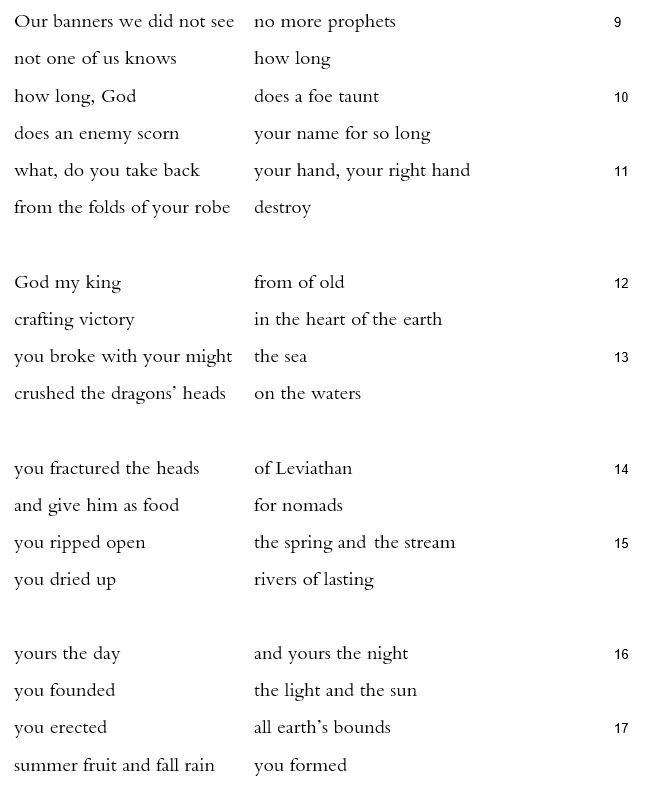
    The ruins commemorated and lamented in the psalm are what remains from intentional destruction by an enemy armed with flags, torches, and axes. The sequence of verses from 4 through 9 is concerned not with the slaughter of people, though there are “no more prophets” according to verse 9, but with the desecration of places: “your foes snarled | in the heart of your assemblies” (4), “they burned | your sanctuary to the ground / they hollowed | the tabernacle of your name” (7), “they set fire to all | the assemblies of God in the land” (8). Into these perfective verbs are set two verses that rely on imperfect forms, an effect that mirrors the English historical present: “and now her carvings | all together / with hatchet and hammer | they shatter” (6). That word “now” (`attah) works marvels, making timeless the moment of the destroying of figures carved to be timeless themselves, while also invoking by opposition its own near-homonym, “you” (’attah), used of God seven times in verses 12-17. The destruction is complete; its immediacy persists in a repeated now.

    Against this panel of historical fact (4-9) is positioned a panel of prehistorical legend (12-17), the people’s memory followed by what should be God’s memory. The explicit second person sharpens the point. If anyone has the power to defeat enemies and lay foundations, it is you, God: “you broke | with your might the sea / crushed the dragons’ heads | on the waters” (13), “you ripped open | the spring and the stream / you dried up | rivers of lasting” (15),  “you erected | all earth’s bounds / summer fruit and fall rain | you formed” (17). In the first narrative, God was the “you” in the object possessive: “your foes… your assemblies… your sanctuary… your name.” In this second account, God is primarily a subject, controlling verb after verb of action.

    The first narrative is flanked by questions for God. The poem opens by pulling no punches: “What, God | have you been mad for so long | your nose fumes | at the flock of your field” (1). Both the interrogative lamah (what? why? how?) and lanetsach, the word rendered here as “for so long” return in verses 10 and 11:

    how long, God | does a foe taunt        

    does an enemy scorn | your name for so long

    what, do you take back | your hand, your right hand   

    from the heart of your chest | destroy

    “How long?” The opening question has multiplied and become the psalmists’ cry. More, the passage reads like a stutter, especially when paired with the end of verse 9: “not one of us knows | how long / how long, God | does a foe taunt.” How curiously, how doubly, the question about God having taken away God’s hand becomes the imperative, “destroy.” The hand that has been inexplicably taken back into the folds of the robe retroactively becomes, through the final imperative, a hand being taken out from the folds of the robe.          

    The imperative kalleh, “destroy,” which was used notably in a different verbal stem in the previous psalm (kallah, in “my body ends” 73:26), is the third in a remarkable series of twelve orders that order Psalm 74. “Recall,” God is instructed three times (2, 18, 22). Most of the instructions are clustered at the psalm’s end, from verses 18-23: “recall… do not give some animal | the neck of your dove… do not forget for long (lanetsach) / Consider the pact… do not let the oppressed | return ashamed… Rise up God | plead your case / recall how the fool | taunts you all day / do not forget | the voice of your foes.”  This burst of insistence blends appeals to memory with calls for action. The “Rise up” of verse 22 and “Recall” of verse 23 return to the opening imperatives, the “Recall” of verse 2 and “Lift her your footfalls” of verse 3. A poem that begins with God’s nostrils flaring and hinges on God’s hand has perhaps its most poignant moment in this image of God stepping up “to what’s been ruined so long,” yet another line that uses the word netsach, a word for what lasts.
    Share:

    • Share on X (Opens in new window) X
    • Share on Facebook (Opens in new window) Facebook
    Like Loading…

    About Me

    My name is Mark Minster. I’m an English and Comparative Literature professor with a background in ministry and in poetry. I teach courses on writing, reading, religion, and nature.

    Recent Posts

    • Psalm 150
    • Psalm 149
    • Psalm 148
    • Psalm 147
    • Psalm 146

    Newsletter

  • May 22nd, 2023

    Psalm 73

    (an Asaph lyric)

    * * *

    The central collection of psalms in the Psalter (Pss 73-89) begins with this meticulous, searching lyric that is wise beyond years and ahead of us all. Its narrative of transformation is held together by a cluster of cues. They shape its discoveries and underscore its contrasts.

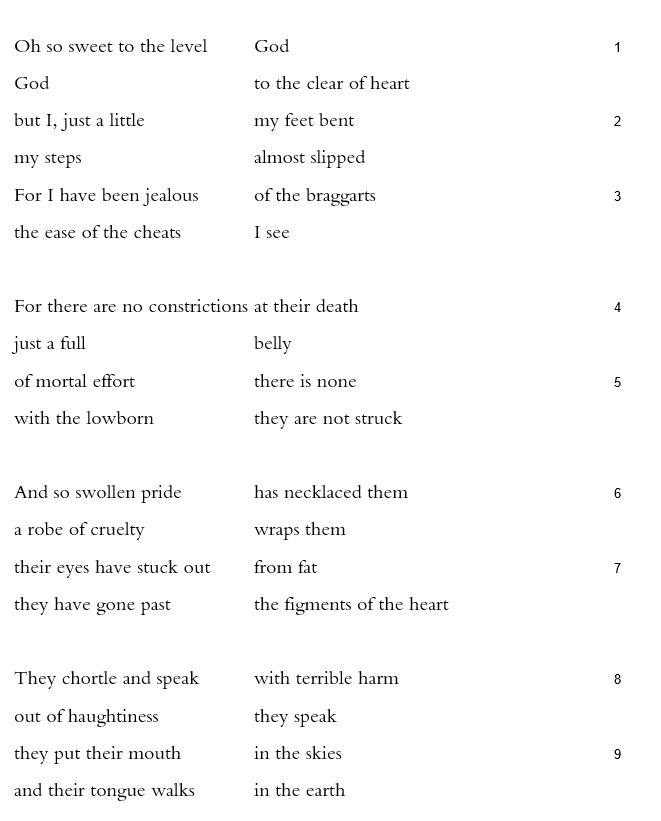
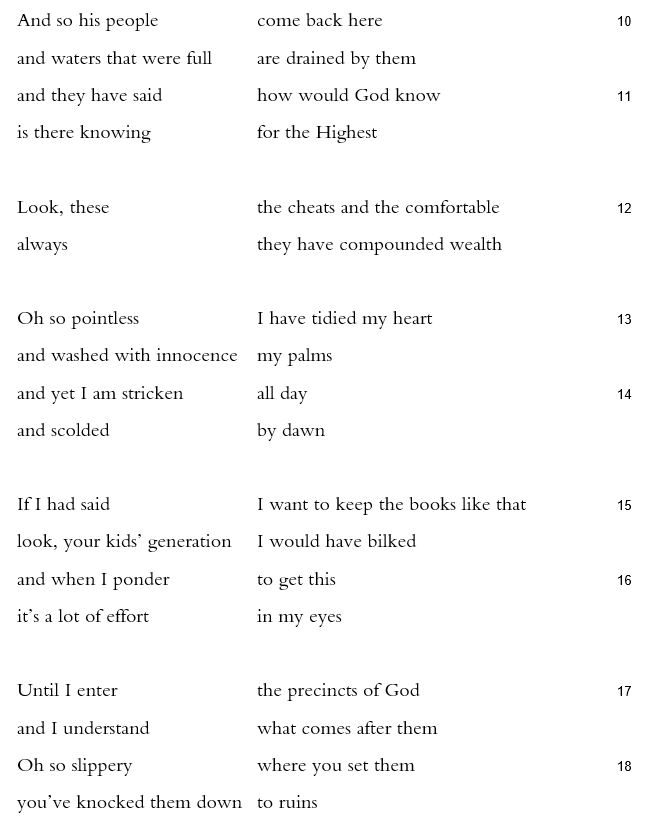
    The basic story is easily told. God may be good to the “level” and “clear of heart,” the speaker begins, but she herself is half a step from falling from upright. Her stumbling comes from seeing two fatal flaws in the theory of retributive justice. The first is what to do when good things happen to bad people. She describes cheats: their excess of ease and their swaddles of fat and unkindness choke and enrobe them (4-7). Their devouring of the common goods of speech and water is captured by the startling image of a mouth stretching to the skies while a tongue drags on the ground (8-11). Against these “the cheats and the comfortable” (12), the speaker resents her own situation, the second flaw of retributive justice, what to do now that bad things have happened to her, despite her having “tidied my heart / and washed with innocence | my palms” (13).

    Two whole systems are indicted here, hoarding and piety, in which bad people accumulate riches while the good instead care about their own cleanliness.

    If I had said | I want to keep the books like that

    look, your kids’ generation | I would have bilked             

    and when I ponder | to get this                

    it’s a lot of effort | in my eyes      (15-16).

    The precision of this accounting imagery comes from the Hebrew verbs of verse 15: ’asapperah and bagadeti, “let me tally” and “I had deceived.” In one move, the speaker exposes the lies of the balance sheets of the wealthy, who compound capital at the expense of the next generation, as well as the lies on the balance sheets of any theodicy that links morality and wealth. The effort (`amal, 16) of understanding these injustices of acquisition and ideology contrasts with “mortal effort” (ba`amal enosh, 5), which the bad never face. The numbers just don’t add up.

    In verse 17, however, the speaker finally starts to understand what she sees. An aftermath faces “them,” a plural “they” who are most likely “the cheats and the comfortable” from verse 12, though the nearest plural noun is “precincts of God” (or “sanctuaries,” miqdeshei-’el). The rest of the poem completes the speaker’s tale. She who had almost slipped because of her jealousy at the ease of the cheats now realizes it is “Oh so slippery | where you set them / you’ve knocked them down | to ruins” (18).

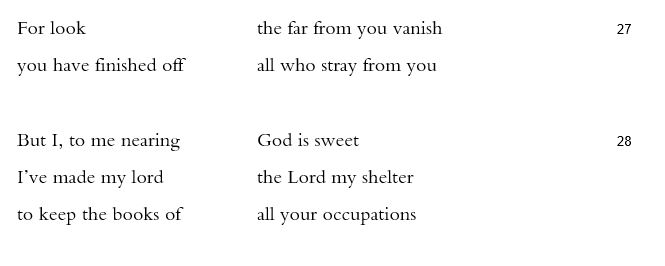
    By the end of the psalm, her transformation is complete. Having begun with the sentiment that God is “oh so sweet to the level” (1), she ends perceiving that “to me nearing | God is sweet” (28). Proximity displaces piety. Having exposed the awful accounting by which the unjust affluent take all the marbles, leaving nothing for the just or the children to come, she comes unto “the Lord my shelter / to keep the books of | all your occupations” (28).

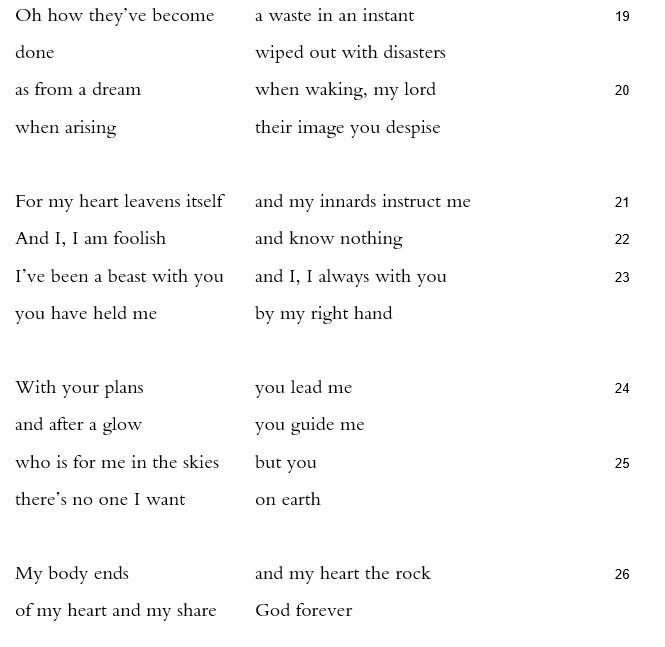
    The details of the speaker’s realization are trickier to parse than the overall story. What exactly has she learned? She’s no longer jealous of cheats because of “what comes after them” (17), a fate that is gestured at, though it’s clearly not good. “Oh how they’ve become | a waste in an instant / done | wiped out with disasters” (19). Her overall indictment of injustice seems solid. Nothing in the second half of the poem contradicts the points she has made against the cruelty and pride of the rich. Rather, what she’s realized has something to do with her perception of the presence of God, the futility of absence from God, and a sense of the limits of life and of knowing.

    Two passages in her coming to awareness are especially profound. The latter is verse 26: “My body ends | and my heart the rock / of my heart and my share | God forever.” That’s beautifully blurry. Is it the body only that ends, while “my heart… and my share” IS God forever? This reading splits the speaker inside and out. It relies upon reading the first vav, the vav before the first “my heart” as a “but”—“my body ends | but my heart…” Or is the second vav contrastive? My body ends, flesh and heart, the stone of my heart, “but my share | is God forever”? This second reading splits the speaker’s personal life from her legacy, which lasts with God forever. Or, finally, the contrast might lie between everything before “God forever” and “God forever”: all of me comes to end, my heart and my share, but God is forever. The text itself does not decide.

    The other passage that is deep and wise also concerns the heart.

    For my heart leavens itself | and my innards instruct me   

    And I, I am a fool | and I know nothing             

    I’ve been a beast with you | and I, I always with you       

    you have held me | by my right hand (21-23).

    The action of the heart and the “innards” (lit. “kidneys”) occurs in two reflexive verbs that are simultaneously precise and ambiguous. What happens in the speaker’s heart or mind is a fermenting, not really a grieving or a bittering: chamets refers to a yeasting action, and in the reflexive stem the figure is of the heart lifting itself through a patient rise. What happens in the speaker’s innards is a piercing (shanan), a particular piercing used reflexively only here. The most frequent use of the verb, in the qal stem, is used for the sharpening of arrows, a kind of whittling, whetting action. But the most famous use of the verb, in the pi’el stem, is in Deuteronomy 6, in which it also follows the word “heart”: “And let these words be, which I am commanding you today, in your heart, that you instruct them to your children…” (Deut 6:6-7). Thus here, the speaker is simultaneously internally soured and struck, enlivened as dough and taught. These doubled reflexive verbs give way to doubled attention to the speaker as a subject. “And I” (ve’ani) opens both verse 22 and verse 23, where it contrasts the speaker’s animal nature—“I’ve been a beast with you”—with the Lord’s presence—“you have held me | by my right hand.”          

    Powerfully, the ve’ani construction shows up twice more in Psalm 73, in one of several repetitions that organize the poem. The “but I” in the psalm’s third line is matched by the “but I” in the psalm’s third-from-the-last line, heightening the speaker’s transformation and revealing the poem’s large-scale chiastic shape. The word “sweet” (or “good”) is also repeated at the beginning and end, in connection with a double naming of God—’el and ‘elohim in verse 1, ‘elohim and adonai YHWH in verse 28. Other repetitions include the “Oh so” (akh) interjection in verses 1, 13, and 18, and even 19 (’eikh), which contrasts the supposed merit of piety, “Oh so sweet,” with the speaker’s critique, “Oh so pointless,” with the unforeseen outcome facing the cheats, “Oh so slippery | where you set them” and “Oh how they’ve become | a waste in an instant.” Four verses begin with “For” or “Oh” (ki): 3 and 4 in the first half, 21 and 27 in the second. Two verses (6 and 10) begin with “and so” or “thus” (lakhen). And there are three iterations of hineh, in verse 12 (“Look, these | the cheats and the comfortable”), verse 13 (“look, your kids’ generation”), and verse 27 (“For look | the far from you vanish”). These structures overlap in a poem that never answers its own unanswerable questions: “how would God know / is there knowing | for the Highest” and “who is for me in the skies | but you.”

    Maybe God knows, but the speaker certainly does not. And probably no one is “in the skies | but you.” In any event, what matters to the speaker is not “what comes after them,” the bad, but nearness, the presence of the present.

    Share:

    • Share on X (Opens in new window) X
    • Share on Facebook (Opens in new window) Facebook
    Like Loading…

    About Me

    My name is Mark Minster. I’m an English and Comparative Literature professor with a background in ministry and in poetry. I teach courses on writing, reading, religion, and nature.

    Recent Posts

    • Psalm 150
    • Psalm 149
    • Psalm 148
    • Psalm 147
    • Psalm 146

    Newsletter

  • May 21st, 2023

    Psalm 72

    (of Solomon)

    * * *

    Of all the judgments and dispositions we bring to bear as we read, maybe none matters more than disinterest. High levels of disinterestedness correspond with analytical distance and curiosity. Low levels of disinterestedness—high levels, that is, of interest and commitment—correspond with sympathy, close identification, and application to practice. Pure disinterest would be cool and clinical, pure interest hot with zeal. Approaching a text like Psalm 72, for example, a reader might wonder about it as a historical document, a cultural artifact of relevance for understanding ancient conceptions of monarchy, justice, and power. Or she might deploy the text as an ethical challenge to contemporary abuses of authority, governments that fail utterly to favor the weak, “the poor | and the oppressed” (13). Or, up through those last two amens, “let it be true | let it be true” (19), she might recite the psalm alone or with others, kneeling or clutching hands in prayer or donating money or time to those whose “blood has worth | in his eyes” (14). One and the same reader might, in one moment, patiently count syllables and speculate about stanza breaks, and in the next moment feel discomfited by the brutality of enemies licking sand, and then tear up at the picture of justice coming down like rain “and much peace | till the moon is no more” (7).

    Scholarship wonders how this psalm’s model of kingship fits its historical and cultural contexts. Scholars ask compelling questions about the textual history of the psalm, when it was written, in what stages it developed by accretion, addition, revision, etc. How does the superscription relate to the postscript, that this poem is Solomon’s and David’s at once? Why end the second collection of psalms with this— besides its obvious emotional power and comprehensive vision of a just society? Jewish and Christian practice tend to show interest in the messianic implications, kneeling to a divinely inspired autarch whose hands will provide fertility and fairness. And liturgy tends to excerpt just lines 17-19, the least concrete and therefore most extractible lines, as part of more general praise and worship.

    A crucial feature of this psalm, impossible to achieve in translation, is that so many of its verbs are temporally undecidable. In the so-called yiqtol form, Hebrew verbs can be rendered by any number of tenses and aspects and moods, from present tense to past imperfect, to future indicative, to present cohortative and jussive. Verses 2 and 3, for instance, are here expressed in this way:

    May he rule your people | justly  

    your weak ones | judiciously

    that the hills might bear | the people peace

    and the hillocks | justice

    But “may he rule” could also be “He rules” or “He will rule” or even “that he may rule” (that is, “let him rule”). And “that the hills might bear” could also be— indeed, in Hebrew, it also IS— “the hills will bear” and “the hills bear” and “let the hills bear.” There is an argument to be made for making as few inferences as possible, presenting every prefixed verb form here in the simple present tense, as the tense that conveys the greatest semantic range, that least forces the issue. Using future tenses captures the poem’s most eschatological resonance, but only by deferring justice and abundance, the rescue of the imprisoned, that single fistful of grain that fruits and waves and feeds cities, putting off fulfillment until a time more distant than the mentions of Tarshish and Sheba suggest. The present tense captures immediacy, but by presenting the vision as already accomplished, which may overly automate the process. The modality of “may” and “might,” the wish is the thing with most of these verbs.

    Disinterestedness must become less disinterested when there are military generals in 21st-century America barking that the nation ought to have one single religion, or when officials ground their grift by wrapping nationalism in theories of the divine right of kings. Does Psalm 72 support such dangerous claims? Or does it weigh against them? Prooftext-seekers snip verses like “may he control | sea to sea / from the river | to the limits of earth” (8) or repost all the lines about kneeling and tribute. But the wish is what guides this psalm. The king’s justice is not the king’s. Justice is greater-than. Justice requires special attention to “the oppressed | who cries out / the weak | who has no one to help” (12). Even time and space depend upon justice, according to the psalm: the hills, hillocks, the hilltops, “the face of the moon” (5), “the face of the sun” (17).

    Share:

    • Share on X (Opens in new window) X
    • Share on Facebook (Opens in new window) Facebook
    Like Loading…

    About Me

    My name is Mark Minster. I’m an English and Comparative Literature professor with a background in ministry and in poetry. I teach courses on writing, reading, religion, and nature.

    Recent Posts

    • Psalm 150
    • Psalm 149
    • Psalm 148
    • Psalm 147
    • Psalm 146

    Newsletter

  • May 20th, 2023

    Psalm 71

    * * *

    The opening words of Psalm 71 call to mind the opening of Psalm 25: “In you Lord.” But instead of an image of reclining—“To you Lord | I lift my throat / God on you | I lean” (25:1-2)—this psalm depends on scenes of retreat. There is a beautiful and potent spilling-over of sheltering imagery in the first eight verses, pairing the mostly spatial figure of the mountain refuge, crag and lair, with the mostly temporal figure of the womb, the memory of the mother’s belly, the cut cord, the speaker’s youth. That cliff imagery is also temporal, part of a narrative of rescue, being snatched up and away after threats. And the maternal imagery is spatial as well, the inside of the mother’s body paralleling the safety of the lofted mountain.

    This landscape and memory give way to the psalm’s center, the speaker fearing the loss of strength that has come with age: “Don’t throw me out | in the time of old age / as my might is spent | don’t leave me” (9). Again, in verse 18, “even until old and gray | God don’t leave me.” The nakedness of these imperatives reshapes the images from the start of the poem—the solidity of the mountain refuge, the vulnerability of the infant.

    In its anxiety about waning power, the poem’s appeals become clear. The speaker wants security (4, 5) as well as power that is not his own (7, 8, 21). He asks for God’s fidelity (22) and extols God’s justice most of all (1, 15-16, 19, 24). By contrast with Psalm 69, the wish is not for revenge but for rescue and justice, not the massacre of those “who attack my neck,” just their turning white, turning red, their “scorn and shame” (13, cf. 24).

    While the repeated “don’t leave me” is the speaker at his most vulnerable, the poem’s most potent repeated phrase shows up in verses 16 and 18. “Let me enter the power | of my lord the Lord,” he says. Two verses later, after repeating the phrase “since youth,” he says, “don’t leave me / until I’ve told of your biceps | to the age / to each | who enters your power.” “Entering the power” poignantly calls back both the cliff refuge and the womb, a complicated wish. The image of the arm muscle (zer`oa) calls to mind the image of seed (zer`ua), which combines with the word “age” to suggest something more than just a return to the speaker’s own birth scene. There is the suggestion of generativity here, the speaker asking for enough power, enough life, to pass on stories of power to the next age, a fitting transition between a psalm that names David (Psalm 70) and a psalm that names Solomon (Psalm 72).

    Share:

    • Share on X (Opens in new window) X
    • Share on Facebook (Opens in new window) Facebook
    Like Loading…

    About Me

    My name is Mark Minster. I’m an English and Comparative Literature professor with a background in ministry and in poetry. I teach courses on writing, reading, religion, and nature.

    Recent Posts

    • Psalm 150
    • Psalm 149
    • Psalm 148
    • Psalm 147
    • Psalm 146

    Newsletter

←Previous Page
1 … 18 19 20 21 22 … 37
Next Page→

Blog at WordPress.com.


Loading Comments...
 

    • Subscribe Subscribed
      • The Book of Psalms
      • Already have a WordPress.com account? Log in now.
      • The Book of Psalms
      • Subscribe Subscribed
      • Sign up
      • Log in
      • Report this content
      • View site in Reader
      • Manage subscriptions
      • Collapse this bar
    %d