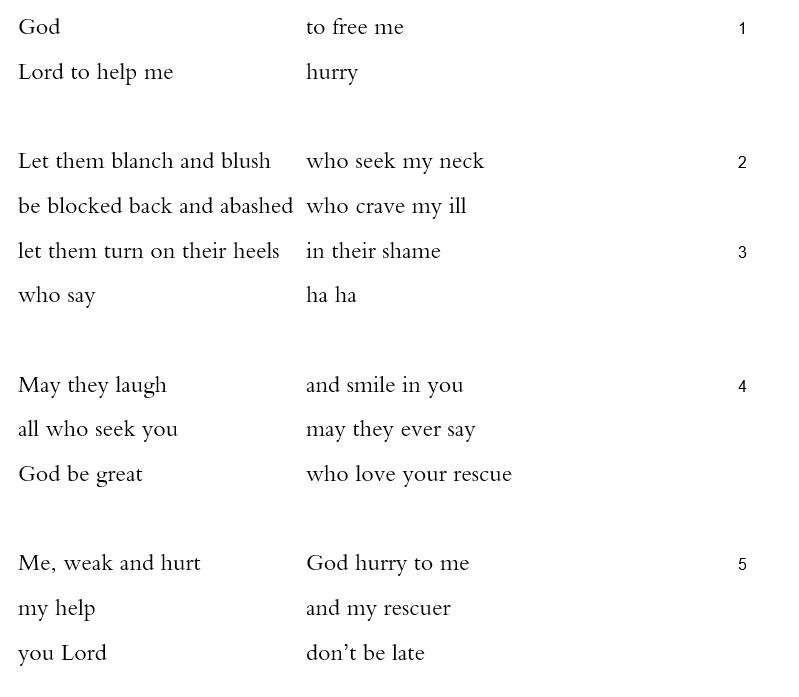
This brief psalm is almost identical to Psalm 40:13ff. This fact raises a number of questions. Why repeat? Why repeat lines from near the end of the first collection in the Psalter (Psalms 1-41) here, near the end of the second collection (Psalms 42-72)? (Note that 40 and 70 also quote or are quoted by Psalm 35.) Differences between the two versions are slight, but what might they mean?
First, it’s clear that this version holds together well. It’s two stanzas of urgent imperatives— God told twice to hurry (1,5)— surrounding negative wishes for those “who seek my neck” (2) and positive wishes for those “who seek you” (4). The central contrast is between the bad, “who say | ha ha” (3), and the good, “may they laugh | and smile in you” (4), two kinds of laughter.
Large-scale repetition like this, reproducing several verses nearly verbatim, would seem to be a structural device, though its purpose is unclear. It’s worth noting that Psalm 39-41 and Psalms 69-71 bear several similarities, combining laments and pleas with consolations. In each case, these lines appear at the center of the three-psalm unit. Perhaps their distillation of the scene of rescue concatenates the themes. Perhaps the two units served some special liturgical purpose. Or perhaps one was intended to echo the other, though to what end is conjecture. Plenty of scholars express confidence that these lines would have been spoken by a king or by a priest, the scholars purporting to date them. For such claims, evidence is undermatched.
The last word in the psalm’s superscription— it could easily be the first word of the text of the psalm itself— is “to remember,” which is ambiguous. Who is to remember? God? The psalmist? The community? Is this evidence that Psalm 70 “remembers” Psalm 40? Does one Psalm revise the other? The common theory that the Elohist Psalter “suppressed” the Lord’s personal name and replaced it with “God” doesn’t seem to hold here. Both versions use the names differently, but the same number of times. Do we have two separate traditions, marked by regional or some other variation? What’s the difference, for instance, between teshuahtekha in 40:16 and yeshuahtekha in 70:4? The semantic range is hard to distinguish. The rest is speculation.
My name is Mark Minster. I’m an English and Comparative Literature professor with a background in ministry and in poetry. I teach courses on writing, reading, religion, and nature.
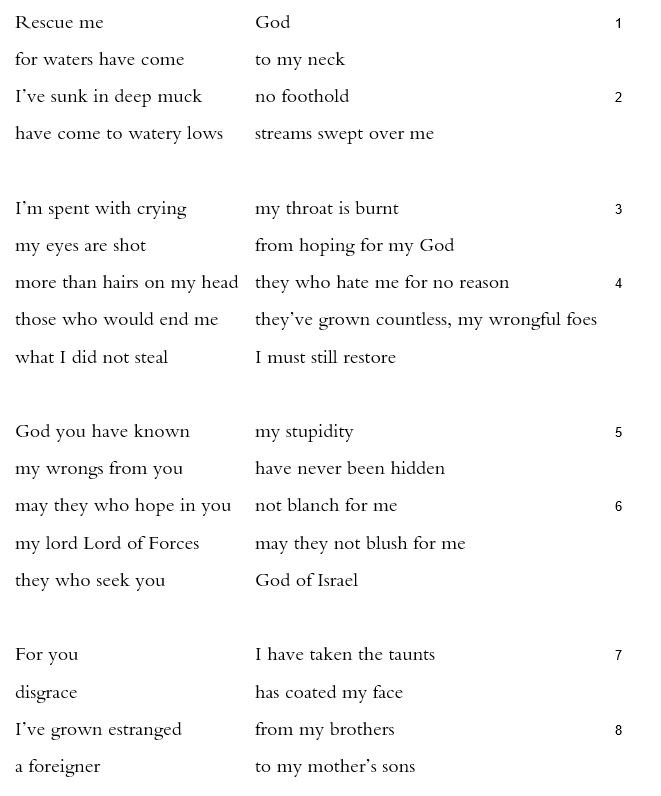
Interpretation always risks being wrong. Vital clues might be missing or missed. Contextual signals from the primary scenes of writing and reading might be tuned too low, while noise from we the interpreters’ own culture and bent might be turned up too loud. We might not just be wrong, but pettily wrong. Take, for example, what Mitchell Dahood says of Psalm 69, calling it “the lament of an individual who prays for deliverance from his personal enemies and especially from his archenemy, Death. Kraus… rightly notes that the text of this lament is excellently preserved, but this of itself does not permit the inference that traditional translations have necessarily grasped the thought of the psalmist” (155). Who could know, ever, if we have “grasped the thought of the psalmist,” both nouns singular? Despite Dahood’s claim, this psalm has far less to do with death, let alone Death personified, than with a speaker deeply ambivalent about her own demonstrations of piety. She parades her persecutions and seeks pity, compensating for her pain with a completely disproportionate fantasy of revenge.
An interpretative danger more specific to psalms like this is that understanding relies so heavily on whether we believe the speaker’s claims of persecution. Our default setting, influenced by liturgical recitation and our own kind hearts, is to identify with a first-person speaker, taking as evidence of virtue her claims of virtue, ignoring the logical circle. In a society that asserts that we assume innocence until guilt is proved, a line like “what I did not steal | I must still restore” (4) easily evinces pity and fury at injustice. But reading is not a court of law. Nothing necessitates our sympathy, let alone our credulity. The first verses express that the speaker is sinking. Is this literally true or is it a topos, a commonplace? Verses 3 and 4 suggest that drowning is a figure for feeling surrounded by “they who hate me for no reason / those who would end me… my wrongful foes” (4). In these verses, innocence is asserted— “for no reason” she is hated, the foes are “wrongful,” what she did not steal she must pay back.
And yet the very next verse brings admissions of a different kind of guilt: “God you have known | my stupidity / my wrongs from you | have never been hidden” (5). If we are talking of wrongs, what exactly is the accusation, the threat, the crime? Why turn from insistence on being beleaguered to an acknowledgement of wrongs? And from there, in verse 6, why worry that the speaker’s guilt might reflect badly on “they who hope in” and “they who seek” the God of Israel?
The psychology of martyrdom deepens from there. Verses 7-12 describe the negative consequences of the speaker’s piety. “For you | I have taken the taunts… I’ve grown estranged | from my brothers… when passion for your house | devoured me / the taunts of your taunters | fell on me” (7-9). Her focus is not on devotion to the Lord, nor on anything inherent in rites such as fasting, but curiously on the opinions of others and on the “you.” The lines veer between self-pity and blaming God— “look what I have done for you… and this is the thanks I get.” In these lines, there is no real threat of death, just noise from those who mock the speaker.
Verses 13-15 return to the drowning imagery from the first two verses, with redoubled emphasis: “snatch me from the muck | let me not sink / snatch me from my haters | from the watery lows” (14). This sinking takes on added significance in verse 15, not just the wish that “streams of water | not sweep over me,” but that “the deep | not swallow me / may the pit its mouth | not shut on me.” These lines do indeed show fear of death, but death as the outcome of inundation. The deep and the pit justify the urgency behind the appeals to the Lord’s “care,” mentioned before and after the lines, in 13 and 16, alongside the threefold call to “answer me” in 13, 16, and 17. As with the earlier turn from oppression to confession in verses 4-5, this whole section of appeals to God’s care and compassion is followed by an admission: “you’ve known my scorn | my shame my indignity / right there before you | all my distresses” (19). The effect of this movement on the particularly poignant lines in verses 20-21 is to deepen whatever attitudes we readers have towards the speaker. “I hoped for pity | none / for sympathy | I found none” (20). Our own responses of pity and sympathy completely determine how we read these lines, whether we are moved to accept her figurative claims— she is literally drowning and literally dying— or retain some measure of critical distance.
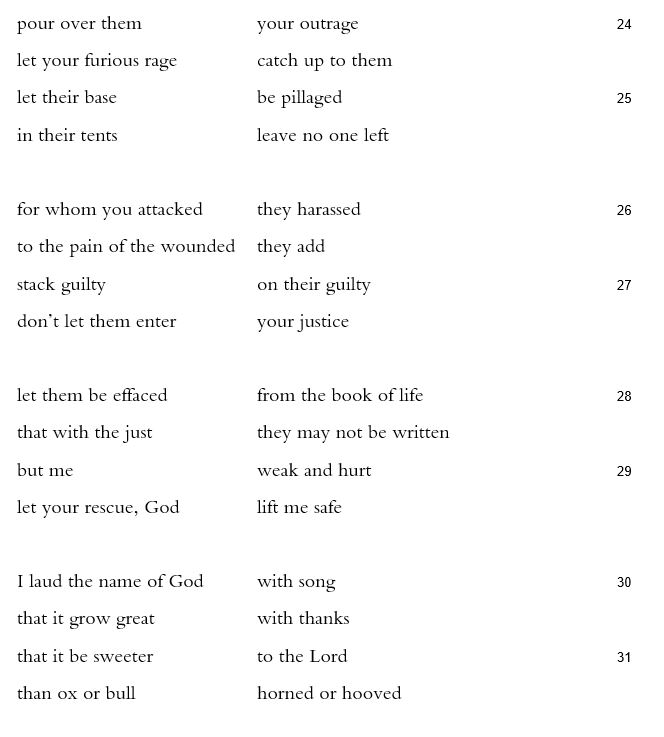
Why does our critical response matter? Because the next four four-line stanzas call for extraordinary punishment of the speaker’s enemies, a punishment that explicitly asks for justice to be withheld: “stack guilty | on their guilty / don’t let them enter | your justice” (27). There is no more mention of care or pity. Rather, she wants revenge. Not just revenge, but a storm of harm: “make their eyes | too dark to see / make their privates | constantly stumble” (23), “let their base | be pillaged / in their tents | leave no one left” (25), “let them be effaced | from the book of life / that with the just | they may not be written” (28). Lamech to his wives in Genesis 4 has not such rage.
Cumulatively, then, we have a speaker who feels beset and wronged for her convictions and practices, comparing her embarrassment to drowning. She begs rescue and sympathy, then craves revenge to the point of genocide. Sure: a danger of reading is that readings might be wrong. And so it is possible, of course, that the speaker is indeed as completely innocent as she claims. And yet a danger of sympathetic identification is how it allows us to intone with others, reciting this psalm, her terrible wish for divine justice and care to be suspended to make room for a bloodbath.
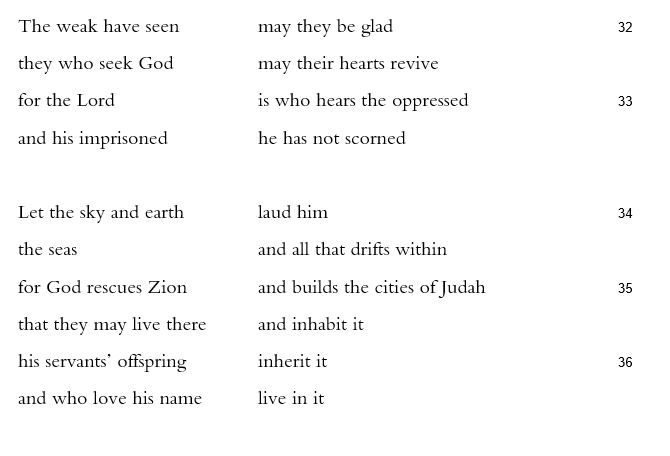
The closure of this psalm, verses 30-36, might be spoken by anyone. It makes no mention of personal circumstances, as do the previous twenty-nine verses. In this context, following the personal drama that precedes it, this part too seems like a wish. It is the moment when hot rage has passed and cool piety sets in. That hearts might revive, that the oppressed might be heard, the imprisoned rescued, the whole earth rejoice—these all are sentiments worthy of praise. But reading the psalm, actually reading it, demands that we ask how these final verses—the rescue of Zion—fit with what comes before. Again, our answer depends on the dynamics of identification. How willing are we to indulge the fantasies of the speaker in verses 22-29?
My name is Mark Minster. I’m an English and Comparative Literature professor with a background in ministry and in poetry. I teach courses on writing, reading, religion, and nature.
Like the shorter, less specific psalm that precedes it, Psalm 68 cares about the relationship between God and “us” and “them,” not any personal, individual relationship. Like Psalm 67, what matters to this song are the dynamics of local and universal. How can Israel’s God be both here and everywhere? How can a God be both located and mobile? How can a God dwell in one mountain when everyone knows other mountains have gods of their own?
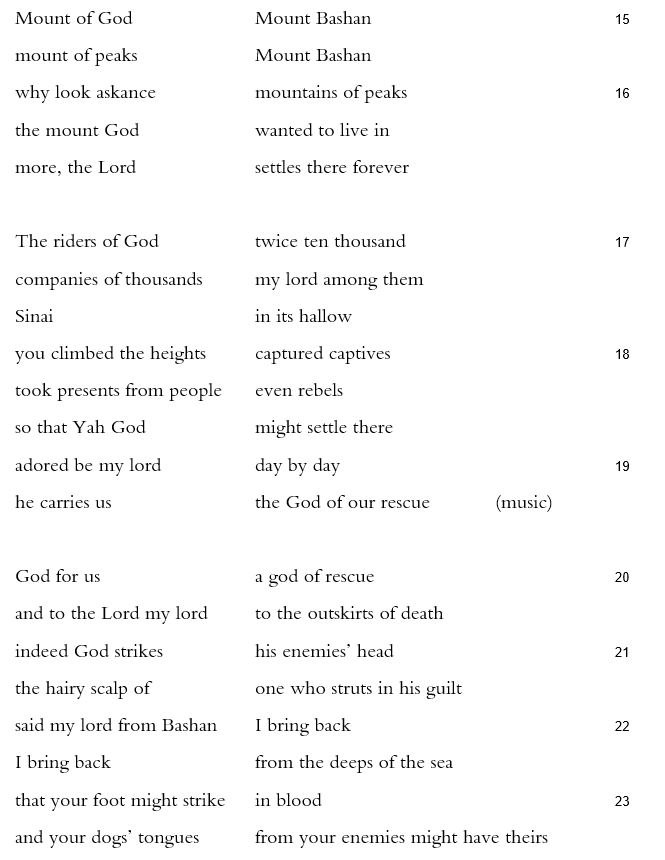
The song hangs on the tension between the stationary and the moving. At stake are questions of God’s presence and identity, encapsulated already in verse 1 with a clear allusion to the Ark of the Covenant.
“They set out from the mount of the Lord on the road for three days, the Ark of the Covenant of the Lord setting out before their face on the road for three days to scout them a place to rest, the cloud of the Lord above them by day at their setting out from the camp. Whenever the Ark set out, Moses said, Rise, Lord, so that your foes scurry and your haters flee from your face. Whenever it rested, he said, Return, Lord, to the ten thousands, the thousands of Israel.” (Num 10:33-36, my italics)
With the Ark, the Lord moved and rested, rested and moved. In Psalm 68, the question seems to be, which mountain is the “mount of the Lord”? How does one hill claim pre-eminence? Even, how did God— ark or no— get from one mountain to the next?
Throughout the psalm, one cluster of verbs underscores movement, another staying still. The poem begins with God’s rising and the enemies’ radiant dispersal, to the point of disappearance (1-2). By the second stanza, images of settlement—God’s “hallowed habitat” (5), God “giving | loners families,” and “only rebels have settled | in the scorches” (6)—contrast with images of God’s motion, “the Rider of the Clouds” (4), “leading captives | to freedom” (6). Movement comes in the form of roots like “ride” (rakhav: 4, 17, 33), to walk (halakh: 21, 24 x2), to go out (yatsa’: 6, 20), to go up (`alah: 18), to bring back (shuv: 22 x2; shavah: 18 x2). Settlement takes the form of verbs for sitting (yashav: 6, 10, 16), resting (shakhav: 13), and dwelling (shakhan: 6, 16, 18). By the end of Stanza 3, for instance, as in the passage from Numbers, God’s movement seems both liberating and preparatory. Orphans, widows, loners, and captives all are brought to a home. The cloudbursts that followed from Sinai have “steadied” the land, the “property” where “your creatures | have lived” (8-10).
In Stanza 4, word is sent and women bear good news, while kings retreat and retreat. In opposition to this motion, there’s a staying home: “she who stays home | splits the spoils / when you all lodge | in the sheepfolds” (11-13). The stanza ends with movement: “when Strength spreads out | kings from there / it snows | on Zalmon” (14). This motion, with a change of color, may be what that lovely image of the wings of the dove is really about. The contrast of dark mountain and snow cover is like the contrast of the wings of a resting turtle dove and those wings in flight.
The payoff of these images of settling down and taking flight becomes clear as we approach the center of the psalm. Zalmon—wherever that is—gives way in Stanza 5, verse 15, to Mount Bashan, wherever that is. Either might be a specific place, associated with other deities and shrines: Mt. Zaphon, linked to Baal; Mt. Tabor, Mt. Hermon, Mt. Meron. Or both might be designations for a whole category of mountains notable to biblical audiences for being neither Mt. Sinai nor Mt. Zion, the true mountain homes of Israel’s God, the Lord. The jealous glance of Mount Bashan is met in perhaps the psalm’s most important line by “the mount God | wanted to live in / more, the Lord | settles there forever” (16). The poem doesn’t need to name the mountain where it claims God wanted and continues to dwell.
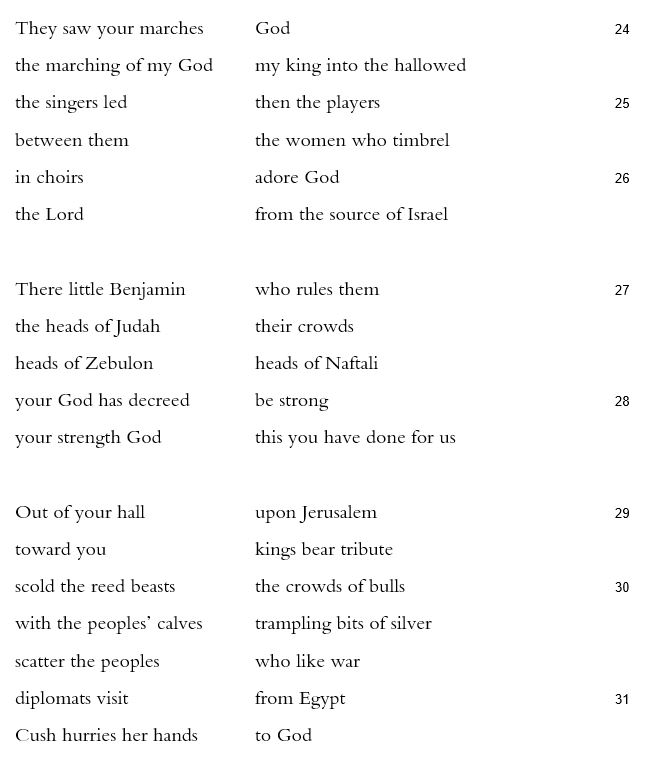
Thus this psalm’s overall organizational logic comes clear. All of God’s movement has been purposive, away from captivity towards rescue, away from Sinai and Bashan, towards the processional that leads to Jerusalem: “They saw your marches | God / the marching of my God | my king into the hallowed” (24). Stanza 6 names Sinai, but its description could equally well refer to Zion: “you climbed the heights | captured captives / took presents from people | even rebels / so that Yah God | might settle there” (18). Stanza 7 names Mount Bashan, but it’s syntactically ambiguous whether Bashan is where “my lord” speaks, or whence he “brings back” (22). Stanza 8 identifies liturgical roles (“the singers led | then the players / between them | the women who timbrel” 25), while Stanza 9 names tribal leaders “little Benjamin… the heads of Judah… heads of Zebulon | heads of Naftali” (27), mapping land from south to north. Stanza 10 names Jerusalem at last: “Out of your hall | upon Jerusalem / toward you | kings bear tribute” (29). The exact meanings may be unclear—what are “the reed beasts | the crowds of bulls / with the peoples’ calves | trampling bits of silver” (30)? Are these symbols? rites? idols? Still, the shape and direction are obvious. Others’ sacred mountains, their practices, their peoples and their gods, all of these are shown Jerusalem, which has dislocated them all.
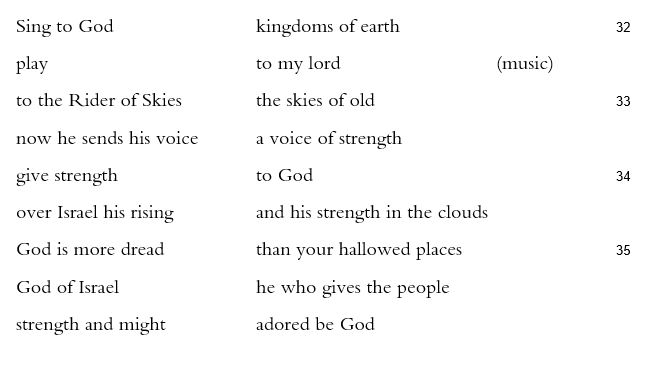
“Sing to God | kingdoms of earth,” the final stanza begins (32), but its two key points come later. First, in verse 33, there is an important opposition between what was and what is. “The Rider of Skies | the skies of old / now he sends his voice | a voice of strength.” That “now” is the word hein, “behold,” which marks a rupture in space or time. What differs from the mountains and gods of the past and the mountain and God of now? There’s a clue in the psalm’s shift from the repeated word “face” in the first verses of the poem (1, 2 x2, 3, 4, 7, 8 x2) to the repeated word “strength,” used in the final verses (28 x2, 33, 34 x2, 35). The face of God was Sinai; Zion is a voice of strength. Visual encounter has ceded to orality, the power of voice.
The second key point of the psalm’s last stanza appears in one of its many hard-to-render lines: “God is more dread | than your hallowed places / God of Israel | he who gives the people | strength and might” (35). Most translations miss the comparative element, opting instead for something like “O God, [thou art] terrible out of thy holy places” (KJV). It’s easy to miss the comparison, because why would God be compared to God’s holy places? But “God” here (‘elohim) does not equal “God of Israel” (’el yisr’ael), as indeed “God” did not in verse 8: “at the face of God | Israel’s God” (’elohim ’elohei yisr’ael). Missing this leads to—or results from—a misreading of the entire psalm. All of the hallowed places of neighbors across the map—Sinai, Zalmon, Bashan, even Jerusalem—are less to be reverenced than God, which the psalm asserts as the God.
No other psalm names God this often. Even in the so-called Elohistic Psalter (Pss 42-83), it stands out. ‘Elohim appears 25 times, ‘El 5 times, YHWH and Yah only 3 and 2 times. This naming is so insistent it asks to be understood. In a psalm that spends so long dislocating and relocating, dwelling and moving, a psalm that replaces presence with power, the naming of God serves a similar function: it displaces other Gods, other names. Its potent ambiguity is to be both plural and singular, all of the deities and one of them. Baal is subsumed—the Rider of the Clouds. Shaddai is subsumed. Even Yah, the Rider of the Skies, is absorbed. The gods are taken into God, even as the diplomats who visit from Egypt and Cush. In the process they become “bits of silver” or are taken into God, whose defining trait in this psalm is strength.
My name is Mark Minster. I’m an English and Comparative Literature professor with a background in ministry and in poetry. I teach courses on writing, reading, religion, and nature.
This brief benedictory song celebrates a very particular triangle. At the start and end of the psalm, there’s “us,” an unnamed first-person plural, always the object of a verb (twice in verse 1, once each in 6 and 7). Throughout the psalm, there’s “God,” named six times (1, 3, 5, 7, and twice in 6). And in the middle verses there’s “they”: the “others” (2), the “nations” (twice in 4), the “peoples” (once in verse 4, twice each in 3 and 5).
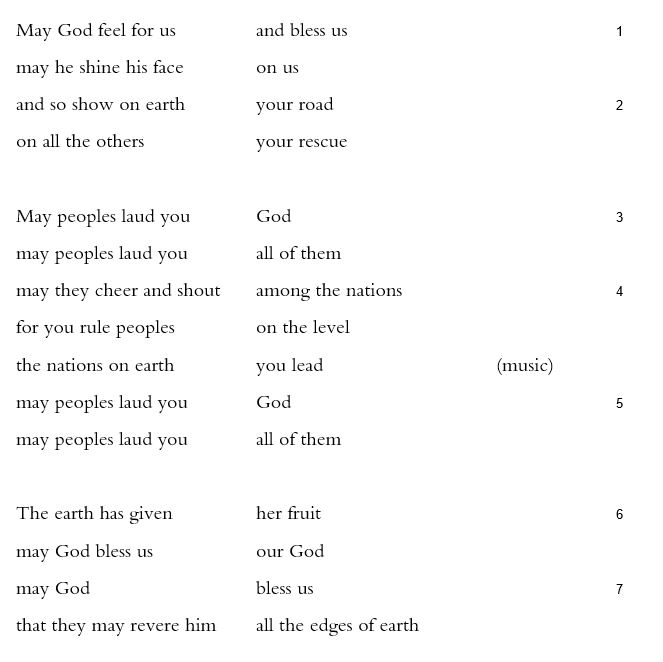
This us-God-they triangle implies specific kinds of logical arrangement. In the opening stanza, the speaker (or speakers) wish for God’s blessing for “our” sake: “May God feel for us | and bless us / may he shine his face | on us” (1). And yet the second verse reveals that this favor is not just for “us,” but for “them”: “and so show on earth | your road / on all the others | your rescue” (2). In the middle stanza, the speaker wants others to praise God because God leads everyone fairly. This wish, the refrain of verses 3 and 5, frames the three central lines of the song:
may they cheer and shout | among the nations
for you rule peoples | on the level
the nations on earth | you lead
The final stanza recalls the first, returning to “us” before ending with the rest of the world, “all the edges of earth.” It reveals one final wish, “that they may revere him” (7).
So this tight triangle expresses a precise, parochial universalism. Local blessings and a face that shines on “us,” these also shine for “them,” showing a road and a rescue, rule and reverence. Nevertheless the song doesn’t hope for everyone to be blessed or felt-for equally. Us and Them are not erased, but triangulated. God blesses us, so they praise God, the logic goes.
Understood this way, the role of “earth” in this psalm is ambiguous. The word erets can mean the whole world, or its land, or it can mean just the land, the Land of Israel. All four times the word appears in this psalm, in verses 2, 4, 6, and 7, it can refer to the known world of lands and peoples, or to a particular territory, one section of that world. For a psalm of such limited universalism, the difference matters. How far do the boundaries of road, rescue, rule, and reverence extend? How far goes the blessing?
My name is Mark Minster. I’m an English and Comparative Literature professor with a background in ministry and in poetry. I teach courses on writing, reading, religion, and nature.




 The Book of Psalms