• Page list
    • Posts
    • The Book of Psalms

The Book of Psalms

  • May 15th, 2023

    Psalm 66

    (director: a song, a lyric)       
    * * *

    This psalm, or “song” as it’s called by the superscription, is shaped around a series of ten plural imperatives which “all the land” is enjoined to do. Four of these insistent verbs start the first stanza:

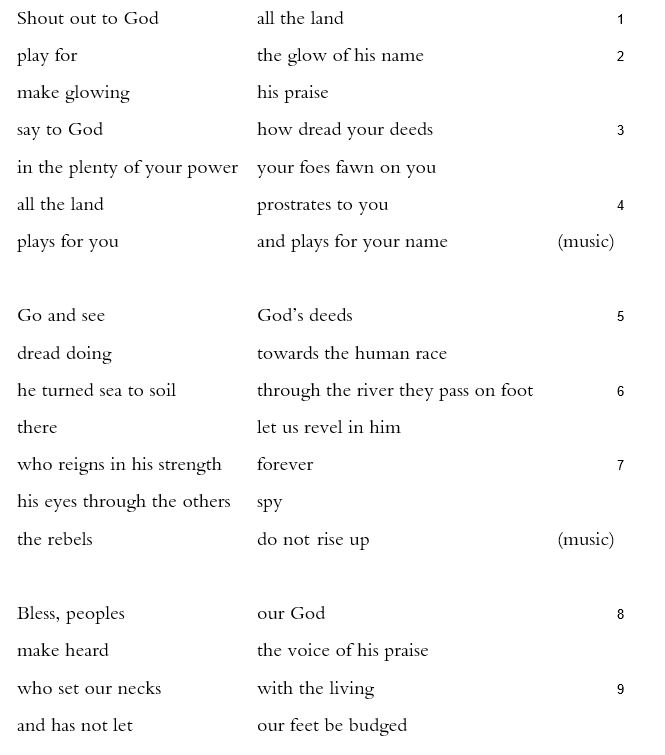
    Shout out to God | all the land                         

    play for | the glow of his name           

    make a glow | of his praise

    say to God | how dread your deeds          

    These four lines neatly turn around the centerpiece of “glow of his name / make a glow,” kevod shemo simu kevod. They move from the sounds of worship to its effects.

    Later imperatives carry this momentum from the effects of worship into strange maps of collective memory, taking us together away from and into the temple, then down deep into the speaker’s mouth. What begins as encouragement to make music turns into a meditation on hearing. In verse 5, the people—presumably still “all the land,” but all the “land” or all the “earth” is unclear—are encouraged to “go and see | God’s deeds / dread doing | towards the human race.” What deeds? “He turned sea to soil | through the river they pass on foot / there | let us revel in him” (6). The passage invokes scenes of creation and recreation, from the gathering of waters and appearance of dry land (Gen 1:9) to the receding of flood waters (Gen 8:8,13) to the crossing of the Reed Sea (Exod 14:21-22).

    In response to this memory come the psalm’s seventh and eighth imperatives: “Bless, peoples | our God / make heard | the voice of his praise” (Ps 66:8). And yet the sequence does not culminate until verse 16, with a doubled imperative that recalls the “go and see” from verse 6:

    Go and hear | that I might tally       

    all you who revere God | what he has done for my neck

    By this point, it’s hard to know where “we” the psalm’s plural audience are and where we’re being sent. Just to recap, all across the land we have been told to make noise (1-4). We were sent back to the Exodus to see (5-7). Again we were again told to make noise (8) in praise for having been rescued by God, “who set our necks | with the living / and has not let | our feet be budged” (9). (Not budged, that is, except for this song, which whisks us all over.) In this context the next two stanzas, verses 10-12 and verses 13-15, surprise. The first of these stanzas sends us either back to the Exodus or out to exile or both: “you drove people | over our heads / we went in fire | and in water / that you might lead us out | to relief” (12). The second introduces a first-person speaker, who enters the temple to make offerings: “I come to your house | with sacrifices” (13). For a people whose feet have not been budged there’s a lot of movement.

    The greatest surprise in all of this motion is where we go next, in verses 16-18. “Go and hear.” Go where? The song takes us inside the speaker’s mouth:

    to him with my mouth | I called                                       

    and he was lifted | behind my tongue                         

    if I had seen trouble | in my heart              

    would my lord | not hear

    If this is a poem of universalism, celebrating “all the land” or “all the earth,” it is also a curiously centralizing, personalizing poem. All the history of rescue from exile, the testing of the people, all the sacrifices of the speaker, all of the tensions between feet that are not moved and the repeated commands to go—it all crystallizes inside the mouth of the speaker, “behind my tongue… in my heart” (17,18). The map of history, the acts of worship, they come together. The speaker’s ability to breathe and produce sounds allows promises “which my lips | have parted / for my mouth to speak | in my distress” (14). It also bears witness to the lifting away of distress entirely: “if I had seen trouble | in my heart / would my lord | not hear” (18).

    Share:

    • Share on X (Opens in new window) X
    • Share on Facebook (Opens in new window) Facebook
    Like Loading…

    About Me

    My name is Mark Minster. I’m an English and Comparative Literature professor with a background in ministry and in poetry. I teach courses on writing, reading, religion, and nature.

    Recent Posts

    • Psalm 150
    • Psalm 149
    • Psalm 148
    • Psalm 147
    • Psalm 146

    Newsletter

  • May 14th, 2023

    Psalm 65

    (director: a David lyric, a song)

    * * *

    This stunning crescendo of a psalm modulates relentlessly and almost invisibly. Psalm 65 starts as one thing, ends as something else. It begins centered in Jerusalem, celebrating quiet. “To you | stillness is praise / God | in Zion” (1). How is silence sufficient praise? Praise is usually defined in auditory terms, as shouts and song. How, to God, in Zion, does stillness “make a promise good” (1c)? By the end of the poem, however, we have learned how: “joy the hills | strap on / fields have dressed in flocks | vales are draped in grain / they shout | even more they sing” (11d-12). Things as they are are ample praise. Thomas Merton claims something similar: “A tree gives glory to God by being a tree.” Calm is praise because it is enough, and calm is praise because it allows one to notice what life does already.

    There is a kind of economy set up in the first stanzas of this psalm, a typical economy of evenness—the shalom in “makes… good” (1). The worshipper offers God what God is due. She enters the yards of the tabernacle with praise, promise, and prayer. She is repaid “with justice” (5). That economy, however, gives way in verses 4 and 5 to something greater, an economy characterized by surfeit. It begins with a wish: “may we feel full | with the sweet of your house / the hallow of your halls” (4). Quickly, however, we launch beyond Zion, beyond full, mapping out the excess of the earth itself: “the leaning back / of the edges of land | and distant seas” (5). The earth’s economy already includes reverence and praise: “those who sit at the edges | they revere your signs/ the sources of dawn and dusk | you make ring out” (8). Time and space, morning and night, the edges of the world—how far we are flung.

    The last two stanzas follow fullness and sweetness out of the sanctuary, celebrating the superfluity of the earth’s fruitful multiplying. All is overload: “You tended the land | to saturate it / with so much | you surfeit her” (9). The fullness of the soil makes plant life possible. “You set up their grain | which is how you set her up,” verse 9 jokes in earnest, seeing the vertical founding of the earth (“you set her up”) in the verticality of crops whose stems flow thick with water. Verse 10 follows that water everywhere throughout earth’s plants: “her furrows to flood | to swell her roots / with showers you soothe her | her blooms you bless.” The soothing, here and in verse 7, recalls the stillness with which the psalm began. So too the fullness in flood and roots and blooms recalls the feeling of fullness from verse 4. Sweetness (goodness) returns from verse 4 in verse 11: “You have crowned the year | with your sweetness.” It overflows: “your walkways | drip what’s ripe / they drip | the wild meadows do.” Even the images of dressing suggest that everything signifies a greater-than sign. Sweetness adorns. Joy is girded on. Flocks and grain are as clothes and cloaks, their existence a shout and a song.

    We have become accustomed to talking about the supernatural as if there were a nature somehow sub-supernatural, the extraordinary as if there were an ordinary. In this poem’s vision, the experience of being drawn near to “the hallow | of your halls” (4) is met by “all edges of land | and distant seas” (5), the divine sweetness of the sanctuary spreads across the rooting and blooming of a world that is not supernatural but surfeited, spilling over. Words mean more than the things they signify—one need not cite Derrida to see this. But things themselves mean more than can be signified, this psalm says and celebrates. It’s something Blake might say: silence is excess and excess is praise.

    Share:

    • Share on X (Opens in new window) X
    • Share on Facebook (Opens in new window) Facebook
    Like Loading…

    About Me

    My name is Mark Minster. I’m an English and Comparative Literature professor with a background in ministry and in poetry. I teach courses on writing, reading, religion, and nature.

    Recent Posts

    • Psalm 150
    • Psalm 149
    • Psalm 148
    • Psalm 147
    • Psalm 146

    Newsletter

  • May 13th, 2023

    Psalm 64

    (director: a David lyric)

    * * *

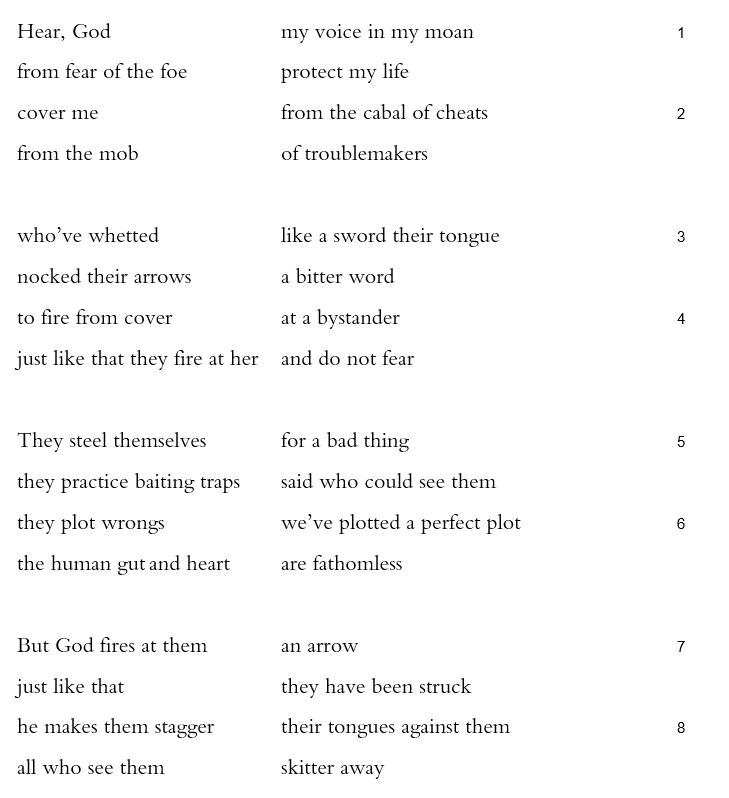
    Psalm 64 has a narrative pleasure that’s obvious—a tight story of revenge—and a marvel of sounds that are hidden in English.

    The story is taut and clear. The curtain opens. The speaker, surrounded, is calling for help. Villains, armed to the teeth, wield metaphorical weapons: “who’ve whetted | like a sword their tongue / nocked their arrows | bitter words” (3). They aim at the innocent: “just like that they fire at her” (4). By the middle stanza, their tactics become both less direct and yet more blatant: “they practice baiting traps | said who could see them / they plot wrongs | we’ve plotted a perfect plot” (5b-6a). These bad ones who gang up on the speaker have gotten cocky, slinking there in the shadows. They perseverate about their “plotting.”

    In the fourth stanza, God responds in kind, a hidden archer if ever there was, and “fires at them | an arrow / just like that | they have been struck” (7). The effect is surreal, even cartoonish: “he makes them stagger | their tongues against them / all who see them | skitter away” (8). In payback for plural figurative arrows (3), God shoots one literal arrow (7). It pierces what was one collective tongue (3), cutting it into plural tongues (8), which they appear to trip over (or perhaps their tongues trip over them!). The crowd disperses. Stanza Five—almost called it Scene Five—shows the people fearing, as the “cheats” and “troublemakers” did not. The curtain falls on the singular just person, around whom now not the bad, but the good, gather and effuse.

    What really makes this psalm, however, is not its pat plot but its verbal dexterity, a dazzle of puns on the words “fear” and “see,” and a half-dozen other similarities that loop threads through verses to tie the whole together. In verse 2, for instance, the speaker asks God, “cover me” (tastireni). Two verses later, the deceitful mob hurls its insults “from cover” (bammistarim). In this case, the English word “cover” manages to get both senses of the Hebrew seter, to protect and to keep secret. In the case of the Hebrew word tam, there’s no English word that conveys both innocence (“bystander” in 4) and perfection (“perfect” in 6), so the English version loses that ironic barb. We do get just fine the word pit’om for “suddenly” or “just like that” in verses 4 and 7, which marks both the instant of crime and of punishment. But we don’t see in translation the word qerev, rendered here as “gut” in verse 6, calling back the word cherev, “sword,” from verse 4. And we can’t notice in English the unscrambling by which wayyakshiluhu in verse 8, “he makes them stagger,” resolves itself in hiskilu in verse 9, “they consider.” In this wordplay, in a poem on the theme of language misused, and in the divine contrapasso, arrow for arrow, the psalm calls to mind the Tower of Babel story.

    Psalm 64’s most significant pyrotechnics are touched off in verses 2 and 3 with merei`im and devar mar: “from the cheats” and “a bitter word.” These sound clusters erupt first in verse 4, with lirot…yoruhu vel’o yira’u: “to fire… / they fire at her | and do not fear.” In the first half of verse 5, the “bitter word” comes back as devar ra`, “a bad thing.” In the second half of verse 5, both yoruhu “they fire” and yira’u “they [do not] fear” return from verse 4 as mi yir’eh lamo, “who could see them,” the words that the troublemakers say to convince themselves they’re invulnerable. Their verbal archery, lack of reverence, and not-half-as-secret-as-they-think self-confidence are lashed together. In verse 7, God’s response, vayyorem, “he fires at them,” is not just the slinging of an arrow. It punishes their lack of reverence and of sight as well. After all, the upshot of the punishment is that “all who see them…” (kol ro’eh vam) flee, and “all mortals fear them” (wayyir‘eu kol adam). The ra` of badness, the ra’ah of sight, the yara’ of reverence, and the yarah of shooting—all catch fire together in a tour de force.

    Share:

    • Share on X (Opens in new window) X
    • Share on Facebook (Opens in new window) Facebook
    Like Loading…

    About Me

    My name is Mark Minster. I’m an English and Comparative Literature professor with a background in ministry and in poetry. I teach courses on writing, reading, religion, and nature.

    Recent Posts

    • Psalm 150
    • Psalm 149
    • Psalm 148
    • Psalm 147
    • Psalm 146

    Newsletter

  • May 12th, 2023

    Psalm 63

    (of David, lyric, when he was in the wilderness of Judah)

    * * *

    The value of translating nefesh not by the anachronistic “soul” but by its literal sense of “neck” or “throat” becomes perfectly clear in Psalm 63, where “my throat” is paired with “my body” (1), “my mouth” (5), and “your right hand” (8). The word shows up a fourth time as that part of the speaker that has been hunted by the villains, “those who to waste it | seek my throat” (9). Even God’s name only appears three times.

    Pronouns for “me” and for “you,” however, are even more prominent. I count eleven first-person-singular suffixes for nouns: my God, my throat, my body (1); my lips (3); my life, my hands (4); my throat, my mouth (5); my bed (6); my throat (8), my throat (9). I count twelve second-person-singular suffixes for nouns and verbs (“behind you” in verse 8 functions as a preposition and a a noun): I greet the dawn for you (1); I have looked to you, your power, your glow (2); your care, venerate you (3);  I kneel to you, your name (4); I have remembered you (6); your wings (7); behind you, your right hand (8). In addition, there are prepositional suffixes: “for me” or li (7) and “held me up” is literally “for me supported your right hand,” started by the word bi (8); the two “for you” clauses (lekha) in the middle of verse 1, and the “of you” ending (bakh) of verse 6. The first verse of the psalm includes the standalone preposition “you” (’attah). That totals thirteen first-person suffixes, “me” or “my,” and sixteen explicit second-person markers, “you” or “your,” all but one of these concentrated in just the first eight verses.

    All of this is to say that the first eight verses of the poem are remarkably intimate. They linger in the depths of the speaker’s throat, which thirsts and fills and murmurs and hews to “you.” These verses starts at dawn and wake in the night. They name two bodies the way lovers do, the way a Yehuda Amichai poem does: “my lips,” “my hands,” my mouth,” “your glow,” “your wings,” “your right hand.”          

    It’s those last verses, verse 9 through 11, though, that change the poem’s experience entirely. They fit the first eight verses by the images of “throat” and “mouth” which bracket them (9a, 11c), but not by much else. There’s no first or second person after “my throat” in 9a. You and I disappear. Instead, the psalm becomes desire for punishment for bad guys we didn’t even know were there, desire for the king’s joy, and a general statement about the importance of telling the truth. The punishments are vivid and memorable, but they pose a problem. So much of the poem is about a relationship of care, which takes place intimately, in and between the speaker’s body and God’s. That’s why the throat matters, our readiest way to open to food and drink and air. And yet the only body parts here at the end are the slammed jaws of liars and the guts of people the speaker fears, poured over the pommel of a sword, devoured by foxes.

    Share:

    • Share on X (Opens in new window) X
    • Share on Facebook (Opens in new window) Facebook
    Like Loading…

    About Me

    My name is Mark Minster. I’m an English and Comparative Literature professor with a background in ministry and in poetry. I teach courses on writing, reading, religion, and nature.

    Recent Posts

    • Psalm 150
    • Psalm 149
    • Psalm 148
    • Psalm 147
    • Psalm 146

    Newsletter

←Previous Page
1 … 20 21 22 23 24 … 37
Next Page→

Blog at WordPress.com.


Loading Comments...
 

    • Subscribe Subscribed
      • The Book of Psalms
      • Already have a WordPress.com account? Log in now.
      • The Book of Psalms
      • Subscribe Subscribed
      • Sign up
      • Log in
      • Report this content
      • View site in Reader
      • Manage subscriptions
      • Collapse this bar
    %d