• Page list
    • Posts
    • The Book of Psalms

The Book of Psalms

  • May 11th, 2023

    Psalm 62

    (to Jeduthun, a David lyric)
    * * *

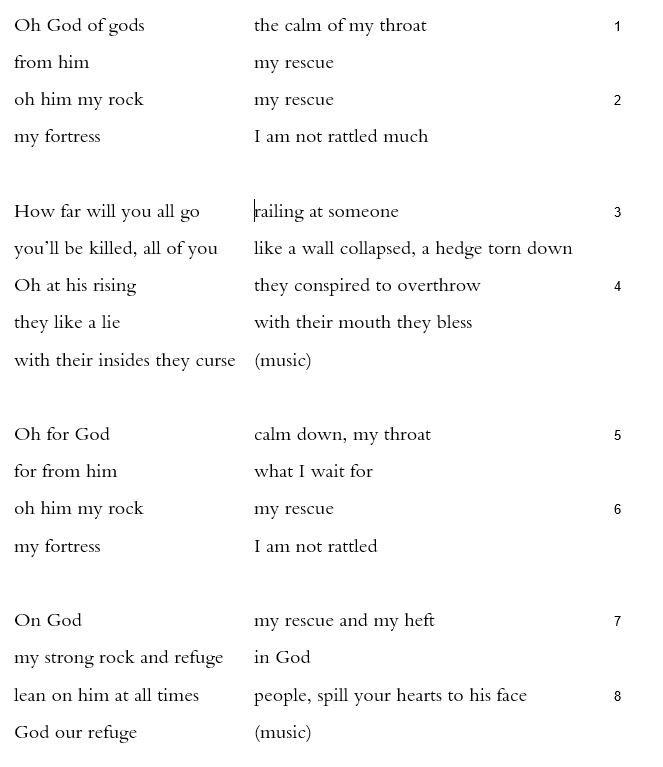
    “Once God spoke | twice I heard this,” the speaker of Psalm 62 says near the end of this duplicative, twice-heard poem (62:11). The first and third stanzas, verses 1-2 and 5-6, are near-doubles that work as a refrain. Partly the lines repeat: “from him | my rescue / oh him my rock | my rescue / my fortress” (1b-2 =5b-6). But differences between verses 1a and 5a seem less like variations on a theme and more like textual variants, “Oh God of gods | the calm of my throat” becomes “Oh for God | calm down, my throat.” To be fair, that first version might just be a preposition and the name “God”—“Oh to God.” But if the first stanza does locate God within the company of plural gods (‘el ‘elohim can easily be read this way) before the third stanza refers to just a singular God (l‘elohim), then that third stanza functions almost as a kind of corrective, an erasure of those other gods.

    The fourth stanza, verses 7-8, elaborates on verses 5-6. It takes up the words “God,” “my rescue,” and “my rock” and does so insistently. It names God three times instead of once, adds “and my heft” to “my rescue,” and turns “my rock” into “my strong rock and refuge | in God… God our refuge.”

    Seeing the first and third stanza as a kind of repeated chorus, with the fourth stanza as a kind of second chorus, we can see the second and fifth stanzas, verses 3-4 and 9-10, as curiously parallel. Both are plural: “How far will you all go” and “they conspired to overthrow” in the second stanza, “Oh air are the lowborn | the highborn a lie” in the fifth. Neither mentions God explicitly, but a powerful presence is felt. In verse 4, unnamed others are warned

    How far will you all go | railing at someone               

    you’ll be killed, all of you | like a wall collapsed, a hedge torn down      

    Oh at his rising | they conspired to overthrow 

    they like a lie | with their mouth they bless   

    with their insides they curse. 

    Who are these others? Against whom do they rail and conspire and lie? And who will kill them?

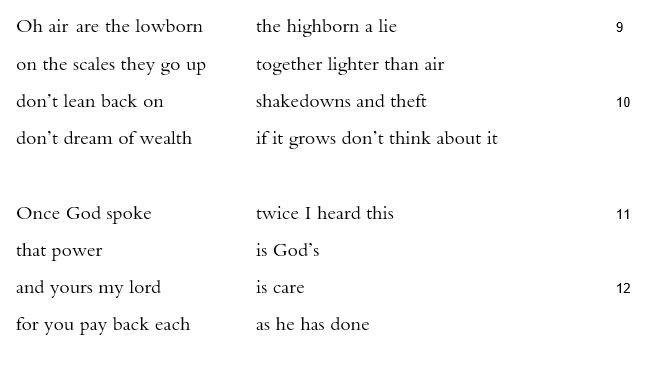
    These questions are not answered by the fifth stanza, which turns all humans to vapor upon “the scales” of what we assume is divine justice: “on the scales they go up | together lighter than air” (9).

    Explicitly, these two stanzas are about people. The plural conspirators in verse 3 rail against a person, `al ’ish, while “lowborn” and “highborn” are literally benei ’adam and benei ’ish. It’s humans, after all, who speak a lie (kozav 4, kazav 9) and who trust or rely on “shakedowns and theft” (10). And yet the mere possibility that `elohim in verse 1 could be plural—see, for example, Psalm 82— colors the “others” of verse 3 as lesser gods, mutinous gods. The “he” implied by “Oh at his rising” becomes not a person but God. Read this way, the distinction between the lowborn and the highborn in verse 9 takes on mythic significance. Plural, lowercase ‘elohim weigh no more than mortals.

     This reading finds double meaning in the final stanza’s twin assertions “that power | is God’s / and yours my lord | is care” (11b-12a). Power belongs neither to renegade gods nor to upstart mortals, nor could either of these groups tip the scales of justice, nor can they be relied on for chesed, care. In the context of the poem, this final stanza emphasizes that neither conspiratorial lying nor the briberies and robberies of the rich can prevent God’s system of retributive justice, in which “you pay back each | as he has done” (12).

    Detached from this psalm, the final lines could be marshalled as prooftexts for claims about an afterlife or for attempts to explain suffering as punishment for crimes. Those uprooted interpretations, however, lose much when ripped from the whole psalm. That “each” at the end of the psalm, it is the word ’ish returning from verse 9, the “highborn,” returning from verse 3, the person the conspirators attacked. The insubstantial scales are the crucial image here, everything lighter than air. The scales depend on power, the poem says God says. The speaker suggests we hear this twice, before adding, in the speaker’s own voice, “and yours my lord | is care” (12). Caveat lector.

    Share:

    • Share on X (Opens in new window) X
    • Share on Facebook (Opens in new window) Facebook
    Like Loading…

    About Me

    My name is Mark Minster. I’m an English and Comparative Literature professor with a background in ministry and in poetry. I teach courses on writing, reading, religion, and nature.

    Recent Posts

    • Psalm 150
    • Psalm 149
    • Psalm 148
    • Psalm 147
    • Psalm 146

    Newsletter

  • May 10th, 2023

    Psalm 61

    (director: on strings, of David)

    * * *

    There is so much conventional imagery in this plain psalm that it’s not hard to imagine it might have been written by a king, as many suppose. It doesn’t take much: verses 6-7 refer to a king; verses 5 and 8 use the first person. Still, such conjectures are better avoided. What can we know about ages lost? Does it matter to how we read now?

    Many claims about the life-setting of psalms, not just those with Davidic superscriptions, beg the question. A psalm that mentions a king is called a royal song, which, it’s said, must have been used in royal settings because it mentions a king and is a royal song. The details can be more elaborate, but the arguments usually no less circular. All depends on assumptions, interpreted. But with Psalm 61, to imagine that perhaps a king wrote it seems a relatively harmless guess. All it assumes is that kings have skillsets other than poetry.

    The psalm is tidy and contained, four four-line stanzas with a Selah break in the middle (4). Three imperatives frame the first stanza: “Hear… heed… lead” (1-2). The second stanza adds two more wishes, cohortative, to its matrix of four locations: “let me stay… let me nestle” in “my shelter / a tower of strength… your tent… the secret of your wings” 3-4). These verb forms skip the third stanza but return in the fourth, imperative and cohortative, “appoint” and “let me hymn” (7-8). That’s a satisfying pattern, four imperatives plus three cohortatives, spaced out nicely within a psalm that largely moves from the spatial to the temporal. Whoever this psalmist was, they sought order in form.

    To guess this psalmist was a king also assumes that rulers are willing to offer their own third-person intercessions, which again doesn’t seem like a stretch. There’s the first-person statement in verse 5 that makes sense in the voice of a leader: “you’ve given me the gift | of those who revere your name.” The next four lines shift person, however: “days to the days of a king | you keep adding…. He sits forever / at the face of God” (6-7). The second half of the poem shows abiding interest in preserving not just the realm but the reign of this individual king. Most telling, however, is that final imperative, “appoint,” in the line “appoint care and fidelity | they guard him” (7b). Who but a king would consider “those who revere your name,” the God-fearers, as a personal bequest, his own property? Who but a king would imagine chesed and `emet, care and trust, as being appointed and delegated rather than mutual and relational?

    Share:

    • Share on X (Opens in new window) X
    • Share on Facebook (Opens in new window) Facebook
    Like Loading…

    About Me

    My name is Mark Minster. I’m an English and Comparative Literature professor with a background in ministry and in poetry. I teach courses on writing, reading, religion, and nature.

    Recent Posts

    • Psalm 150
    • Psalm 149
    • Psalm 148
    • Psalm 147
    • Psalm 146

    Newsletter

  • May 9th, 2023

    Psalm 60

    (director: “The Witness Lilies,” in stone, to teach, of David, when, battling Aram of the Two Rivers and Aram Station, Joab returned to strike Edom in Salt Valley, 12,000)

    * * *

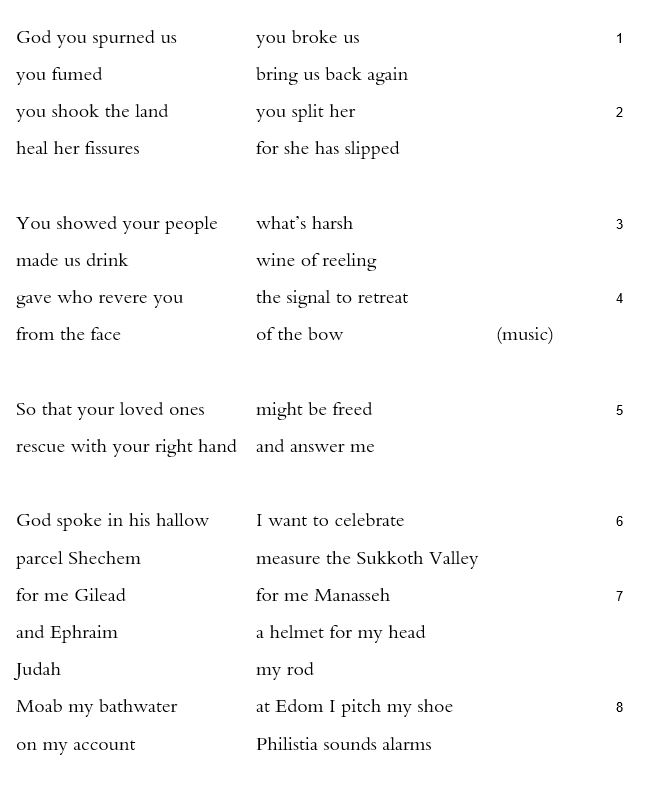
    Even if biblical Hebrew had periods and quotation marks, would we want them? Our desire for clarity in poetry and song has to be weighed against the values of richness and complexity. In Psalm 60, for instance, God speaks with—or in— God’s own uniqueness, God’s sacral apartness, God’s “hallow.” God’s speech seems to begin with “I want to celebrate / parcel Shechem | measure the Sukkoth Valley” (6). It’s God who celebrates and metes out, the reader concludes, since the psalm’s previous first-person speaker is likely not positioned to apportion territory. Verses 7 and 8 also seem to be spoken by God:

    for me Gilead | for me Manasseh                 

    and Ephraim | a fort for my head

    Judah | my rod

    Moab my bathwater | at Edom I pitch my shoe

    on my account | Philistia sounds alarms.

    That shift from locations within ancient Israel and Judah to Moab, Edom, and Philistia comes with a significant change of tone, from the serious “fort” and “rod” to jokes. Moab is a “washpot.” In contemporary colloquial English, Edom gets the finger. Does this shift of tone suggest that verse 7 should have quotation marks within quotation marks, as quoted speech while verse 8 is parodic? Or is this all one layer?

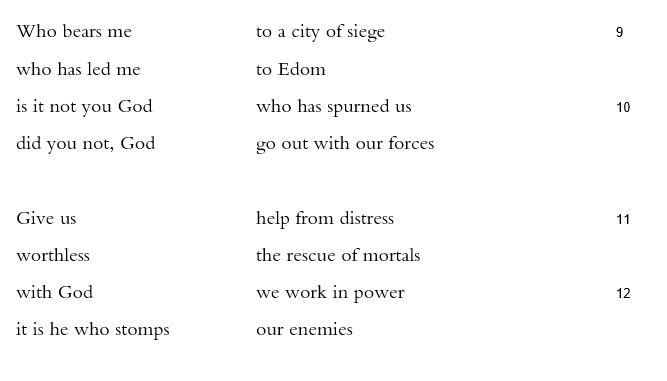
    It’s verse 9 that makes quotation marks seem simultaneously desirable and unwanted. Does God’s speech continue here or has it ended? “Who bears me | to a city of siege” makes sense if God or the Lord is speaking from the Ark of the Covenant. Who else besides God would be borne this way, led to Edom? Joab? A king? Because we can’t tell for certain, the questions bear both divine weight and human intimacy. Open-endedness continues—grows, even— in the question asked in verse 10: “is it not you God | who spurned us”? Surely God is not asking this of God? But then who speaks now? The speaker from verse 5? Is this speaker asking, rhetorically, “who is it who leads us to battle with Edom, God, if not you, the selfsame God who rejected us before?” Is the speaker on the battlefield trying to jog God’s memory? The negative question “is it not” gives this passage extra force. We know the answer should be “yes,” but wonder a moment all the same.

    Verse 4 requires not question marks, but a period, perhaps, to clarify whether it fits better with verses 1-3 or verse 5. In continuation of the psalm’s first verses which have six verbs in the perfective form, verse 3 clearly indicates completed action: “You’ve shown your people | what’s harsh / made us drink | wine of reeling.” But verses 1-2 also have two imperative verbs: “bring us back again.. heal [the earth’s] fissures.” So does verse 5: “rescue with your right hand | and answer me.” Verse 4 is difficult, but it looks like it has an additional perfective verb: “[you] gave who revere you | the signal to retreat / from the face | of the bow.” In this reading, “the signal to retreat” parallels “what’s harsh” as “from the face | of the bow” pairs with “wine of reeling.” Without punctuation it’s impossible to decide.

    Mitchell Dahood and others argue in favor of the so-called “precative perfect,” in which a perfective form takes on imperative meaning: “To those who fear you, give a banner / to which to rally against the bowmen” (75). In this reading, the speaker’s call to action starts earlier. In the grand scheme, it hardly matters. Regardless of how it’s sliced, in verses 1-5, the speaker recounts God’s prior rejections and calls for restoration, a restoration that’s wished for until the very last verse of the psalm. By that last verse, the speaker has grown all too confident: “with God | we work in power / it’s he who stomps | our enemies” (12). In a less-grand scheme, that confidence slips a little. It’s hard to tell exactly where and when in the psalm we turn from God’s prior punishments to God’s wished-for victory. And because it’s hard to tell, there’s a fair bit of quaver in that voice. Whoever says, “who leads me | to Edom” comes to sound less rhetorical and more worried.

    Share:

    • Share on X (Opens in new window) X
    • Share on Facebook (Opens in new window) Facebook
    Like Loading…

    About Me

    My name is Mark Minster. I’m an English and Comparative Literature professor with a background in ministry and in poetry. I teach courses on writing, reading, religion, and nature.

    Recent Posts

    • Psalm 150
    • Psalm 149
    • Psalm 148
    • Psalm 147
    • Psalm 146

    Newsletter

  • May 8th, 2023

    Psalm 59

    (director: don’t destroy, in stone, of David at Saul’s sending to watch the house to kill him)

    * * *

    Psalm 59 starts straightforwardly with a fourfold wish for rescue (“free me…evacuate me… free me… rescue me,” 1-2) and a threefold “not guilty” plea (“no crime is mine | no wrong is mine Lord / no fault is mine,” 3b-4a). By its second half, however, the psalm labors to reconcile its three invocations of God as strength (`oz) with its three invocations of God as care (chesed). “Strength” and “Care” are proximate or paralleled all three times:  “Strength | for you I wait / for God | my Fort // my God my Care | goes before me” (9-10a), “I sing | your strength / and ring out at dawn | your care” (16), and “My Strength for you | I want to play / for God my fort | God my care” (17). 

    In a call for rescue from enemies encircling like packs of wild dogs, the combination of might and caring makes sense. Freeing another person requires motive and means. Love without power spins its wheels; power without love careens. Only together can kindness and strength free.

    The sticky question, however, is what strength and care are to do with those enemies once the liberation is complete. And in verses 11-13, the speaker seems wildly incapable of deciding:

    don’t slay them  | or my people will forget       

    strew them | with your force        

    and take them down | Our Shield my lord

    for the fault of their mouth | the words of their lips

    may they be caught | in their conceit

    and for the curses | and lies they recount

    finish them in rage | finish them off entirely                   

    that they may know | God reigns

    in Jacob | to the ends of the earth        

    Having roused “the Lord | God of Forces / God of Israel,” and asking God in battle gear “to deal with | all the others” (5), the speaker asks now for these enemies to be spared, dispersed, and demoted (11). Then, promptly, she asks for them to be wiped out (12-13). Verse 13, as it stands, seems like a contradiction in terms: “finish them off entirely / that they may know | God reigns” (13a-b). If the goal is to teach “them” that God reigns, death would seem to be both definitively instructive but not particularly useful.

    Which response does the speaker want from God “my Fort / my God my care” (9-10)? Is it to not “feel for | all the harmful traitors” (5) or to “finish them in rage” (13)? Does the speaker not see these differences, too blood-blinded to tell that scattering enemies and eradicating them are completely different responses? Or is this one long slippery slope, from God’s laughing and scoffing at enemies to making an example of them to finishing them off? Are all these responses equal parts Strength and Care?  

    The psalm’s two refrains show clearly the questions are not resolved. “My Strength… / God my fort | God my care” (17, cf. 9-10) lead us one way, pairing kindness and power. Those dogs that twice come snarling at dusk (6-7, 14-15), even after the call for their obliteration, they lead down another road entirely.

    Share:

    • Share on X (Opens in new window) X
    • Share on Facebook (Opens in new window) Facebook
    Like Loading…

    About Me

    My name is Mark Minster. I’m an English and Comparative Literature professor with a background in ministry and in poetry. I teach courses on writing, reading, religion, and nature.

    Recent Posts

    • Psalm 150
    • Psalm 149
    • Psalm 148
    • Psalm 147
    • Psalm 146

    Newsletter

←Previous Page
1 … 21 22 23 24 25 … 37
Next Page→

Blog at WordPress.com.


Loading Comments...
 

    • Subscribe Subscribed
      • The Book of Psalms
      • Already have a WordPress.com account? Log in now.
      • The Book of Psalms
      • Subscribe Subscribed
      • Sign up
      • Log in
      • Report this content
      • View site in Reader
      • Manage subscriptions
      • Collapse this bar
    %d