• Page list
    • Posts
    • The Book of Psalms

The Book of Psalms

  • May 7th, 2023

    Psalm 58

    (director: don’t destroy, of David, in stone)

    * * *

    The images of Psalm 58 are toothed and bloody. They bite each other, making this an easy poem to not understand. It’s so not understood that Dahood leaves verse 9 blank in the Anchor Bible translation rather than even trying to translate it. Anglican committees omitted it from prayer books and temporarily banned sermons on it, seeing it as a call to exacting murderous revenge.

    But it’s better than that and much worse; darker and more ironic.

    The psalm begins by interrogating justice and fairness themselves, opposing them to “an unjust heart… vicious your hands” (2). It ends much the same way, with savage sarcasm:

    The just one is glad | when she has seen revenge

    she bathes her steps | in the blood of the bad

    so that someone will say |  ah but there’s fruit for the just

    ah but there are gods | who judge in the land (10-11).

    Far from endorsing violence, the opening and closing verses of the psalm indict the entire concept of retributive justice. Verse 10 does not condone or encourage the bloodbath of revenge, just as verse 11 does not sanction the someone who says, “ah but there’s fruit for the just / ah but there are gods | who judge in the land.” Rather, Psalm 58 is better read as a Job-like refutation of theodicy. It begins with a question and with the word for faithfulness and truth: “Really?” That “really” inflects the whole psalm. A just person dancing on the bad person’s grave: “that’s the payoff for the just.” Really? Really, “there are gods | who judge in the land”? This? This is justice?

    If there is justice, where does evil come from? It’s in the blood, the heart of the psalm asserts; it’s hardwired, at least for some: “The bad are strange | from the womb / they stray from the belly | speaking lies” (3). One need not be a Calvinist to appreciate the argument that goodness and fidelity to truth are learned behaviors and attitudes. In a spectacular figurative shift, verse 4 leaps from the blood of birth to the teeth of a serpent, which suggests that bad accumulates like poison in the fangs. The move from maternity to the mouth of a snake is psychologically and culturally potent, complicated, dangerous, calling to mind Isaiah 11:8 and Eve, lending extra significance to the fruit in verse 11. Likewise, the snake imagery spills across multiple verses, conjuring the threat of the rising, charmed viper.

    It is those snake teeth that the psalmist’s actual wish for vengeance focuses on. “God, crack their teeth | in their mouth / root out | the fangs of young lions” (6). This isn’t a wish to murder one’s enemies, let alone a celebration of revenge. It is a prayer for the dangers of the world to be defanged, a dream that lions and tigers and snakes might all “run off | like waters that wander” (7).

    The triumph of this psalm is in its most inscrutable lines, in verses 7-9, where the similes take over, comparisons that arise from the psalmist’s evidence that the world is unjust:

    … | it’s like they’re cutting themselves    

    like a mollusk melting | as it moves     

    like a woman’s miscarriage | who hardly saw the sun

    before they can sense | your thorns the thicket

    like the living like rage | he sweeps them away  (7b-9).          

    Both birth and teeth return here in the miscarriage and the thorns. Even though the serpents and lions may have just had their bad removed, these verses go beyond good and evil, beyond the bad. This is what the world is like: not a womb in which bad is born, but a world of thorns and thickets, vernal teeth; a world of miscarriages, the stillborn child “who hardly saw the sun” (8). It is a red of claw, where God has barely nocked his arrows before things start circumcising themselves, scraping their guts against the rasp of the world.  

    So now, at the troublesome verse 10, the point is not that the just should celebrate or ought to wash her feet “in the blood of the bad.” It’s a declaration. We all walk in spilled blood. That’s the cost of doing business, the price of existence. Some will doubtless conclude that all of this blood is the fruit of justice, but such a presumptuous claim to know good and bad forgets that the path to that tree has long been barricaded.

    Share:

    • Share on X (Opens in new window) X
    • Share on Facebook (Opens in new window) Facebook
    Like Loading…

    About Me

    My name is Mark Minster. I’m an English and Comparative Literature professor with a background in ministry and in poetry. I teach courses on writing, reading, religion, and nature.

    Recent Posts

    • Psalm 150
    • Psalm 149
    • Psalm 148
    • Psalm 147
    • Psalm 146

    Newsletter

  • May 6th, 2023

    Psalm 57

    (director: don’t destroy; of David, in stone, when he ran from Saul into the cave)

    * * *

    Probably no biblical Hebrew word presents the challenges the word kavod presents. It appears three times in the second half of Psalm 57 (verses 5, 8, 11), twice in a refrain in reference to God. The other time, in verse 8, the word seems to refer to something of the speaker’s. The common translation is “glory,” which nearly every English version has in verses 5 and 11, and most have for verse 8. There in verse 8, some translators choose “my soul” or “my heart.” According to linguists, the word likely originally indicated heaviness and weight, the valence of which is entirely positive—the weight of one’s riches, the superabundance of bodily prosperity, a kind of fullness or saturation that comes to mean luxury or grandeur or dignity or honor.

    Whether because of those abstracted qualities or for some other reason, kavod also refers to a grand, dignified presence, usually the presence of the Lord, a presence that is nevertheless not necessarily a substance, a kind of surrounding something that is visible (Exod 24:16) and shines (Isa 60:1). Glowing is part of the semantic range of “glory,” though contemporary usage of the word “glory” tends to have lost even that insubstantial substance, making it seem both pious and not really there. What’s needed in translation, then, is something both weighty and glowing, something ethereal with gravitas, or one or the other. “Ambience” calls to mind candles; “aura” conjures crystals. “Honor” gets most of the abstract qualities; “heft” gets half of the concrete meanings with most of the abstract qualities as well. It’s a big ask.

    For Psalm 57, the word “nimbus” seems to work. Its etymology and meteorology give it a dark atmospheric weight, while its association with haloes keeps its register and valuation fitted for characterizing God in the Psalms: “Rise above the skies | God / above all the earth | your nimbus” (5). “Atmosphere” feels too literal here. “Heft” would be laughable in this context—though it works well in Psalm 3:3 (“my shield / my heft | the lifter of my head” ) and in 96:7 (“give the Lord | heft and might”). And while “glory” seems too much for a speaker to conjure for herself, “nimbus” colors the speaker’s imperative both gold and gray: “Awake, my nimbus | awake, ten-string and lyre / I want to wake | the dawn” (57:8).  

    Compellingly, the psalm’s emphasis on the kavod maps it above the psalmist’s enemies and their “net they set for my feet” (6). Those enemies have hunted the speaker, who lies “amid the lions… the ones who consume | mortals / their teeth | spear and arrows / their tongue | sharp sword” (4). Down against those hunters, the Lord “sends | his care and faithfulness” (3, cf. 10), which descend just as the kavod rises. As the enemies who would crush the speaker (3) are laid low, chesed and ’emet descend. Kavod rises. At the same time, the weight/glow also opposes the “hungers” with which verse 1 ends, the havvot. And so the heavy light that accompanies both God and the psalmist’s music comes as compensation for the experience of internal emptiness and destruction. Against a hungry imploding, the poem posits outward explosions, weighty eruptions of glory and light.

    Share:

    • Share on X (Opens in new window) X
    • Share on Facebook (Opens in new window) Facebook
    Like Loading…

    About Me

    My name is Mark Minster. I’m an English and Comparative Literature professor with a background in ministry and in poetry. I teach courses on writing, reading, religion, and nature.

    Recent Posts

    • Psalm 150
    • Psalm 149
    • Psalm 148
    • Psalm 147
    • Psalm 146

    Newsletter

  • May 5th, 2023

    Psalm 56

    (director, to “the hushed dove of far away,” in stone, of David when the Philistines snatched him in Gath)

    * * *

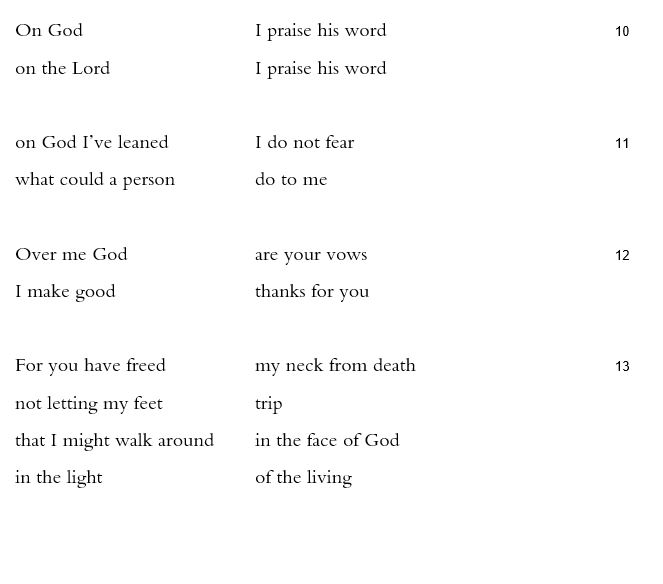
    Though not the most original of psalms, Psalm 56 has interesting shape. Stanzas that beg for personal intervention and rescue from enemies are met with refrains that show confidence. The refrains in 3-4 and 10-11 share language and imagery. They both feature the leaning-on of the verb betach, the phrase “on God” (4a, 4b, 10a, 11a), and the statement/question “I do not fear / what could a person | do to me” (11; 4 has “a body” for “a person”). These refrains punctuate the psalm, setting off the opening and closing verses as narrative problem (1-2) and solution (13) while framing the narrative stanzas between (5-6 and 8-9).

    At the center stands verse 7, which pairs the people’s wrong with God’s wrath. The concentric shape is tight, uneven only in verse 12, which like a musical bridge links chorus and verse: “Over me God | are your vows / I pay back | thanks for you” (12).  

    Two of the psalm’s moments are worth special attention. The first appears in the paratext, the superscription, that phrase that seems like it must have been the title of a tune, “the hushed dove of far away.” There’s the lyricism of the words themselves, such a lovely ache, the two long O sounds in yonat eilem rechoqim— and especially that second O, between the two guttural consonants ch and q, in the word for “far away.” And then there’s the fact that an ancient melody has been lost: music we don’t have, witnessed by lyrics we do. And then there’s our wondering about the poignant combination of silence and distance. Has the dove gone quiet because it’s gone away, or was it quiet already as it went?

    In the poem itself, the movement from verse 8 to verse 9 is also touching:

    My grief you have tallied  | oh put my tears in your bottle

    are they not | in your book                      

    when my enemies turn back | then I will call                                        

    The word “grief,” nod, sounds like the word “bottle,” n’od. The two words literally enclose that first line, verse 8a, all the grief, all the tears, counted and captured in a bottle. Verse 8b has the quality of all questions in the negative, with some percent confidence, some measures of hope, of fear. Most powerful, however, is that after this mention of a book, a scroll in which all of the speaker’s suffering is recorded, there is that word “call,” which in Hebrew also means “read” (qar’a). Only after the enemies have turned back will the speaker be ready to read, to recite aloud a litany of sorrow.

    Share:

    • Share on X (Opens in new window) X
    • Share on Facebook (Opens in new window) Facebook
    Like Loading…

    About Me

    My name is Mark Minster. I’m an English and Comparative Literature professor with a background in ministry and in poetry. I teach courses on writing, reading, religion, and nature.

    Recent Posts

    • Psalm 150
    • Psalm 149
    • Psalm 148
    • Psalm 147
    • Psalm 146

    Newsletter

  • May 4th, 2023

    Psalm 55

    (director: with strings, instructive, of David)

    * * *

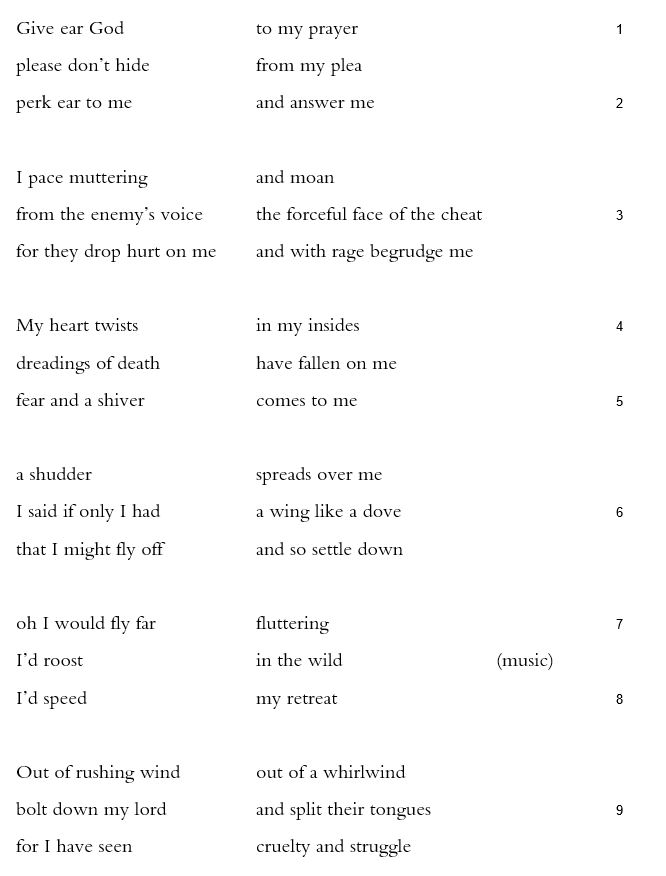
    Psalm 55 appears to be deeply personal, interior, a psalmist suffering inwardly. The voice of the enemy and the face of the vile have mentally torn up the speaker: “My heart twists | in my insides” (4).

    That root word for “insides,” qerev, holds the poem together. It shows up not just to describe the suffering, but the end of that suffering: “he bought back in peace | my throat in my insides” (18). Curiously, it also describes the whole city where “they” go around: “harm and trouble | in her insides / hunger in her insides” (10c-11a). They themselves, whoever they are exactly, have “bad in their lodgings | and in their insides” (15). Most intriguingly, that same consonantal root qerev shows up as qerav in verse 21 where it describes conflict within someone, someone third-person: “smoother than butter | his mouth / and aggression | was in his heart” (21). (Given that that word “aggression” is paralleled by the word petichot, which seems to mean an opened sheath or drawn sword, the similarity between qerev  and cherev, “sword,” seems purposive.)

    That there are numerous “insides” in the psalm suggests something less personal than it first appears. After all, the poem turns from the twisting and shivering heart (3-5) to the wish for a wing, the desire to get away (6-8a). From there it turns, hinged by “out of rushing wind | out of a whirlwind” (8b), to a second wish, a wish that the Lord would descend and punish (9). In verses 10-11 the personal becomes collective, the insides of the city. And yet just as it turns, the psalm ironically becomes more personal, the first-person speaker addressing a second-person betrayer.

    For if an enemy slurs me       that, I can bear         

    if a hater swelled against me   from him I could hide

    but you                              someone of my worth

    my close friend                    one so known to me

    who sweet talk as one           in the house of God  

    we walk                             with the masses (12-14).

    The piling up of appositives (“you | someone of my worth …  who sweet talk as one”) deepens our sense of the speaker’s pain even though it comes no closer to naming the disloyal friend. Instead, brutally, this psalm that emphasizes insides goes all the way out into the temple with what seem like intimate whispers, only to disappear again, diffused into a crowd.

    The wish for destruction that follows immediately in verse 15 still doesn’t name the “they.” Context implies the “masses” with whom the speaker and the disloyal friend walk. Their walking calls back those “in the city | days and nights / [who] go round | up on her walls” (10). Are all of them betrayers? Are they part of the city’s insides, rotten to the core, or are they invaders from without? What does “there’s no changing them | they do not revere God” (19) reveal about them? Have they—plural or singular—betrayed the speaker or have they betrayed God?

    From this they whom the speaker clearly wants to see punished (the word “answer” in “may God hear | and answer at them” in verse 19 sure looks like the word “harm”), the psalm whipsaws back to the singular “he”:

    He sent his hands                 against his friends

    he broke                            his pact

    Smoother than butter           his mouth          

    and aggression                     was in his heart         

    his words were slicker           than oil                             

    and they                             were unsheathed (20-21).

    Who is this “he” who sent out against his friends and broke his pact? And what is this description doing here? If this is more evidence against the disloyal friend, it seems to be justifying the call for harsh punishment. But wedged here, between calls for punishment in verses 15 and 19 (which flank a relatively straightforward call for rescue, similar to that with which the psalm began) and celebration of that punishment in verses 22-23, this third-person singular sounds almost like it refers to the one doing the punishing.

    It isn’t necessary to conclude that this psalm is hopelessly broken, as others have claimed, nor that it must have resulted from two different psalms having been stitched together or interleaved. Rather, whatever the core experience of this psalm, whatever its origins, there are tensions hard to resolve. There are tensions between what happens inside and what happens outside, tensions between the singular personal experience of betrayal by one person and collective generalizations about “them, “people of blood and fraud” (23). These others didn’t break just one person’s trust, but he, the bad one, “sent his hands | against his friends” plural (20). Like Poe’s purloined letter, the insides of Psalm 55 are right there on its surfaces, inward pain facing out, suffering becoming a call for terrifyingly, problematically disproportionate response: “let death come over them | let them be buried alive / bad in their lodgings | and in their insides” (15).

    Share:

    • Share on X (Opens in new window) X
    • Share on Facebook (Opens in new window) Facebook
    Like Loading…

    About Me

    My name is Mark Minster. I’m an English and Comparative Literature professor with a background in ministry and in poetry. I teach courses on writing, reading, religion, and nature.

    Recent Posts

    • Psalm 150
    • Psalm 149
    • Psalm 148
    • Psalm 147
    • Psalm 146

    Newsletter

←Previous Page
1 … 22 23 24 25 26 … 37
Next Page→

Blog at WordPress.com.


Loading Comments...
 

    • Subscribe Subscribed
      • The Book of Psalms
      • Already have a WordPress.com account? Log in now.
      • The Book of Psalms
      • Subscribe Subscribed
      • Sign up
      • Log in
      • Report this content
      • View site in Reader
      • Manage subscriptions
      • Collapse this bar
    %d