(lyric, of Asaph)

* * *
Maybe nowhere in the Bible is the idea of a covenant as simply put as in Psalm 50:14-15:
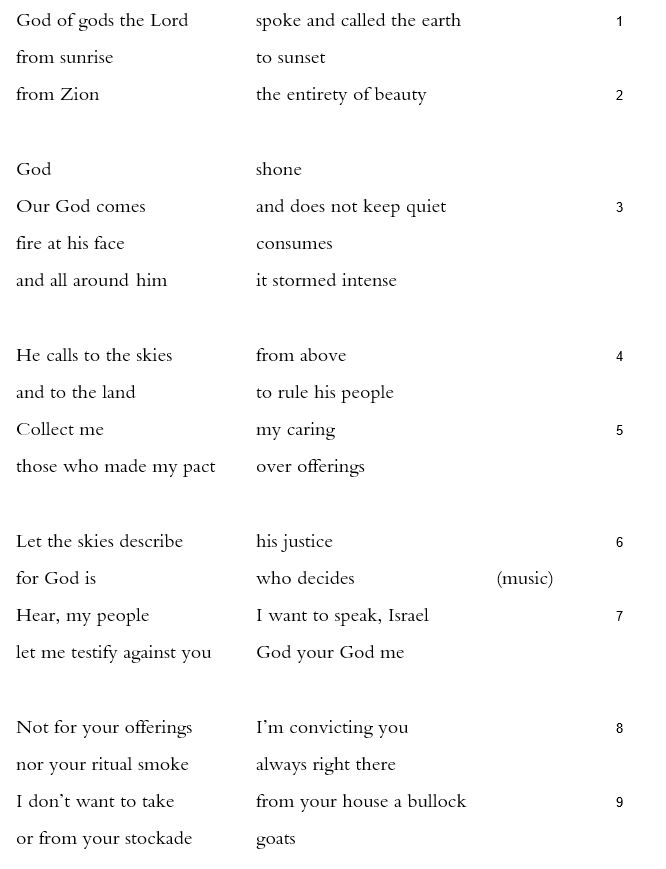
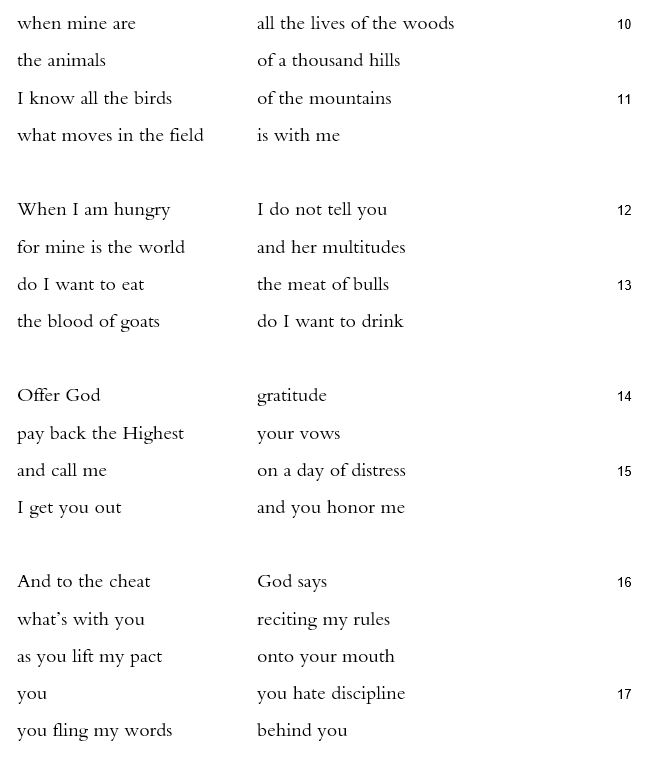
Offer God | gratitude
pay back the Highest | your vows
and call me | on a day of distress
I get you out | and you honor me.
That’s the deal, a contract between unequals, a suzerainty treaty between a lord and a vassal: “I get you out | and you honor me.” Psalm 50 stands out from other psalms for its vision of a divine lawsuit in which God indicts the people of Israel for having misunderstood something so simple.
The psalm joins other devastating critiques of empty ritual in Amos 4-5 and Isaiah 1:11:
What are to me your many offerings | says the Lord
I am stuffed with slaughtered rams | and well-fed fatlings
and the blood of steers lambs and goats | I have never liked.
The Lord’s outrage is shaded with dark humor. Why would I need your lunch? I packed my own: “all the lives of the woods / the animals | of a thousand hills” (Ps. 50:10). Do I have to check in when I want a snack? Did any of you ask if I like meat?
The problem is not the sacrificial rites themselves: “Not for your offerings | I’m convicting you / nor your ritual smoke | always right there” (8). The real problem is not in the fire but in the face: “what’s with you | reciting my rules / as you lift my pact | onto your mouth/ you | you hate discipline/ you fling my words | behind you” (16-17). Unlike in Isaiah and Amos, here the people’s mistakes have less to do with social injustice and more with untamed speech, a tongue silent before theft and adultery, a tongue both too free—“your mouth you let loose | to harm”—and too crafty—“your tongue | frames fraud” (19). As with the rich who were called out in Psalm 49, the worst consequences affect a brother: “You sit and speak out at | your brother / the son of your mother | you slander.”
These lines lead up almost all the way to God’s resting his case, his mic drop: “I convict you | and lay my case before you” (21c). In between batches of evidence of speaking against one’s own family members and the psalm’s final statement of God’s case come the most cutting lines:
you did all this | and I kept quiet
you reckoned I would be | just like you (21a-b).
Here, it is God’s silence that opposes deceitful speech. Or rather, God’s silence has opposed wrongful speech until this moment in the courtroom. Divine silence is long gone: “Our God comes | and does not keep quiet” (2). It has been replaced not just with verbal display, God’s prosecutorial argument from verses 7-21, but with full sunlit theophanic fire: “God | shone / Our God comes | and does not keep quiet / fire at his face | consumes / and all around him | it stormed intense” (2-3). Even more biting is that sharp and distancing line, “you reckoned I would be | just like you.” The storm and the courtroom prove otherwise.
It is not clear, however, why, if God testifies against all Israel, as verses 4, 6, and 7 explicitly say, the actual charges that are detailed in the second half of the suit should be directed only at “the cheat,” the bad person (16). Is all of Israel guilty, or just this bad person? Does it matter that that obtrusive stage direction, “And to the cheat | God says,” is particularly unpoetic or that that line tames charges that would otherwise indict all of Israel? The final lines of the psalm are similarly problematic. Is the accusation suddenly that Israel—or some of its people—have been forgetting or ignoring God? (22) The issue isn’t improper gifts, or deceptive speech, but that people have forgotten God? That fiery divine appearance would be hard to forget, as would the sudden leap from articulate argument to the violent threat of ripping God’s people to shreds (22). The meaning of the final half-verse is also unclear, and its language of rescue could not have been predicted by anything else in the psalm.
To be fair, the beginning of the psalm is just as strange as the ending. The psalm starts with three divine names: ‘El, ‘Elohim, and YHWH, with nothing in between. The end of verse 2 and the start of verse 3 name both “God” and “our God,” and verse 7 ends with “God your God me.” Is this one divinity or more? Strangely, even when the Lord (or God) seems to be speaking, “God” is often referred to in the third person: “Offer God | gratitude / pay back the Highest | your vows / and call me” (14-15). The final stanza, again, confuses:
Consider this | you who ignore God
lest I shred | with no one to snatch away
who offers thanks | honors me
and there I will show | a path to God’s rescue.
Shifts of person are common in biblical Hebrew, but the separation of roles here is pronounced. The first-person seems both to punish and to reveal, while God in the third person seems to have been forgotten but to be capable of rescue. The name El, plus the fire and the storm, plus the little gaps between the speaker and God, all suggest something plural, whether Canaanite or ancient or something else. What’s perfectly clear is the covenant centered in the psalm, with its injunction to give thanks. What’s less clear stands at either end of the psalm, in the faceted, elusive God with whom that covenant is made.



 The Book of Psalms