• Page list
    • Posts
    • The Book of Psalms

The Book of Psalms

  • April 25th, 2023

    Psalm 46

    (director: Qorachites: song tuned high)         

    * * *

    All the Qorachite psalms (Pss 42-49, 84-85, 87-88) are strong, structurally and musically. They rely on stanza-and-refrain patterns to help the psalm mean. There is the two-part structure of Psalm 45, king and bride, for instance, and there’s the three-part shape of Psalm 42/43 and of Psalm 44, which both move from the remembered desired to the far-from-ideal to a wished-for reconciliation. Psalm 46 ably manages to have both a two-part and three-part structure: two five-line stanzas (2-4a, 4b-6) surrounded by two two-line refrains (1, 7) against a third five-line stanzas (8-9), followed by a two-line envoi (or coda) (10) and a final two-line refrain (11). We move from an imagined flood that fails to harm the city of God (2-4a) to a flood remembered from within the city walls (4b-6) to wastelands at the country’s edge, at the end of the nation’s wars (8-9). In the refrains, God is “for us” (1), the Lord of Armies, the Lord of Forces, YHWH Sabaoth, is “with us” (7, 11), and a shelter (1) that becomes a fortress is “for us” (7, 11). Keeping the whole thing tight, God is named seven times, the Lord three.

    Sonically, too, Psalm 46 is full of marvels. The first verse, the tongue on the gums, pairs `oz and `ezrah, “strength” and “help,” followed by betsarot nimtsah “in distress | … found.” In verses two and three, behamir, the infinitive that means transformation (“altering”), is picked up by harim (“hills”) and then in the “waters |clamor and lather,” yehemu yechmeru meimav and again by harim. The effect is to blend in sound what spill into each other in song, the hills and the seas. “Dwellings” (mishkenei) and “cheer” (yesammechu) play off each other in verse 4, and “who placed wastes” in verse 8 calls back those sibilants and m-sounds (asher sam shammot). Verse 9, however, is the real tour de force. The words “stopping” and “snaps” are mashbit and yeshabber, the words “edge” and “bow” and “cuts” are qetseh, qeshet, and veqitseits, but they’re even better in the context of the whole verse:

    mashbit milchamot | `ad qetseh ha-aretz

    qeshet yeshabber | veqitseits chanit

    `agalot | yisrof ba’esh

    Here the effect is also to blend sounds and sense, and to lend a kind of chiming inevitability to the ending of war.

    As for the historical context of this psalm, that’s impossible to know for sure. The song’s message of patience in the face of external threats —“Let go and know | that I, God / rise over the others | rise over the land” (10)— accords well with Isaiah’s counsel during the Assyrian crisis. The combination of the “channels” in verse 4 and the “wastes in the land / stopping wars” makes for another compelling parallel, also in the 8th c. BCE, when Hezekiah’s workers kept water from Sennacherib’s armies in the Kidron Valley, tunneling that water to the Pool of Siloam, inside Jerusalem’s walls (2 Kgs 20:20). This evidence, however, is circumstantial, and any historical moment could be for the psalmist as much as matter of collective cultural memory as the drowning of Pharaoh’s army seems to be (6), as much as matter of mythmaking as the stories of creation and Noah’s flood.

    Detached from its context, the psalm easily becomes nearly apocalyptic, with the inundation and desolation of the erets, that loaded word that means both “land” and “earth.” The easily detachable “Let go,” especially in translations that supply a copula between “I” and “God” to make the even more detachable “Be still and know that I am God,” sounds not just comforting but quietist (10). Together, these detachings make this psalm sound as if it suggests fiddling while Rome burns, chasing privatized peace while the earth dissolves and slides into the sea.

    Just to be clear, that imperative to “let go and know | that I, God / rise over the others | rise over the land” is a plural imperative rather than a personal one. It has a political thrust in a time of war. The psalmist could not have foreseen rising sea levels on a global scale, for example, and nothing in the song implies or celebrates inaction in the face of that kind of siege.
    Share:

    • Share on X (Opens in new window) X
    • Share on Facebook (Opens in new window) Facebook
    Like Loading…

    About Me

    My name is Mark Minster. I’m an English and Comparative Literature professor with a background in ministry and in poetry. I teach courses on writing, reading, religion, and nature.

    Recent Posts

    • Psalm 150
    • Psalm 149
    • Psalm 148
    • Psalm 147
    • Psalm 146

    Newsletter

  • April 24th, 2023

    Psalm 45

    (director: on “The Lilies”; of the Qorachites: skilled, a song of love)

    * * *

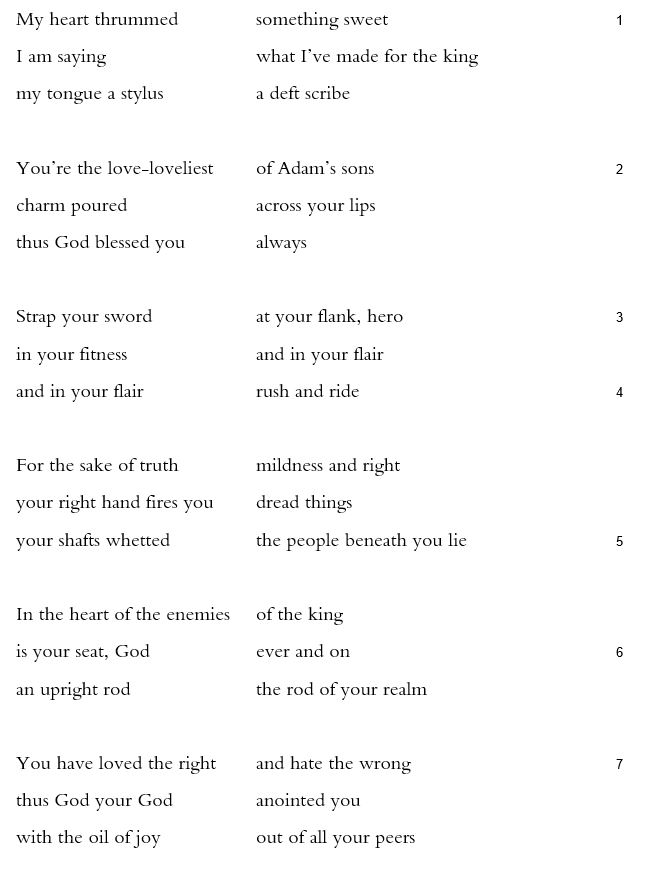
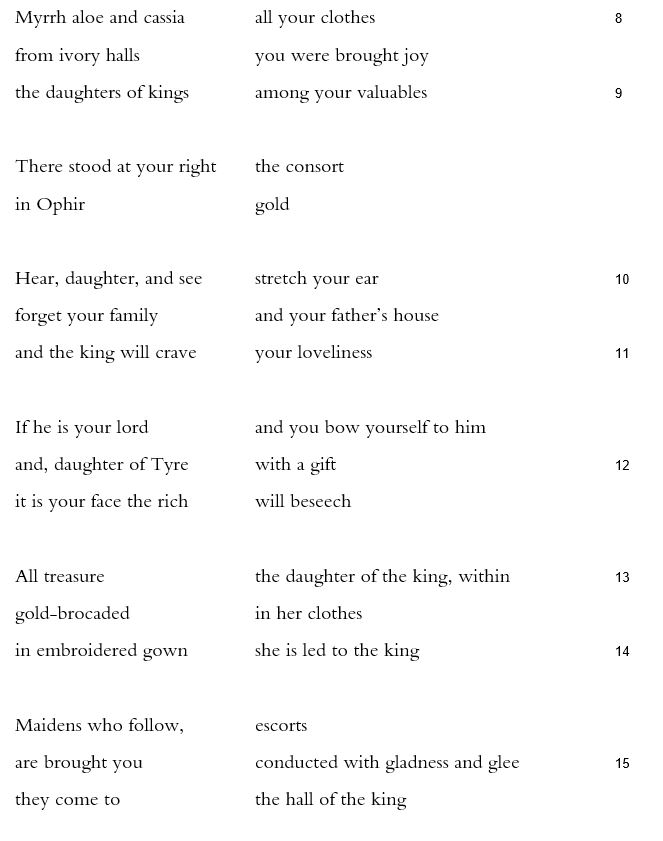
    What are we doing, reading Psalms? Taking part in a worship tradition? Or overhearing, out of historical curiosity or aesthetic purposelessness? What do we expect and what do we find? A text like Psalm 45 confronts us the way the Song of Songs confronts us, at the limits of purposiveness and the purposeless. If we expect the Bible to be “religious” or “spiritual” or theologically relevant, then our encounter with a sensuous song that celebrates the marriage of an ancient king forces a choice. Either we adapt our categories and how we apply them— the Bible, the religious, liturgy, theology— or we cram a poem like this into those categories, forcing it to be what we expect it to be. Is a psalm like this in the Psalter because it is messianic or allegorical, code and metaphor for the love between God and Israel his bride, or wildly anachronistic code for Christ and a Christian Church several hundred years from being born? Or is the psalm included in the Psalter because of its disinterested beauty, a powerful song too potent not to have been anthologized?

    Obviously “we” is a problematic word.

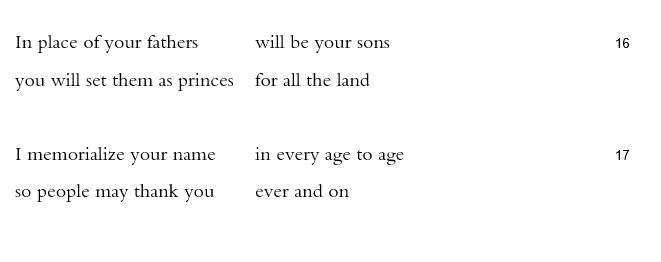
    The first-person speaker who grandly introduces this song by pronouncing his prowess—“my tongue a stylus | a deft scribe” (1)—announces his purpose in the final verse: “I memorialize your name | in every age to age / so people may thank you | ever and on” (17). But memorialize whom? God? Surely not the king. And memorialize how? How is a psalm that maybe addresses God in the second person only once—at the start of verse 6, and even then only maybe—a memorial to help people thank God? The three verses that do explicitly mention God suggest distinct purposes. Verse 2, which celebrates the king and his beautiful lips, concludes that “thus God blessed you | always.” Verses 5 and 6, which break up the text confusingly, locate God’s seat “in the heart of the enemies of the king.” And verse 7 asserts that the king knows right from wrong, “thus God your God | anointed you.” Thus four theological explanations lie on the table: this psalm remembers God’s name, or it celebrates God for having authored the king’s physical beauty, or for having provided the king with political and military might, or for having chosen a moral king. 

    And maybe all of those explanations make sense. 

    Still, the psalm is built in uneven halves, six tercets plus a couplet addressing the king (2-9), four tercets addressing his bride, the daughter of Tyre (10-15), plus a final couplet to the king (16). The king’s verses stress his political and procreative power by emphasizing phallic signifiers of that power: his sword (3), his right hand (4) his arrows (5), his scepter (6). (The mention of a “stylus” in verse 1 led to my use of masculine pronouns for the psalmist, but who knows.) The princess’s verses stress subservience to her potent husband (12), but also her beauty (11, 12), her riches (12-13), and her new preeminence over “maidens who follow, | escorts” (14). If the point of the king’s verses is to show his divine favor, nevertheless those verses culminate with things, lovely smelling things, property, and more property: “the daughters of kings | among your valuables” (8-9). Chief among these valuables is the queen in her Arabian gold. The point of the princess’s verses—she seems likely to be this queen consort—is that for the low, low price of her “family | and [her] father’s house” (11) plus a dowry or tribute (12), she can have all this and more, from her “treasure…within,” which works equally well as a heart of gold or as a euphemism, to the favor-currying of the affluent (12).

    Ultimately what the king gets is offspring, and a kind of continuous life: “In place of your fathers | will be your sons” (16). Maybe this is a psalm of peace, then, a royal vision of an endless reign. In that case, it really is the king who is memorialized, rather than God precisely, the king being thanked “ever and on” at the end of the psalm. The psalm we have doesn’t name any particular king, so the word “name” opens possibilities. Maybe something has been lost, or God is meant though last mentioned half a song ago, or else “name” stands for fame and wealth, and power most of all.

    Share:

    • Share on X (Opens in new window) X
    • Share on Facebook (Opens in new window) Facebook
    Like Loading…

    About Me

    My name is Mark Minster. I’m an English and Comparative Literature professor with a background in ministry and in poetry. I teach courses on writing, reading, religion, and nature.

    Recent Posts

    • Psalm 150
    • Psalm 149
    • Psalm 148
    • Psalm 147
    • Psalm 146

    Newsletter

  • April 23rd, 2023

    Psalm 44

    (director: of the Qorachites, instructive)

    * * *

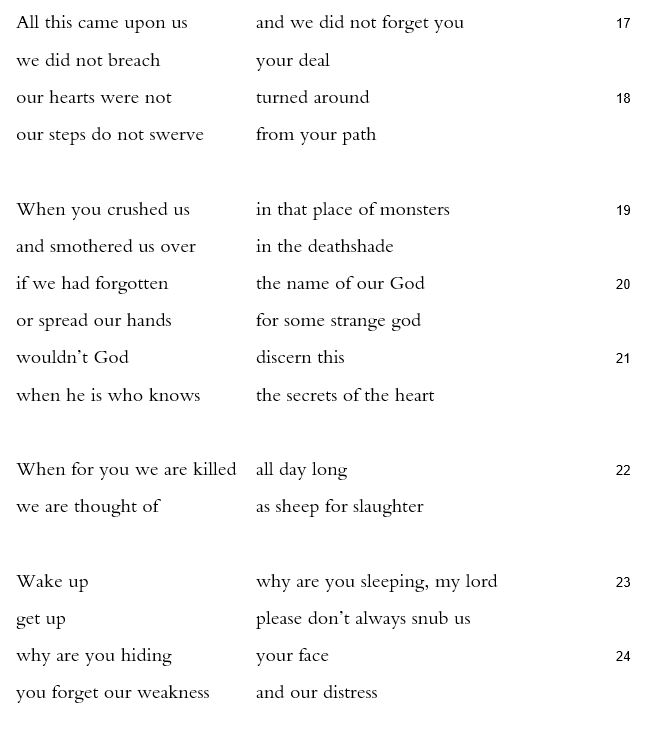
    By contrast with the preceding double psalm, which mentions God’s name 27 times, Psalm 44, which is longer, names Elohim only 5 times. The effect is to highlight God’s absence. In Psalm 42, it was the speaker’s enemies who asked, “where is your God?” (42:3, 10). Here, the speaker wonders much the same thing: “why are you sleeping, my lord” (23), “why are you hiding | your face” (24).

    That hiddenness of God, Deus absconditus, absence, is a key theme for both of these psalms. But what Psalm 42/43 does with space, yearning for Jerusalem from afar, Psalm 44 does with time, yearning for a lost age. The speaker of the earlier psalm(s) cannot get home. What faces this speaker of this psalm is a belated era, signaled by the repeated phrase “all day long” (44:8, 15, 22) and its variants at the start of the song: “in their days | in days gone by” (44:1).

    That brief refrain “all day long” reveals the psalm’s three-part shape, which mirrors the shape of the previous psalm. Here, the psalm moves from the collective memory of God’s past rescue and the logical expectation that that rescue should continue (1-8) to the brutal actuality of having been sold off to enemies (9-16) and the complaint that all of Jacob are innocent (17-26). Psalm 44 has generally been classed as a collective lament by genre critics, and indeed first-person plural “we” predicates are frequent, showing up in 1, 5, 8, 17, 20, 22. (Verses 18 and 25 each add a pair of third-person plural metonyms for “we”: “our hearts… our steps…” and “our throats… our bellies.”) Note, however, that the middle of the psalm’s three movements, verses 9-16, has none of these “we” predicates. There, the collective community shows up only as a grammatical object. Ten times as an object, in fact: twice each in verses 9 through 11, three times in 13, once in 14. In verse 12, that -einu suffix (“us”) is replaced by a third-person suffix, for the noun “your people,” which skews the psychic distance between God and God’s people slightly. “Your people” pans the camera a few degrees from “we,” a few degrees towards “you.”

    Though the bulk of the poem is collective, each of its sections nears its end by shifting focus grammatically, zooming in. The psalm’s first section includes just a glimpse of an individual speaker: “it’s not my bow | I rely on / my sword | doesn’t rescue me” (6). The second section does the same: “All day long | my disgrace before me / the shame on my face | hid me” (15). These verses in the singular are spotlights. They personalize the community, with both hope for some present-era rescue and crushing disappointment. The rhetorical strategy of twice turning from the crowd to the individual creates an expectation for attentive readers and reciters. We anticipate that the third section of the psalm will end by shifting focus in much the same way. And indeed there is a shift, but not to the first-person. Instead, the psalm culminates with its only imperative verbs: “Wake up… get up” in verse 23, and “get… and buy us back” (26).

    And of course it does. A shift to the first-person in a section of the psalm that insists on innocence would have undermined the whole thing. Rescue is not a function of an individual, according to this psalm. This point cannot made loudly enough or often enough, especially for those who would replace “rescue” with “salvation.” Rescue does not mean punishment for the bad. It does not mean victory or ransom or healing for the morally right. Rescue is the work God has done in the past, according to the speakers’—and speaker’s—parents. It is a function of caring, which the psalm says God has forgotten and needs to remember. Imperative reminders are its last resort.

    Share:

    • Share on X (Opens in new window) X
    • Share on Facebook (Opens in new window) Facebook
    Like Loading…

    About Me

    My name is Mark Minster. I’m an English and Comparative Literature professor with a background in ministry and in poetry. I teach courses on writing, reading, religion, and nature.

    Recent Posts

    • Psalm 150
    • Psalm 149
    • Psalm 148
    • Psalm 147
    • Psalm 146

    Newsletter

  • April 22nd, 2023

    Psalms 42/43

    (director: instructive, of the Qorachites)

    * * *

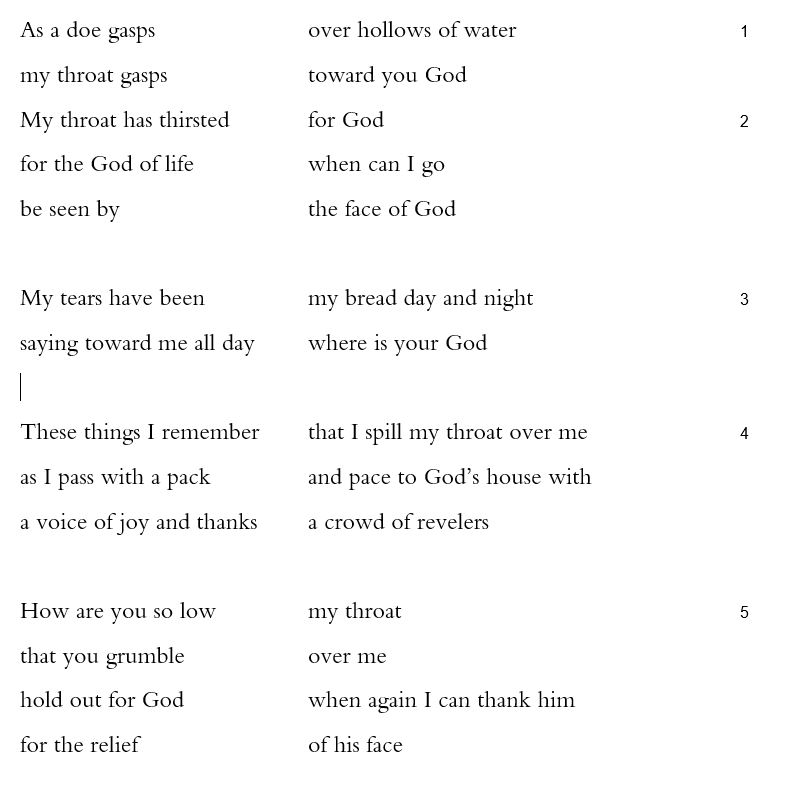
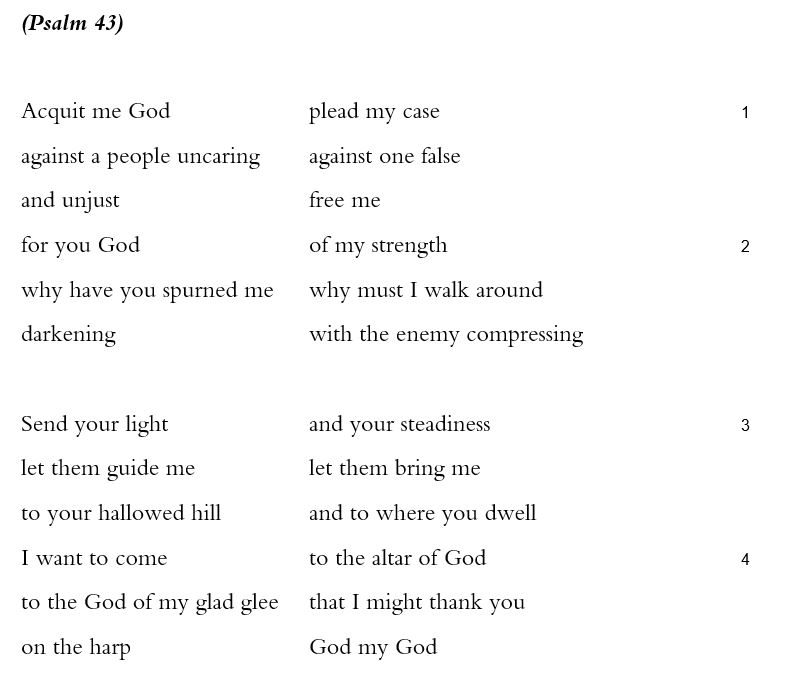
    The red deer that begins this double psalm, and with it the second collection of the book of Psalms (Pss 42-72), draws our attention first. Yet every other word in the first verse matters more. The rare verb ta`arog, to cry or pant for, conveys bodily longing. It appears twice here, marking what’s shared by the deer’s throat and the speaker’s nefesh, that resonant word for neck or throat that gets at the life of a creature. The ‘afiqei-mayim, usually translated as “brooks” or “streams of water,” describes the geological feature of a ravine, a streambed that seasonally goes dry or flashfloods in torrents. These properties are paired with God, ‘Elohim, about whom the verse makes us wonder: is this the God of floods or the God of drought? Our answer changes how we read the whole verse, indeed the whole psalm, especially the gasping of the deer and the throat. Do they gasp dying of thirst, or gasp slaking it?

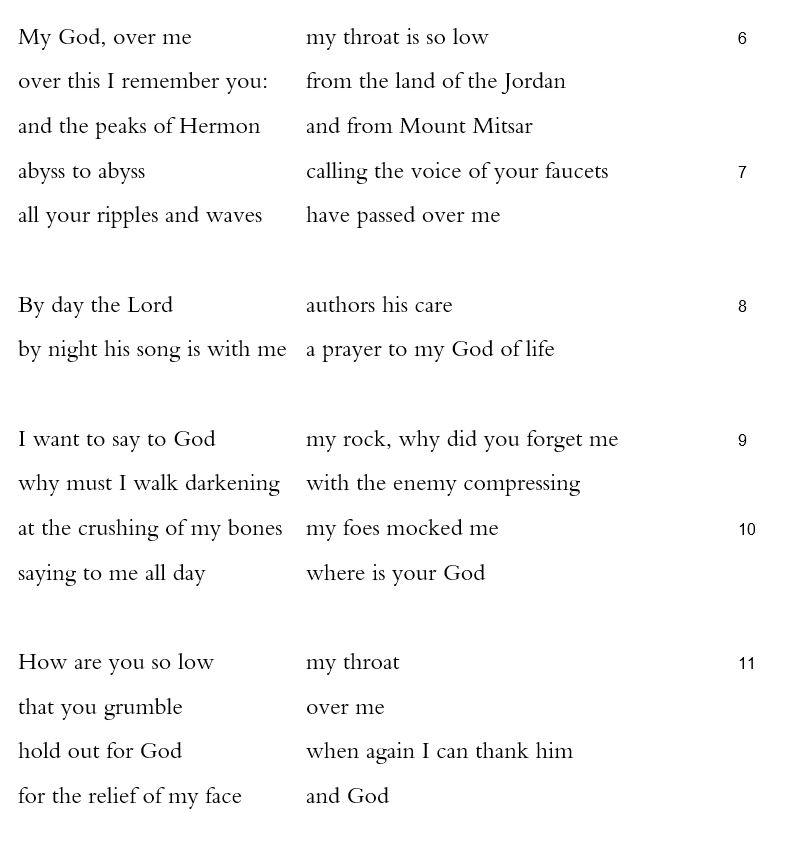
    Already in this first verse, something crucial happens even in the prepositions. The deer gasps “over” or “upon” the ravines or “hollows,” whereas the speaker’s throats gasps “toward” or “at” God. The prepositions sound similar: `al means “over”; ’el means “to.” The word ’el also means God (see 42:2, 8, le’el-chay, God of life; 42:9, le’el-sal`i). The Hebrew word for deer—the noun is masculine but the verb is feminine— is the similar sounding ’eyyal. Thus the verse pairs `al and ‘el, setting in motion a motif that runs throughout the double psalm’s three main stanzas (42:1-4, 42: 6-10, 43:1-4) and three main refrains (42:5, 42:11, 43:5). The psalm’s direction is ’el-’Elohim, toward God. But the speaker is elsewhere. The speaker’s throat is poured out “over me” and is low “over me”; it grumbles “over me”(`alay, 42:4, 5, 6, 11). Others say to the speaker (to me, ’elay), ’ayyeh ’eloheykha “where is your God?” (42:3, 10). The deeps call “to” (’el) the deeps, even as the waves have gone “over me” (`alay, 42:7). This verbal play shows up later, too, even in the words “these,” ’ellah, in 42:4, and “over this,” `al-ken, in 42:6.

    In the first two verses of Psalm 43, ‘el is part of the name of God, `Elohim. It returns four times in 43:3-4, where it points with stepwise closeness to God’s presence in Jerusalem: “to your hallowed hill | and to where you dwell… to the altar of God | to the God of my glad glee.” All told, the name of God appears 27 times in this double psalm, 7 of those in Psalm 43. That’s a resonant start for the so-called Elohist Psalter, this second collection of the book of Psalms. The step-by-step closeness works in reverse through the whole song, which imagines a return to Jerusalem from exile, contrasting the procession of worshippers (42:4) with their “darkening” walks among oppressors (42:9, 43:2). Deftly, the double psalm manages to be both towards and away from at the same time, anticipating the light without denying the dark.

    Share:

    • Share on X (Opens in new window) X
    • Share on Facebook (Opens in new window) Facebook
    Like Loading…

    About Me

    My name is Mark Minster. I’m an English and Comparative Literature professor with a background in ministry and in poetry. I teach courses on writing, reading, religion, and nature.

    Recent Posts

    • Psalm 150
    • Psalm 149
    • Psalm 148
    • Psalm 147
    • Psalm 146

    Newsletter

←Previous Page
1 … 25 26 27 28 29 … 37
Next Page→

Blog at WordPress.com.


Loading Comments...
 

    • Subscribe Subscribed
      • The Book of Psalms
      • Already have a WordPress.com account? Log in now.
      • The Book of Psalms
      • Subscribe Subscribed
      • Sign up
      • Log in
      • Report this content
      • View site in Reader
      • Manage subscriptions
      • Collapse this bar
    %d