• Page list
    • Posts
    • The Book of Psalms

The Book of Psalms

  • April 17th, 2023

    Psalm 37

    (of David)

    * * *

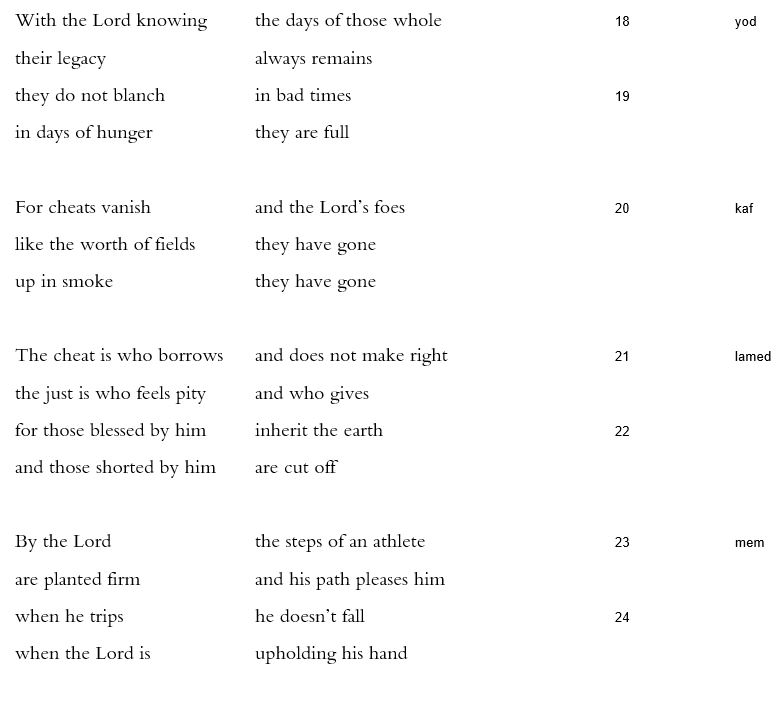
    With Psalm 119, this may be the book of Psalms’ most accomplished acrostic. Its basic unit is the quatrain, offset by a few tercets (dalet in 7, kaf in 20, and qof in 34), and a few longer stanzas that seem to have been expanded (nun in 25-26, samech especially in 27-29, and tav in 39-40). Across this structure, the psalm builds a multi-pronged argument against stewing over injustice. Some of its lines of reasoning are more persuasive than others, but the most developed lines emphasize an inheritance that belongs not necessarily in the future, but is already in process.

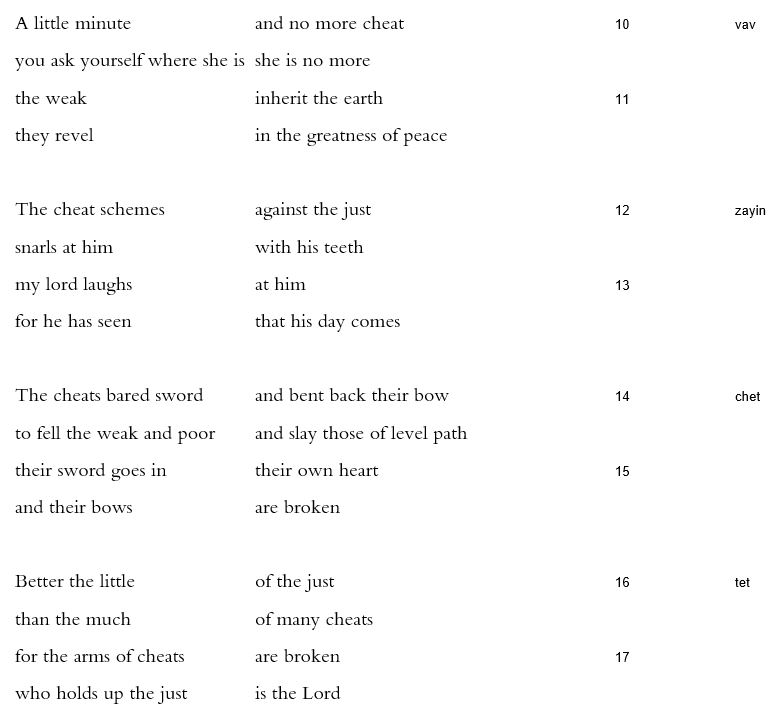
    Verses 1, 7, 8 urge calm and quietism in the face of those who harm others and those who succeed. “Relax the ire | loose the rage / don’t burn yourself” (8) could be a therapist’s advice, valuable in any age of bad news. The reflexive stem of a verb for burning supports the case that the danger of outrage is what it does to the outraged. Depending on the speaker, depending on the reader, this advice also sounds just like gaslighting. One thinks of the phrase “the politics of envy,” which defends the status quo by patronizing the abused: “don’t burn yourself | over one who succeeds” (7). Similarly reflexive is the hoist-on-their-own-petard suggestion in the chet and tet verses, 14-17, that the resha`im, the villains, only injure themselves. Don’t worry about injustice, the psalm argues, for the sword and bow of the bad harm the bad themselves, and even “the arms of cheats | are broken” (17).

    More pervasive in Psalm 37 is the repeated claim that crooks don’t last because they are cut off. “Fast as grass | they are mowed down” (2). “A little minute | and no more cheat… she is no more” (10). Their impermanence is shown in both the perfect and imperfect tenses: “his day comes” and they have gone / up in smoke | they have gone” (13, 20). “Abusers | are cut off” (9). It’s double-edged, this word “cut off,” as the same verb used to mark a covenant, the cutting of a covenant. They’re the same metaphors used for an inheritance or a deal in English: the one bequeathing can cut you in, or cut you out, cutting you off. The word shows up repeatedly, in verses 9, 22, 28, 34, 38, with “cheats” and “the offspring of cheats” and “those shorted by him” [i.e., the Lord].

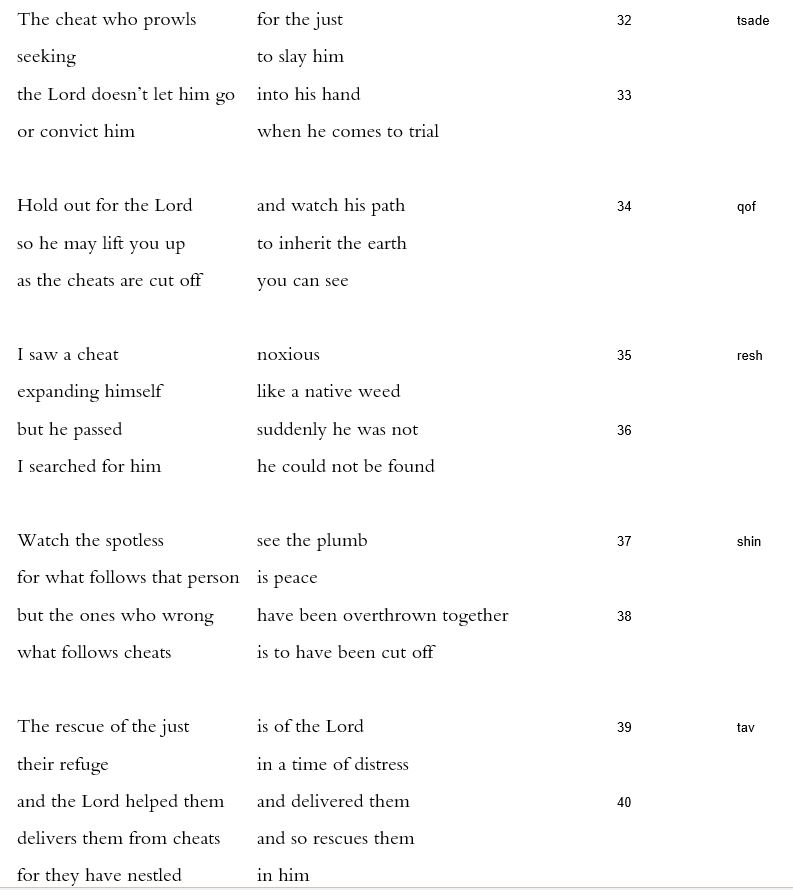
    What about the just, and the poor, the weak, the abused? The speaker tells them, not terribly convincingly, “I was a child | and I have grown old / and I have never seen | the just being let go” (25). “Watch the spotless | see the plumb / for what follows that person | is peace” (37). This vision is clouded at best. It calls to mind God’s chiding of Job’s so-called friends: “My rage has flared at you… for you have not spoken of me what is true” (Job 42:7). More persuasive anecdotal evidence comes in Psalm 37:35-36: “I saw a cheat | noxious / expanding himself | like a native weed.” This, by contrast, all of us have seen.

    Most pervasive is the psalm’s claim, the promise, that the just “inherit the earth” (9, 11, 22, 29, 34). What this means, alas, is not exactly clear. It is associated with “reveling” in the Lord (4, 11), with a vision of things going well, the Lord “upholding his hand” (24), so that “her steps do not slip” (31). It’s associated with claims about the Lord, the Lord’s guidance, protection, rescue, and courtroom justice (mishpat accompanies tsedeqah in verses 6, 28-29, 30, and 32-33).

    What’s most interesting about the inheritance of earth as presented in Psalm 37 is when it happens. So frequently, these promises are translated by the future tense—they just will inherit the earth. But the imperfect construction in Hebrew also covers the present tense, and several moments in the psalm imply that true justice, the justice that inverts the world’s many visible, upsetting injustices, is perfective as well, already accomplished, even if the waiting for the Lord continues (7, 10). The disappearance of cheats, for instance, is both seen as if prophetically— “he has seen | that his day comes” (13)— and pronounced as a fait accompli— “they have gone” (20).

    Towards the end of the psalm, the blurring of past, present, and future becomes even more fascinating. The bad person whom the speaker has seen expanding himself, is described in verse 36 as evanescent: “but he passed | suddenly he was not / I searched for him | he could not be found.” Both “he passed” and “I searched for him” are in the vav-consecutive verb form, which takes the imperfect form and can be rendered by both present and future as well as by the historical present, as completed action. Similarly, the psalm’s final verse repeats “deliver” both with and without the vav-consecutive, mapping out a past and present and a future.

    If the just and the weak inherit the earth now, already, our expectations shift. This is not the kind of credulous, pipe-dream hope for the future that encourages only inaction and wish-fulfillment, pie-in-the-sky. For all of its Horatian quietism— see especially verse 7— the psalm emphasizes the earth as much as it does justice. And action in the present tense is encouraged–action in the earth. “Lean on the Lord | do good / dwell in the earth | and graze on faithfulness,” verse 3 preaches, as if we ourselves have already inherited. “Swerve from bad | do good / and dwell always” (27).   

    Share:

    • Share on X (Opens in new window) X
    • Share on Facebook (Opens in new window) Facebook
    Like Loading…

    About Me

    My name is Mark Minster. I’m an English and Comparative Literature professor with a background in ministry and in poetry. I teach courses on writing, reading, religion, and nature.

    Recent Posts

    • Psalm 150
    • Psalm 149
    • Psalm 148
    • Psalm 147
    • Psalm 146

    Newsletter

  • April 16th, 2023

    Psalm 36

    (director: of the servant of the Lord, of David)

    * * *

    From its first line, Psalm 36 surprises. It starts with the hallmark of the prophetic oracle, the word ne’um, which is usually followed in the Bible by the divine name— “the word of the Lord”; “thus says the Lord”—and only rarely, by another human (Balaam in Numbers, David in 2 Samuel). Only here does the word personify a concept, pesh’a, revolt, transgression. Rebellion’s oracle is delivered to another abstraction: the criminal who lives in the speaker’s heart. The gesture is strikingly self-conscious for biblical art, as befits such an inward-looking series of verses. It’s Wrong who diagnoses the crook in the heart, the criminal whose eyes are not at all concerned about the Lord. We go down and in. Inside this cheat who lives in the heart are eyes that do not see but are “smoothed over, ”a second personification nested within the first. These are Russian dolls of self-deception and, as we learn in 2b, layers of self-loathing: “finding guilt | hating it.” Verse 3 moves swiftly out to the consequences: “The words of his mouth | harm and fraud / he is done being smart |doing good.”

    From this inside-inside-out setup, the psalm turns to the much more common vertical axis: lying on a bed followed by standing on a road (4), care and faithfulness and justice to the skies and clouds and mountains, high and higher (5), “verdicts | the mighty deep” (6). Badness might be deep within the heart, a guilt, a hatred of guilt, a covering over of guilt or of the hatred of guilt, but four of the Lord’s key traits are mapped onto the planet’s heights and depths.

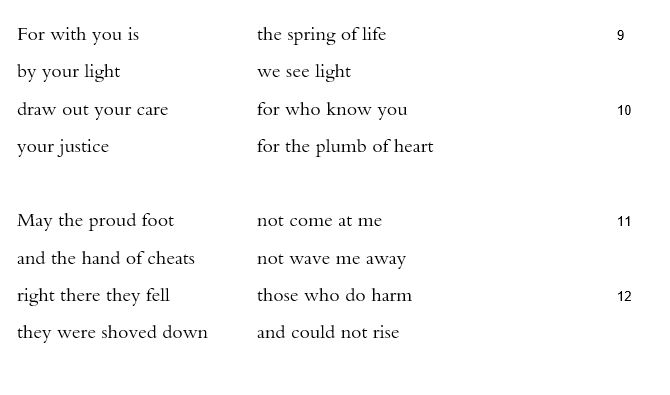
    Shrewdly, the psalm turns from inwardness and upwardness to immersion, the nestling in wings (7), this suffusion with rich oil and “the stream of your charms” (8). The liquid is participatory: “you give them to drink / For with you is | the spring of life” (9); “draw out your care” (10). So is the psalm’s most immersive, participatory line, which returns to the eyes from verses 1 and 2: “by your light | we see light” (9).

    The final stanza’s turn is a return. It retrieves both the inward and the vertical. “Those who do harm” recalls “harm” from verse 3 as well as, from verse 4, the one who “plots harm | from his bed” and “stands himself | on a road not good” (4). This one who plots harm, in context, was “the cheat in the heart” of verse 1, as verse 11 reminds, “the hand of cheats | not wave me away” (11). Here by the end of the poem, marked by a locative “there,” all of those who do harm have fallen— downward— “they were shoved down | and could not rise” (12). To the modern ear, the thought of something dangerous inside being “shoved down” sounds like a recipe for disaster. Freud spoke on dreams, of the mind’s art of disguise and disguising disguise. But in the outside world, the cheats standing by the road are dropped and the Lord’s care remains drawn out and soaked through.

    Share:

    • Share on X (Opens in new window) X
    • Share on Facebook (Opens in new window) Facebook
    Like Loading…

    About Me

    My name is Mark Minster. I’m an English and Comparative Literature professor with a background in ministry and in poetry. I teach courses on writing, reading, religion, and nature.

    Recent Posts

    • Psalm 150
    • Psalm 149
    • Psalm 148
    • Psalm 147
    • Psalm 146

    Newsletter

  • April 15th, 2023

    Psalm 35

    (of David)

    * * *

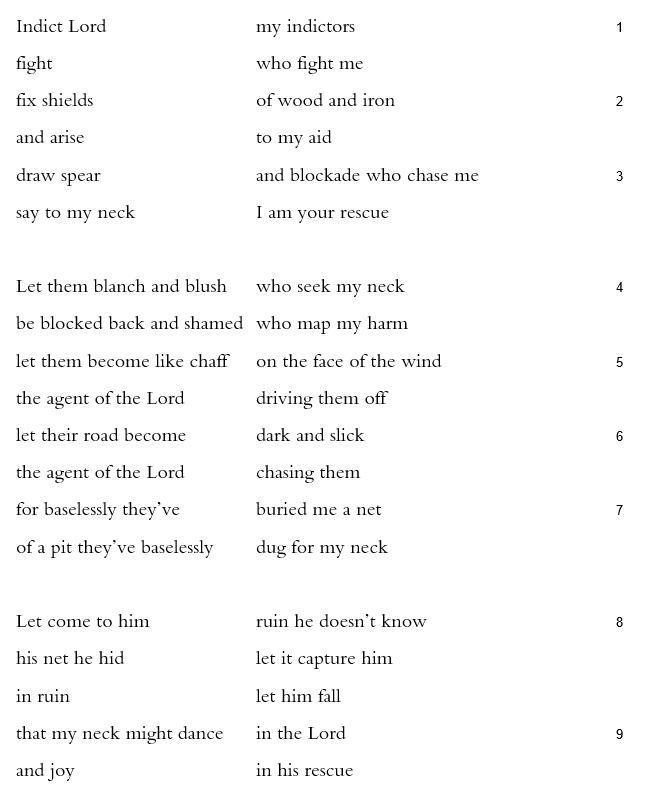
    In this psalm, everything depends on who speaks. If, as it seems from several verses, it’s one who’s been falsely accused, then Psalm 35 depicts desperate indignation and the desire for justice. “There arise | vicious witnesses,” the speaker says in verse 11. This reading fits the actions and speech of verses 19-21. The “lying foes / who baselessly hate me | they wink an eye” (19). Against the one being framed, these fraudsters have claimed falsely—complete with villainous exclamations— that “our own eyes | have seen” (21). Opposed to these winking and lying eyes are the eyes of the Lord, who sees rightly: “My lord | how much do you see” (17) becomes “You have seen Lord | don’t be silent” (22).

    Other verses, however, suggest that the enemies aren’t exactly deceivers. Instead, they’re bullies who seek more literally the speaker’s neck. Is this a metaphor or a thing that happened: “baselessly they’ve | buried me a net / of a pit | they’ve baselessly | dug for my neck” (7)? What about this: “as I stumbled they joyed… attackers I did not know | they tore and did not stop” (15)? Is the perjury literal, merely figured as a scene of violent pursuit? Or are the attacks literal, the courtroom figurative? Verses 13-16 describe a personal experience of communal betrayal. “But I when they were sick | my clothes were sack,” the speaker narrates (13). “I wandered | like a mourner for a mother” (14). “But as I stumbled they joyed | and the gathered gathered against me” (15). What, exactly, happened to this speaker?

    It matters who speaks. It matters because the line between vindication and vindictiveness can be fine. “Indict” and “fight” may not rhyme in Hebrew, but they are doubled and paired in the first verse. The legal system is evoked alongside the weapons of war, a nervous association. If it is read in the voice of someone bullied or abused, someone betrayed, a representative of “the weak and the poor” who seeks rescue “from who plunders them” (10), the psalm is powerfully transformative. Read, however, in the voice of an abuser, a liar, a slumlord, oil baron, or opiate magnate, some representative of those who present themselves as put upon, as victims of witch hunts, the psalm’s transformative power slips away. Because we cannot know what really happened, the speaker’s passion our only evidence, the psalm maximizes emotional availability at the expense of its resistance to being co-opted.

    In the context of group recitation, therefore, Psalm 35 becomes something else. Maybe most psalms do. Without clear knowledge of the speaker’s situation, anyone can take on the role of the beleaguered. Can a majority sing this psalm, or a nation or state?

    In fact, they have. The most notable example of this reading comes from Jacob Duché, Anglican priest and—until he wasn’t—American patriot. In September 1774, at the opening of the First Continental Congress, Reverend Duché read the collect of the day, Psalm 35, which John Adams described as a particularly moving experience. How could those political leaders not have identified, individually and collectively, with the desire for vindication against attackers and false witnesses? It might be hard to pin down the psalmist’s own experience—if “experience” is even singular—but the feeling of driving off enemies ran deep. Shields and spear were perfectly real. Three years later, Duché, having been jailed by the British, sent a letter to George Washington urging an end to the war, an act that led to his having to flee from America as a traitor. By the 1780s, Duché was writing to Washington again, asking for vindication against Congress, crying out for justice, feeling himself betrayed.

    Share:

    • Share on X (Opens in new window) X
    • Share on Facebook (Opens in new window) Facebook
    Like Loading…

    About Me

    My name is Mark Minster. I’m an English and Comparative Literature professor with a background in ministry and in poetry. I teach courses on writing, reading, religion, and nature.

    Recent Posts

    • Psalm 150
    • Psalm 149
    • Psalm 148
    • Psalm 147
    • Psalm 146

    Newsletter

  • April 14th, 2023

    Psalm 34

    (of David, at his scrambling of sense before Abimelech, so that he exiled him and he went)

    * * *

    The superscription of Psalm 34 is particularly sharp. In 1 Samuel 21, David’s north-northwest madness in the court of Philistine King Achish (whose title may have been Abimelech, “my father is king”) allows him to escape unscathed. Narratively, David’s deception of Achish foreshadows his later acts of double agency in 1 Samuel 27, when he pretends to fight for the Philistines while gathering power in Judah. At the same time, David’s duplicity becomes a defining character trait. His feigning shapes how we read his every future move, from the killing of Saul to the killing of Uriah to the killing of Joab. Before we read a line of Psalm 34, we wonder if the king knows a hawk from a handsaw. The “scrambling of sense” in the superscription also reads like an apology in advance for a psalm whose turns are sometimes baffling. Or it reads like a taunt: though this be madness, is there yet method in it?

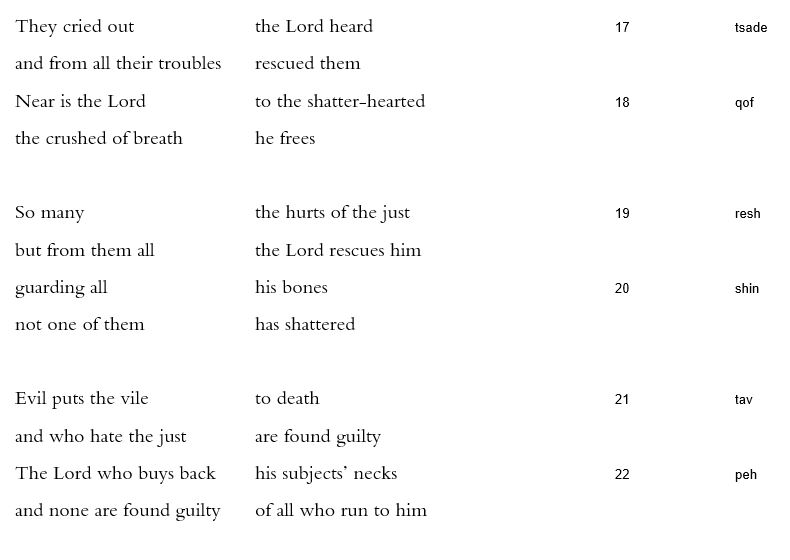
    There is clearly method. An acrostic psalm of 22 verses, Psalm 34 lacks only a vav for the complete aleph-bet, and all the lines are of normal length. The second half of the poem is as unified as an acrostic can be. Verses 11-14 work as a unit of instruction, with imperatives in 11, 13, and 14: “Come, children… hear me… keep your tongue | from the bad… seek peace | and chase it.” Though the next two verses shift to third-person narration, they pair well with the tongue and the lips. “The eyes of the Lord | are on the just / his ears | on their cry for help / the face of the Lord | at those doing bad” (15-16a). The “they” who “cried out” in verse 17 leaps from “those doing bad” to “the just,” given that “the Lord heard… and rescued them.” But our confusion is momentary, even rewarded by the next verse which gives detail about “the just”: “Near is the Lord | to the shatter-hearted / the crushed of breath” (18). The last four verses of the psalm, including the out-of-place peh verse 22, continue the theme of the Lord’s protection of the just (19, 21).

    It’s the first half of the psalm that seems, if not madness, at least a disguise. Wisdom hides in thanks, or vice versa. The poem starts in the first person, with enthusiastic praise: “Let me kneel to the Lord | all the time / endless | his praise in my mouth” (1). Verse 5 gives pause. “They have looked at him | and gleamed / but their faces do not blush.” Who have looked? At whom? The “poor,” last mentioned in verse 2? Surely not the “terrors,” the most recent plural noun. Why do their faces not blush? Is this a way of saying that the humble have been taken care of? Verse 6 starts with “this poor one.” Is this a singularization of the ones who looked at him and gleamed? Does “this poor one” equal the I of the first four verses, the first-person masquerading as third-person? Would the missing vav verse between 5 and 6 have clarified things?

    What about the messenger in verse 7, “who encamps all around / the ones who revere him”? When this messenger bears away the reverent ones, is this how the Lord rescued “this poor one”? And how do we get from there to the sense of taste in verse 8: “Sense and see | how good the Lord”? Or from this first half of verse 8 to the second half: “all set, the hero | who flees to him”?

    There is a logic here, it’s true, in the broadest sense: the Lord has taken care of “this poor one,” who may be both the first-person speaker of the first four verses, and one of “those who revere him” and “the hero | who flees to him.” Our confusions may be on the surface. Words that repeat multiple times such as “all” (8 times)” and “revere” (4) begin to pull the whole experience together.

    Perhaps what makes it seem most unified are some of its lightest touches. The word ta`am appears in the superscription as the “sense” that David has disguised, then returns in verse 8 as the sense in “Sense and see.” The word in verse 2 translated as “goes crazy,” tithallel, comes from a reflexive intensive stem for the verb that means praise, which shows up in the noun form in verse 1: “his praise,” tehillatov. Reflexively, it means something like praising oneself or boasting. In another reflexive intensive stem, different in the vowels but not in consonants, the verb means to be out of control or insane. One place it appears is, not coincidentally, 1 Samuel 21:14, to describe David’s feigned madness. The doubleness of praise and madness is followed by the doubled response of the poor (the weak, the humble) who hear (yishma’u) and are glad (yismachu).

    Share:

    • Share on X (Opens in new window) X
    • Share on Facebook (Opens in new window) Facebook
    Like Loading…

    About Me

    My name is Mark Minster. I’m an English and Comparative Literature professor with a background in ministry and in poetry. I teach courses on writing, reading, religion, and nature.

    Recent Posts

    • Psalm 150
    • Psalm 149
    • Psalm 148
    • Psalm 147
    • Psalm 146

    Newsletter

←Previous Page
1 … 27 28 29 30 31 … 37
Next Page→

Blog at WordPress.com.


Loading Comments...
 

    • Subscribe Subscribed
      • The Book of Psalms
      • Already have a WordPress.com account? Log in now.
      • The Book of Psalms
      • Subscribe Subscribed
      • Sign up
      • Log in
      • Report this content
      • View site in Reader
      • Manage subscriptions
      • Collapse this bar
    %d