• Page list
    • Posts
    • The Book of Psalms

The Book of Psalms

  • April 13th, 2023

    Psalm 33

    * * *

    So much of the Bible—of every scripture, indeed of all art—is revisionary. Texts make sense of other texts, making meaning by difference. This psalm begins as praise but it becomes something else, “a new song” (3).

    The first stanza conveys typical images of a laudatory psalm: “thank the Lord | with the lyre / with the ten-string | strum to him” (2). Melody and volume are encouraged twice. “A hymn is lovely” and “play nimbly” suggest craft, while “Shout” and “loud noise” imply gusto (1, 3). But the crucial terms are “a new song” and those who are singing and shouting and playing: the just (tsaddiqim), and the plumb or level or upright (yesharim) (1). These last two terms, frequently paired, convey alignment on two different axes. “Justice” is the horizontal fairness of the balance scales, while “uprightness” is the moral upstanding of the vertically plumb. The terms return in verses 4 and 5, interlaced with two other frequently paired terms, which are mappable on the same axes: the vertical emunah (4) and the arguably horizontal, arguably vertical chesed (5), the first based on firmly planted pillars, the second on a relationship of care.

    It’s that care that this new song privileges. The morally upright are on the level because the word and work of the Lord are rooted sure and true. But the stanza emphasizes “the care of the Lord,” which fills the whole earth (5). Not just the stanza, either. The whole psalm culminates with chesed: “Let your care Lord | be upon us / just as we have held out | for you” (22). The very eye of the Lord is not only on “those who revere on him,” but on those “who hold out | for his care” (18).

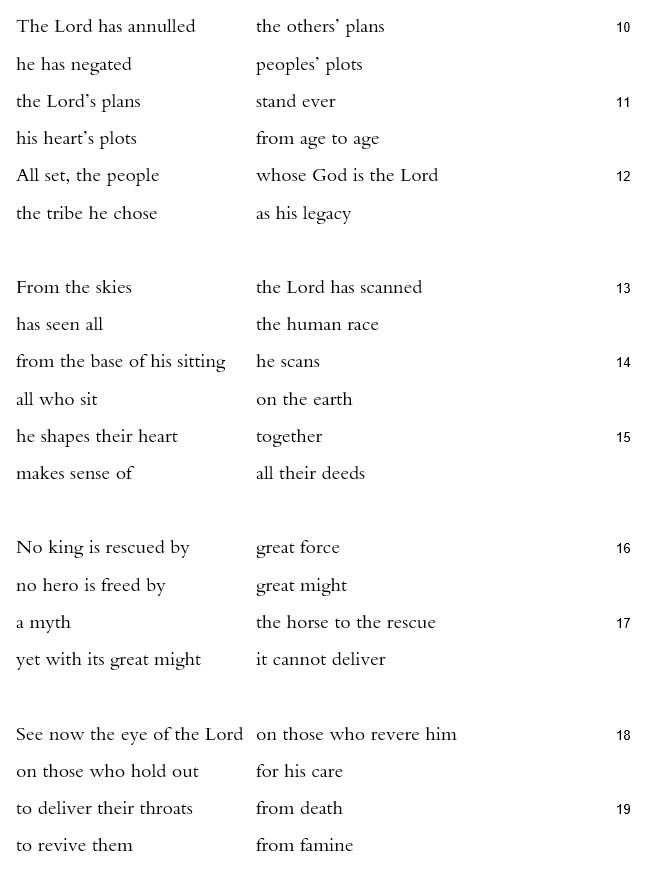
    What makes the song new is clear from its allusions to Psalm 1 and to Psalm 18. Like the first psalm, Psalm 33 describes who is “all set” based on where they sit and where they stand. Instead of the singular, “All set, she who” of Psalm 1, we have the plural, “All set, the people | whose God is the Lord” (12). Yet instead of standing and sitting being associated with the troubled and the wrong, as they are there, here sitting and standing convey rootedness on both the horizontal and the vertical: “All the earth | reveres the Lord / they stand amazed by him | all who sit in the world” (8). And why? Because he spoke and commanded, and “so it stood” (9); the Lord’s plans “stand forever” (11). In case the two axes aren’t clear, note how the Lord sees “from the base of his sitting… all who sit | on the earth” (14). The verticality is insistent. The horizontal is subtle. Unlike the older songs, the moral lesson is not for the lone individual, but for “all”— all the earth, all who sit, “all | the human race.”

    To the same revisionary end, verse 13 calls to mind a different psalm, in which the Lord “from the skies | leaned down to see humans / to see if anyone’s smart… no one’s doing good” (14:2-3). Here, in Psalm 33, the Lord’s scanning leads to beautiful lines: “he shapes their heart | together/ makes sense of | all their deeds.” That’s not “no one doing good.”

    To Psalm 18, which pairs cosmic history with the bellicose sanctioning of the king, Psalm 33 has a separate, related reply. Complementing a series of allusions to God’s creation in verses 6-9, verses 16 and 17 present a king who is not clothed in might. The statement is profoundly anti-militaristic.

    No king is rescued by        great force               

    no hero is freed by             great might

    a myth                               the horse to the rescue                   

    yet with its great might    it cannot deliver

    Rescue is not smashing enemies’ teeth or making migrants cower at the borders. Psalm 33 supplants force with care.

    * 

    33:1 you just… the plumb  These two terms for the Lord’s devotees are explicitly paired. The verse moves from the immediacy of second-person plural address to a broader characterization in the third-person plural. But both moments emphasis the worshippers’ rectitude and propriety, drawing attention to their virtue.

    33:2 with the ten-string  Lit., “with a harp of ten”

    33:5 of the care of the Lord  This object phrase is emphasized because it precedes verb and subject (“the earth is full”). At the same time, the Lord’s care momentarily feels like an extension of the description of the Lord in the first half of the verse, “who loves the just | and the right.”  

    33:7 in the cellars  The fanciful expression captures the underground location of “the deeps” as well as the actions of amassing and storing for later.

    33:8-9 they stand amazed… all who sit… and so it stood  The verb yaguru is the word for sojourning, but also for fear and amazement (cf. Ps. 22:23, where, as here, it parallels yira’). Because sitting and standing both imply dwelling, there’s a curious texture to this stanza. It literally describes the erecting of order out of the chaos of verses 6 and 7. At the same time, it moves from verbs for settling migration to settlement to rooting.

    33:10 the others’ plans… peoples’ plots  These possessive constructions pair common synonyms for intentions (the nuclei of the genitive phrases) and common synonyms for other ethnic and cultural groups (the modifiers). While sometimes the Israelites are included among the goyim (usually rendered as “the nations”), more often the term refers to peoples other than the Israelites, hence “the others.”

    Share:

    • Share on X (Opens in new window) X
    • Share on Facebook (Opens in new window) Facebook
    Like Loading…

    About Me

    My name is Mark Minster. I’m an English and Comparative Literature professor with a background in ministry and in poetry. I teach courses on writing, reading, religion, and nature.

    Recent Posts

    • Psalm 150
    • Psalm 149
    • Psalm 148
    • Psalm 147
    • Psalm 146

    Newsletter

  • April 12th, 2023

    Psalm 32

    (of David, didactic)

    * * *

    This psalm is several fabrics held by delicate stitches. It is a careful chiasm, with hallmarks of wisdom literature as its A-A’ frame (1-2, 10-11), a fascinating B-B’ second frame that pairs suffering with the bridling of a horse or mule (3-4, 8-9), a C-C’ third paneling of prayers of confession and praise (5, 7), and a center, X, verse 6, that is as precise as it is profound.

    It makes sense to start in the center. The syntax is complicated enough that translations routinely misunderstand it:

                        Thus prays to you      each of the caring                          

                        in the moment          of finding for sure in a flood            

                        that mighty waters     will not touch him     (6).

    It’s that “moment | of finding,” literally “the time to find,” that confuses, leading the KJV and its descendants to some version of “a time when thou mayest be found.” That reading requires grammatical invention, adding a “thou” and inverting the infinitive from active to passive stem. More problematically, it also means giving God office hours: at what time may God not be found? Siesta? But the “finding” makes far more sense, literally, grammatically, and theologically, as adiscovery of the chasid, the devotee, the one caring and cared-for. The verse insists that some prayers are uttered when cataclysm threatens, others in perfect calm, and still others— these— are delivered in that instant when what has threatened recedes. It’s the exact moment of the Kantian sublime, a precipice moment, when imminent danger, just thwarted, reconstitutes the transcendental subject. But given that this is a moment of prayer, it is not Reason that reveals its constitutive powers, but divine care.

    But which “Thus prays to you” is this prayer? The prayer before verse 6’s moment of flood or the prayer after? Or even the prayer during? At the center of verse 5 is a confession: “I said let me admit | my crimes to the Lord.” The sense of verses 5 and 6, then, seems to be that the caring one admits wrong when disasters have just been averted (in an experience that calls to mind William James’s observation that the feeling of silence is the feeling of thunder just gone). Or, the caring one prays thus, in verse 7: “You my secret from stress | you keep me / with shouts of escape | you embrace me.” Having been saved from a deluge, the caring one offers not confession but gratitude and a marveling embrace. It’s even possible to read verse 6 as saying that, in the moment of finding oneself in a flood, each of the caring prays to the Lord thus: “that mighty waters | will not touch him.” The “thus” is thus potent. It reverberates with meaning.

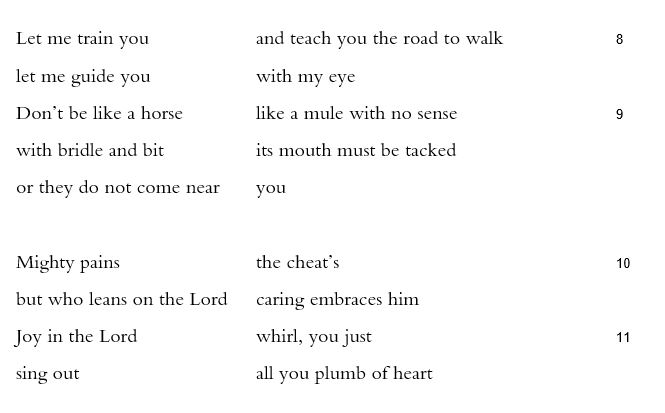
    The B-B’ frame, in verses 4-5 and 8-9, presents not prayer but quiet. The earlier verse pair describes the speaker’s suffering, dramatically and uniquely: “your hand weighed on me / my chest turned over | in the fevers of summer” (4). Through this pain, the speaker does not speak, but groans: “Oh I’ve kept quiet | my bones have worn out / with moaning | all day.” In the later verses, silence returns not as reluctance or inability to speak, but as a taming. The “I” of the first part of the psalm is now a “you,” addressed either by God or someone else: “let me guide you | with my eye” (8). This line is followed by an actual bridling. “Like a mule with no sense / with bridle and bit | its mouth must be tacked” (9).

    At the psalm’s two ends, its opening and closing, the three vocal prayers of the psalm’s middle, plus the two kinds of silence, are all held together between “breath” (2) and singing— “sing out | you plumb of heart” (11). That chiasm works not just formally, from outside to inside, further inside to center, but narratively from start to end. We move from breath to quiet groans to, finally, confession, a movement followed in the second half of the psalm by praise, “shouts of escape,” a disciplined mouth, and a culmination in song.

    Along the way, repetitions and symmetries stitch the piece together. The language of verses 1 and 2 is picked up by verse 5: “fault” and “suppress.” The hand that “weighed on me” (4) becomes the “eye” that guides (8). The nearing of the waters in verse 6 becomes the nearing of the bridled horse in verse 9. And in verse 10, caring returns from verse 6, together with the particular stem of the verb for “surrounding,” also used in verse 7. Each time it means “embrace.”   

    *

    32:1 didactic  It’s not clear what makes one psalm more instructive than another, but the root of the word maskil, which appears in the superscription of thirteen psalms (here and Pss 42, 44-45, 52-55, 74, 78, 88, 89, and 142) has to do with developing wit or wisdom or skill. It makes little sense to leave this word untranslated: its semantic range is clear, even if its meaning in context is not.

    32:1-2 crime… fault… wrong… guile  Ringing the changes on “wrongdoing,” the opening stanza leads from pesha` to chata’ah from `avon to rimiyah. If the term “didactic” indicates a psalm that’s teachable, the arrangement of these terms provides food for thought and fodder for discussion. Like the progression of synonyms at the start of Psalm 1, which also begins with “all set,” these terms move from the outside in, from action to intention. There may be other organizational principles at play as well.

    32:4 my chest turned over | in the fevers of summer  Neither “chest” nor “fevers” is at all certain. The word leshadi may consist of the first-person singular suffix attached to leshad, a word used elsewhere only in Numbers 11:8, likening the taste of manna to oil. Or leshadi could be parsed as first-person singular suffix, the directional or possessive preposition l-, and the word shad for “breast.” The expression becharbonei qayits, “the fevers of summer,” seems to refer to either drought or rot. Since the word leshad may have to do with juiciness and qayits means “summer fruit” as well as “summer,” the speaker is experiencing a kind of disrupted fertility, an inward sickness.

    32:6 in the moment | of finding … will not touch him  Dynamic translation, for all its merits, loses the experience of following syntax as it unfurls, word by word. See the introduction to this psalm.

    32:7 from stress | you keep me  There’s a deft pun here: mitsar titsereini. The word for danger or a foe, tsar, is followed by, even absorbed in, natsar, to protect.

    32:9 must be tacked  The verb balam appears only here, but its meaning seems clear.

    Share:

    • Share on X (Opens in new window) X
    • Share on Facebook (Opens in new window) Facebook
    Like Loading…

    About Me

    My name is Mark Minster. I’m an English and Comparative Literature professor with a background in ministry and in poetry. I teach courses on writing, reading, religion, and nature.

    Recent Posts

    • Psalm 150
    • Psalm 149
    • Psalm 148
    • Psalm 147
    • Psalm 146

    Newsletter

  • April 11th, 2023

    Psalm 31

    (director: lyric, of David)

    * * *

    Like a kitchen sink, Psalm 31 is full. At first glance, it’s a jumble of quotation and cliché. Psalms 7, 11, 16 and 71 all start with the same image of refuge, and the first line here (1a) seems cribbed from Psalm 25:20: “In you Lord I nest.” Verse 2 seems to compile other prayers’ introductory verses. “Stretch me | your ear” shows up in 86:1, 88:2, 102:2, and in the second verse of Hezekiah’s prayer in 2 Kings 19:16. The cliff, tsur, appears in Psalm 18:2 and 28:1 (28:2 itself seems to be quoted in 31:22). In 31:3, “for the sake of your name” is also in 25:11 and, together with the third-person “..his name,” also in 23:3, a verse that includes the verb “he guides me,” while 23:2 includes “he makes me rest.” We could go on.

    But if the psalm is quoting, why? It’s one thing to evaluate—“a jumble of quotation and cliché”—and another to understand. The line in verse 9, “it’s rotted with grief, my eye,” for instance, quotes a psalm where the image fits, where it makes poetic sense: “I make my bed swim | all night / with tears | I melt my couch / from grief | my eyes have rotted” (6:6b-7a). But here in Psalm 31, there has been no grief (yet), let alone overflowing tears that would make eyes waste away. Instead, the rotted eye provides only generic evidence of generic “trouble.” The psalmist continues, but diffuses the image rather than honing it: “it’s rotted with grief, my eye | my throat, my belly / for my life has been spent | with ache” (9-10). Images from Psalm 6 recur: the sighs, the bones. Again, why?

    It’s impossible to answer with certainty. At one extreme, we could conclude that this is sloppiness and disinterest, a rough draft, a scribe trying to remember other psalms, a third-rate writer cobbling something from others’ music and verbal pictures. At the other extreme, we could assume the psalm and writer are accomplished and adjust our aesthetics to match it. After all, a chunk of this psalm itself appears to be remade as Psalm 71—or vice versa—and there are other psalms that include, or are, wholesale copyings and borrowings. In between, we might imagine strategies of quotation, revision, and commentary that writers and musicians expected reciters to notice. This is more than allusion, but without our cultural stigma of plagiarism.

    It’s tempting with a psalm like this to take out scissors as Jefferson with his gospels or Pound with Eliot, excerpting only the fresh and new, freeing it from all the all-too-familiar. There’s that image of the speaker handing over her breath to the Lord God of faithfulness, as opposed to those who guard the worthless, “keepers of empty air” (5-6). And when the speaker who’s compared herself to a dead person “forgotten… from the heart” pairs herself with a “broken jar” (12), the effect is shattering. Even more powerfully, there’s the vivid idea that the Lord keeps those who seek shelter “secret | with the secret of your face,” an image only the book of Job has the inventiveness to match (Job 13:10, 24:15). That pause to wonder: where are the secrets of the face? Oh.

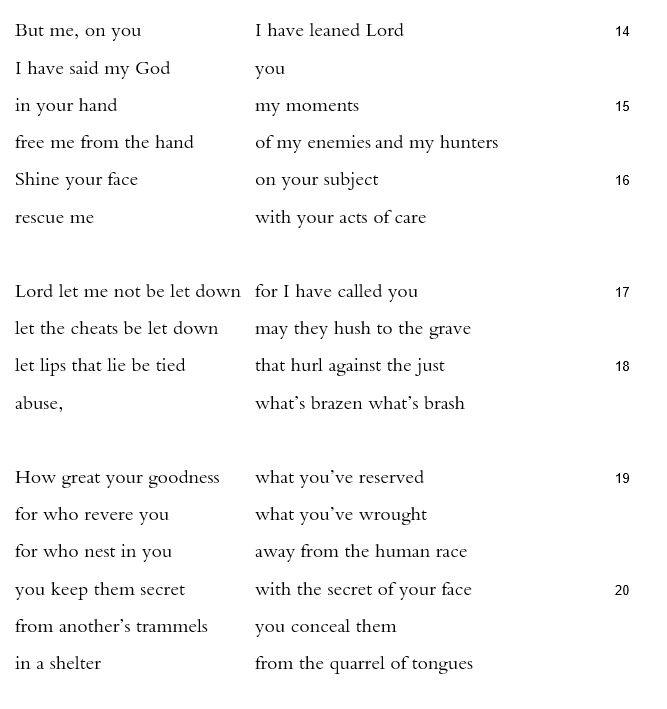
    As a whole, the psalm attempts to process an experience of siege. “His care for me | in a city besieged” (21) is not the central line, but it might be the most telling. Whether siege is literal or figurative, collective or individual, hardly matters. Quotation, at least in this psalm, is not a careful collage of found images that fit together, recollected in tranquility, but a kind of emotional rush of a flipping through a catalog. To be beset and surrounded is to nest, to hide in a fort, to hide from a net in a fastness—a kind of acknowledgment that the word metsudah means both “net” and “stronghold” (1-4). It is to be closed in, though yearning for space (7-8). It is to witness a cityscape in which enemies mock and friends flee and forget, and terror encloses (11-13). And it is to return again and again to whatever works, “feel for me Lord | for I am in trouble” (9) and “free me from the hand | of my enemies and my hunters” (16)  and “for I said | in my panic / I’m severed | from before your eyes / and you heard | the voice of my pleas” (22). The process is not linear, the experience not about originality or about convention, but a jumble, a blur of panic and praise.

    *

    31:2 be my cliff fastness / a fort of defense  Consonance here in English tries to replicate the effect of consonance in the Hebrew: hatsileini… litsur… metsudot, “free me… cliff… defense.”

    31:5 To your hand I hand over… you ransomed me  Here, too, repetition attempts to keep wordplay, though it’s actually “you ransomed” (paditah) that chimes with “your hand” (beyadikha) and shares consonants with “I hand over” (aphqid). The punning in Hebrew connects the divine act of rescue with the speaker’s own devoted response.

    31:6 the keepers of empty air  The speaker pledges opposition to those who guard or watch havlei–shav’, a term that pairs two euphemisms for idols, “breath” (hevel) and “worthlessness” (shav). See also Jonah 2:8.

    31:7 have known my neck | through troubles  Following the verb “to know” (yada`) with the preposition b- (“with” or “in” or “through”) creates an expression both literal and idiomatic. The Lord has perceived the troubles of the speaker (“neck” is a synecdoche) and has known the speaker, even through distress.

    31:9 it’s rotted with grief, my eye | my neck, my belly  Those (e.g., NIV, ESV, NASB, and more) who take nefesh to mean “soul” see this verse (likely an expansion of Psalm 6:7) as concluding with “soul and body,” reading a kind of dualism into the text. The more literal, more vivid, and more defensible reading is to understand here a grief so eviscerating that tears destroy the entire body as they fall from eye to throat to gut.

    31:13 the hearsay of many  Dibbat implies subtle slander.

    31:18 let lips that lie… what’s brash  The verse’s syntax relies on increasingly outraged apposition, while its rhythm moves from three carefully measured four-syllable semantic units to a unit of five and a unit of six.

    31:20 you keep them secret | with the secret of your face  The normal biblical idiom is to hide one’s face (e.g., Exod 3:6, Ps 13:1). This line turns the idiom around: they (the ones “who revere you… who nest in you” from verse 19) are not hidden from the Lord’s face, but by it.

    31:20 from another’s trammels  This noun only appears here. The Hebrew root rokes appears to derive from the Assyrian word riksu, a binding strap, such as the mark­asu, the strap that binds the cosmos. (See Assyrian Dictionary of the Oriental Institute 347-55) A precise, slightly difficult word seemed in order.

    31:22 I’m severed  Another hapax whose meaning seems clear enough from context.

    31:23 the true the Lord | preserving / requiting… the doer of pride  “Preserving” is a singular participle, so it’s the Lord who protects the faithful. It’s also the Lord who makes things even—the verb is shalom—with the proud, a point of considerable ambivalence.

    31: 24 Stay stout  The word chizqu is used in benediction by both Moses (Deut 31:6, cf. 31:7,23) and Joshua (Josh 10:25, compare the words of the Lord and the people in Josh 1:6-9, 18), both times in combination with the verb ’amats. See also Psalm 27:14.

    Share:

    • Share on X (Opens in new window) X
    • Share on Facebook (Opens in new window) Facebook
    Like Loading…

    About Me

    My name is Mark Minster. I’m an English and Comparative Literature professor with a background in ministry and in poetry. I teach courses on writing, reading, religion, and nature.

    Recent Posts

    • Psalm 150
    • Psalm 149
    • Psalm 148
    • Psalm 147
    • Psalm 146

    Newsletter

  • April 10th, 2023

    Psalm 30

    (lyric, a dedication song for the house of David)

    * * *

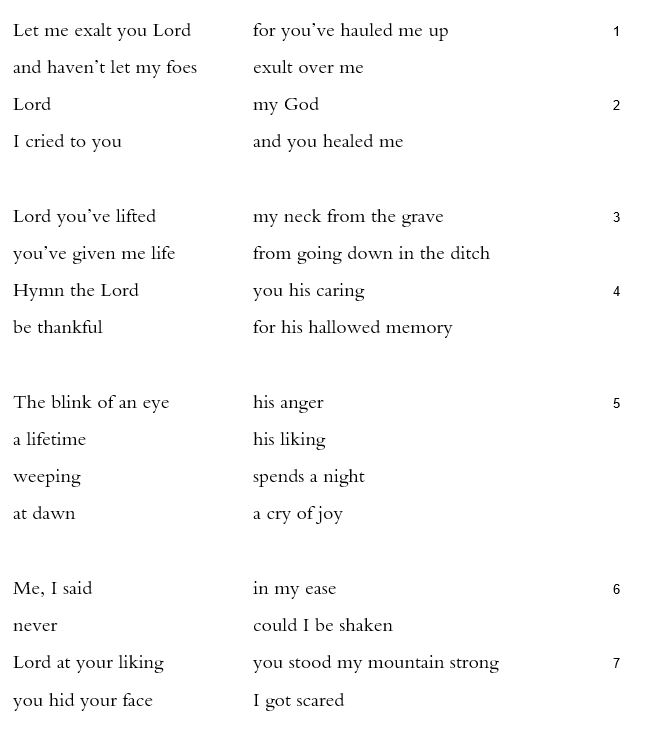
    A defining dynamic of lyric poetry runs between the speaker’s world and the reader’s. One I speaks, many I’s read. As I recite, “Lord | my God / I cried to you | and you healed me” (2), there is a tension. I am not actually the speaker of Psalm 30 and yet, through a range of possible responses, I come to identify with her, pulling her close, or evaluate her, holding her at arm’s length. This dynamic of identification and distance allows for absolute immersion—how many people over millennia must have said, deeply personally, “I cried to you | and you healed me,” in how many languages. Yet at the same time, that lyric “I” allows for scholarly critical analysis: who is she, where, when, how, why, even whether?

    In Psalm 30, this general readerly dynamic is stretched even farther in one direction by the context, a public commemoration in or of the temple, and by the opposing pull of the psalm’s many appeals to private feeling. Psalm 30’s superscription and the plural imperatives of verse 4 tug our experience of the psalm towards the ceremonial and liturgical, a collective historical memorializing that dedicates the “house of David” through the singing and worship of the chasidav: “you, his caring / be thankful | for his hallowed memory.” Which house of David? The dynastic line? Solomon’s temple? The Second Temple? How different this psalm looks without the superscription or without verse 4.

    On the other hand, most of the psalm is shaped around either pleading for or gratitude for healing. Healing from what we don’t know, but not knowing tips us towards identification. No single narrative sequence is clear, but the speaker seems to have felt confidence (6-7a), then fear (7b), which has led to pleading (8-10). Injury or desperation is figured as the edge of death, in a pair of verses that refer to the pit or “the ditch”: “what good is my blood | if I’m going down in the ditch” (9); “you’ve given me life | from going down in the ditch” (3). Other verses reflect on the experience of healing, which the psalm presents overwhelmingly as a fait accompli (1-5, 12). Being healed results not from the speaker’s innocence or goodness, nor even from the speaker’s fidelity, but from the pathos that is the Lord’s fidelity. The Lord likes the speaker. “A lifetime | his liking” is complemented by “Lord at your liking | you stood my mountain strong,” both times the word ratson (5, 7). And the Lord feels. The root chanan appears twice as well, in “plead” (8) and “feel for me” (10). The terms touch, each translatable by the word “favor,” though the word rendered here as “liking” has more to do with pleasure, while the second is more like pity, compassion, one’s heart going out to someone.

    This psalm, then, is not a singular thing. What song or poem is? It is instead a dramatic range: quiet begging, communal celebrating. Holding it far enough away to see it through lenses of curiosity or analysis, we notice how it personalizes collective memory in an experience of gratitude, how it makes feeling-better recapitulate liturgical practice. Coming close enough to identify with or feel like the speaker, we are brought near a near-death experience to join the joy of the morning, “weeping | spends a night / at dawn | a cry of joy” (5). And reading somewhere between assessment and absorption, we are able to sympathize. Maybe most dramatically, in so doing, the role we take on is the Lord’s: “Hear Lord | and feel for me” (10).

    *

    30:1 exalt… exult  As with “hauled” and “healed,” this instance of verbal play is not in the Hebrew. This particular poem’s own connective devices (or moments of pleasure) are harder to replicate—the semantic alignment of verbs on the vertical, the play of ’elohei and ’eilekha, “my God” and “to you.”

    30:4 be thankful | for his hallowed memory  It’s not clear what it means to thank or praise, literally, “the memorial/memento of his apartness/holiness.” Possibilities include a specific object of ritual value and cultural memory, a personal memory the speaker has, or the act of gratitude itself, which recalls as it gives thanks.

    30:5 The blink of an eye.. a cry of joy  A treasure of a verse, both for the precision of its oppositions and for its potent hope, this aphoristic quatrain maps bodily images of sorrow and anger, pleasure and joy, against experiences of different duration. The NIV waters down the poetry, supplying four verbs for a verse with only one.  

    30:7 I got scared  This stanza (verses 6-7) reverses the preceding one. Instead of moving from grief and divine wrath to divine favor and joy, it moves from ease and favor to the speaker’s being “shaken” and frightened by God’s disappearance. Parallel to the false sense of security in verse 6, this second half of verse 7 relies on a verb + participle of process: literally, “I became frightened.”

    30:11 my keening  The context is obviously not Irish, but the Irish caoineadh means much the same as the Hebrew mispeid (here: mispedi), the crying out for the dead.

    30:12 so respect might hymn you  In a curious circumlocution, the speaker imagines the music of praise from either the Lord’s kavod, or his or her own, or from glory itself.

    Share:

    • Share on X (Opens in new window) X
    • Share on Facebook (Opens in new window) Facebook
    Like Loading…

    About Me

    My name is Mark Minster. I’m an English and Comparative Literature professor with a background in ministry and in poetry. I teach courses on writing, reading, religion, and nature.

    Recent Posts

    • Psalm 150
    • Psalm 149
    • Psalm 148
    • Psalm 147
    • Psalm 146

    Newsletter

←Previous Page
1 … 28 29 30 31 32 … 37
Next Page→

Blog at WordPress.com.


Loading Comments...
 

    • Subscribe Subscribed
      • The Book of Psalms
      • Already have a WordPress.com account? Log in now.
      • The Book of Psalms
      • Subscribe Subscribed
      • Sign up
      • Log in
      • Report this content
      • View site in Reader
      • Manage subscriptions
      • Collapse this bar
    %d