• Page list
    • Posts
    • The Book of Psalms

The Book of Psalms

  • April 9th, 2023

    Psalm 29

    (lyric, of David)

    * * *

    In bright contrast with Psalm 28, this is a psalm of power. Where the prior psalm found roundabout ways of saying much the same thing, Psalm 29 explicitly repeats. The Lord’s name appears eighteen times, ten times in refrains: “Grant the Lord” three times (1-2), and “the Lord’s voice” seven (three times before verse 5, once in verse 5, three times after). Yet despite this repetition, or because of it, the psalm moves.

    So much is specific and concrete that even the psalm’s abstractions feel grounded. Cedars snap. Calves—aurochs calves, more precisely—leap. The wilds quicken as if giving birth. The voice of the Lord thunders, not just anywhere or everywhere, but far south in the wilderness of Kadesh, and far north in the Lebanon and Anti-Lebanon mountain ranges, the Lebanons, whose name points to their whiteness, and Mount Sirion, or Mount Hermon, seat of the Canaanite god Baal, whose Sidonian name refers to snow.

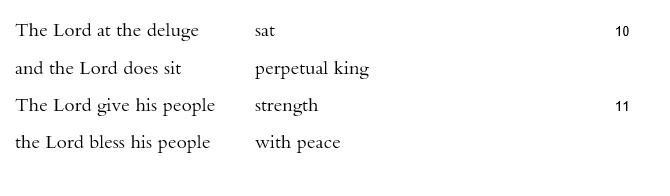
    Through the psalm, we move neatly from present imperatives to past, to present events and back, even as the refrains drown temporality in sound. The first stanza commands listeners to credit the Lord with “respect,” kabod, which again means heft, weight, and honor, as well as visual glory (see 8:5 note and the introduction to Psalm 57). The second stanza flashes back in time to the waters, the waters of creation, to the waters of the flood, that second creation, to the waters that swept away Pharaoh, a third creation (3-4). The intense third stanza— two prefixed verbs and a present participle (5-6)—and the doubly intense fourth—four prefixed verbs and two present participles (7-9)—both take place now, first in northern mountains, then in southern wilds, then the temple in between, with “everyone saying | respect” (9). The fifth and final stanza moves swiftly from past to present to out of time: “The Lord at the deluge | sat / and the Lord does sit | perpetual king” (10). The psalm ends with a benediction, two statements that are also wishes: “The Lord give… the Lord bless” (11).   

    It is disappointing to hear others interpret this psalm as a description of a thunderstorm, as if that explains what happens here. That approach turns us into Victorian-era armchair anthropologists, bemused by naïve anthropomorphic explanations of natural phenomena that would be better explained (puffs cigar, swirls sherry) by scientific inquiry. This psalm is not the bad science of primitives, nor does it supernaturalize the natural world. Whoever wrote this, they were not simpletons cowering from storms. This psalm sees power and display inside the imperatives of its collective practice. And it does so outside, out in a world that is not sub-supernatural, not even natural, for there is no biblical concept of “nature.” There is, rather, leaping and writhing in respect and strength.

    It is possible to read this as an extractive poem, in which the stripping of forests gives way immediately to a temple built from their timber. In this reading, the grammar of “everyone saying | respect” aligns this “everyone” with the deer and with the woods, all made to writhe even as they are stripped bare. It’s better, however, to read the psalm as new creation in a constant present tense. This reading accounts for the writhing in verses 8 and 9, which are really birth pangs. And it accounts for the dancing in the mountains in verse 6. The Lord sits where he always sat, verse 10 asserts, even before the deluge, back to creation.

    The poem begins by addressing “children of gods,” benei ’elim, continuous with the God (’el) of respect in verse 3. Since it ends, as well, with the Lord’s people, we are invited to wonder who these “children of gods” are and what they are capable of. Most importantly, the poem ends by returning almost exactly where it began, with “respect” (1, 2, 3,  9) and with “strength” (1, 11).

    Not exactly where it began, though. The psalm’s final word for what the Lord’s voice makes happen is “peace.”

    *

    29:1 Grant the Lord… respect and strength  The refrain calls for giving to the Lord before it names either the audience—“children of gods” (benei ’elim), descendants of the mighty, an open-ended appellation—or the direct objects that are to be given, the open-voweled kavod va`oz and kavod shemo, “respect and strength” and “the respect of his name.”

    29:2 in hallowed display  In the perfect dactyls of the King James Version: “worship the Lord in the beauty of holiness.” 

    29:3 the God of respect thundered  As in verse 1, “respect” may seem less impactful to readers of some generations than others, but all audiences have a less automated theological response to “respect” than to “glory.” The name of God here is not the more common ’elohim, but ’el, which means either “God” or “god” or “might.” As a preposition, ’el indicates direction towards, which here would play off the two `al prepositions in the phrases that precede and follow.

    29:6 he makes caper.. the aurochs  A good example of the kind of chiastic parallelism that ties the second half of the first line to the first half of the second line: “the White Mountains / and Snowy Mountain.” “Lebanon / and Sirion” would also work, but the name Lebanon does not refer to what readers will think of as the country, and the derivations of both geographical terms are striking.

    29:7 carving blades of fire  Such a skillful line. The participle chotsev suits activity both destructive and constructive, while the lahabot are things that glint, both flames and blades. Thus the voice of the Lord might be what forges blades or splits them, what fuels flames or divides them.

    29:8-9 wreathes | the wilds of Qadesh… makes writhe the does  The verb chul has tremendous range. The common translation “shakes” is fine, but there seems to be a twisting, wrapping motion involved as well, continuous with labor pains and dancing. The name for female deer  ’ayalot compellingly calls back ’el and ’elim from verses 1 and 3.

    29:9 everyone saying | respect  The phrase “in his temple” would seem to limit this “everyone” to human worshippers. And yet the psalm’s persistent celebration of how Lord’s voice affects animals, mountains, wilderness, and woods makes the saying resonate outside the temple as well.

    29:10 at the deluge | sat / and… does sit  Note the contrast with 26:4-5 “I have not sat… I will not sit”

    29:11 The Lord give  The verb functions as a jussive as well as an indicative, as wish and as declaration.
    Share:

    • Share on X (Opens in new window) X
    • Share on Facebook (Opens in new window) Facebook
    Like Loading…

    About Me

    My name is Mark Minster. I’m an English and Comparative Literature professor with a background in ministry and in poetry. I teach courses on writing, reading, religion, and nature.

    Recent Posts

    • Psalm 150
    • Psalm 149
    • Psalm 148
    • Psalm 147
    • Psalm 146

    Newsletter

  • April 8th, 2023

    Psalm 28

    (of David)

    * * *

    There has to be a least interesting psalm. Psalm 28 volunteers. Full of circumlocutions, abstractions, and cleverness, its petty moral sensibility leaves readers little to reward attention. It reads like a wordy elaboration on the first verses of Psalm 18/2 Samuel 22: “my cliff” (28:1, 18:2), “my strength my shield” (28:7, 8; 18:1, 2), “the stronghold” (28:8, 2 Sam 22:33).

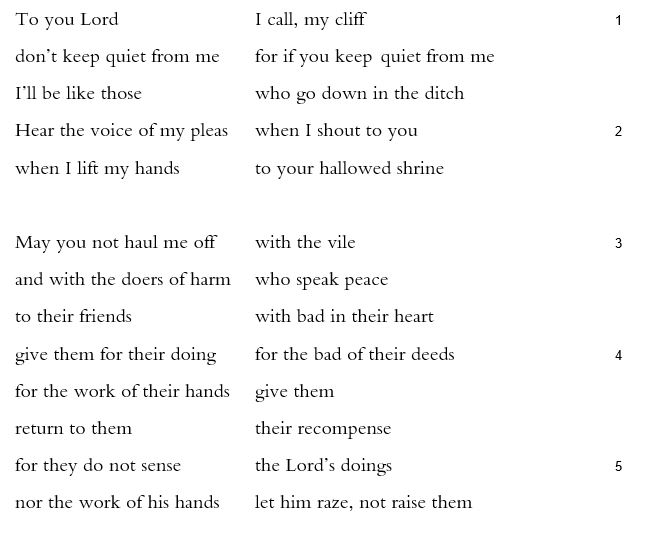
    What is it that the speaker wants? Having worshipped, she calls for a response: “hear the voice of my pleas | when I shout to you / when I lift my hands | to your hallowed shrine” (2). What kind of pleas are these? “May you not haul me off | with the vile” or with those who make trouble or those who “speak peace… with bad in their heart” (3).

    Other psalms provide passionate evidence of the trouble the “I” is in. Other psalms call for justice that would prove the speaker’s innocence, or tug at the Lord’s pity, or remind him of his fidelity and care. This speaker speaks instead in a coy second-person imperfect—not the imperative. Rather than demanding with a full-throated imperative, not to be lumped in with the bad, she speaks indirectly, deferentially, “may you not” (“you do not” is possible as well).

    Worse, instead of justice for herself, she seeks punishment for wrongdoers in general, not anyone who has specifically wronged her:

    give them for their doing       for the bad of their deeds                          

    for the work of their hands    give them                

    return to them                     their recompense

    The language is generic, not to mention repetitive. Parallelism can do so much more! It can intensify, clarify, deepen, map. What does “give them” add the second time? How does the cliché “the work of their hands” focus or adjust “for the bad of their deeds”? Maybe there is a matching here, the three kinds of bad in verse 3 matched with appropriate retribution? But nothing is specific about either the crime or the punishment. “I have worshipped, so please don’t treat me like those awful people who get what’s coming to them?” The piety begrudges; it grates.

    These central moments of the psalm are led and followed not by details, but by puns. The bad do bad (ra`ah) to their friends (re`eihem) in verse 3, which is similar wordplay to Psalm 23 (see note to Psalm 23), though this pales in comparison with that, in range and significance. In verse 5, the play is somewhat stronger, ki lo‘ yabinu, “because they do not sense,” which is met by velo‘ yibneim, “he shall not build them up.” But what doings of the Lord has the psalm asked the reader to sense?

    Read Isaiah 1, I want to tell the speaker, whom I feel sure I’ve met before.

    *

    28:1 don’t keep quiet from me  A very literal rendering of the Hebrew idiom, which describes not just any kind of silence, but privation or secrecy.

    28:3 May you not haul me off  The verb mashak does not necessarily suggest a formal register, though the verb’s conjugation in the indicative makes it more polite than the imperative would have been. Some readers may find this translation too informal, others may think it too formal. That tension is in the Hebrew.

    28:3 their friends | with bad  A Hebrew pun, as the introduction to Psalm 28 points out: re`eihem ra`ah enacts the corruption of friendship. 

    28:5 let him raze, not raise them  The pun in the verse actually pairs velo’ yibneim “not raise them” with ki lo’ yabinu, “for they do not sense.” In the Hebrew, then, the etymology suggests that the Lord’s refusal to establish the bad is rooted in their failure to discern. This translation’s pun gives only the flavor of the original.

    Share:

    • Share on X (Opens in new window) X
    • Share on Facebook (Opens in new window) Facebook
    Like Loading…

    About Me

    My name is Mark Minster. I’m an English and Comparative Literature professor with a background in ministry and in poetry. I teach courses on writing, reading, religion, and nature.

    Recent Posts

    • Psalm 150
    • Psalm 149
    • Psalm 148
    • Psalm 147
    • Psalm 146

    Newsletter

  • April 7th, 2023

    Psalm 27

    (of David)

    * * *

    All poems and hymns are composite, whether they seem the work of one hand or many. Lines and stanzas take different angles. New images complement or challenge old ones. Abstractions butt heads. It would be valuable to be able to know whose hands—whose eyes, whose ears—put which pieces where and when, who arranged Psalm 25 to mirror Psalm 34 with Psalm 29 in the middle. And to know who paired Psalm 27 and Psalm 31. It would be nice to know which seams within psalms were intentioned by authors and which by editors— if there was even a difference. And yet the whole exercise, trying to find which parts were made by whom, is fraught with logical circles.

    As an instance of this unknowable intentionality, Psalm 27 relies on a curious shift. In reductive applications of form criticism, it is often called a psalm of “trust,” as if one word could convey a theme, let alone a genre. The whole psalm, it should really be said, pokes at the tissue of trust. It presents a psychologically rich portrait of trust being torn and repaired, with layers of bravado and vulnerability and dread. It’s a therapist’s stomping ground.

    The psalm begins with a doubled question of identity, a move seen before in Psalms 15 and 24. The questions in Psalm 27—not about who, but “of whom” should I be afraid?—become more than rhetorical. Verses 1-3 sound like bluster. Given that the Lord is my fortress and light, the zombie-like horde of villains who pile up in verses 2 and 3 are met with two statements of calm: “my heart does not fear… through this I lean back.” The word betach, the most common biblical word for “trust,” relies on an image of relying on, of reclining in peace. The picture of a teambuilding trust-fall comes to mind, or of carrying children off to bed.

    From leaning, however, the psalm turns to images of sanctuary. Verse 4 is a strange leap after confidence, the sudden wish to live in the temple, a movement clearly marked as a retreat:

    For he hides me in his den     on the bad day he conceals me         

    under cover of his tent          to a cliff uplifts me (5).

    There are three locations here, at least two of them metaphorical— the Lord’s tent, likely literal, flanked by an animal’s burrow or warren or den, which goes down, and a cliff to which the speaker is “uplifted” seemingly within the tent. From safety, within the tabernacle or temple, above the enemies, the speaker offers song. But how does this retreat from threat relate to reclining in trust? The psalm has moved from confidence to concealment.

    Once the psalm shifts to first-person address, the image of hiding returns. In the song that the speaker sings, rather than narration, we hear a complicated desire and plea:

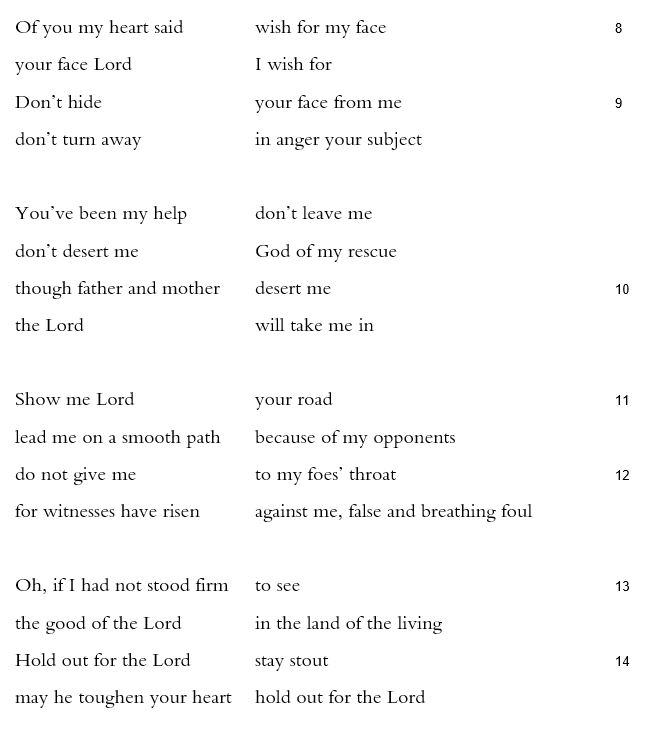
    Of you my heart said            wish for my face                 

    your face Lord                     I wish for      

    Don’t hide                          your face from me    

    don’t turn away                   in anger your subject

    You’ve been my help           don’t leave me         

    don’t desert me                   God of my rescue

    though father and mother   desert me                

    the Lord                             will take me in          (8-10).

    That wish in verse 8f or the face to stay—literally “seeking” the face— is particularly blurry. A vulnerable sentiment is expressed: Look for my face, Lord! I look for yours! Is that “trust”? Having voiced confidence in the face of armies, the speaker is whisked into sanctuary, whereupon she sings this song of what smacks of desperation: “don’t hide… don’t turn away… don’t leave me / don’t desert me” (9). You don’t need a counseling degree to want to ask a follow-up to verse 10: “though father and mother | desert me / the Lord | will take me in.” Tell me more about your parents…?

    Maybe the hiding doesn’t last. The final four verses anticipate movement away from shelter: “Show me Lord | your road / lead me on a smooth path | because of my opponents” (11). How curious, then, that the psalm ends with the speaker waiting. The word qavah means to be expectant, to hope, to gather while waiting.

    But it’s not just waiting. The final verse is a first-person address to some second-person singular who is not the Lord. That “you” might be liturgical, to be sure, one worshipper to another: “Hold out for the Lord | stay stout / may he toughen your heart | hold out for the Lord” (140. But within the poem, this reads more like someone psyching herself up. A declaration of trust at the beginning has transformed, gone vulnerable, grown up, gone deep. Here at the end that trust has become a kind of self-encouragement, far removed from a naïve trust fall. But then, maybe trust is hope or holding out, a mirror scene of telling yourself to stand firm, stay strong.

    *

    27:5 in his den  A figure for the tabernacle, to be sure (e.g., Ps 76:2), the word is also used for the shade where lions lie (Job 38:40).

    27:8 Of you my heart said | wish for my face  An example of the tremendous power of preserving ambiguity. Most translations deploy quotation marks and reverential capitalization of “my” here to read “wish for my face” as the speaker citing God’s desire for the speaker to seek God’s face. But it is also possible to read the line more simply as the speaker’s desire to be sought. The more common idiom understands the speaker to be beseeching the Lord—as indeed happens in the second line of the verse: “your face Lord | I wish for.” But this line admits the opposite as well: the speaker also wants to be wanted. See also the introduction to this psalm.

    27:13 false and breathing foul  The meaning of vipeiach, a hapax legomenon, is uncertain.

    27:13 Oh, if I had not stood firm | to see  The word lulei is counterfactual, “unless I had stood firm,” which makes literal translation unsatisfactory. Some translations supply a “then” to complete this line’s “if not” clause: for example, “[I had fainted] unless I had believed” (KJV). The emotive power, however, comes from not knowing or not stating what would have happened.

    Share:

    • Share on X (Opens in new window) X
    • Share on Facebook (Opens in new window) Facebook
    Like Loading…

    About Me

    My name is Mark Minster. I’m an English and Comparative Literature professor with a background in ministry and in poetry. I teach courses on writing, reading, religion, and nature.

    Recent Posts

    • Psalm 150
    • Psalm 149
    • Psalm 148
    • Psalm 147
    • Psalm 146

    Newsletter

  • April 6th, 2023

    Psalm 26

    (of David)

    * * *

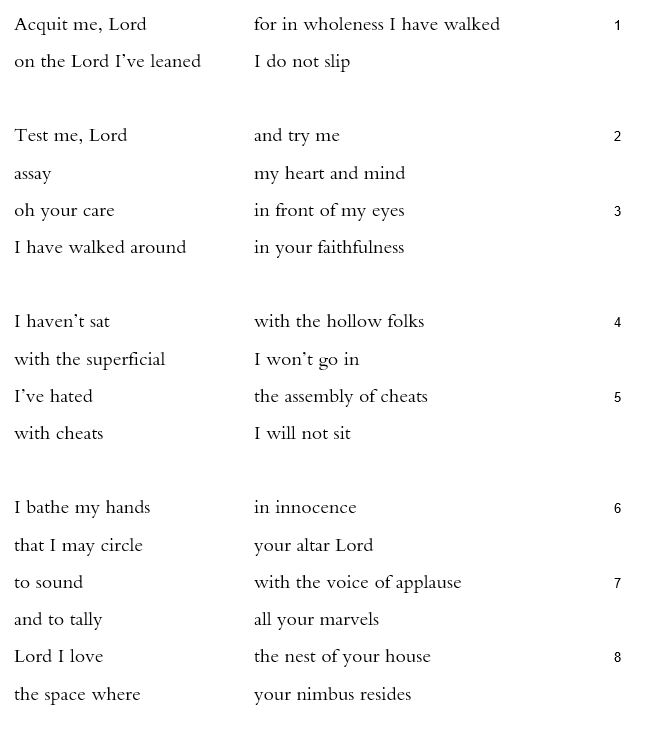
    Psalm 26 choreographs a claim of innocence. But while the word choreography comes from the word chorus (χορός), the psalm is the performance of a singular speaker. The rarer word chorography, from the word for space or position (χώρα), refers to mapping territory, marking out space, which this psalm even more pointedly does. All the evidence of the speaker’s integrity and fidelity is presented in the psalmist’s body, feet, and hands, even the heart and the kidneys in verse 2 (translated “heart and mind”). This body is not static—the speaker walks and walks around, walks “in wholeness” (1,11) with sure feet (1, 12), and walks around in general “with your faithfulness” (3).

    At the center of the psalm, the practice of walking around becomes a rite: “that I may circle | your altar Lord” (6). The circumambulation of the altar in verse 6 centers the speaker, enacting commitment, even as it honors the Lord. More, it marks out space, “the nest of your house / the space where | your honor resides” (8). That moment in the middle of the psalm stands out, too. It moves from visible motion, the dance, to aural performance, the voice: “to sound | with the voice of applause / and to tally | all your marvels” (7).

     On either side of this central act at the altar, the speaker’s moving body is contrasted with the stilled bodies of the guilty. In verses 4 and 5, these are “the hollow folks… those who cover up…the assembly of cheats” with whom “I have not sat… I will not sit.” In verses 9 and 10, the empty and the deceptive have become “offenders” and even “the bloodstained,” defined now by acts of deception and filling, “in whose two hands | a scheme / whose right hand | has filled with a bribe.” It is their hands that cheat. Their feet don’t move.

    And so in the end, the guilty cannot plant their feet “in the assemblies” (12). They aren’t even there, so of course they cannot kneel.

    *

    26:1 in wholeness I have walked  Compare “in wholeness | I walk” in verse 11. The performance of the psalm seems to turn the metaphorical walking with integrity, here at the start of psalm, into a more literal kind of walking.

    26:2 Test me  The word bechaneini deftly includes the word chaneini, “feel for me,” which appears with a similar-sounding vav-prefix in verse 11. Brilliantly, the process of testing both incorporates and yields sympathy, pity, feeling.

    26:4 with the hollow folks / with the superficial  Literally, “with the men of emptiness and with the ones who are concealed.” The pairing points first to an absence of depth, then to an abundance of surface.

    26:6 I bathe my hands  See also 73:13. The verb nearly always indicates ritual cleanliness.

    26:6 that I may circle | your altar  The center of the psalm features a ritual circumambulation. The verb is cohortative with a vav-prefix, indicating a desire and purpose.

    26:8 the nest of your house  I miss the KJV word “habitation” here, but the Hebrew really is much simpler and more common, used for the home of animals in Jeremiah 9:11 and 10:22.   

    26:9 May you not lump  Literally, “don’t gather with the errant my neck.” It’s an urgent attempt to distance himself or herself from those to be punished.

    Share:

    • Share on X (Opens in new window) X
    • Share on Facebook (Opens in new window) Facebook
    Like Loading…

    About Me

    My name is Mark Minster. I’m an English and Comparative Literature professor with a background in ministry and in poetry. I teach courses on writing, reading, religion, and nature.

    Recent Posts

    • Psalm 150
    • Psalm 149
    • Psalm 148
    • Psalm 147
    • Psalm 146

    Newsletter

←Previous Page
1 … 29 30 31 32 33 … 37
Next Page→

Blog at WordPress.com.


Loading Comments...
 

    • Subscribe Subscribed
      • The Book of Psalms
      • Already have a WordPress.com account? Log in now.
      • The Book of Psalms
      • Subscribe Subscribed
      • Sign up
      • Log in
      • Report this content
      • View site in Reader
      • Manage subscriptions
      • Collapse this bar
    %d