• Page list
    • Posts
    • The Book of Psalms

The Book of Psalms

  • April 5th, 2023

    Psalm 25

    (of David)

    * * *

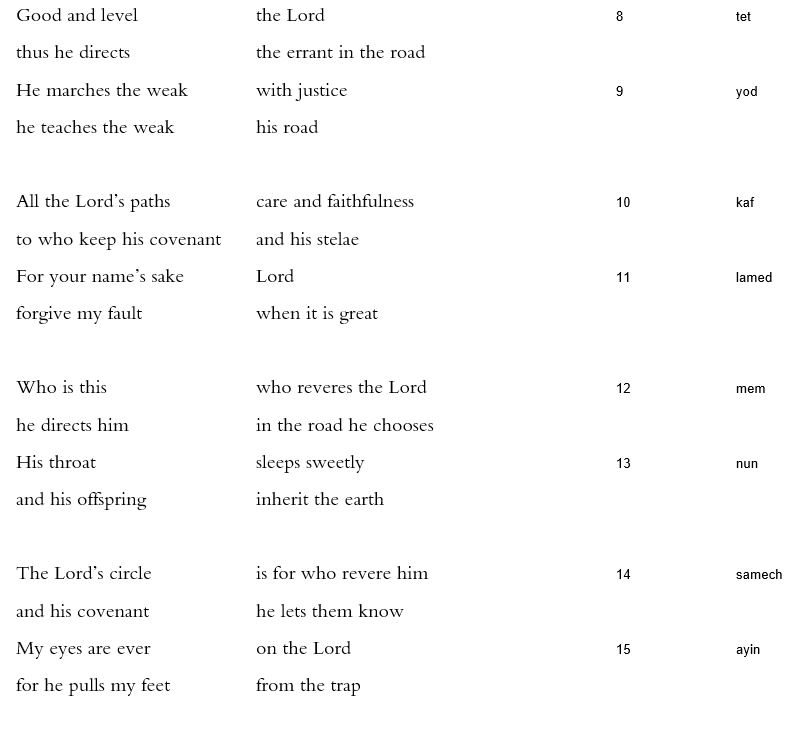
    What is this? What holds it together? To call Psalm 25 an imperfect acrostic is to scratch the surface of its imperfections. As an acrostic, it lacks the letters bet, vav, and qof, but doubles the resh and adds a final peh. How did this happen? There are all kinds of possibilities, accidental through intentional, though without documents we rely on conjecture. One hypothesis that’s been suggested is that belated scribes failed to notice that their source material constituted an acrostic, and so shaped pieces of it into a new whole, discarding or disregarding some letters. This seems a stretch. Otherwise deft editors would suddenly miss the alphabet? And for the sake of this, which is not exactly a cohesive whole? Failure to notice makes less sense than some situation or intention or criterion of value about which we can only speculate, given the verses or parts of verses that seem to have gone missing. Any hypothesis makes less sense than the observation— forgive me— that this is in any case a middling psalm at best.

    What is here? An introduction and conclusion pair a vulnerable throat (nafshi, 1, 20) expressing a wish not to be let down (or “ashamed,” al-aboshah, 1, al-abosh 20), having waited for help from God (“all holding on for you” 3, “I hold on for you” 21). Not clearly related, verses 4-5, 8-10, and 12, maybe 15, all depend upon the image of the road, with the Lord as a guide: “your paths | teach them to me” (4), “Good and straight | the Lord / thus he directs | the mistaken in the road”(8). To “learn the way” is a biblical figure for moral practice, made somewhat unique here by the doubled use of the denominal verb “to road,” translated as “to march,” in verses 5 and 9. Inside this cluster of verses are two verses that don’t refer to paths or walking at all. Verses 6 and 7 (which may have been preceded by a vav verse) ask the Lord to remember a relationship of love and to forget the speaker’s errors: “the mistakes of my youth |and my mutinies” (7).

    The second half of the psalm is a touch more interesting, with theme-words that stitch cleverly across verses. It seems to center on “who is this,” the question in verse 12 that recalls the previous group of psalms, Psalms 15-24, while turning to the yirei Adonai, those “who revere the Lord”:

    Who is this                         who reveres the Lord

    he directs him                    in the road he chooses  

    His throat                           sleeps sweetly

    and his offspring               inherit the earth

    The Lord’s circle               is for who revere him

    and his covenant               he lets them know

    Verses 12 and 13 pick up the image of the road from the psalm’s first half and the figure of the throat from the introduction, attaching them to the person “who reveres the Lord,” probably the convert who has joined from outside. Verse 14 makes this joining explicit, drawing the “circle” (sod, a council) and even the covenant around the singular, then plural, fearers-of-the-Lord. Verse 12 even presents a nice momentary ambiguity: who is it who chooses the road down which the Lord directs the one who reveres God?

    But in verses 16-22, we don’t know what to make of the appeal for help from enemies and from heart-strain. The “weak” who were directed in the road in verse 9, we assume, return in the first-person in verses 16 and 18, just as the “mistakes” of verses 7 and 8 return in verse 18. But what does all of this imply? Having been taught the road, having been remembered, having been included in the circle of the Lord, how is the speaker now alone? There is a generic squeezing in verses 17 and 22, “pressures.” Is this experience of stress why the speaker feels let down?

    But maybe these are the wrong questions. It’s an acrostic, after all, which means perhaps we should not expect cohesion. Maybe we should not feel let down by mostly conventional language and imagery.

    *

    25:2 let me not blanch  Like the verb chafer, with which it is often paired in the book of Psalms (cf. 35:4, 40:14, the verb bosh seems to refer to the physical manifestation of embarrassment. Circulation can run hot or cold, as blood floods an area of the face (“blush,” chafer) or leaves it pale (“blanch,” bosh). This may be wild speculation—poetic logic.

    25:3 let them blanch | who cloak for no reason  The word habbogdim (“they who deceive” or “who cloak”) comes from the root bagad, whose core image is of clothing (beged) as concealment.

    25:8 thus he directs  Here the image is rich and clear: the Lord is “good and level,” and can therefore guide those who swerve from the road. This course correction is not punishment, but follows from both the Lord’s kindness and/or morality (“good”) and the Lord’s position and/or example (“level”).

    25:10 and his stelae  See note to Psalm 19:7

    25:12 Who is this  See introduction to Psalm 25 and note to Psalm 24:8

    25:12 he directs him | in the road he chooses  Biblical Hebrew’s habit of ambiguous pronoun reference, irksome to grammarians, is best preserved. The right and responsibility of puzzling through who directs whom according to whose choice is delegated to the reader.

    25:13 sleeps sweetly  The verse is sometimes interpreted to refer to material comfort that follows the one “who reveres the Lord” (verse 12). But the line very literally says “his throat with good lodges.” “Prosperity,” the word chosen by both the NIV and the JPS translations, opts for a very narrow segment of the semantic range of tov, which indicates all kinds of goodness. The NIV just does what it feels like here, discarding the Hebrew: “They will spend their days in prosperity…” The verse emphasizes not days but nights, actually, with the verb talin, to spend the night. People sleep well with good consciences, not piles of cash.

    25:17 The pressures… from my constrictions  One of the strongest verses in the psalm, the tsade verse pairs two images of deliverance as a release from squeezing pressures: the first release is a widening, the second an extrication.

    25:22 Ransom, God  A second peh verse (see 16) appears at the end of the psalm, out of alphabetical order. Because this verse asks for God to buy back Israel from its strictures, shifting from the first-person singular, perhaps it makes more sense here than it would after or in place of verse 16?
    Share:

    • Share on X (Opens in new window) X
    • Share on Facebook (Opens in new window) Facebook
    Like Loading…

    About Me

    My name is Mark Minster. I’m an English and Comparative Literature professor with a background in ministry and in poetry. I teach courses on writing, reading, religion, and nature.

    Recent Posts

    • Psalm 150
    • Psalm 149
    • Psalm 148
    • Psalm 147
    • Psalm 146

    Newsletter

  • April 4th, 2023

    Psalm 24

    (lyric, of David)

    * * *

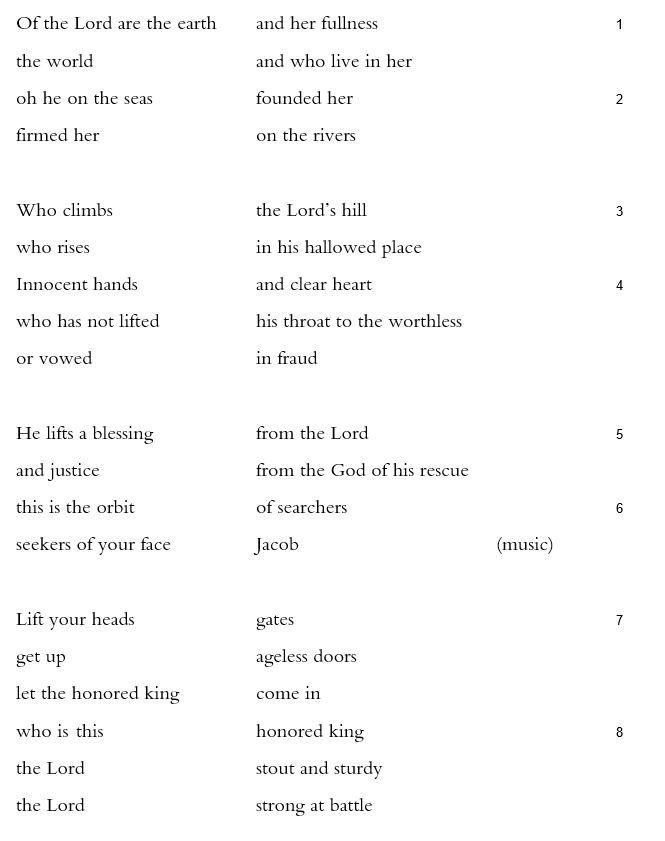
    A reader is a seismograph, marking tremors of experience. “Who climbs | the Lord’s hill / who rises | in his hallowed place.” When we read this near the beginning of Psalm 24, we register familiarity (24:3). Attentive, we remember the questions that started Psalm 15: “Lord, who camps | in your tent / who lives on your hallowed hill” (15:1). Hearing that “who” chime twice, we observe how close the nouns are. Lord…your tent. Your hallowed hill. The Lord’s hill. His hallowed place. We tick and sequence the verbs: “camps,” “lives,” “climbs,” “rises.” From a sound that repeats, we link what’s new with what’s known and make a note.

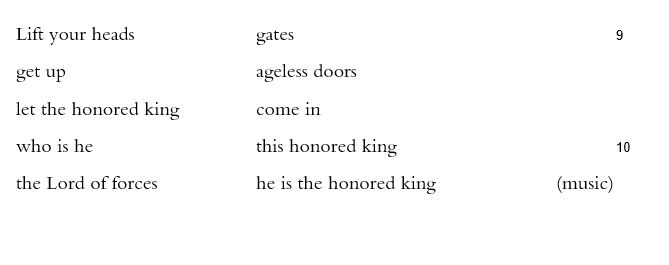
    A reader is also a seismologist. She reads her own seismographs, circling patterns, noting anomalies. Psalm 24 asks “who” twice more: “who is | this honored king” and “who is he this | honored king” (8, 10). Four times, this psalm asks who. Two times the question concerns a person, a pilgrim to Jerusalem, a devotee; two times it concerns the Lord. We scan our graphs and see a pattern, way back in Psalm 18: “but who is the god | except the Lord / who is a rock | save our God” (18:31). Our camera zooms out to the whole unit, Psalms 15-24: eight times, this asking who. Twice of a person, twice of God, twice of a person, twice of God. Our index finger on our perforated accordion-fold printouts, scrolling between the first four and last four of those psalms, we find Psalm 19:12: “Failures— | who could perceive them? / of hidden things | acquit me….” A ninth “who”?

    Zoom in. The word “acquit” there in Psalm 19:12, near the center of the Psalm 15-24 collection of psalms, is followed in Psalm 19:13 by the related verb “to be innocent”:  

                        of hidden things                   acquit me                          

                        of arrogances                       spare your servant                                   

                        may they not rule me           then I will be whole

                        will be innocent                   of great crime

    Twice in the verb form (naqah), innocence shows up in the middle of this larger unit of psalms. Zoom back. Does it appear elsewhere in Psalms 15-24? Yes! As a nominalized adjective, twice. It’s in Psalm 15:5 as the tenth and final trait of the person who is the answer to “who”: “a bribe against the innocent |she never took.” And it’s in Psalm 24:4, as the first trait of the person who’s the answer to “who.” Who climbs the Lord’s hill? “Innocent hands | and clear heart / who has not lifted his throat to the worthless.”   

    From here, reader, we can choose. There are many connections and patterns to catalog: the heart in Psalm 15:2, 19:8, 19:14, and 24:4; the word kavod, “honor” (or “heft” or “weight”) once in 15:4, and five times in 24 (24:7, 8, 9, 10 [x2]); the word qadosh, “hallowed,” in 15:1 and 24:3. Maybe most interesting in this list is the verb ns’a, “to lift,” which appears in 15:3 (“never lifted/brought shame”) and again in 24:4, 5, 7, 9. It’s a motif, really, in Psalm 24, the lifting of the head of the gates in verses 7 and 9, which matches the lifting of the blessing/gift in verse 5.

    Instead of cataloging, at any point we can pause to ask the psalms we’re reading, why? Why ask questions about who qualifies to enter the sanctuary? Given the prompt and lengthy answers, the psalms’ questions seem rhetorical. And yet, what then are we to make of the “who” question in Psalm 19:12, centered between Psalms 15 and 24: “Failures— who could perceive them? / hidden things.” After—and before— all these character traits, what are these hidden things, these failures?

    And why pair these questions about an ideal person with questions about God, who God is? These questions seem less rhetorical and more performative. Knowing the answer, we point: “this honored king,” “this honored king” (24:8,10). And we name: The Lord, three times: “stout and study… strong at battle… the Lord of forces.” Why?

    Is the psalm a vertical map, the innocent at one pole, the Lord at the other? Or is the sweep of ten psalms a horizontal experience, temporal as well as spatial, a journey from outside the sanctuary to within? Or is there something else inside this particular psalm, pointed to by the “this” at its center, which could serve as a motto for our acts of attention: “this is the orbit | of searchers / seekers of your face | Jacob” (24:6). Does Jacob name the people of Israel? Or is it a figure for the Lord, “the God of Jacob”? Given all the parallel interrogatory questions “who,” how could the answer not be both? Both the face of the people and the face of God?

    *

    24:1 Of the Lord are the earth | and her fullness  Both the word for “earth” or “land” (ha’arets) and its synonym “world” (tebel) are grammatically feminine. As with “of David” in the psalm’s superscription, the inseparable preposition l- in “of the Lord” can indicate possession or origin or direction.  

    24:3 Who climbs  “Who” in Hebrew is nearly always a question rather than a relative pronoun, but the question can be rhetorical, so there is no need for interrogative punctuation here.

    24:4 his throat to the worthless  “The worthless” may imply emblems of other deities, as the word shav’ does in Jeremiah 18:15, or it may allude to the prohibition on “bearing false witness” in the Decalogue (Exod 20:7 x2, 23:1; Deut 5:11 x2, 5:20). The complete verse reads like a midrash on the commandment, mapping out honesty, integrity, and ritual and legal propriety from hands and heart to an injunction against perjury and hypocrisy, rather than a ban on taking any oaths at all or naming God.

    24:6 this is the orbit… Jacob  The word dor is virtually always temporal in the Hebrew Bible: “age” or “generation” (Isa 38:12 and 53:8 may or may not be exceptions; see Ps 14:5, “cohort”). But, as in the Latin passus or the English “pace” or, more closely, the Arabic word dawr, a temporal word can easily be a spatial word as well. If, as Benjamin Sommer has argued persuasively, this psalm— or whole series of psalms— shows evidence of having been part of a ritual procession, then both the “this” and the “orbit” take on practical significance, as does the double-duty term “Jacob,” a metonym for both the people and their God. See the too-modestly titled “A Commentary on Psalm 24,” Gazing on the Deep: Ancient Near Eastern, Biblical, and Jewish Studies in Honor of Tzvi Abusch, eds. Jeffrey Stackert, Barbara Nevling Porter, and David P. Wright (Bethesda, Md.: CDL Press, 2010), 495-515.

    24:8 Who is this   See the introductory note above. The most famous mi-zeh construction in the Bible is probably God’s question to Job from the tempest: “who is this who darkens advice with speech without knowing” (Job 38:2, misquoted by Job in 42:3). Note that the mi-zeh returns immediately in Psalm 25:12, where it may mark an inclusion with Psalm 34:12.

    24:10 the Lord of forces  The word tseba’ot has often been taken to be part of an epithet referring to the Lord in battle gear, the Lord of “hosts” or “armies.” Others read the term as a marker of majesty. It makes sense to preserve possibilities.

    Share:

    • Share on X (Opens in new window) X
    • Share on Facebook (Opens in new window) Facebook
    Like Loading…

    About Me

    My name is Mark Minster. I’m an English and Comparative Literature professor with a background in ministry and in poetry. I teach courses on writing, reading, religion, and nature.

    Recent Posts

    • Psalm 150
    • Psalm 149
    • Psalm 148
    • Psalm 147
    • Psalm 146

    Newsletter

  • April 3rd, 2023

    Psalm 23

    (lyric, of David)

    * * *

    It is more wish than insight to call the whole of Psalms “great poetry.” I mean no disrespect. For their people and purposes, psalms are after more than power and precision or beauty and delight, more than the cleansing of perception. Reading the psalms may be an aesthetic and epistemological experience, but it is also an ethical act of participation and pragmatics—what one does with what one reads and recites. The Twenty-Third Psalm is all of these. Not just the most widely read and repeated of psalms, it may be the most tightly strung and it is certainly the most resonant. To use R.P. Blackmur’s terms, Psalm 23 is both buoyant and moored. Stretched on its canvas around a single conceit, it paints a kind of pastoral in which what matters is not the hick shepherd’s distance from urbanity, but the sheep’s proximity to both terror and care. There is politics in the country as well.

    It’s a love poem between species, a love poem despite the unequal relationship. It begins in a bower, follows a walk, imagines a meal, and all throughout it overflows: “he lays me,” “he refreshes me,” “he revives| guides me” (2-3); “your crook and staff | still me,” “you set me a table” (4-5). Their love differs, the speaker’s from the beloved’s. The shepherd is attendant, all provision, full of “sweetness and care” (6). The sheep is dependent, made less of need than desire, led by the icons of masculinity and power, “your crook and staff.” Together, in the sheep’s imagination, they end by entering the shepherd’s house.

    In the center of the psalm, while the sheep stays in the first-person, the Lord moves from “he” to “you.” This shift of person is common in Hebrew poems, and notes increasing intimacy (e.g., “Let him kiss me… for your kisses are sweeter than wine,” Songs 1:1). It’s the very center of this poem, the seventh of thirteen lines: “I fear no ill | when you are with me” (4b). In the original, there is such music and depth. Lo i’ra r`a means “I do not fear bad,” but its last two of four syllables sound like an echo—we are in a valley, after all—even as they actually do echo the syllables that start the psalm: YHWH ro`i, the Lord my shepherd. The word shepherd (ro`eh), the word friend (rei`ah), the word bad (r`a), the word fear (yir’ah), which also means reverence—all play off one another. “When you are with me” is also “for you are with me,” which sounds confident, and “if you are with me,” which registers doubt. Because there’s no copula in Hebrew, the phrase is just ki + ettah + immadi. When/For/If/Oh-how. You. With me.

    The psalm’s popularity must have something to do with the simplicity of its claim, its abundant evidence of abundance, and with how lightly it wears its piety. Two of the Bible’s most important theological themes are here in tsedeq and chesed, justice (in the adjective form) and care. They are not hidden, either: “on tracks just right” and “Oh sweetness and care” show up near the culmination of each of the poem’s halves (3b, 6a). Yet both are completely integrated into the psalm’s motion, the sheep walking justly, evenly, in alignment, both caring and cared for, followed by the shepherd, who leads from behind, showing care. It’s how they walk the paths together, stopping together to eat and to drink, that joins justice and care with feeling full.

    *

    23:1 The Lord my shepherd | I’m not deprived  The line is four words in eight syllables—nine if you substitute “Adonai” for “the Lord.” It’s usually translated as two independent clauses: “The Lord is my shepherd. I shall not want.” So rhythmic and potent, this translation bears the weight of time. But the line can also be parsed as an absolute phrase, noun + participle, followed by an independent clause, or even as direct address. That is, “The Lord being my shepherd, I have no needs.” Or, “Oh, Lord my shepherd, I don’t lack anything.”

    23:2 by hushed waters | refreshes me  Very literally, and roughly, “over the waters of stillness he watering-holes me.” The verb does very specific detail work by referring to the herder’s care of guiding to watering places. The adjective, for its part, does double-duty, conveying both quiet contentment and refreshment. Here, a dynamic approach is better than a formal one.

    23:3 my throat he restores  Doubtless some air-conditioned readers, expecting “soul,” feel let down by “throat.” Not sure how a soul can be restored without a drink of water. The nefesh is not some separable essence in the book of Psalms.

    23:3 on tracks just right | it’s who he is  Possibly the freest translation in this entire book of Psalms. Literally, the second (roughly) half of Psalm 23:3 has “in the encircling tracks of justice on account of his name,” a hideous mouthful. “The paths of righteousness” is relatively literal, but ironically it’s too allegorical. Hebrew idiom puts nouns in a genitive relationship (“in construct”) often to make the second, possessing noun modify the first: “the righteous paths.” “Tracks just right” emphasizes first the literal tracks and then their rightness, as does the original. As for the last two words, lema`an shemo, “for the sake of his name,” they are idiomatic for God’s being true to form, upholding a reputation and identity. “It’s who he is”: an idiom for an idiom.  

    23:4 the death-shade vale  The word tsalmavet is also a portmanteau: “shade” plus “death.” It’s so much more taut in Hebrew than the beautiful, too-beautiful “valley of the shadow of death.”

    23:6 Oh sweetness and care | chase me  Instead of, say, being stalked by lions. The line is half-declaration, half-hope.

    Share:

    • Share on X (Opens in new window) X
    • Share on Facebook (Opens in new window) Facebook
    Like Loading…

    About Me

    My name is Mark Minster. I’m an English and Comparative Literature professor with a background in ministry and in poetry. I teach courses on writing, reading, religion, and nature.

    Recent Posts

    • Psalm 150
    • Psalm 149
    • Psalm 148
    • Psalm 147
    • Psalm 146

    Newsletter

  • April 2nd, 2023

    Psalm 22

    (director: tune “Doe at Dawn,” lyric, of David)

    * * *

    Psalms of lament are grounded in a number of ways. Having stated or cried out about a problem—lamented it— with more or less metaphor, the speaker calls for mercy or rescue or revenge, appealing either to abstract principles of justice (4:1, 5:12, 7:8-9, 11:7, 14:5, 17:1, 18:20) and moral opposition to wrong (5:4-6, 11:5, 18:23); or to a relationship of divine care (Ps 4:3, 6:4, 13:5, 16:1); or to feelings of compassion and pity (Ps 6:2, 9:13; 18:19); or to God’s identity and reputation (3:8, 6:5, 9:10-12, 12:5). As an argument, the lament has a claim (“help me”), evidence (“for I am in trouble”) and a warrant (“rescue | is the Lord’s” 3:8; or “you’ve never left | who seek you Lord” 9:12). I am just; my enemy’s a cheat; you hate injustice. I follow the rules; my foes are bad; rules are rules. I am hunted; these hunters are terrifying; you care for who shelter in you. I suffer; look at these bones; pity me. I might die; these haters won’t stop; how can I praise you if I’m dead (6:5)?  

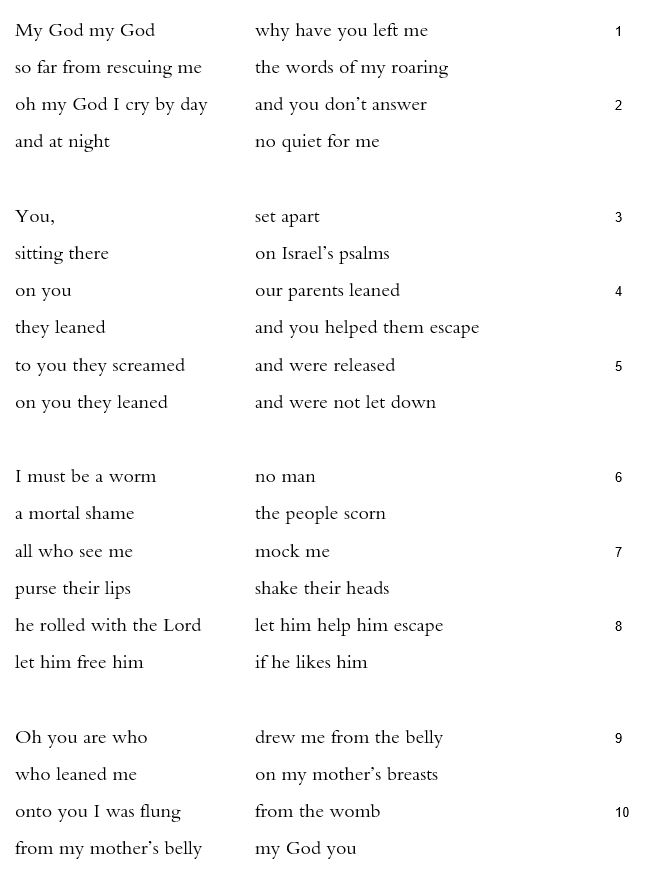
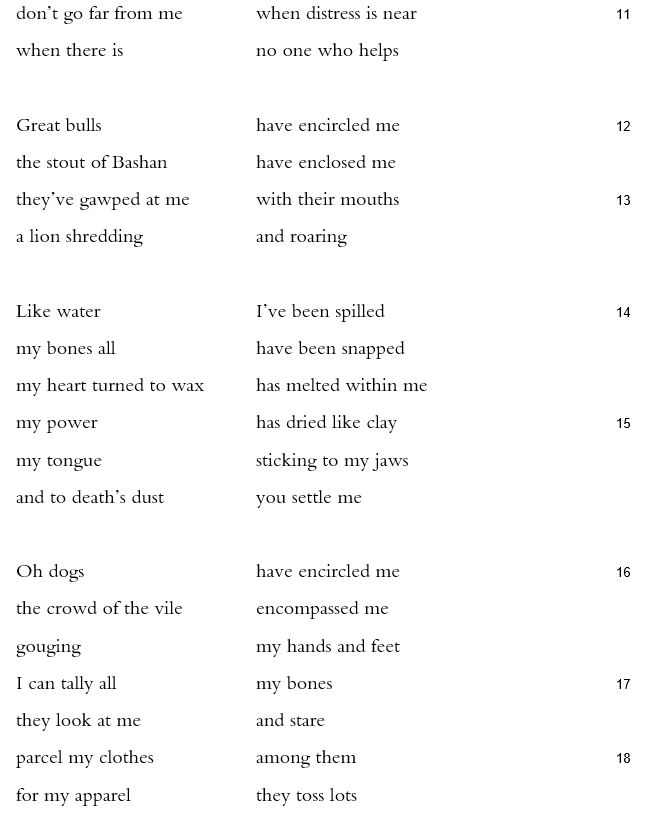
    Psalm 22 is remarkable in all three of these areas, in claim, evidence, and warrant. Its complaint is elaborate and tart, the threat vivid and brute, the rhetorical appeal rich and generational, to who God was and will be. You have gone far away; the beasts are closing in; remember our past and imagine the generation to come. The speaker is distraught, even outraged, driven to “roaring” like an animal (1, cf. 13) at the Lord’s removal: “so far from rescuing me” (1). Distance is the problem: “don’t go far from me | when distress is near“ (11). These two poles, far (rachoq) and near (qerov) occasion a scramble of verbal dexterity. Several key words in the psalm pick up on their sounds: the dog/dogs (kelavim, 16, kelev 20), the sword (cherev, 20), my power (kochi, 15), my jaws (malqochai, 15), they divide (challequ, 18). The difference between here and there resonates.

    Outraged, the speaker’s accusations broach sarcasm. In verse 3, a line that’s sometimes been read as an addition, the speaker declares God’s sanctity: “You, | set apart / sitting there | on Israel’s psalms” (3). The line reads as a celebration of the Lord’s holiness, which sets up the historical appeal of verses 4 and 5. It also reads as a barb, God’s set-apartness, the quintessence of qadosh, precisely the thing that keeps him far away. Again in verse 6, “I must be a worm | no man” reads as both self-abasement and ironic critique. Even verse 8, with its lines that seem to quote those who scorn the speaker, makes sense as denunciation: “let him help him escape / let him free him | if he likes him.”

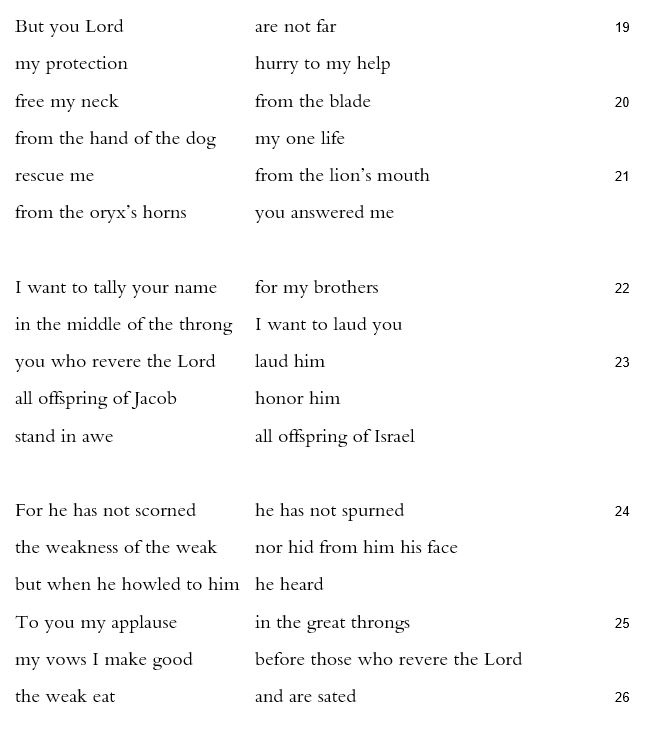
    Besides mockery, what actually threatens the speaker? It’s hard to tell. The psalm groans under the weight of its figures: lions and bulls and dogs, oh my. The imagery is arresting, but probably none of it is literal: “my bones have all | been snapped” and “I can tally | all my bones” are obvious hyperbole (14, 17). But the lack of a single clear referent or literal meaning is what makes this psalm so potent and adaptable, most notably by the writers of the gospels, who shape the passion narrative around allusions to it: (v.1, v. 8, v. 18).

    Why does the speaker think God should care about such a censorious complaint, described almost entirely metaphorically? He looks first to the past and then to the present. The past is generational: “on you | our parents leaned / they leaned | and you helped them escape (4). Perhaps it’s the verb betach—to trust, to rely, but literally to lean—that triggers the noun beten—the belly. Or maybe it’s just thinking about parents—literally, verse 4 says “fathers.” But verses 9-11 return to the generational appeal in the psalm’s most intimate lines:

    For you are who                 drew me from the belly                            

    who leaned me                   on my mother’s breasts

    onto you I was flung          from the womb                  

    from my mother’s belly    my God you

    don’t go far from me         when distress is near            

    when there is                      no one who helps.    

    It’s not that long ago God rescued the speaker’s parents, who leaned, in dead metaphor, against the Lord. But when God was the midwife, the leaning was not abstract, but concrete, bodily, maternal: “who leaned me | on my mother’s breasts” (9b). The Freudian image of Anlehnung, the leaning-on of desire, comes clear to mind. Gender, too, is fascinating here. “I am no man,” the speaker says in verse 6, though the mockers use masculine pronouns in verse 8. And here, the speaker recalls being “flung | from the womb / from my mother’s belly | my God you” (10b). Is this a father delivering a child? Or is God the mother onto whom the newborn is laid, or the nursemaid? (The divine epithet “my protection” in verse 19, for what it’s worth, is grammatically feminine.) The generic fathers of v. 4 have become this speaker’s earliest caretaker.

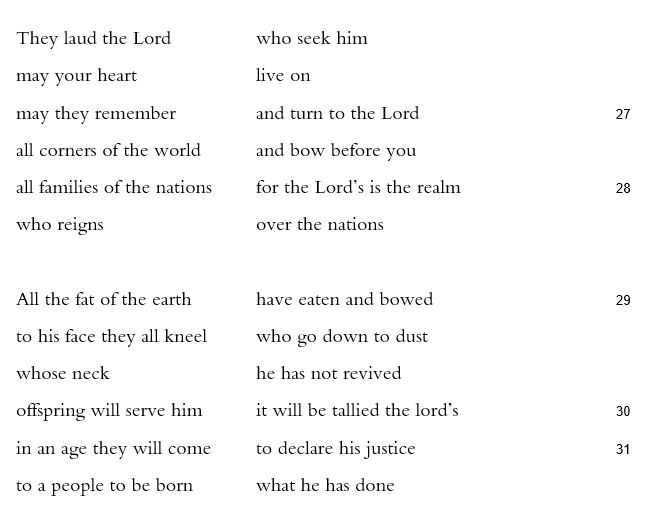
    Only in its turn to thanksgiving is this psalm relatively common. The Lord responds—or, has responded, strikingly, in the middle of a verse (21b)—and the psalm become laudatory in traditional ways (“They laud the lord | who seek him,” 27). Still, the second half of the poem fits the first half in at least one way. It picks up the generational appeal as it turns to the future: “all offspring of Jacob… all offspring of Israel” (23). The psalm’s closure is explicit about this:

    offspring will serve him         it will be tallied the lord’s     

    in an age they will come        to declare his justice  

    to a people to be born           what he has done (30-31)

    To many Christian readers, it’s the psalm’s afterlife in the gospels that make it memorable. Other readers relish those bestial images, worm and bulls, even an oryx, and those trippy bodily images of a melting wax heart and countable bones. Ending with “a people to be born,” however, snaps the reader back to the moments of birth and just after, skin-to-skin contact, an appeal not to generations but to generativity, to leaning on the mother’s body.

    *

    “Doe at Dawn”  Beautiful in Hebrew, too, ’ayyelet hasshachar appears to be the name of a melody

    22:1 My God my God | why have you left me  The cry is rhythmic in the original, punchy two- and four-syllable words. This is the first of three parts of Psalm 22 borrowed by the gospel writers, who punctuate their Greek with the line in Aramaic or Syriac Eloì, Eloì, lemà sabachtháni (Mk 15:34), Elì, Elì, lemà sabachtháni (Mt 27:46).

    22:1 the words of my roaring  It’s the sound a lion makes.

    22:3 You, | set apart  Treating this as a clause with an implied copula (e.g., in the KJV: “But thou [art] holy”) misrepresents the tone. The speaker isn’t asserting a theological fact. The speaker speaks daggers—or darts, at least—while pointing out that God was there for the older generation.  

    22:6 I must be a worm  Here, however, supplying a copula makes sense for the literal “I a worm” in the Hebrew. The addition of the modal “must” helps to register the tone of the original, more bitterly sarcastic hyperbole than actual self-abasement.

    22:8 he rolled with the Lord | let him help him  Biblical Hebrew idiom coincides with English idiom strangely well here in “roll with,” which suggests accompaniment and trust. Since the verse is clearly the reported speech of the cruel jeerers, informality seems appropriate. The verse is dramatized by the gospel of Matthew, where the mockery is spoken by Roman soldiers: “He relied on God. Let him free him now if he wants him” (Mt 27:43).

    22:12 the stout of Bashan The phrase ’abirei bashan is rich. The first word, the plural “stout,” is a general descriptor of strength and a synonym for “bulls” or other strong animals, or powerful people. A northern region east of the Jordan River, Bashan with its bulls (and the lion of verse 13) likely figures the dangers of the Amorites and/or the Assyrians. 

    22:18 parcel my clothes… toss lots  These images are so vivid that they become part of all four gospels’ passion narratives: implicit allusion in Mark 15:24 and Luke 23:34, explicit reference in Matthew 27:35 (“so that what was spoken by the prophet might be fulfilled”) and John 19:24 (“so that the writing might be fulfilled which told…”).

    22:21 you answered me  Such a strange place for this sudden perfect-form declarative verb, marked to indicate completed action, in the last half-line of a verse. A revision for logic would position this at the start of a new stanza, but there’s a potency to its location, interrupting a litany of imperatives.  

    22:22  I want to tally your name  Compare verses 17 and 30. With the singular object “your name,” the verb saphar (here conjugated as ’asapperah, a first-person singular cohortative) tends to work better as telling than as counting, which makes more sense with plural objects, as in “telling” or “numbering” the stars (Gen 15:5). But “tally” conveys the speaker’s enthusiasm, while keeping transparent in translation the psalm’s movement from counting bones, to recounting of the Lord’s name, to accounting the children of the next generation as “the lord’s.”

    22:29 All the fat of the earth…  revived  From verse 26 to this point, as the first-person singular speaker fades from view, the psalm’s logic seems to lurch. The overall drift seems to be that both the weak (26) and the rich (“the fat” 29) will eat and be satisfied and show gratitude, if not in their own lifetime, then in the generation of their “offspring” (30).

    Share:

    • Share on X (Opens in new window) X
    • Share on Facebook (Opens in new window) Facebook
    Like Loading…

    About Me

    My name is Mark Minster. I’m an English and Comparative Literature professor with a background in ministry and in poetry. I teach courses on writing, reading, religion, and nature.

    Recent Posts

    • Psalm 150
    • Psalm 149
    • Psalm 148
    • Psalm 147
    • Psalm 146

    Newsletter

←Previous Page
1 … 30 31 32 33 34 … 37
Next Page→

Blog at WordPress.com.


Loading Comments...
 

    • Subscribe Subscribed
      • The Book of Psalms
      • Already have a WordPress.com account? Log in now.
      • The Book of Psalms
      • Subscribe Subscribed
      • Sign up
      • Log in
      • Report this content
      • View site in Reader
      • Manage subscriptions
      • Collapse this bar
    %d