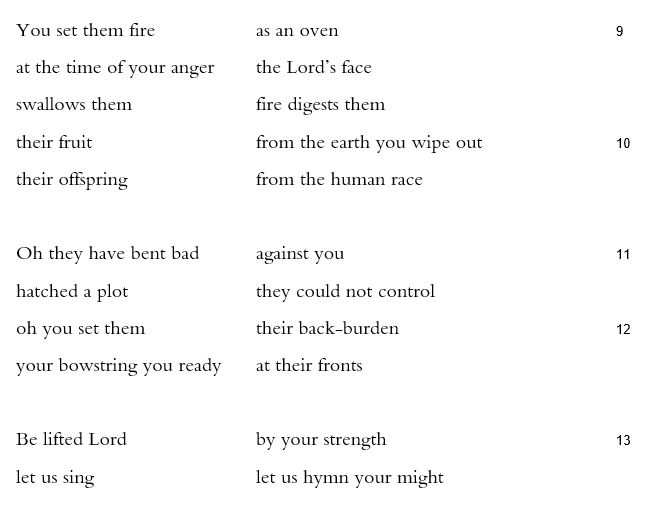
Psalm 21 is explicitly a royal psalm and a martial one at that. It is also, implicitly, a providential psalm. The king is mentioned twice, once at the start of each half (1a, 7a), and there’s a golden crown (3b), while the conclusion pairs “strength” and “might” (13; cf. Ps 89:13). Throughout the psalm runs the insistence that whatever the king has is a gift from the Lord: “sweet gifts,” “blessings that last” (3a, 6a). “You gave him” (2a, 4a), the psalm repeats; “you set” (3b, 5b, 6a, 9a, 12a). The psalm’s claim is that the Lord’s strength pleases the king (1). And why should it not, since the evidence for the claim is a list of all the Lord has handed him?
Both halves begin with the king’s reliance on the Lord. The first half ends with gladness, as it began (1a, 6b). But the happiness that the Lord’s face elicits in verse 6 contrasts sharply with the fury of the Lord’s face in v. 9. If glad reliance frames the king’s gifts in the first half of the psalm, the second half is enclosed by a deft contrast between the king’s posture—leaning without being shaken (7)—and the posture of his punished foes, who are bent with burdens and shaking in terror (12).
This overall structure inverts Psalm 18, which moved from the mythological anger of a descending God to the king’s military campaign against an array of enemies. Here we start with the king’s rewards—narratively, the result of the rescue called for in both Psalm 20 and Psalm 18—and then we move back to God’s punishment. Fittingly, the psalm closes not with descent but ascent: “Be lifted Lord | by your strength” (13). All’s right with the king— God’s in his heaven (again).
*
21:5 grandness and grandeur The words in Hebrew are hod and hadar, both gesturing at the decorative splendor.
21:7 the Highest As a parallel to “the Lord” in this verse, the word `elyon functions primarily as a divine epithet, though it can also mean “the most.” Sadly, using the lowercase “highest” here, as in “the highest / utmost care,” wouldn’t preserve the ambiguity, but would make the secondary reading seem primary.
21:9 at the time of your anger | the Lord’s face / swallows them Though it’s on the page here as three lines with two parts, verse 9 parses better as a pair of lines with three elements each. Still, “at the time of your anger” fits with both the fiery oven of 9a and the Lord’s consuming face. Note the shift from second to third person. Clearly this conception of divine rage as fire serves as a model for those who want to imagine a hell with punishing fire, or a fiery apocalypse. And yet the moment here is not eschatological—it’s contemporary with, or even a precondition for, a human realm.
21:11 they have bent bad | against you The verb natah is to stretch out or to lean or to diverge (e.g., Job 31:7). “Turn bad” is accurate, but more on-the-nose than the original.
21:12 their back-burden Literally, “you appointed them a shoulder.” In 1 Samuel 10:9, the shoulder represents the turning of the back. Here in Psalm 21, however, the verb doesn’t indicate turning, and so the more common implication of “shoulder” in the Bible makes more sense: the location of a weight to be carried (e.g., Gen 9:23, 24:15, 45; Judg 9:48). In other words, the Lord is imagined here to be subjugating foes.
My name is Mark Minster. I’m an English and Comparative Literature professor with a background in ministry and in poetry. I teach courses on writing, reading, religion, and nature.
This psalm is as compelling in its parts as it is as a whole. Its overall structure and movement are clear, with three intertwined motifs. First, a prayer for “answer” (1, 6, 9) and “help” (2) or “rescue” (5, 6 [x2]. 9). Second, a call for remembrance (3, 7). Third, the raising of the divine name: the Lord’s four-letter personal name appears five times (1, 5, 6, 7, 9), “God” three times (1, 5, 7), and maybe most significantly, the word “name” itself appears three times: once as an appellation (1), once as a source of celebration (5), and finally as an object of memory (7). With these strands braided together, the psalm becomes both collective memorial and continuing prayer, for it ends with almost the same wishes with which it began: “The Lord answer you” becomes “may he answer us” (1, 9). The overall movement is from benedictions upon a singular “you” (1-4, 5c) to a homiletic plural “we” (5a-b, 6-9), which makes the appeals and the memories collective. It’s camera work. Cue: a speaker saying “the Lord answer you.” Cut to: “His anointed he answers” (6). Cut to: “may he answer us” (9), where that last “he” is pointedly ambiguous in its reference to either the Lord or the king (as the Masoretic Text preserves).
At the center of this whole are the dramatic words “Now I know” (6), which reveal the first-person speaker and locate the psalm in the present tense. But what does the speaker now know? That “the Lord has rescued”— another perfect tense, showing completion. After all, in verse 5, the speaker has just called for banners and shouts to be raised “for your rescue.” How does this accomplishment of victory in the middle of the poem, anticipatory or actual, affect the last verse? Having been answered already by God, does the collective “we” now call on the king in turn? Or does this last call for rescue suggest that the “rescue” celebrated earlier was only in process, “mission accomplished,” or imagined? It seems a psalm that would have to be repeated. Now. No, now.
While the psalm works well as a whole, what seem like stanzas also read like they would fit different settings and contexts. They seem detachable: verses 1 and 2, verses 3 and 4, verse 5, verse 6, verses 7 and 8, verse 9. Each part has its own coherence and deserves its own attention. The first two verses, for example, tightly crafted, are valedictory. The next two are liturgical, a benediction for prosperity. The stanza of collective memory in verses 7 and 8 are a gem on their own: “These of chariots | these of horses / we of the name of the Lord | our God make remembrance” (7). The particle represented here by “of,” before “chariots,” “horses,” and “the name,” can be translated in multiple ways: we make a memorial of the name, a memorial in the name, a memorial by, with, or through the name. Most English translations supply “trust in” or “boast in” before the chariots and horses. But the verb is already there: “to cause to remember.” What making remembrance means may not be apparent. That it must be enacted, however, is the point of the line, the stanza as a unit, the psalm as a whole.
*
20:1 the name of Jacob’s God The reference to Jacob may just be a synonym for Israel. It also calls to mind Jacob’s name change and his request to know God’s name in Genesis 32.
20:2 the hallowed place I.e., the sanctuary in Jerusalem
20:3 your meat offering |may it drip fat The verbal root dashein literally means to become rich and greasy, and has specific ritual meanings (Exod 27:3 and Num 4:13). In the Book of Proverbs, it also suggests prosperity (e.g., Prov 11:25, 15:30). Alter comments that this line is “a linguistic survival (not necessarily a theological one) of the pre-monotheistic idea that the gods took pleasurable nourishment offered them” (66 n4). While the exact parameters of the ancient whole-offering (rendered here as “meat offering”) are described in detail in Leviticus and afterward, the origins of the practice are not known (see Jastrow et al., “Burnt Offering” The Jewish Encyclopedia). The pleasures of meat, fire, smoke, and fat are hardly merely “pre-monotheistic.”
My name is Mark Minster. I’m an English and Comparative Literature professor with a background in ministry and in poetry. I teach courses on writing, reading, religion, and nature.
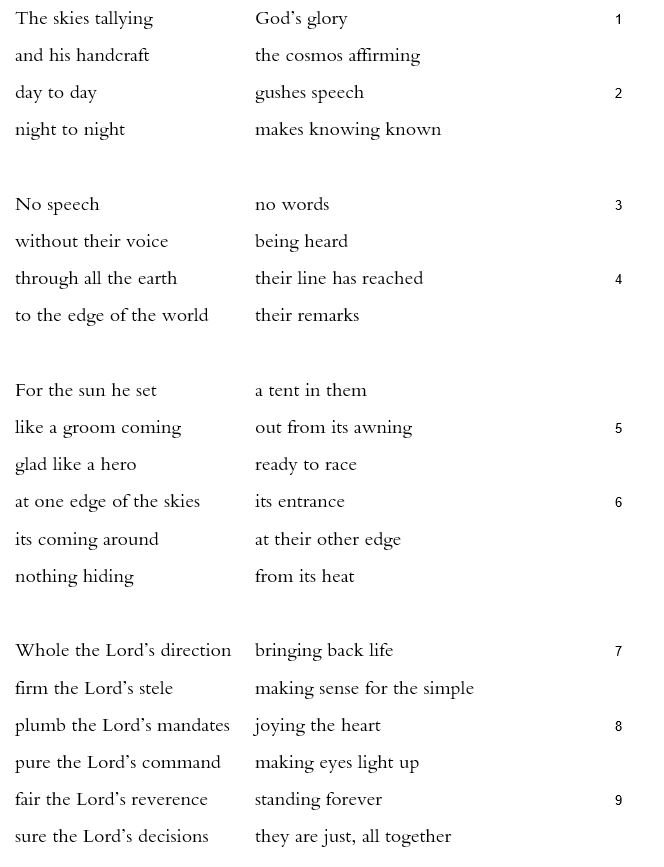
Psalm 19 shows the potential and the limitations of collage. There are three main movements, each with two parts. The first movement (1-6) bears passing resemblance to an Italian sonnet— eight lines plus six, with a turn between. The second movement (7-11) also falls into two parts, with a striking change of topic. The final movement (12-14) shifts again, less dramatically, again with two parts. As with Psalm 18, the reader’s questions concern parallels and placement: why this with that? Why here? Why there?
The first part of the first movement is transcendent, to me the finest block of four verses in the entire book of Psalms. It’s confident and terse, layered and profound. The first verse is virtually always rendered as two complete clauses. In the marvelous music of Haydn, for instance—those amphibrachs! those iambs!— it’s “The heavens are telling the glory of God; the wonders of his work displays the firmament.” While this reading is grammatical, technically the original text makes us wait until the second verse for a conjugated verb. The first verse is noun + participle + noun phrase, then noun phrase + participle + noun, the skies + tallying + glory-of-God, and work-of-his-hand + affirming + firmament. The verse is a perfect chiasm, a mirror form, each element having a partner.
To parse these constructions as clauses, we can easily supply an “is” or an “are,” since Hebrew doesn’t have a copula: the skies are tallying the glory of God; his handiwork is announcing the vault of the heavens, or, more likely, the vault of the heavens (in this translation, “the cosmos”) is displaying his handiwork. And indeed the verse does work this way, participles construed as the present continuous tense. But it also works, as written, to see the first verse as a sequence of absolute phrases, “the skies that tally God’s glory, the cosmos that proclaims his handicraft,” as a lead-in to the main clauses that arrive in verse 2.
Read this way, verse 2 hits hard on the explosive verb yabbia, literally “it gushes forth.” But what gushes? The text is ambiguous: days gush speech to other days? or speech gushes day to day? Read with verse 1 as two left-branching absolute phrases, there’s a third possibility: daily, all of this, the skies, God’s glory, the craft of his hand, the arch of the heavens, all of it gushes speech.
Either way, the gist is clear. The broad blue and clouds of day, the wide of black and starry night— it all speaks, the world pours speech, makes knowledge possible. The allusions to Genesis are evident, too: in the speaking by which God created the “heavens,” making the “firmament” on the second day of creation; and in those two subtle echoes of Eden at the end of verse 2. “Makes knowing known” mentions knowledge and slyly names Eve (Chavvah) inside a word that looks almost like the name of the Lord: yechavvah. The world is not just spoken into existence. It speaks. Knowledge comes not from a garden tree. It pours from the celestial dome.
After this beginning in which all is language and meaning, verses 3 and 4 stop us in our tracks. There is no speech. There are no words. It’s worth pausing there, at the screeching halt of the two negatives: literally, “no speech and no words.” Well, does the world speak or doesn’t it? Does it speak without speech? In the Analects, Confucius asks his disciplines, who had asked what they would pass along if he did not speak to them, “Does Heaven (tian) speak? The four seasons change, all things are born. Does Heaven speak?” (17.17). The answer is probably as yes as it is no.
Here in Psalm 19, in the second half of verse 3, the negative beli plays it both ways. “No speech | no words / without their voice | being heard” could equally be read as “No speech | no words / their voice | is not being heard.”
How long does this negation of the first two verses last? By verse 4, the claim of verse 2 returns: “through all the earth | their line has reached / to the end of the world | their remarks.” The “line” is a measuring line, but any line works: the firmament (see Job 38:5), the boundaries between nations (see 2 Kings 28:13), even the line of poetry (see Isa 28:10,13). The verb “has stretched,” y’atsa, shows up in verse 4a in an exact parallel to the verb “gushes” in verse 2a. Gushing and stretching are, with “makes known,” the only conjugated verbs in the first four verses (4b is yet a third absolute phrase, and 4c properly belongs with verses 5 and 6). Thus in the verb position these verses are all in motion, motion outward, motion in excess, pouring out and announcing and pushing out, while language and speech are absolute and everywhere, then nowhere, then everywhere again. It’s a tour de force.
The sestet to this octave begins with 4c and continues through 6, in a passage that focuses on the sun. The setting is still in the skies, but apart from a few verbal links (“edge,” qatseh, for instance, shows up in 4 and twice in 6), everything else is different, theme and tone especially. This second part of the psalm’s first movement is more clever than profound, the sun compared to both a bridegroom and an athlete, culminating in what seems like a joke: “nothing hiding | from its heat” registers the sun’s warmth as well as the athlete’s as well as the groom’s ardor. There is no trace of the deeper concerns of the first four verses, the surplus of meaning in a world that everywhere speaks. Why these lines, here? Why move from the speech of the skies to the coming and going of the sun?
Everything differs again in verses 7 through 9, the center of the psalm. It’s customary to read this psalm as having two sections juxtaposed—one on the book of nature (1-6), the other on the book of the law (7-14). But it’s busier than that, since only 1-4 and 7-9 (maybe 7-10) explicitly take on nature’s language and God’s. Verses 5-6 and 11-14 take us elsewhere. This central section, for its part, indeed concerns the law, but not the Torah that comes eventually refer by extension to the traditional five books of Moses, or the whole Hebrew Bible, or the whole Bible including the Oral Torah and the entirety of Talmudic and rabbinical tradition. Rather, the torah that leads this list of synonyms for instruction is both larger and smaller than that later concept of Torah. It’s all instruction, in and beyond the biblical texts and traditions. Torah is first in a list of six kinds of rules—why six? the six days of creation? to ensure that the psalm names the Lord seven times, including verse 14? This list is shaped, too, around six iterations of the divine name, six traits (two singular, one plural; two singular, one plural), plus six participial phrases (one of these participles is a trait: emunah in 7b).
As with the first part of Psalm 19’s first movement, participles lead to a single conjugated verb. Here “justice” is the verb. Thus, all of this, all of these rules doing these things, “they are just, all together” (9b). This structure, all these absolute phrases, powerfully allows verse 9 to recreate the effect of verse 2 and of verse 4, energizing the main verbs even as it allows that “all together” to embrace more than the laws of 7-9. All the Lord’s direction from standing stone (`edut, cf. da`at “knowledge” in verse 2) to verdicts, show justice, plus the skies and all they say. Like the skies, laws speak without speaking, but nothing speaks without them. And yet, while the skies burst forth with sense, language, and knowledge, note how motionless the Lord’s instructions are: “whole… firm… plumb… pure… fair… sure” (7-9). It is reasonable and resonant to pair 1-4 and 7-9, passages that artfully complement one another.
What troubles this tidy concept, however, are all the psalm’s other parts, not least of which is that passage about the sun. How does that passage affect what comes before and what comes after? Does the sun figure the speech of the skies, or the Lord, or the Lord’s justice? Is its motion across the sky linked to “the Lord’s command | making eyes light up” (8)? That seems a stretch. We bump now against the limits of collage. It makes sense to juxtapose, to ask questions, even at times to overwhelm us with questions. If everything speaks, it’s hard to hear.
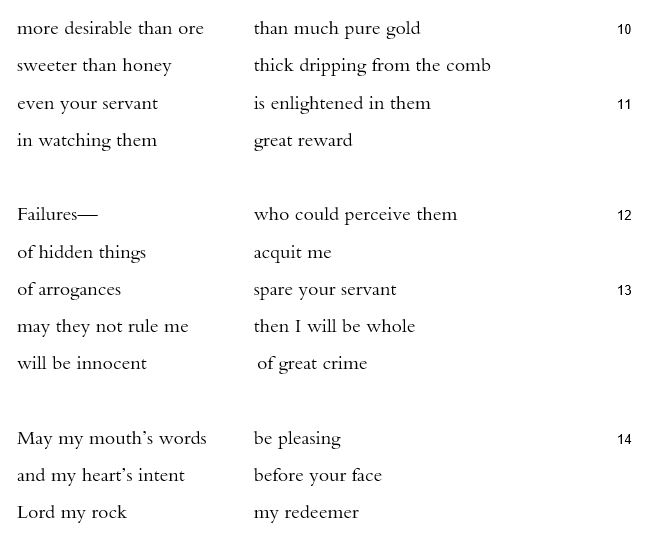
The next parts of the psalm, how do they fit? Verses 10 and 11 are also constructed around participles rather than main verbs. Like 9b, they have an open-ended “them” (11, x2), desirable and pouring forth honey from the comb. This seems to refer directly to the Lord’s commands and potentially again/still the skies.
What about the turn in verse 11 to the speaker, “your servant,” which carries through to the first-person person supplication of verses 12-14? Is this a kind of parallel to the singular “sun”— that is, an elaborate analogy, the speech of the skies : sun :: law : your servant? If so, then the third movement returns to the first, but with different angles, different themes. Note that the speaker’s “hidden things” (minnistarot, 12) recall the “nothing hiding” (velo nistar, 6) of the first movement. Perhaps even the use of mashal “to rule” picks up the role of the sun in Genesis 1:16 “to rule the day.” This is guesswork, for the collage work has grown strange. What are these failures, these hidden things, these arrogances the speaker wants to be exonerated from? Why here? Do they relate to the six kinds of divine command? To the sun’s constant motion? To the burst line of cosmic speech?
In the last verse speech returns to the poem: “may my mouth’s words | be pleasing.” This is a far cry from where we began.
Nothing against psalms that raise more questions than they answer. Nothing against oblique angles or puzzles that exceed our grasp. It’s possible to overthink things, maybe, wondering what sun and servant are doing in this psalm. If we end with questions, it’s only because the verses that start Psalm 19 are so strong that they make it seem impossible to overthink anything ever, so surfeited with significance is the world.
*
19:1-3 The skies tallying .. being heard See introductory note above.
19:4 their line has reached In Jeremiah 31:39, a surveyor’s “line” “reaches,” which is likely the most literal meaning here. But the association of lines with speech— divine speech, perhaps without sense— appears in Isaiah 28:9-13 as well.
19:4 For the sun he set A stanza break here emphasizes the etnachta under “their remarks” in the Masoretic text, a break that downplays the squinting of the syntax. In other words, the line “their remarks to/for the sun” is a grammatical possibility made less likely by punctuation. The question the reader has to ask is how the sun is like a tent in “them”— in those plural remarks, or the skies of verse 1, or the speech and knowing of verse 2.
19:7 Whole the Lord’s direction… firm the Lord’s stele In Leviticus (e.g., Lev 4:28, 32) and Numbers (e.g., Num 19:12), the adjective temimah (“whole”) describes the intact body of a herd animal to be sacrificed. The body’s completeness, its entirety, is here applied to the entire torah (“direction”), with the ranging reference of that word. The word `eidut, for its part, refers most specifically to something contained (Exod 40:20) in the Ark of the Covenant (sometimes called the Ark of the `eidut, as in Exodus 30:6) or in tablets of the law (e.g., Exod 31:18). By metonymy, the word refers to the entire tabernacle (Exod 38:21), to its veil (Lev 24:3), or to the body of the law itself (e.g. Ps 119). The English words “witness” and “testimony” do reflect the Hebrew derivation, but they don’t convey the solidity of the thing that is meant. Moreover, to some communities, they connote particular kinds of practice, enthusiastic, first-person, autobiographical, which to me makes them unusable here. It may be somewhat fanciful to translate `eidut as “stele,” the kind of standing stone that existed throughout the ancient world. But such stones bore inscriptions and laws and took on ritual value (see Exod 16:34 and 2 Kgs 11:12). “Stele” seems to me to maximize reliability and firmness, which are clearly what matter.
19:10 thick dripping from the comb It’s hard to express how lush this is in Hebrew: venophet tsuphim, so forward in the mouth. The two root words, nuph and tsuph, convey such movement and flow.
My name is Mark Minster. I’m an English and Comparative Literature professor with a background in ministry and in poetry. I teach courses on writing, reading, religion, and nature.
(director: of the Lord’s servant, of David, who spoke to the Lord the words of this song on the day the Lord rescued him from the grip of all his enemies and from Saul’s grasp. He said…)
* * *
The parallels that shape biblical poetry on every level—from word to line, from verse to stanza to poem— are just juxtapositions. This, then that. These two, then those. The art is collage. The kiru in a haiku is similar, a jump cut from one image to another. So are the leaps in a Chinese shi (a word pronounced much like the Hebrew shir; both words mean “song”). The questions of reciter and writer are always these: why this with that? why here, why there?
In Psalm 18, these questions are best asked first of the fiery mythological passage in verses 7-15, in which God rages thunder and lighting, and of the bellicose passage in 37-45, in which the speaker, equipped “with strength for battle” (39), obliterates his enemies, grinding them to powder, dumping them “like the muck of the streets” (42) until other nations “cringe to me… wilt / they quake at the borders” (45). Why pair a powerful scene of divine descent with a bloodthirsty warrior’s boast? The theophany, including its introductory and closing verses, takes up almost the first third of the psalm (4-19), while the whole warrior’s passage takes up most of the last third (32-48). As panels surrounding a center, they invite—and reward— comparison. The warrior finishes what “the Lord / the Highest” started (13). God “sends his arrows | and scatters them” (14) which becomes, by narrative causality, “training my hands | for battle / so my arms can bend | a metal bow” (34). Cosmic precedent justifies both national conflict and the singular authority of the warrior. After all, it is God, the speaker asserts, who arms him, “who grants me | retribution / speaks down | peoples beneath me” (47). This much seems obvious: Psalm 18 works to authorize charismatic military force—“my enemies | you’ve given me their napes / those who hate me | I wipe them out” (40). It justifies war by making brutal personal vengeance seem both divinely sanctioned and as natural as a storm.
And yet between this pair, these two thirds of the psalm, is lodged a striking central section, verses 20-31, in completely different language and a completely different tone. The stitches show. In the tight and unified verses 16-19, the speaker claims that he has been rescued by the Lord from the dangers he describes only metaphorically back in verses 4-6, and that this rescue has occurred “because he likes me” (19b). The intervening mythological verses, by the way, make no reference to any humans, neither enemies nor victim, nor to good or bad (despite the suggestion of anger in verses 7 and 15). After verses 16-19, however, morality shows up suddenly, in full Deuteronomic language. As with the flood story in Genesis, where competing explanations for Noah’s rescue show up in subsequent verses, at a seam in the text—“Noah found grace in the eyes of the Lord. These are the generations of Noah. Noah was a just man and perfect in his generations..” (Gen 6:8-9)—so here the center of the psalm offers a second, competing explanation for the speaker’s rescue. Not that God “likes” him, but “he treats me | as for my justice / as for my clean hands | he returns me” (Ps 18: 20). The center of the psalm introjects a moral:
With the caring you show yourself caring 25
with one who’s whole you show yourself whole
with the clean you show yourself clean 26
with the twisted you show yourself wound up
From here the seams overlap. Verses 27-29 link the Deuteronomic vision of retributive justice to the speaker’s military prowess. They anticipate verses 32 and on: “by you I outrun an army” (29a) sounds more like “making my feet like a doe’s” (33a) than it does anything from verses 20-26 or 30-31. For their part, verses 30-31 pick up the word “whole” from verses 23, and 25, stitching together the moral that patches the poem: “he is a shield to all | who shelter with him” (30).
The tying together of the psalm’s three parts thus implies that the mythical, anthropomorphic God of storms and fury, doubtless already archaic by the time of Psalm 18’s assemblage, justifies military actions led by a charismatic fighter, because both ancient mythology and contemporary war are subsumed under the category of divine justice. This tying together is completed at the psalm’s edges, its beginning and its end, which rope the three parts to the story of David, turning the warrior into a king, making the mythical historical. That there is no mention between verses 1 and 50 of anything royal, let alone of David in particular, hardly registers with most readers. Most scholars still call it a royal psalm (Dahood, Kraus, and more).
Linking psalms to David, especially this one, which bears the book of Psalms’ longest superscription and which appears in slightly different form in 2 Samuel 22, has at least two important functions. The rhetoric and poetry of this psalm shape how we read David, deepening the history-like prose about Israel’s monarchy. Into David’s narrative is imported this psalm’s argument, its mythology, its militarism, its sanction. History gains immediacy. At the same time, the recitation of this psalm, whoever sings it, whenever, wherever, gains simultaneously historical and timeless meanings. Its justification of aggression brings to the performative present a newly mythologized David, whose offspring it emboldens to carry on.
*
18:1 of the Lord’s servant… Despite its length, the superscription links this psalm not to one specific “day” in David’s life—one would be hard pressed to find such a day, either before or after he became king—but to the sweep of his life as a whole.
18:1 I feel tenderly for you | Lord my strength This line can be read as part of the superscription, part of the psalm itself, or both, or even neither. Stylistically it could fit with the first verse, perhaps. But it does not appear in the parallel version in 2 Samuel 22, and the image of tendern-heartedness—the root rechem comes from the word for “womb”—is conspicuously out of place.
18:4 they terrify me This is a good example of why it’s important to register verb forms with care in translation. In a sequence of mostly suffixed verbs, the English past or present tense, this prefixed form stands out, with its imperfect aspect and present or future tense. Cords of death would continue to terrify me, too.
18:7 And the earth shakes | and shivers Here the issue of tense is more complicated: we have prefixed verbs introduced with a vav, which usually functions in narratives like the historical present or the past tense (called the vav-consecutive, or vav-conversive). And yet as a sequence and in context both, this mythological storm works better in the present tense, blurring the line between the historical and the present. The words sound similar in Hebrew: vattig`as vattir`as.
18:10 climbs on a cherub It was tempting to render “cherub” with a different spelling (keruv would be more accurate) to dislodge delicate images of doughy babies. The mythical cherubim were doubtless more like griffins. In Hebrew, there’s a tight play on words: Vayyirkav al-keruv.
18:12 out of the bright before him | thunderheads have passed Strong wordplay in the original: minnogah negdow `avav `averu.
18:25 you show yourself caring The reflexive stem of the verb chesed. It’s only three syllables in Hebrew, but that information density is impossible to capture here. The implication is that God’s caring is reflexive, caring for one who cares as well as for himself, perhaps even that he reveals himself in this caring-for.
18:27 the peering proud Lit., the eyes of the rising. Since a literal rendering doesn’t work in English, the translation tries to capture both the hauteur and the eyes.
18:30-32 The god The Hebrew ha’el can mean any number of things: God, a god, the god, even “is God?” Translation forces a choice, though each option is fraught. It’s used here three times—30a, 31a, 32a—and could mean God each time. But the passage seems to be asking, then answering what kind of god God is, so some distinction between Ha-‘El and ‘Elohim seems important to preserve.
18:41 They yelp | and none who helps them The verbal roots are close in Hebrew: yeshavve`u and moshi`u.
18:44 At the hearing of an ear | they heed me In the original, this is lesheim`a ‘ozen yisham`u li. The verbal dexterity is nice.
18:47 speaks down Used rarely in the causative stem, the common verb “to speak,” dabar, takes on the meaning of “subjugate.”
My name is Mark Minster. I’m an English and Comparative Literature professor with a background in ministry and in poetry. I teach courses on writing, reading, religion, and nature.





 The Book of Psalms